
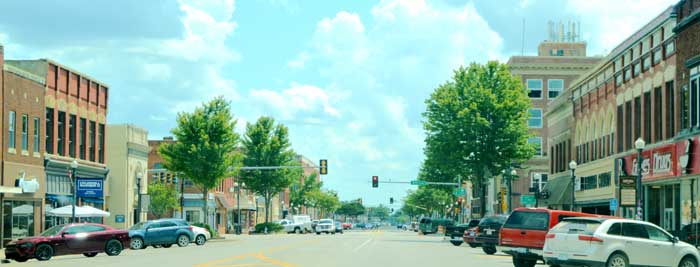
Commercial Street, Emporia, Kansas by Kathy Alexander.
Emporia, Kansas, is the county seat of Lyon County and one of the state’s principal cities. It is located near the center of the county. Situated six miles above the junction of the Neosho and Cottonwood Rivers, it lies within the geographic area known as the Osage Cuestas in north-central Kansas.
Emporia was founded on February 20, 1857, and is located on an upland prairie, named after a historic Greek market center. When the Kansas Territorial Legislature ratified the town charter for Emporia, it declared it “the loveliest site in the world for a town.” When the city was founded, it was part of Breckinridge County, which was formed in 1855 and named for John C. Breckenridge, a military officer who was elected Vice President of the United States in 1857.
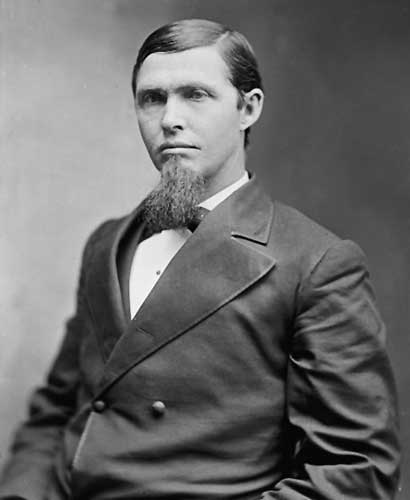
Preston B. Plumb.
The principal founder and promoter of the settlement was Preston B. Plumb. Although a young man at the time, only 20 years old, Plumb, originally from Ohio, was ambitious. After founding Emporia, he was admitted to the bar, served in the Civil War, served as a member of the Kansas House of Representatives, and later became a U.S. Senator. Other interested parties in founding the new settlement included George W. Deitzler, G.W. Brown, Lyman Allen, Columbus Hornsby, and the entire town of Lawrence. C.V. Eskridge was appointed as the agent of the townsite company to sell its property and look after its general business interests.
The town charter prohibited gambling and liquor sales, with the penalty being forfeiture of the property on which the offense occurred. Thus, Emporia’s founders established the first prohibition town in the world, anticipating by 23 years the state prohibition amendment and by 61 years the 18th Amendment, bringing national prohibition.
The first building was a 1½-story wooden boarding house erected by John Hammond. Before long, Mr. and Mrs. T.H. Clapp from New York came to town. Hammond hired Mrs. Clapp, the first woman in the settlement, to cook for him. Within no time, the boarding house was crowded to its utmost capacity. The building was also used for religious services and educational purposes, as well as for county headquarters and a broker’s office.
The second building was the store of Hornsby & Fick. Townsite agent C.V. Eskridge, who would eventually own it, worked as a store clerk.
The next building completed was the Emporia House, the town company’s hotel. John Hammond, who owned the boarding house, first operated it, but, after running it for a few months, resigned in favor of Mrs. Elizabeth Storrs, who, therefore, may be considered the first regular landlady of Emporia. In the meantime, the News building was not yet completed, and the Emporia House also served as the newspaper’s temporary printing office. Town founder Preston B. Plumb published the first edition of the Kanzas News, later the Emporia News, on June 6, 1857, from an upstairs room. In its first edition, the newspaper provided this description of the fledgling town:
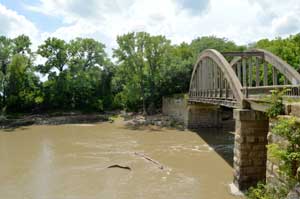
Cottonwood River, Emporia, Kansas by Kathy Alexander.
“Emporia is situated between the Neosho and Cottonwood creeks, six miles above their junction. To the west, it gradually rises over several miles. On the north and south are large belts of the finest timber along the Neosho and Cottonwood Rivers, while the various smaller streams emptying into them at this point, all well-timbered, serve to make it one of the best-timbered regions in Kansas. Coal and building stone are found here in abundance. Emporia was located in March last. About April 1, the town company commenced the erection of a large hotel, which has just been completed. A commodious storehouse has just been erected and filled with goods; another is in the process of erection. A large saw and gristmill, with lath and shingle machines attached, is being put up on the townsite. Another larsawmill is in the process of construction, one-half a mile distant. There is, at present, a sawmill in operation near the junction, six miles distant, which has furnished the lumber used in the erection of the buildings now on the townsite. There is also another sawmill eight miles above, on the Cottonwood River, which is in operation.”
When the News building was completed, it became the fourth building on the townsite. It served as a newspaper for 14 years before being used for several other purposes, including as a residence, a post office, a bank, a furniture factory, a city hall, a church, and a hardware store.
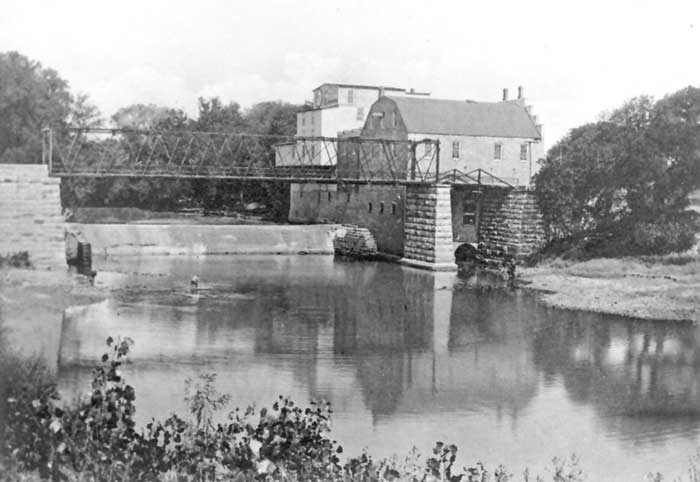
The Soden Flour Mill on the Cottonwood River was one of Emporia’s early businesses. William T. Soden built the two-story structure in 1860. Unfortunately, it was destroyed by fire in the 1930s.
Founder and newspaperman Preston B. Plumb would state in his paper: “The country around here is fast filling up with an energetic, industrious, and intelligent population who will develop the rich resources of this fertile region and make it the center of wealth and intelligence.” Jacob Stotler, the print foreman for Plumb’s Kanzas News, attributed much of the town’s early growth and development to the newspaper. The news not only provided information but also served as an early-day chamber of commerce.
“We do not exaggerate when we say that the regular appearance of The News during the first year of the history of Emporia did more to save the town and establish its firmness in the confidence of the people than all else put together,” Stotler wrote. “It betokened a faith and purpose which put down the croakers who prophesied that the town would fail. It inspired confidence in those already here, and induced others to come. Its suspension, even temporarily, would have resulted disastrously for the town, and its combined regular publication during that year was the greatest pecuniary sacrifice that has been made for the benefit of Emporia and this surrounding country.”
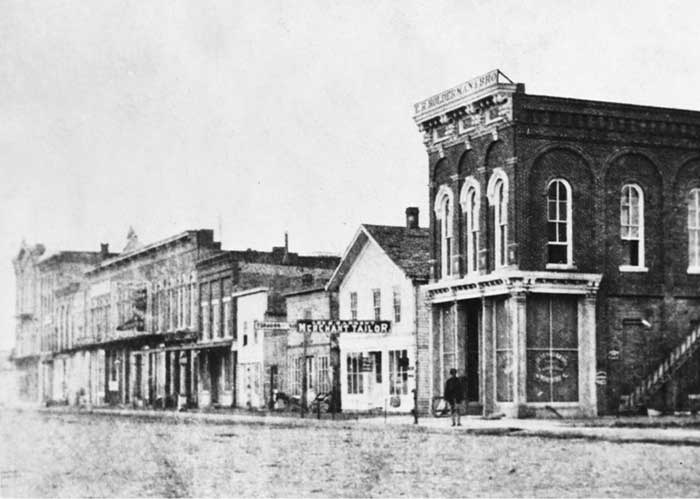
Early day, Emporia, Kansas.
The town company encouraged improvement by setting aside several lots for those who would put up buildings on them. Mr. Parham, a druggist from Leavenworth, Kansas, and Mr. Phelps, a Michigan man, built a sawmill among the new arrivals.
Despite the area’s fast growth that first year, Emporia’s actual population was only about 540 people. The town’s two greatest needs were water and railroads. During the first year, water was carried from the Cottonwood River in barrels.
In the summer of 1857, railroad matters, religious matters, educational topics, a lack of water, and mail troubles all agitated young Emporia. The Baptists and Methodists held services in the old hotel office. Mail facilities were abominable, and the citizens of Emporia insisted on having a school. The third public meeting ever held in the town was a railroad convention that assembled in June.
The first issue to be resolved was the mail. Because a post office had already been established at Columbia, three miles southeast of Emporia on the Cottonwood River, the government refused to favor one for Emporia because the other was so close. However, when Columbia postmaster John Fowler resigned, the post office was moved to Emporia on September 19, 1857. Hornsby & Fick store owner, Mr. Fick, became Emporia’s first postmaster. The issue of schools was resolved when Miss Mary Jane Watson taught the first public school in October 1857.

Kanzas News, Emporia, Kansas.
In April 1858, the Reverend G.C. Morse and his wife opened the Emporia Academy. In the second week of May 1858, the water problem was also resolved when a well was drilled. Preston B. Plumb had hired John Hammond to find water. He was successful while digging on Mechanic Street on the site of the present-day civic auditorium. The town’s growth was brisk from the outset. In the years preceding the Civil War, a steady stream of settlers in the town and surrounding countryside established new businesses, and several churches were built.
The Kanzas News became the Emporia News in 1858, and Plumb sold half of his interest in the business to his print foreman, Jacob Stotler. The following year, Stotler bought Plumb’s remaining interest in the newspaper as Plumb pursued other political interests.
As 1859 began, the Emporia News congratulated the town on its New Year’s issue, noting the city’s growth and general prosperity. “All its mechanical shops had plenty to do at good wages, “Stotler wrote. “There were four stores at that time, and they were profitable (the Procter Gamble merchandise store, the hardware store of Edward Borton, the Fick & Eskridge, and the P.G. Hallberg stores). Several houses were in the course of construction, and seventeen lots had been donated by the town company for new buildings to be erected at once. More than fifty houses would be erected during the season.”
In December 1859, the first school district was organized in Emporia. Its Directors were Colonel F.W. Cloud, C.C. Dodge, and Ed. Borton. In 1862, C.V. Eskridge, then a member of the Kansas Legislature, secured the passage of a special act authorizing Emporia District No. 1 to issue bonds for $6,000 to erect a school building. The bonds were issued and sold, and with the proceeds thereof, a building was erected, which, at the time, was considered the finest common-school building in the State outside of Leavenworth. Given the plan’s success, this special act became the basis of general school law for the entire state.

Missouri, Kansas & Texas Depot in Emporia, Kansas.
In early 1860, the location of the county seat was a significant issue. The county seat had been designated as Americus two years earlier, in 1858. Ultimately, Emporia was chosen as the county seat by 155 votes over Americus in February 1860; it remains the county seat today. At that time, there were approximately 3,500 residents in the county, but that year the area experienced a severe drought, and many moved eastward. Some relief was provided to those who remained, but the county would continue to experience an economic downturn the following year, with the outbreak of the Civil War.
On December 22, 1860, the Missouri-Kansas-Texas Railroad reached Emporia, setting the stage for the city’s emergence as an important railroad hub. By this time, the city had a population of 843.
During the Civil War, Emporia was one of the towns listed in Confederate General Sterling Price’s itinerary of destruction and would have been sacked and burned, but for the prompt response that, throughout eastern Kansas, checked the invasion. The city soon became a stopping point for soldiers on campaigns against bushwhackers and Indians during and after the war. With the Civil War in full swing, the county name was changed in February 1862 because the former Vice President Breckenridge had become a secessionist and a high-ranking officer in the Confederate Army. The patriotic anti-slavery legislature changed the name of the county to Lyon in honor of Nathaniel Lyon, the Union general who had lost his life in the Battle of Wilson’s Creek the previous August.
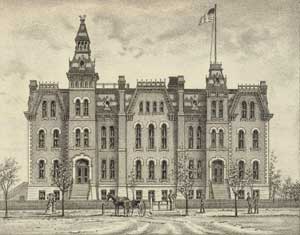
State Normal School in Emporia, Kansas.
In 1863, C. V. Eskridge, as a Kansas Representative, introduced a bill providing for the establishment of a State Normal School at Emporia. The bill was passed, and the state made an endowment of 45,680 acres of land. In February 1864, a Board of Directors was appointed, and an appropriation of $1,000 was made for teachers’ wages. The District School Board of Emporia donated the use of the second story of the old stone school building for classes, and the first term was opened in February 1865 with 19 students. During that year, the Kansas Legislature appropriated $10,000 to erect suitable buildings. In 1866, a stone building was completed on a site of 20 acres. At this time, the school numbered 100 students and employed three Instructors. The school’s general progress over the next five years was so rapid that the building became inadequate. By the fall of 1871, 215 students were enrolled, and the following year, the Legislature appropriated $50,000 for a new building, which was completed in 1873 for $68,000.
In the meantime, the first Lyon County courthouse was built in 1866 in Emporia at Third and Commercial for $19,695. It served the community until a second courthouse was built in 1901 at the intersection of Fourth and Commercial.
In July 1870, the Atchison, Topeka & Santa Fe Railroad arrived in Emporia, and the city became an important railroad center. By this time, the city had continued to grow rapidly, with a population of 2,168.
1878 was a bad year for the Kansas Normal School. First, a tornado damaged the main building and another smaller building. In October, both the new and the old buildings were destroyed by fire, and nothing was saved. Enrollment declined to 90 students, and the rebuilding process resumed. The following year, the Kansas Legislature appropriated more funds, and work began on a new building, which was completed in May 1880 atop the foundation of the burned building.
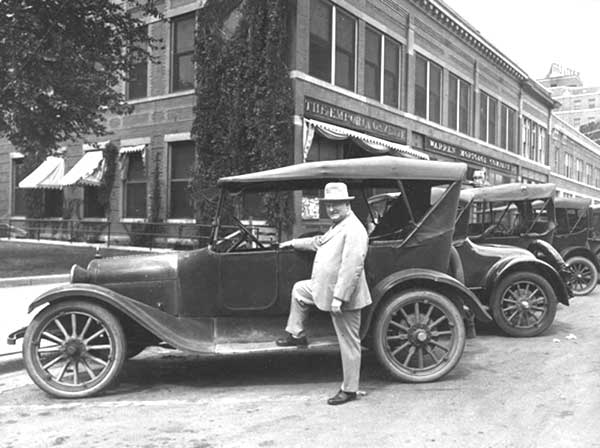
William Allen White, owner of the Emporia Gazette.
By this time, the city was flourishing and home to some 4,631 people. It was filled with several beautiful churches and banking institutions noted throughout the State for their substantial and “unfailing” qualities, first-class hotels, and numerous prosperous businesses.
By 1889, the number of students enrolled at the Kansas Normal School (908) was higher than the enrollment at the University of Kansas (508) and Kansas State University (514). The following year, the school became the largest in the state and the largest normal school in the nation.
Through the years, Emporia had several newspapers, including its first, the Kanzas News, followed by the Emporia Republican, the Emporia Democrat, and the Emporia Ledger. In 1890, J.R. Graham founded the Emporia Gazette, which would last for the next 100 years and beyond.
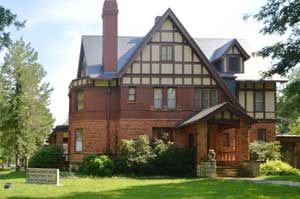
William Allen White’s house in Emporia, Kansas, is a state historic site, photo by Kathy Alexander.
In 1895, William Allen White, a 27-year-old, borrowed the money and paid $3,000 for the newspaper. After writing for several Kansas publications, White considered purchasing newspapers in several northeastern Kansas cities, including Lawrence, but ultimately chose Emporia, the town where he was born and where he had attended college. As a small-town country editor, he addressed controversial issues in a blunt style that set him apart from other journalists of his time. His editorials, often supporting small-town values, were frequently printed in national newspapers and magazines, bringing worldwide recognition to him and the Emporia Gazette.
White continued to gain prominence through his political associations, national writings, and a Pulitzer Prize, and became a confidant of the President. Today, he is known as one of the most outstanding journalists ever. Over the years, a Liberty ship and a B-29 Bomber were named for him during WWII, a 3¢ stamp was issued in his honor by the U.S. Postal Service in 1948, and the University of Kansas School of Journalism was named for him. His home in Emporia is now a Kansas State Historical Site, museum, and National Historic Landmark. The Emporia Gazette continues to operate today under the White family. The newspaper office features a small museum.
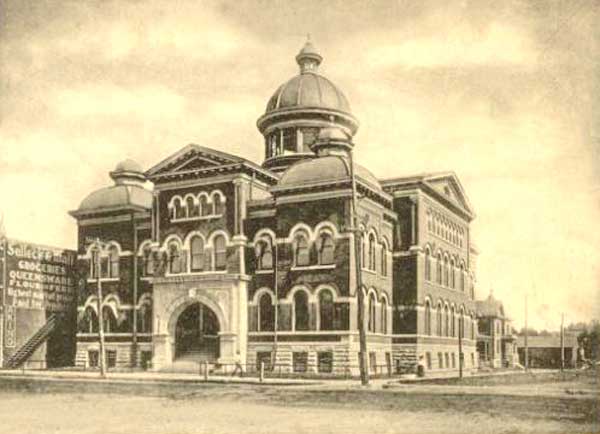
Lyon County Courthouse, Emporia, Kansas.
By the turn of the century, Emporia was home to 8,223 people. In 1901, a second courthouse was built at Fourth and Commercial Streets and served until 1954. In the early 20th century, Emporia had become an important railroad center at the junction of the Missouri-Kansas-Texas Railroad and the main line of the Atchison, Topeka & Santa Fe Railroads. It was the terminus of three branches of the latter system, one running to Holliday, one to Chanute, and the other to Moline. It had waterworks, electricity for lighting and power purposes, police and fire departments, well-paved streets, and a public library. Among the city’s industries were woolen and flour mills, foundries, machine shops, carriage and wagon works, an ice plant, broom factories, a planing mill, a creamery, brick and tile works, a corrugated culvert factory, and marble works. The town also boasted three banks, one daily and two weekly newspapers, an international money order post office with ten rural routes, an opera house, telegraph, and express service, and an essential mercantile center. By 1910, the population had grown to 9,058.
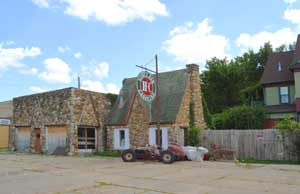
Old Sinclair Station in Emporia, Kansas, by Kathy Alexander.
Emporia’s population will continue to grow for the next century, maintaining its diversity as a center for manufacturing, trade, education, medicine, and tourism.
The Kansas Normal School grew over the years, becoming the Kansas State Teachers College in 1923 and changing its name to Emporia State University in 1977. Currently, about 6,000 students are enrolled.
In 1953, Emporia again received national attention when it hosted the first Veterans Day observance in the United States. At the urging of local shoe cobbler Alvin J. King, U.S. Representative Edward Rees introduced legislation in the United States Congress to rename Armistice Day as Veterans Day. President Dwight D. Eisenhower signed the bill into law on October 8, 1954. That same year, the city had grown to such an extent that Lyon County needed a new courthouse, which was completed in 1954 at Fourth and Commercial, the same location as the old courthouse.
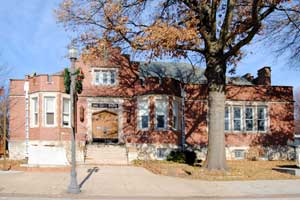
Lyon County Museum in Emporia, Kansas, by Kathy Alexander.
Today, the city is home to about 24,600 people. Despite a growing business and industry community, the community proudly maintains its small-town charm. Many Victorian homes, tree-lined avenues, and brick streets have been preserved. Thirteen structures within the city are listed on the National Register of Historic Places, including the Old Emporia Public Library, the Granada Theater (also known as the Fox Theater), the Anderson Carnegie Memorial Library, the original homes of Preston B. Plumb and William Allen White, as well as several other beautiful homes. More information on the history of Emporia is available at the Lyon County Museum & Historical Society, located at 118 E. Sixth Avenue.
Emporia is between Topeka and Wichita, at the intersection of U.S. Route 50 and Interstates 335 and 35 on the Kansas Turnpike.
More Information:
Emporia Chamber of Commerce
719 Commercial St.
Emporia, Kansas 66801
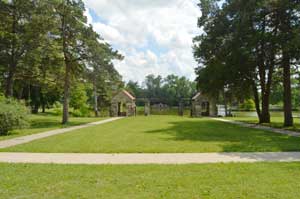
Peter Pan Park in Emporia, Kansas, by Kathy Alexander.
620-342-1600 or 800-279-3730
©Kathy Alexander/Legends of Kansas, updated December 2025.
Also See:
See Sources.