
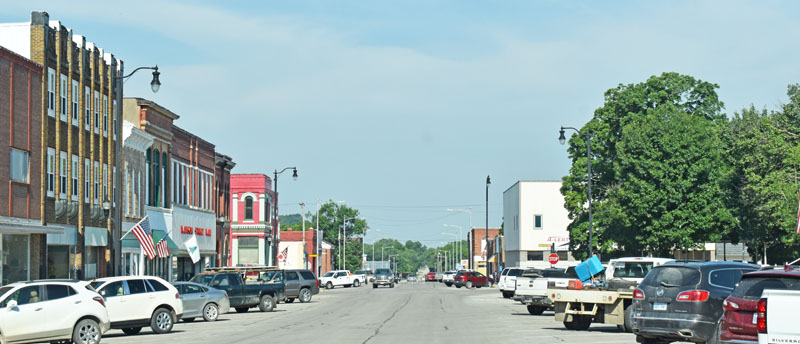
Fredonia, Kansas Business District by Kathy Alexander.
Fredonia, Kansas, is a city in and the county seat of Wilson County, located in Center Township, near Fall River in the southeast part of the county. As of the 2020 census, the city’s population was 2,151, and its total area was 2.45 square miles, of which 2.44 square miles is land and 0.01 square miles is water.
In 1857, the first European-American settlers came to the area.
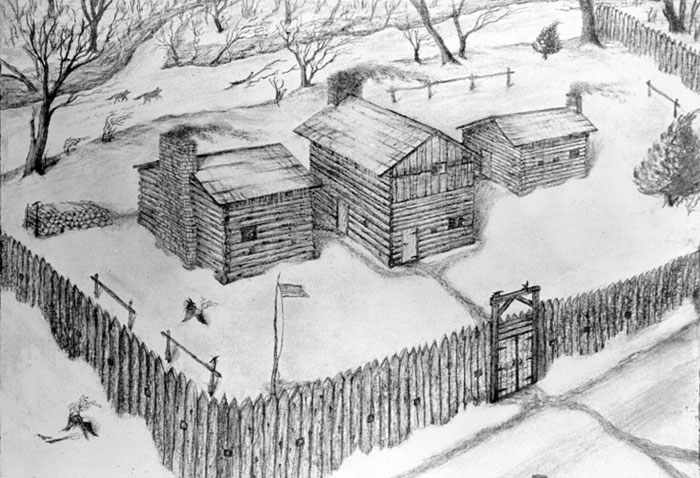
Fort Row in Wilson County, Kansas.
In 1861, Creek Indian leader Opothle Yahola led 7,000 Native Americans and 300 slaves, who were loyal to the Union Cause, from Deep Fork, south of present-day Tulsa, Oklahoma, to escape conscription into the Confederate Army. They ran north through Montgomery County to Fort Row north of Fredonia, hoping to find the promised food and other aid from the Union Army.
Fredonia was founded in 1868 near a large natural mound in southeastern Kansas. It was named after Fredonia, New York. Dr. J.J. Barrett built the first building, with materials procured from the mill of Jackson & Hickox, on Fall River, above New Albany. Upon the completion of the building, Albert Troxel opened a store in it. A post office was established on August 26, 1868, with J.J. Stoffle appointed Postmaster. The post office was in a frame building on the southeast corner of the square.
The second building on the townsite was a box courthouse, measuring 16 by 24 feet, built by Samuel Hill, and the third was a hotel, built by C.S. McCoon.
The new town’s growth was slow at first; in the first year, there were only five buildings.
Soon thereafter, Albert Troxel retired from storekeeping. Afterward, Charles H. Mariner purchased a stock of goods and established his business.

Fall River in Kansas.
In April 1869, several settlers met at Fall River and organized the Fredonia Town Company, with the following officers: Justus Fellows, President; J.J. Barrett, Secretary. The other members of the company were W.H. Williamson, J.H. Broadwell, Elisha Hadden, G.F. Jackson, John T. Heath, W.T. Barrett, John E. King, Albert Troxel, and D.P. Nichols. That summer, the town was laid out by the County Surveyor, Charles H. Mariner, and the land was entered on September 16 at the land office at Humboldt by C.S. McCoon, acting for the Town Company.
A county election on June 8, 1869, selected Fredonia as the county seat. Fredonia School District No. 40 was organized on July 10 of that year. That year, there were 16 buildings in Fredonia. With the settlement of the county seat question came a rush to Fredonia.
The first newspaper published in Wilson County was the Fredonia Daily Herald, which began publication on January 20, 1870. It was styled the Wilson County Courier, and was published by John R. Jennings, who committed the new sheet to Republican principles. The paper started as a six-column folio and was shortly enlarged to a seven-column folio. It was never a very substantial sheet, often appearing as a half-sheet or being missing in many instances.
By that time, there were about 30 buildings on the townsite. That year, a three-month school was held by Miss Ella Longwell, with 59 males and 50 females in attendance, for a total of 109. A schoolhouse measuring 20 by 30 feet was erected this year.
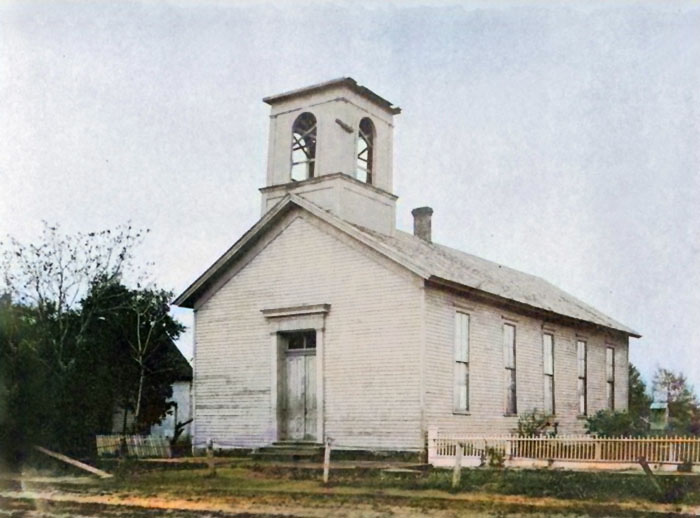
Methodist Church in Fredonia, Kansas.
The first issue of the Wilson County Citizen was published in Guilford, Kansas, on April 21, 1870, and was titled the Guilford Citizen. It was published by John S. Gilmore, a practical printer of Emporia, Kansas. It was a seven-column folio of pronounced Republican politics. Guilford was a mere hamlet of ten or a dozen houses, and the editor soon decided that its prospects did not assure much of fame or fortune to a newspaper. On October 22, 1870, Vol. 1, No. 27, the paper contained its own obituary.
Afterward, the printing materials were moved to Neodesha, one of the most frugal and promising towns in southern Kansas, which didn’t have a newspaper. On November 18, 1870, John Gilmore issued the first number of the Wilson County Citizen.
During the year, immigration was high, new buildings were constructed, and the population grew to approximately 600. By November 1870, there were 153 completed buildings on the townsite and 12 others under construction.
The first services of the Methodist Church in Fredonia were conducted by Brother Woodward, of the Belmont Circuit.
The Fredonia Journal was started on January 13, 1871, by W.A. Peffer and George M. Wellman. Starting as a six-column folio, with no politics.
The First Congregational Church of Fredonia was organized in the spring of 1871 on land donated by the town company, under the leadership of Reverend George Beckwith. The society had 13 members at the time. Soon after the society’s organization, a wooden church building, costing $1,000, was constructed. was erected.
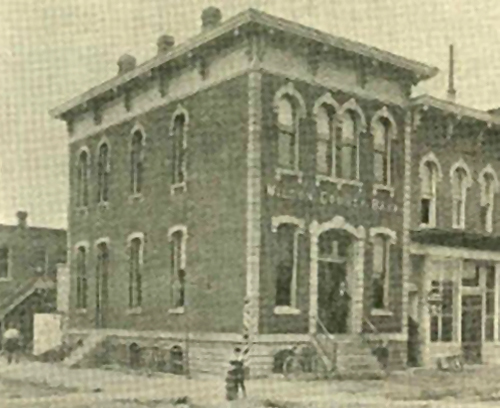
Wilson County Bank in Fredonia, Kansas.
On May 5, 1871, the town was incorporated as a third-class city. An election was held in which 144 votes were polled, and the following officers were elected: T.J. Hudson, mayor; J.L. Russell, city clerk; and John Hammert, W.W. Sholes, C. Christ, and Robert Morgan, councilmen. Citizens of Neodesha contested the election.
That year, 241 students attended the school, with teachers W.L. Martin, Miss Ella Longwell, and Miss Julia McClellan. W.L. Martin was the principal.
The Wilson County Savings Association was chartered on September 9 as the Wilson County Bank. For about a year earlier, it had been operating as a private banking house. Its directors were Joseph P. Hill, Joshua Hill, Milton Short, and Alex. Hunt and T.J. Hudson. The first three named being, respectively, president, cashier, and secretary. It was later known as the First National Bank.
Another bank, R.M. Foster & Co., was also founded about that time. However, it failed in 1877.
The Christian Church of Fredonia was organized in 1872 under the leadership of Reverend Ziba Brown. The church soon began building a neat stone church, which was erected near the Public Square at a cost of $2,000.
On February 12, 1872, the town’s first major fire consumed nine businesses on the west side of the square. The fire was fought by the bucket brigade. The damage incurred was $30,000
Charges of fraud in the May 1871 election were filed in the District Court in 1872. Judge Gooin ruled the election invalid and directed that the county office be removed to Neodesha. This decision was appealed to the State Supreme Court.
The Wilson County Citizen was discontinued in Neodesha on November 29, 1872.
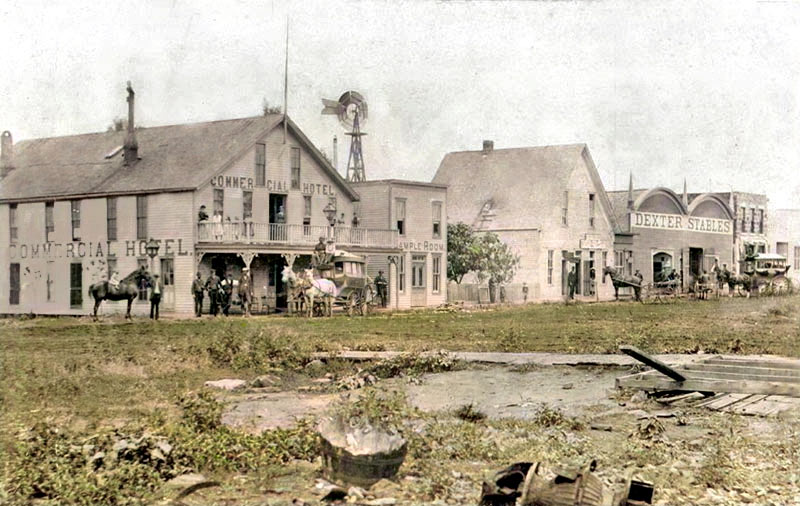
Fredonia, Kansas, in about 1875.
On January 28, 1873, another election was held, and Fredonia was again selected as the county seat.
In May 1873, John Gilmore purchased the Fredonia Journal of Peffer & Wellman, and, on June 6, 1873, revived the Wilson County Citizen. The newspaper soon became the county’s official paper and has remained so to this day. It grew into a first-class country paper, its circulation gradually increased, and success attended the labor and perseverance of its tenacious editor.
In May 1874, the State Supreme Court upheld the District Court’s decision to disqualify the May 1871 election and remove the county offices to Neodesha. That year, the city dug three first-class public wells. The wells were roofed and equipped with buckets, chains, and pulleys. These primary water sources also served as a source of fire protection. The Christian Church received its first bell.
The Fredonia Tribune was started as a Democratic seven-column weekly on September 7, 1876, by B.F. Bowen. In 1878, Douglas Hite bought the Fredonia Tribune.
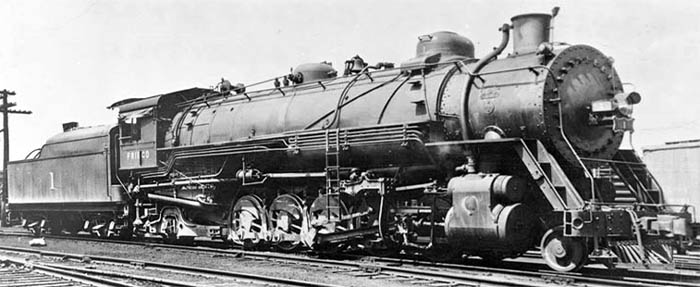
St. Louis and San Francisco Railroad
The St. Louis and San Francisco Railroad was built in 1879. The Graphic newspaper was established on December 18, 1879. It was a seven-column folio and was edited by C.E. Stivers and James Kennedy.
In 1880, a new $10,000 schoolhouse was built on the Mound at the foot of Main Street.
On March 25, 1880, The Graphic newspaper issued its last number, finding no place for a second Republican paper in the county seat.
The school district had 382 children between five and 21 years; an enrollment of 360, and an average attendance of 220 for the past year. The teachers were G.B. McDonald, Mrs. Flora J. Park, Miss Lou Young, and Miss Mary Hunt, assistants. James M. Kennedy was the principal. The building has six recitation rooms.
The Fredonia Building and Loan Association was organized on November 23, 1880. Its objective was to lend funds to members who were desirous of making improvements in the town.
The Wilson County Bank built a new stone-and-brick building, completed at a cost of $7,000, on November 29, 1880.
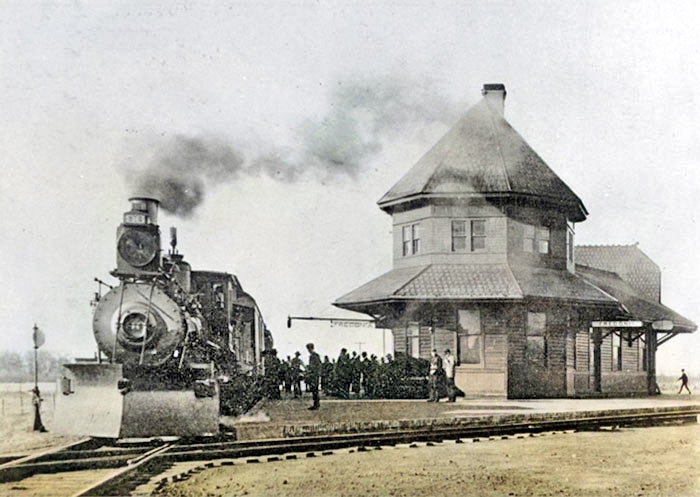
St. Louis-San Francisco Railway depot in Fredonia, in about 1900.
The grain elevator was built in 1880 by S.A. Brown & Co., at a cost of $3,600 and a capacity of 10,000 bushels. Power was furnished by a small portable engine. The amount handled in 1881 was about 130,000 bushels.
That year, there were two fires in Fredonia, resulting in a total loss of $17,000.
A parsonage for the First Congregational Church, costing $600, was added to the church in 1881. By then, there were 50 people in the congregation.
A Sabbath school for the Christian Church was organized in February 1881, with about 40 students.
A.M. Whittaker taught in 1880 and was followed, in 1881, by James Kennedy. The school soon outgrew its schoolhouse, and $7,000 in bonds was raised to erect a substantial and creditable structure. The brick school building was completed in 1880 for $10,000 and immediately occupied. It stood at the foot of East Mound.
The Fredonia Democrat was started on May 25, 1882, with N. Powell as editor and proprietor. It was an eight-column folio of the stalwart Democratic type.
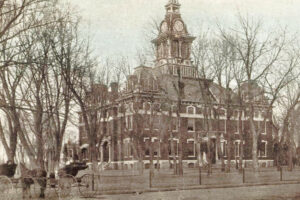
Wilson County, Kansas, courthouse in Fredonia, Kansas.
On September 7, 1885, another election was held, approving a $30,000 bond issue to fund the construction of a courthouse in Fredonia. It was designed by William R. Parson and constructed by Gauth & Sedley. That ended the county seat debate. That year, the Gold Dust Hotel was completed.
Another fire occurred on May 4, 1886, destroying eleven frame store buildings worth $13,500 on the West Side of the Square. Only six weeks later, the North Side of the square burned. Between the two events, more than 24 buildings were damaged or destroyed. That year, several new buildings were built, with total construction capital exceeding $150,000.
In 1889, there was another fire in which Cliff King, a nine-year-old boy, lost his life, and buildings worth $30,000 were destroyed. A flood that year carried away the Center Township bridge over Fall River, and a new one, several feet higher, was built. That year, the Opera House building was opened.
In 1890, a canning factory began operations, and in 1891, a linseed oil mill.
Fredonia was becoming a booming town with an emphasis on large industry.
Otto’s flour mill in Fall River burned in 1898, and his new electric mill was built in 1900. The telephone system was installed in 1900.
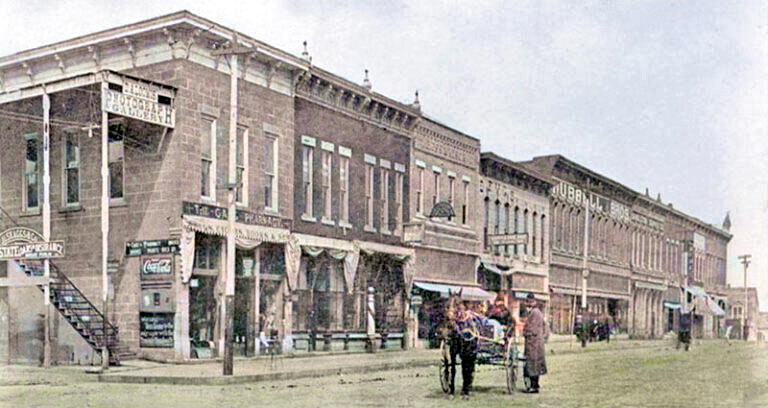
The West side of Courthouse Square in Fredonia, Kansas, 1905.
In 1910, Fredonia had city waterworks, police and fire departments, natural gas and electric lights, three banks, two newspapers, two large brick plants, two independent gas plants, a linseed oil mill, an ice and cold storage plant, cement works, foundry and machine shops, and the largest window glass plant in the West. There were five churches and three public schools. At that time, Fredonia was the county’s railroad center, well equipped with railroad facilities to handle its manufactured and farm products. The Missouri Pacific Railroad ran north and south, the Atchison, Topeka & Santa Fe ran northeast and southwest, and the St. Louis & San Francisco ran east and west, crossing at this point. There were telegraph and express offices, an international money order post office, with five rural routes, and a population of 3,040.
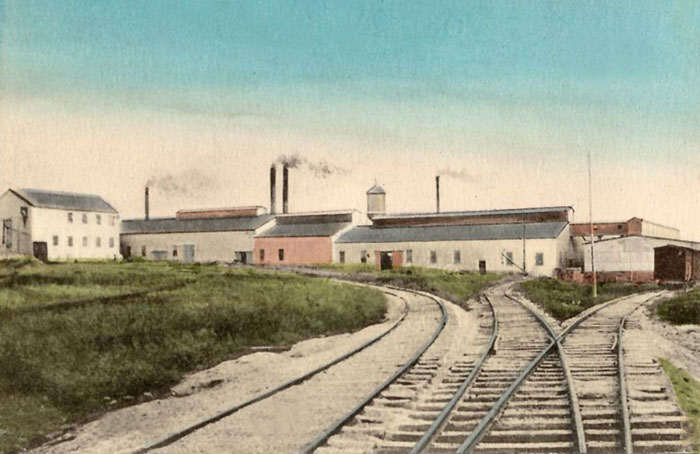
Portland Cement Plant in Fredonia, Kansas in 1918.
A cement plant opened in Fredonia in 1907. That year, Fredonia’s new Catholic Church was dedicated on October 10, 1907.
In 1909, B.E. LaDow of Fredonia Gas Company was granted permission to erect and maintain sufficient lamp posts from the public square to the Frisco-Santa Fe Depot.
In May 1913, a large vein of semi-anthracite coal was discovered near the town. The coal that was found was “said to be of better quality than any other found in Kansas” at that time. With this discovery, there was the possibility of bringing in substantial revenue for the Wilson County area.
That year, the new Methodist Episcopal Church was dedicated on Sunday, October 12.
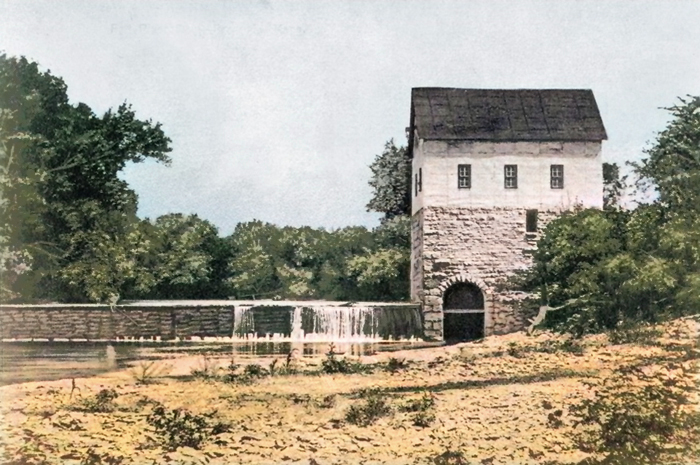
Ottos Mill & Dam in Fredonia, Kansas.
In 1914, the City of Fredonia purchased the dam and water rights from Mr. Otto for the construction of a water plant. That year, the new High School building was completed.
In 1915, the new Wilson County jail opened. It contained the sheriff’s residence, office, and the jail. It cost the taxpayers $2,000. The building now houses the Wilson County Historical Society.
In 1918, Lincoln School was destroyed by fire.
In April 1920, bids were received for the construction of the new Lincoln School, expected to be ready on November 1, with a cost of $75,000. That year, Fredonia’s population peaked at 3,954.
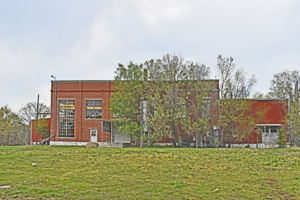
Old waterworks building in Fredonia, Kansas by Kathy Alexander.
In 1924, the City of Fredonia sold $125,000 in bonds to finance the construction of the municipal power plant and distribution system.
In 1925, Ben Paulen of Fredonia became governor of Kansas. Paulen began his political career more than 25 years before as a member of the Fredonia City Council.
In 1928, the economy of Fredonia was boosted by the opening of Archer Daniels Midland Company. The plant operated as a soybean-processing facility and provided numerous jobs for the growing industrial town.
On July 18, 1936, a national record-setting temperature of 121°F was recorded in Fredonia.
Margaret’s Mercy Hospital was dedicated on June 11, 1950.
The new National Guard Armor was dedicated in 1958.
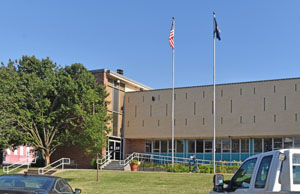
Wilson County Courthouse in Fredonia, Kansas, by Kathy Alexander.
A new courthouse was built between 1960 and 1961. The courthouse opened on April 3, 1961. Built in the Modern style, it was designed by Kene & Bradley Architects of Topeka, Kansas, and built by Freeto Construction Company Inc. of Pittsburg, Kansas. The two-story brick, glass, and concrete structure is located on spacious, landscaped grounds in the center of Fredonia. The first story is faced with reddish flagstone and has horizontal windows. The main entrance is on the east side, with glass panels rising to the roofline. On the second story, the County District Court courtroom is located on the northwest side, and the small courtroom is located on the southwest side. The building houses the County District Court of the 31st Judicial District. A memorial clock tower using the original 1885 courthouse clock is located adjacent to the sidewalk on Monroe Street, on the north side of the courthouse grounds. It is located at 615 Madison Street.
In 1963, Fredonia City Hall was destroyed by an explosion that completely destroyed the interior and roof. The hot water tank was blamed.
Groundbreaking ceremonies were held for the new clock tower in 1965.
In 1967, the new library, built on the grounds of the old Congregational Church, was opened to the public.
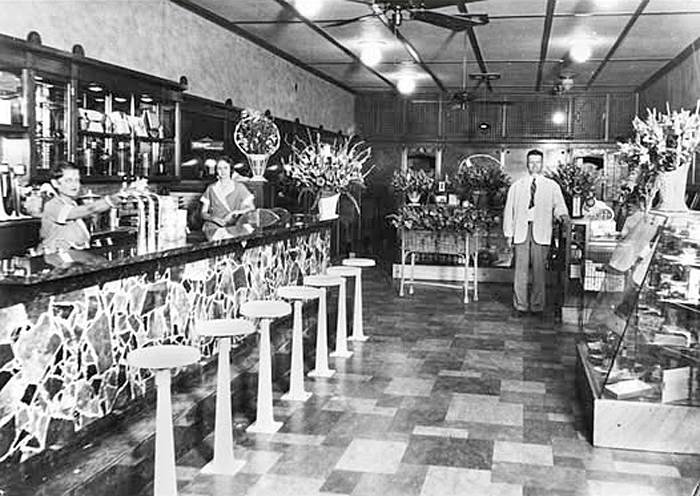
Wiggens Drug Store, Fredonia, Kansas.
In 1971, the last drugstore soda fountain in Fredonia, at Wiggans Drug Store, discontinued service.
In 1973, a contract was signed between Koppers Inc. of Pittsburgh, Pennsylvania, and General Portland Cement for a $2 million dust-control system at the Fredonia plant. The same year, construction began on the new two-million-gallon water storage tank being erected on the West Mound.
The completion of a 10-barrel-a-day well owned by Archer-Daniels-Midland sparked a flurry of drilling along the north city limits in 1980. By that time, oil well drilling had become one of the busiest enterprises in Fredonia. That year, the Fredonia Daily Herald announced that it would cease publication and issue its final edition.
In 1981, the Fredonia Cinema building on the east side of the square was completely gutted by fire.
In 1982, the New Year’s Eve celebration was interrupted when a major fire broke out in downtown Fredonia shortly before 6:00 p.m. The second major blaze in as many months on the square destroyed and severely damaged five other businesses and two offices. Wiggans Drug Store and Mode O’Day received intensive damage. Receiving severe smoke damage were Dryer’s Shoes and Rice’s Jewelry, the real state office of J.L. Elins, and the law office of Rex Lafferty. A furnace malfunction at Coast to Coast was determined to have caused the fire. Bunch Greenhouse was sold after operating under that name since the early 1900s. Dan Schoolcraft became the fourth generation Schoolcraft to be part of the 79-year-old Schoolcraft Lumber Co. Six months after the disastrous New Year’s Eve fire, Wiggans’ Drug Store is back in its remodeled building, and Coast to Coast is reopening in its new building on the west side of the square.
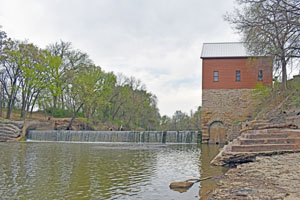
Old mill and dam in Fredonia, Kansas by Kathy Alexander.
During the 1983 drought, the Tulsa District of the U.S. Corps of Engineers threatened to shut off water to the Fall River and Toronto Reservoirs unless cities and industries agreed to begin paying for it. Congressman Bob Whittaker intervenes to prevent the threatened cutoff.
On May 24, 1984, negotiations between General Portland Cement Company and the cement workers’ union apparently broke down, and a strike was called at the Fredonia plant.
In 1985, Mercy Hospital of Kansas, Inc. set a deadline for the hospital’s disposal. A $600,000 county bond issue was expected to cover the period between the Sisters of Mercy’s withdrawal and the hospital’s start of self-billing.
In 1987, in a vote of 6 to 1, the board of education of USD 484, Fredonia, approved a resolution calling for a school bond election for a new high school construction, additional classroom space a the Lincoln School site, formation of a new middle school at the present junior-senior high location, and razing the 75-year-old high school building.
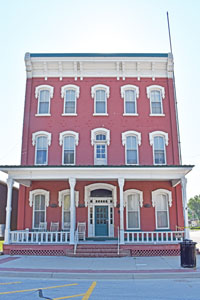
The Historic Gold Dust Hotel in Fredonia, Kansas, is listed on the National Register of Historic Places, photo by Kathy Alexander.
In 1988, a $2 million school bond proposal for USD 484 passed with 1,022 in favor and 582 against.
In 1990, the Butts school building was destroyed by a fire of unknown origin. That year, the Opera House building collapsed at the beginning of the June festival day. No one was injured.
In 1992, the last walls of the 1915 high school building were demolished. That year, Jerry Rice announced plans to open a movie house on the west side of the square.
In 1994, the Mill Dam building was renovated.
On March 3, 1995, Kansas governor Bill Graves signed a resolution stating “Highway 75 from the Oklahoma and Kansas state lines to the steps of our state’s capital be so designated “the Opothle Yahola Memorial Highway” and certain areas in Southeast Kansas, the Verdigris, Neosho and Fall River Valleys and that of the Big and Little Sandy Creek Valleys as the “Opothle Yahola Historic Trail.”
In March 2003, the Archer Daniels Midland Company announced it would close its Fredonia plant effective immediately.
After providing jobs to the community for more than 100 years, the cement plant closed in 2012.
Fredonia is located within 150 miles of the major metropolitan cities of Wichita and Kansas City, Missouri; Tulsa, Oklahoma; and Joplin, Missouri. Its small-town charm, professional healthcare facilities, affordable living, numerous recreational opportunities, and friendly atmosphere make Fredonia a great place to call home. It is located at the junction of U.S. Highways 400 and 47.
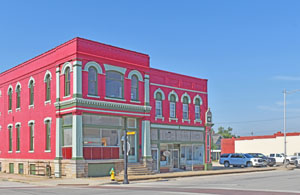
Business buildings in Fredonia, Kansas, by Kathy Alexander.
©Kathy Alexander/Legends of Kansas, updated January 2026.
Also See:
Sources:
American Courthouses
Blackmar, Frank W.; Kansas: A Cyclopedia of State History, Vol I; Standard Publishing Company, Chicago, IL 1912.
Cutler, William G.; History of Kansas; A.T. Andreas, Chicago, IL, 1883.
City of Fredonia
Fredonia Chamber of Commerce
Wikipedia