
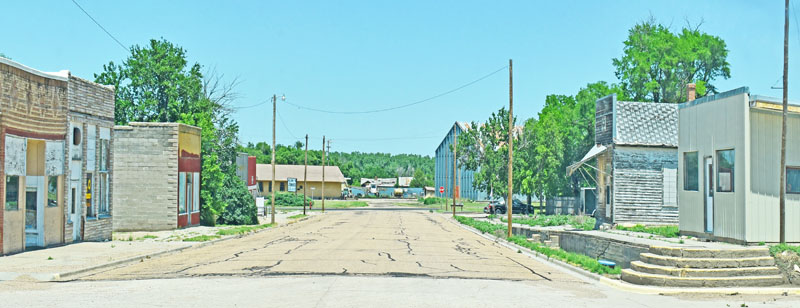
Jennings, Kansas Main Street by Kathy Alexander.
Jennings, Kansas, is a small town in Decatur County. As of the 2020 census, its population was 81, and it had a total area of 0.27 square miles, all land.
On April 17, 1873, a small colony of Czechs from Nebraska came to Big Timber Creek, a tributary of Prairie Dog Creek. These included the Rohans, Steffens, and Cileks, William Heilman, Wenzel, Skalok, Joseph Wenzel, Jacob Joseph, Wenzel Anton, Frank Louis, and Joe Blecha. The Valleys of Prairie Dog Creek and the North Fork of the Solomon River drew settlers to the area.
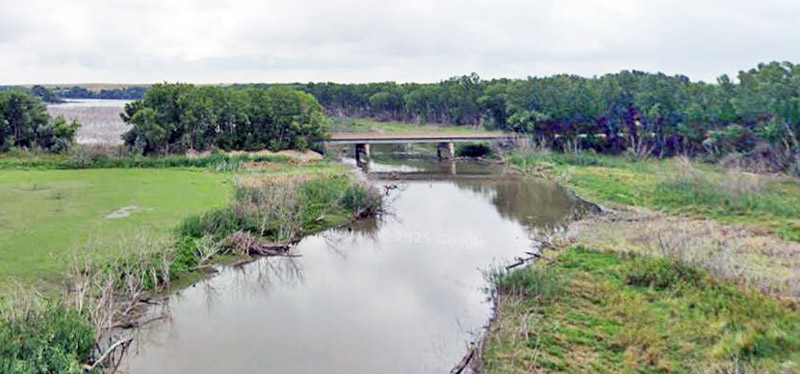
Prairie Dog Creek in Northwest Kansas, courtesy of Google Maps.
The Warren Jennings family came to the area from Iowa in 1873 and homesteaded on Prairie Dog Creek, nearly a mile Northeast of the site of Jennings. They built a two-story frame house from lumber hauled by team and wagon from Fort Kearney, Nebraska, and established the Slab City trading post. Buffalo hunters patronized it, potential settlers, and at times, friendly Indians.
The Slab City Post Office was established on October 22, 1874, with Walter W. Hopkins appointed postmaster.
In 1879, the O. E Munson family came to the area, homesteading the land on which the town of Jennings was settled.
On October 15, 1879, the town and post office were renamed Jennings.
The lack of education for their children was one of the major worries of the early settlers. Informal subscription schools were first held in various homes. The school terms were short — after the fall fieldwork was over and before the spring work began. Many children attended school for only two or three years.
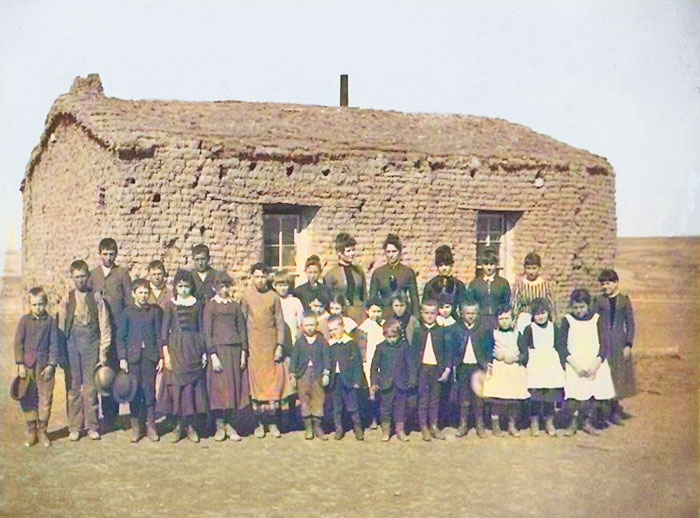
Sod school in Jennings, Kansas.
On March 12, 1880, school district number 18 was formed, and the first school district meeting was held on April 14, 1880, when the first school district officers were elected. The school was named after the town of Jennings. The first school building was erected that year, one mile East and one and a half miles North of the present site of Jennings. It was a sod building measuring about 14 by 24 feet with a straw roof and dirt floor.
By 1884, the Czech settlement on Big Timber Creek had grown from a few isolated dugouts into a small community of 20 families.
In about 1885, the school’s roof burned. A building was rented until they could build another schoolhouse. The new building was also of sod construction and about the same size as the first. This sod building was used until 1887, when a more modern frame building was built one-half mile North of the town.
In 1886, a severe drought gripped the area, and many mortgages were foreclosed. In fact, many loan companies went broke because they were forced to take over land that they could not resell at the time.
Another group of settlers arrived in 1886-1887.
In 1887, the first Jennings newspaper, the Jennings Echo, was founded. That year, the Chicago, Rock Island & Pacific Railroad began building to Jennings.
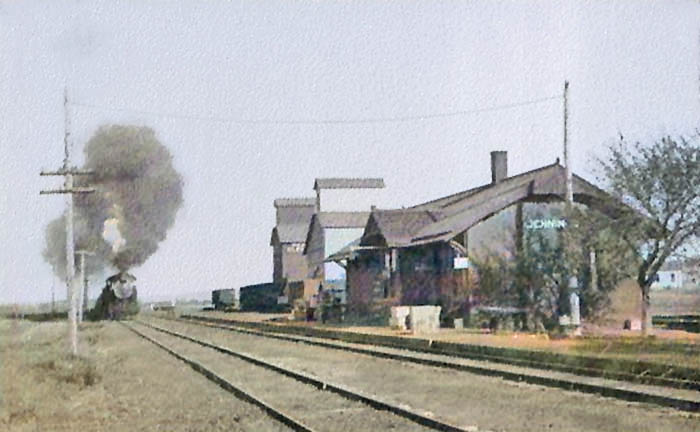
Railroad depot in Jennings, Kansas.
The Railroad was completed through Jennings on May 16, 1888. The first depot was a two-story building, in which the agent lived on the second floor. The townsite of Jenning was laid out that year and named for Warren Jennings, a landowner. Many houses were moved from Allison to Jennings.
A steam-driven flour mill at the town of Jackson, West of Jennings, was built in 1889. For a period of nearly 15 years, the Big Timber settlers had to take their grain great distances to be milled. There were many accounts of people taking wagonloads of wheat, 40 or 50 miles to a mill to be ground into flour.
In 1889, the school was transferred to a two-room frame building located on the hill East of Jennings. A few years later, this building was moved into the city limits to a location in the southern part of town, and two large rooms were added.
School districts were organized, and separate school buildings were built beginning around 1890. The “Big Timber” school, located just West of the Rohan home; the “Kaspar” school, located one mile East of the Old ZCBJ Hall; The “Norway” school, located two miles West of the Big Timber cemetery, and the “Jackson” school, five miles West of Jennings. The few community members who aspired to attend high school went to Decatur County High School in Oberlin.
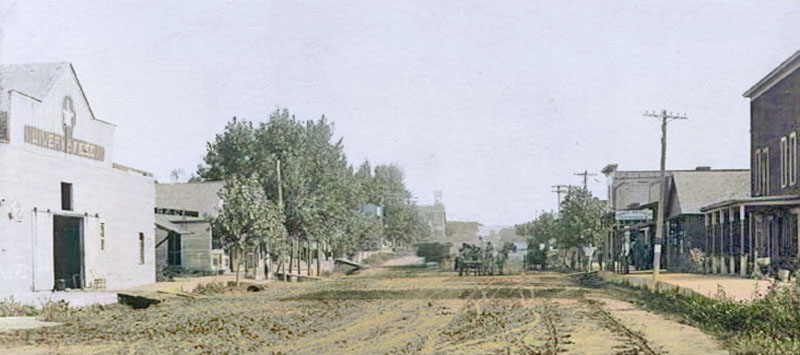
Early day Jennings, Kansas, Main Street.
The Jennings depot burned in 1903, and a new building was erected. That year, the railroad established a new cream train between Goodland and Belleville.
Jennings was incorporated as a town in 1906, with a Mayor-Council type of government. The town’s first mayor was W.E. Winget, the first councilmen were: M.F. Feely, C.E. Potts, W.P. Noone, A.A. Smith, and Bud Harris.
In 1910, Jennings was an incorporated city of the third class, still on the Chicago, Rock Island and Pacific Railroad. At that time, it had a bank, a weekly newspaper called the Echo, express and telegraph offices, a money order post office with two rural routes, and a population of 259.
In 1916, Jennings operated its own light plant. In 1918, the plant burned, making it necessary for the town to get power from a new source. The City voted to issue $20,000 in bonds to construct a 10-mile transmission line.
In 1922, the need for a new school building grew, and construction began on a much larger one than any they had before, fitted with many modern conveniences. It was constructed of brick, two stories high, with a full basement, classrooms, an office, a large auditorium, and a good-sized stage and dressing room on each side. It was equipped with electric lights, a telephone, and steam heating.
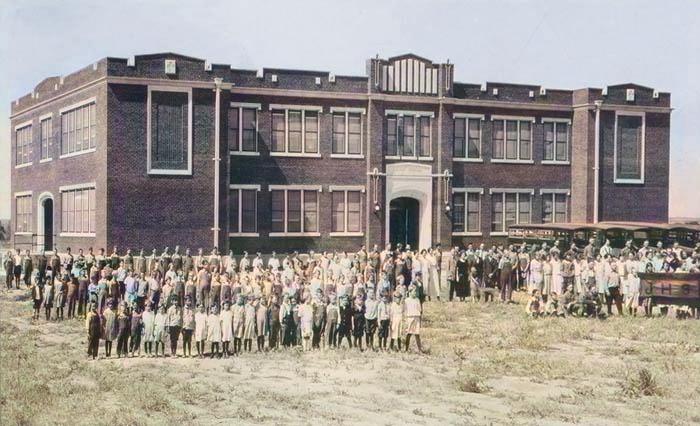
Jennings School, 1923.
The various schools in the area were consolidated around 1924.
The town’s population peaked at 344 in 1930.
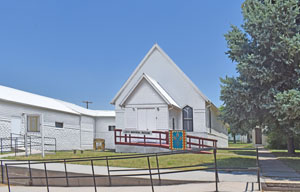
Jennings, Kansas Museum by Kathy Alexander.
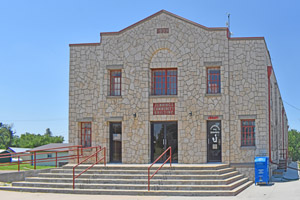
Community building in Jennings, Kansas, by Kathy Alexander.
In 1936 and 1937, the City Council voted a total of $17,000 in bonds for the construction of the city hall. Works Progress Administration workers began construction in 1938 under the supervision of Joseph S. Flaska. This project was completed in 1939.
In 1965, a renewed focus on Jennings’ Czech heritage led to the establishment of an annual Kolache Festival. Community women baked and sold up to 15,000 kolaches at this post-harvest celebration. Colorful Beseda Dancers entertained in the streets, and the festivities featured a parade, various booths, a museum, and the highlight of the day: a traditional Czech dinner. In 1969, around 1,500 people were served dinner in City Hall. At its peak, the festival attracted 5,000 attendees. Proceeds from the event were used for community improvements. However, by 1971, the festival was discontinued due to it outgrowing the town’s facilities, workforce, and law enforcement capabilities.
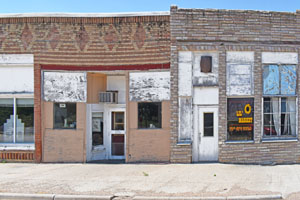
Jennings, Kansas, business buildings.
Jennings schools were closed in school unification.
Today, residents south of Highway 383 are served by the Hoxie USD 412 public school district, and North of the highway are served by the Oberlin USD 294.
Jenning is about 23 miles southeast of Oberlin, the county seat.
©Kathy Alexander/Legends of Kansas, July 2026.
Also See:
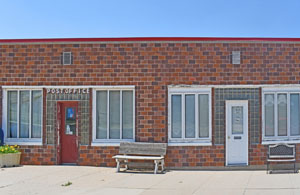
Jennings, Kansas, post office by Kathy Alexander.
Sources:
Blackmar, Frank W. Kansas: A Cyclopedia of State History, Vol. I. Standard Publishing Company, Chicago, IL, 1912.
Decatur County
Kansas Genweb-1
Kansas GenWeb-2
Wikipedia