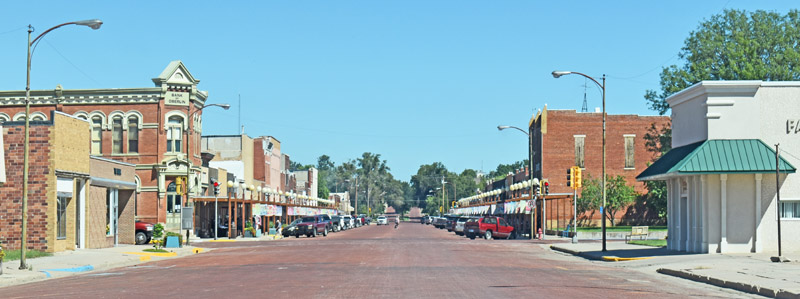
Oberlin, Kansas, Main Street by Kathy Alexander.
Oberlin, Kansas, on the northwest side of Sappa Creek in Oberlin Township, is a city and the county seat of Decatur County. As of the 2020 census, its population was 1,644, and it had a total area of 1.91 square miles, all land.
On April 29, 1873, a deed was granted to J.A. Rodehaver, who received title to the southwest quarter of section 1, township 3, range 29. The same day, a post office called Sappa was established.
On September 12, 1873, several families arrived in Oberlin, including those of Robert Riley and John Stiner.
In the summer of 1874, R.L. Booth killed Frank Adams for insulting his wife – the first death by violence in the county.
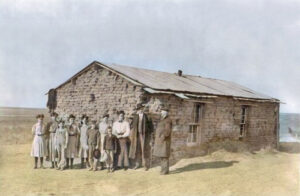
A sod school in Decatur, Kansas.
The first school was held near Oberlin in the fall and winter of 1875-76 and was taught by George Worthington.
A new townsite, called Oberlin, was platted in 1878 and named after Oberlin, Ohio.
On April 22, 1878, the town and post office name was changed from Sappa to Oberlin. By September of that year, the village consisted of one sod and one frame store, a log hotel, and a log blacksmith shop. A frame house and a sod house were also under construction. Mr. Van Wormer opened the first general store, but soon sold his stock to J.W. Allen & Son. R.A. Marks was the next man who ventured into the mercantile trade and subsequently became engaged in banking.
In 1878, R.W. Bariteau moved his family to Oberlin, Kansas, began practicing medicine, and partnered in the firm of Bariteau Bros., druggists.
G. Webb Bertram, an attorney initially from Massachusetts, came to Oberlin and opened his practice. In the fall of 1878, he purchased one-third interest in the townsite of Oberlin.
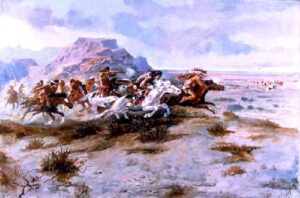
Indian Attack by Charles Russell.
On September 30, 1878, Northern Cheyenne fled from the Indian Territory (Oklahoma) to their homeland in the Black Hills of South Dakota. Along the way, they had many fights with the U.S. Cavalry and settlers. During the Northern Cheyenne Exodus, the Indians attacked homesteaders near Oberlin. Nearly 20 Decatur County settlers were killed in the battles and raids before the Cheyenne crossed into Nebraska. The raid’s victims are commemorated in the “Last Indian Raid in Kansas” room of the Decatur County Museum, and by a monument in the town cemetery.
In 1879, the community consisted of the Oberlin House Hotel, a livery stable, and two mercantile stores. That year, Lewis G. Parker formed a copartnership with G. Webb Bertram in the law and land business on March 15, 1879, and another attorney, J.E. Cochran, came to Oberlin.
The Oberlin Herald was issued in June 1879 by J.C. Humphrey and James N. Counter.
The Bank of Oberlin was established in 1880 by Robert Alexander Marks. A Canadian, he moved to Oberlin from Beloit in the fall of 1878. He initially established a mercantile business and later engaged in lumber, agricultural implements, and banking. Marks later served as Oberlin’s postmaster and as Decatur County register of deeds.
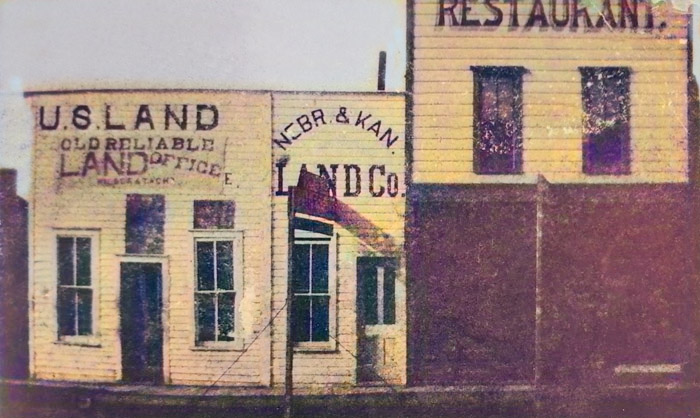
Land Office in Oberland, Kansas.
The U.S. Land Office was established in Oberlin in 1881, stimulating a 13-year boom in the local economy. The land office served as the Northern Land District office for the counties of Decatur, Rawlins, Cheyenne, Sherman, Thomas, Sheridan, Graham, and Norton.
In April 1881, James Counter became the sole manager of the Oberlin Herald.
N.A. Cornih, initially from Indiana, moved his family to Oberlin in May 1881 and practiced law.
The Oberlin News was started in August 1881 by Jacob C. Wilson and others.
In December 1881, William D. Street became the proprietor of the Oberlin Herald.
By that time, Oberlin was the only town in Decatur County that had attained any importance, but it was a mere hamlet compared to many other county seats in Kansas.
On March 1, 1882, the Oberlin News was purchased by the Herald and consolidated with it. J. E. Cochran had been its editor.
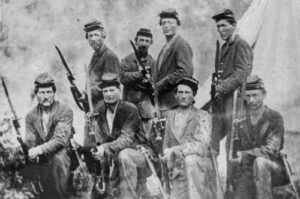
Kansas Militia.
The Independent Volunteer Cavalry Company (State Militia) of Oberlin was organized on December 12, 1882, with 30 troops under First Lieutenant L.G. Parker. At that time, the city’s population was 300.
The school report ending February 8, 1883, showed 36 students in the primary grade and 31 students in the higher department. That year, the Oberlin Herald was the only newspaper in the county. At that time, Oberlin had a population of 300.
In 1885, Oberlin was incorporated as a city of the third class.
The land office processed 6,000 homestead claims between June and September, 1885. In addition to the U.S. Land Office, 24 private land offices had established operations in Oberlin by 1886.
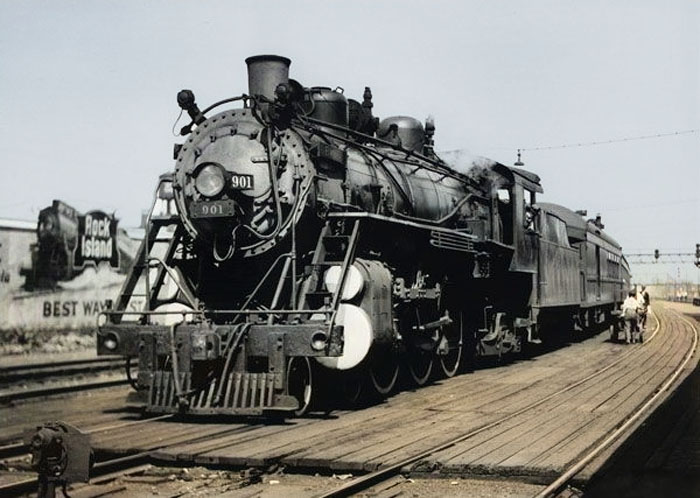
Chicago, Rock Island & Pacific Railroad.
The Chicago, Rock Island & Pacific Railroad completed a spur line from Oronoque to Oberlin in 1886, but despite high hopes, no other lines were built to Oberlin.
In 1886, Robert Marks sold a controlling interest in the Bank of Oberlin to the Schuster banking family of St. Joseph, Missouri. It soon had several stockholders and a capital of $50,000. S.A. Walker was president; J.B. Colt, vice-president; William Browne, cashier
At that time, J.B. Colt ran a hardware store.
Construction of the pressed red brick, Italianate Bank of Oberlin building began in June 1886 and was completed in September of the same year. Located at the corner of Penn Avenue and Hall Street, the two-story building was 28 by 60 feet. The building was steam-heated and constructed with fireproof vaults. Mr. White, of St. Joseph, was the contractor.”
In a special promotional issue published in 1887, the Oberlin Opinion called Oberlin the “Queen City of Northwest Kansas” and described the city’s growth as follows:
“During the last year Oberlin made a splendid growth, and at the beginning of this year presented a city with over one hundred and thirty business houses, and 300 residences. In 1887, 65 new residences were built, many of which would be a credit to any city a thousand miles East, with ten times Oberlin’s population….The city is the money center of all Northwestern Kansas.”
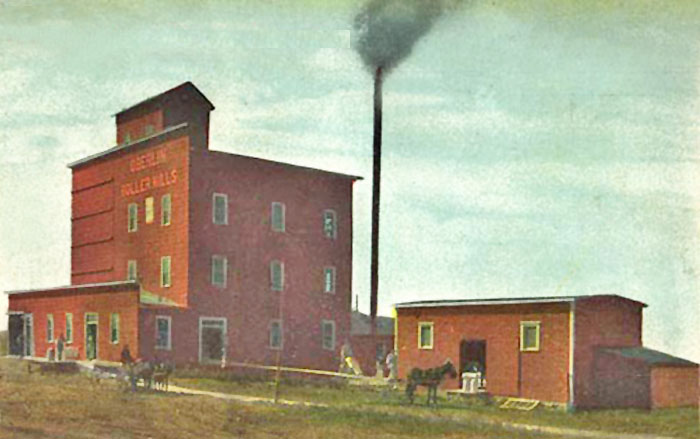
Oberlin Roller Mills.
In 1888, Oberlin’s population had swelled to 2,000. At that time, Oberlin boasted three weekly newspapers, five banks, 25 general merchandise stores, five hotels, five restaurants, two bakeries, two lumberyards, two furniture stores, two brick yards, two laundries, five insurance companies, four meat markets, one physician, one dentist, six churches, 15 attorneys, and 15 real estate agents, in addition to a $25,000 water works.
The population in 1890 was 976.
When the U.S. Land Office closed in 1894 and moved to Colby, Oberlin’s economy faltered, and the business casualties included the Bank of Oberlin. The men in St. Joseph, Missouri, who owned most of the stock, had withdrawn all the funds from the Bank of Oberlin to keep for themselves when the bank failed. This left the bank without funds and compelled it to close.
Following the Bank of Oberlin’s closure, Decatur County filed a $10,000 claim against the bank. In February 1896, the Decatur County Commissioners settled with the bank’s representative; the terms of the settlement included $6,000 in cash and up to $4,000 in dividends from the bank’s assets. Through this settlement, Decatur County acquired title to the bank building, which served as Decatur County’s first permanent courthouse from 1896 until 1927, when a new courthouse was erected.
In 1910, Oberlin was an incorporated city at the terminus of a branch of the Chicago, Burlington & Quincy Railroad. At that time, it had electric lights, waterworks, a fire department, sewer system, an opera house, a flour mill, a foundry, a creamery, grain elevators, a county high school, a public library, two banks, three newspapers — the Times, the Herald, and the News, telegraph and express offices, and an international money order postoffice with six rural routes. The population in 1910 was 1,157.
The Works Progress Administration established Sappa Park, originally by a lake, in 1935. It hired unemployed young men to build its dam and shelter house, and the National Park Service developed it into a state park. It was dedicated in 1939.
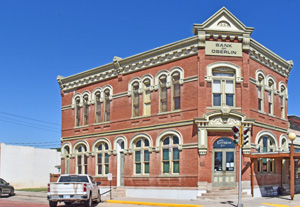
Old Bank of Oberlin by Kathy Alexander.
On April 29, 1942, an extremely violent tornado swept away three farms south of Oberlin, killing 15 people. Oberlin was spared from a direct hit, as it passed one mile East of the city. This tornado was retrospectively rated F5 on the Fujita scale.
The old Bank of Overland building was purchased by United Telephone in 1928 and housed their offices until the 1960s.
Oberlin’s population peaked at 2,387 in 1980.
In early 2026, The Oberlin Herald and five other regional newspapers, including the Colby Free Press, Goodland Star News, St. Francis Herald, Norton Telegram, and Rawlins County Square Deal, consolidated their standalone operations. They are now all published under a single consolidated weekly newspaper umbrella owned by High Plains News.
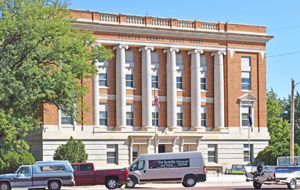
Decatur County Courthouse in Oberlin, Kansas by Kathy Alexander.
Oberlin is home to the Last Indian Raid Museum, which houses 14 late-19th- and early-20th-century buildings filled with artifacts that chronicle the area’s history and the early Plains settlers. Here, visitors learn about the Last Indian Raid on Kansas soil in 1878, see a sod house, jail, railroad depot, one-room school, filling station, Bohemian Hall, and more. It is located at 258 S. Penn in Oberlin.
Today, the City of Oberlin owns Sappa Park, two miles East of town. Over the years, silt filled the lake, and it was drained. Part of the lake has recently been restored as a wetland. It has bike and hiking paths, a nine-hole disc golf course, and a shelter house. A nine-hole golf course is adjacent to it.
Oberlin is a third-class city with a mayor-council form of government. The city council consists of five members.
The old Bank of Overland building serves as the Landmark Inn, a bed-and-breakfast venue.
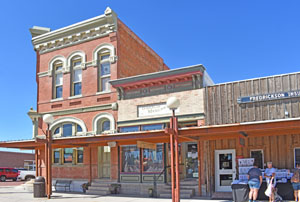
Business buildings in Oberlin, Kansas, by Kathy Alexander.
The community is served by the Oberlin USD 294 public school district, which operates two schools in the city: Oberlin Elementary School (Grades Pre-K-6) and Decatur Community Junior/Senior High School.
Oberlin is located at the intersection of U.S. Routes 36 and 83 in northwestern Kansas. It is 228 miles northwest of Wichita, 238 miles East of Denver, and 320 miles west-northwest of Kansas City.
©Kathy Alexander/Legends of Kansas, July 2026.
Also See:
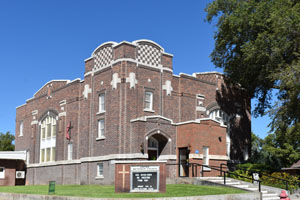
Methodist Church in Oberlin, Kansas by Kathy Alexander.
Sources:
Blackmar, Frank W. Kansas: A Cyclopedia of State History, Vol. I. Standard Publishing Company, Chicago, IL, 1912.
Cutler, William G.; History of Kansas; A. T. Andreas, Chicago, IL, 1883.
Decatur County, Kansas
Register of Historic Places
Wikipedia