
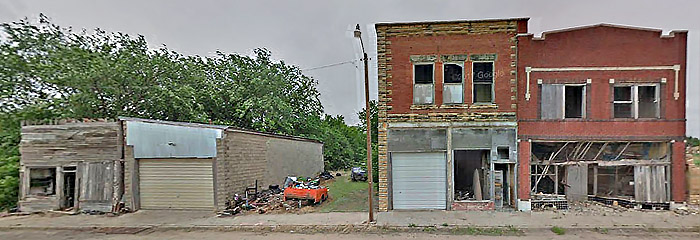
Old buildings in Simpson, Kansas, courtesy of Google Maps.
Simpson is a small town in both Mitchell and Cloud Counties. As of the 2020 census, its population was 82, and it had a total area of 0.25 square miles, all of it land.
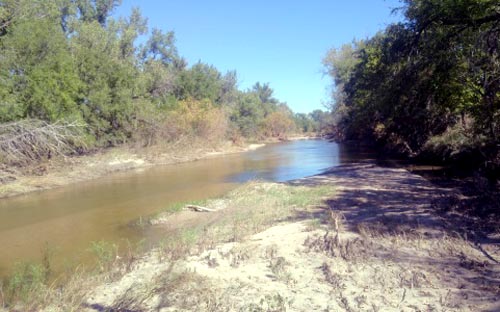
Solomon River in Kansas.
When this place was founded in 1871, G. Beaver, who owned a mill at Delphos, came up the Solomon River looking for a site for a mill. With financial aid from Thomas Shanks and Alfred Simpson, the mill was erected where the community called Brittsville began.
A post office called Brittsville was established on June 22, 1874.
The land on which the city was situated was first owned by T.E. Thackery, who, on December 29, 1875, registered a receiver’s receipt for the property.
Tom Shanks and Alfred Simpson started the first store in the new town, and the first house belonged to George Leinen, Sr.
By 1879, Brittsville was a thriving little village with a store, a drug store, a blacksmith shop, a post office, and a stage stand.
With the coming of the railroad, between 1879 and 1880, Brittsville was moved a mile to the present townsite of Simpson in 1882, after Alfred Simpson deeded a portion of land upon which the town was built. On April 3, 1882, the town and post office were renamed Simpson in his honor.
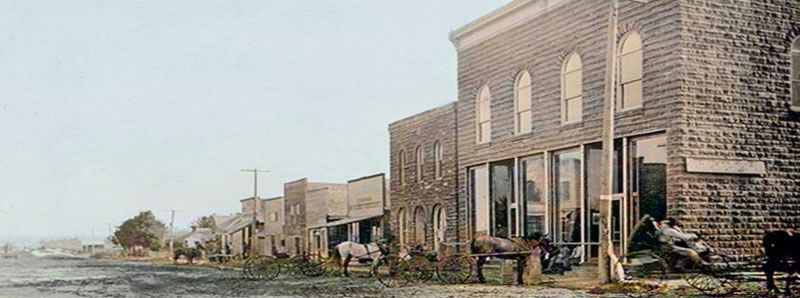
Early-day Simpson, Kansas.
The Simpson Shanks & Company Bank was founded in Simpson on April 4, 1894, as a rural community agricultural bank. It is one of the oldest bank charters in the state of Kansas. It was an instrumental part of the local Simpson farming community for many years.
In 1910, Simpson was an incorporated town located on the Union Pacific Railroad in Logan Township. At that time, it had a bank, a flour mill, telegraph and express offices, a money order post office with two rural routes, and a population of 211.
Dr. Schaffer, who grew up in the Beloit-Simpson area, made historical house calls and ran a hospital out of his home in Simpson. He also operated a well-known drugstore on Mill Street in Simpson that featured a popular soda fountain.
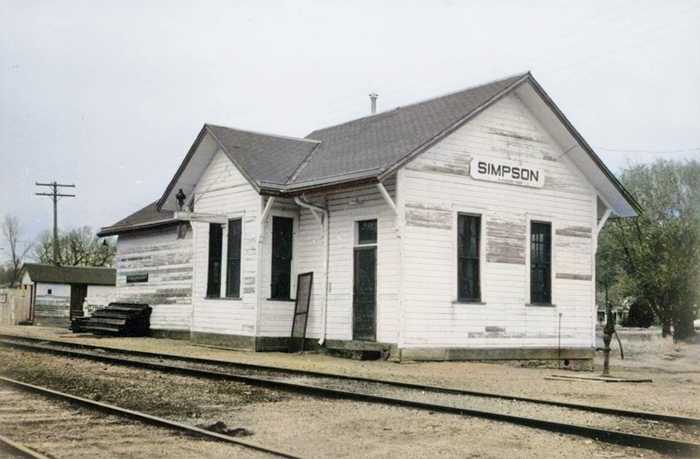
Union Pacific Railroad Depot in Simpson, Kansas.
Just North of the drugstore was the Johnson Bros. grocery store, which boasted a roller-skating rink on the second floor. Across the road, East of the roller rink, was Joe Jindra’s filling station, and above that was a ballroom. When Lawrence Welk was a young traveling musician, he and his orchestra performed in that ballroom.
In 1913, a depot was built at Simpson for $700.
Simpson’s population peaked at 295 in 1920.
As farming shifted toward larger corporate farms and population demographics changed in the mid-1900s, the town of Simpson struggled to retain its local businesses. During this time, the bank also struggled.
In 1953, the business community had shrunk considerably. There were no restaurants, the locker plant had closed, and the drug store died with Doc Schaffer. Louis “Elroy” Horn was hurt while helping the county build the new bridge over the Solomon River south of town and had to close his blacksmith business. The beautiful school gymnasium was being used as a welding shop, and the school playground equipment had turned to little more than piles of twisted metal, broken boards, and rust. However, the grain elevators, the bank, the post office, a filling station, and a small grocery store continued to operate.
The depot closed in 1969.
In the late 1970s, the post office was moved to a new building that also housed the bank.
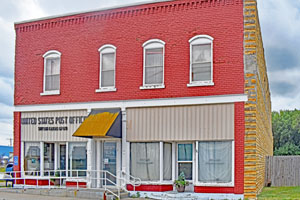
Post office in Simpson, Kansas, by Kathy Alexander.
The old wooden grain elevator burned down in the early 1980s.
In 1998, Lindsay Olsen purchased the bank. In 2000, its name was changed to the TriCentury Bank. Afterward, it shifted its business model to provide more electronic banking services, reaching customers nationwide. These changes helped maintain the bank’s viability; however, it was evident that more needed to be done to enhance the bank’s long-term prospects.
In 2014, Travis Hicks and Lindsay Olsen partnered with a shared goal of building a banking model that would be sustainable for the next century. The plan relocated the bank’s charter to the Kansas City metro market, which could support growth and prosperity, while maintaining the small-community banking model that had always been integral to the bank’s history.
On November 7, 2014, the bank acquired two locations in the greater Kansas City Market. The new locations in De Soto and Spring Hill, Kansas, marked a new beginning for this third-TriCentury bank charter, with the bank’s headquarters moved to De Soto.
The old Methodist Church was converted into a home after the Methodist & Baptist churches united as The Simpson Church in the Baptist building in the 1980s.
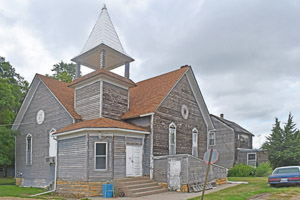
The old Methodist Church in Simpson, Kansas, was converted to a home.
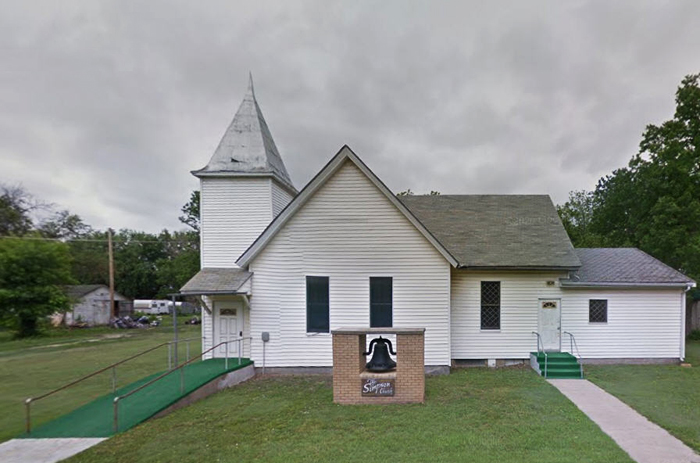
Simpson Church today, courtesy of Google Maps.
Tony Prochaska opened Trapper’s Bar & Grill in 1994 with a 25-seat cafe in a building that had formerly been the post office. Its name came from Tony’s pastime of trapping. Later, he added four rustically appealing dining rooms that could serve 160 at a time. It was the food that people noticed—charcoal-grilled steaks, seafood, chicken, hamburgers, smoked pork chops, and much more. The restaurant was regionally famous, with people as far away as Salina coming to eat there.
Simpson schools were closed as part of school unification.
TriCentury Bank’s latest big move was on November 21, 2021, with the opening of a new branch in Lawrence, Kansas.
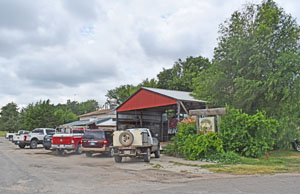
Trappers Bar & Grill, Simpson, Kansas by Kathy Alexander.
In recent years, the original Trapper’s closed but has since reopened under new ownership and was renamed Trapper Joe’s. It is located at 304 Elkhorn Street.
Today, grain is shipped from Asherville, Beloit, and Concordia.
The post office continues to serve the surrounding community.
The community is served by the Beloit USD 273 public school district.
Simpson is about a mile and a half south of US Hwy 24, just six miles West of Glasco, and nine miles East of Beloit.
©Kathy Alexander/Legends of Kansas, updated July 2026.
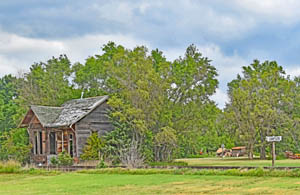
Old depot in Simpson, Kansas by Kathy Alexander.
Also See:
Sources:
Blackmar, Frank W.; Kansas: A Cyclopedia of State History, Vol I; Standard Publishing Company, Chicago, IL 1912.
Kansas Sampler
Mitchell County, Kansas
Tricentury Bank
Wikipedia