Kaw Mission in Council Grove, Kansas by Kathy Alexander.
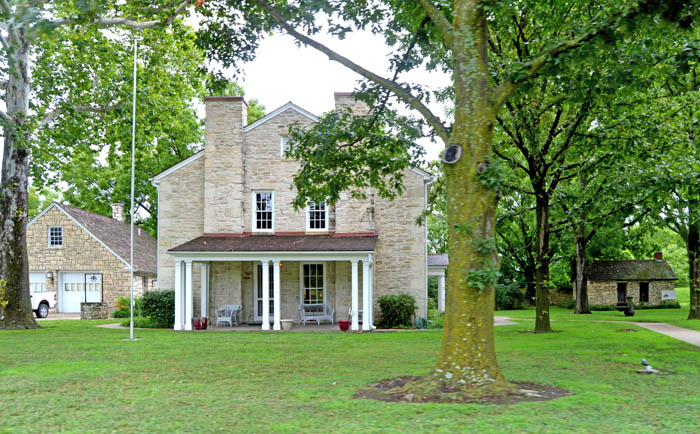
Kaw Mission in Council Grove, Kansas, is a historic church mission that served as a home, school, and church for 30 Kaw (Kanza) Indian boys from 1851 to 1854.
An 1816 treaty with the Kanza relegated them to a 20-mile-square reservation that included the site of present-day Council Grove.
In 1825, the U.S. government negotiated with the Osage Tribe for passage across their lands. This right-of-way became the Santa Fe Trail, and the council with the Osage inspired the name of the town of Council Grove. The Santa Fe Trail served as a commercial route between Missouri and Santa Fe, New Mexico, and passed through present-day Council Grove. Situated on the Neosho River, the community was a natural stopping place, with water, grass, and timber. The area that is now Kansas was the western limit of American settlement.
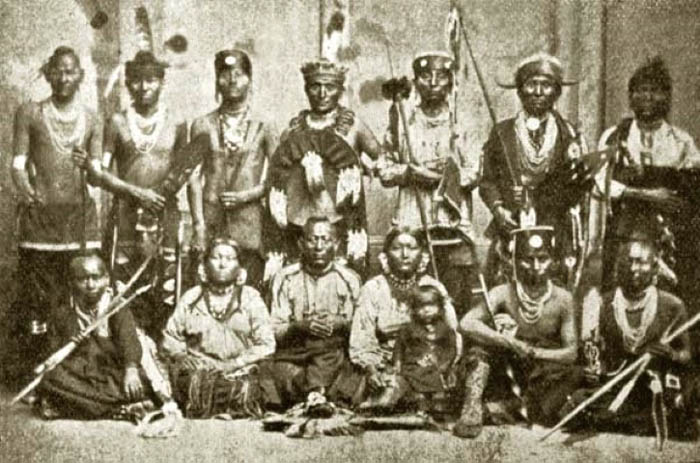
Kanza Indians.
A treaty with the Kanza in 1846 reduced their lands to a 20-mile square tract that included the present-day Council Grove. The treaty with the Kanza established an annual payment of $1,000 to advance their education in their own country. Traders and the government quickly moved to the new location. Seth M. Hays, the first white settler at Council Grove, established a home and trading post there in 1847 along the Santa Fe Trail. Hundreds of wagon trains carrying goods for trade with Mexico passed through daily. Later, speculators followed to path to the gold fields.
In 1850, the Methodist Episcopal Church South, which had ministered to the tribe since 1830, received governmental approval to construct a mission and school building, which was completed by February 1851.
The state of Kansas was named for the Kanza tribe. These people had lived in the area now known as Kansas for many generations. They were moved to the Neosho Valley, where they lived for less than 30 years.
In 1850, the Methodist Episcopal Church, South, signed a contract with the government to establish a mission and school for the Kanza Indians at Council Grove. The government paid for a fee building which was finished by February 1851. The rectangular native stone building had two stories and eight rooms, accommodating 50 student boarders, teachers, missionaries, and farmers. School began in May 1851 under the direction of Thomas Sears Huffaker, a 24-year-old teacher who had served at the Shawnee Manual Labor School in present-day Fairway, Kansas, near Kansas City, Missouri. The average annual attendance was 30 students, who were instructed in reading, writing, spelling, and arithmetic. They received no instruction in the trades. Huffaker also established a white school department in part of this building, with 12 to 15 white students. This was one of the first schools for white children in the Kansas Territory.
Classes continued until 1854, when the school’s excessive fees — $50 per student — led to its closure. Another reason was the Kanza Indians’ failure to respond. The only children sent to the school were orphans and dependent boys. Girls were not allowed to attend the mission.
When the federal government withdrew its financial support for the Kanza school, the school for the white children of Council Grove continued. This was the westernmost Indian mission building constructed in Kansas at the time.
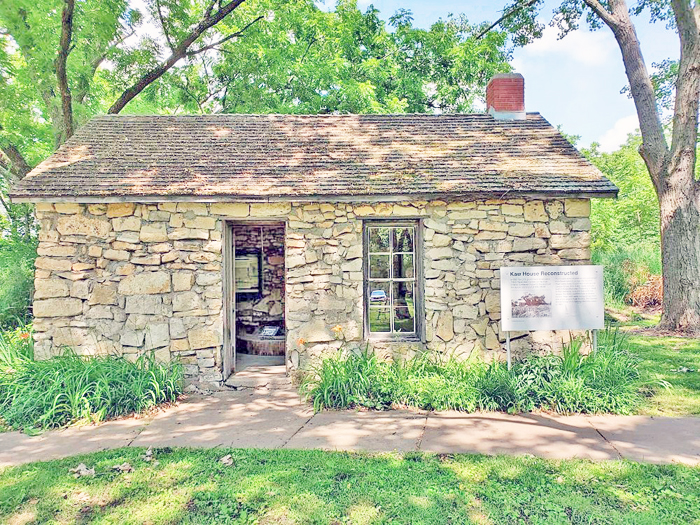
Reconstructed Kanza house at the Kaw Mission in Council Grove, Kansas.
A subsequent change in 1859 further reduced the Kanza land to a 9-by-14-mile tract, placing the mission outside the reservation.
Thomas Huffaker bought the mission lands in 1865 and owned them for 14 years.
Despite an impassioned plea by Chief Allegawaho, the U.S. government forced the Kanza to relinquish their land in the 1870s, and the tribe was moved to a reservation in present-day Kay County, Oklahoma.
In 1926, Carl I. Huffaker, Thomas’s son, bought the part on which the mission building stands.
In 1951, the Kansas legislature authorized the purchase of the mission property.
The site is now administered by the Kansas Historical Society as Kaw Mission State Historic Site. The Kaw Methodist Mission is a sturdy, rectangular stone structure. Except for the addition of several colonial porches, the building’s exterior looks much as it did originally, with rectangular door and window openings and a gabled roof with chimneys at either end. The interior wall structure remains the same, but the lower floor now houses a museum related to Mission activities and the area’s pioneer settlement. Currently, the upper floor serves as the caretaker’s living quarters. The museum displays include Kanza items, mid-19th-century frontier items, and furnishings.
Kaw Mission was listed on the National Register of Historic Places in 1971. It is one of the oldest buildings still standing in this part of Kansas and is operated by the Kansas State Historical Society as a museum. It is administered by the Kansas Historical Society.
Kaw Mission is located at 500 North Mission St. in Council Grove, Kansas.
©Kathy Alexander/Legends of Kansas, January 2026.
Also See:
Santa Fe Trail in Morris County
Sources:
Kansas Historical Society
Kanzas Travel
National Register of Historic Places
Wikipedia