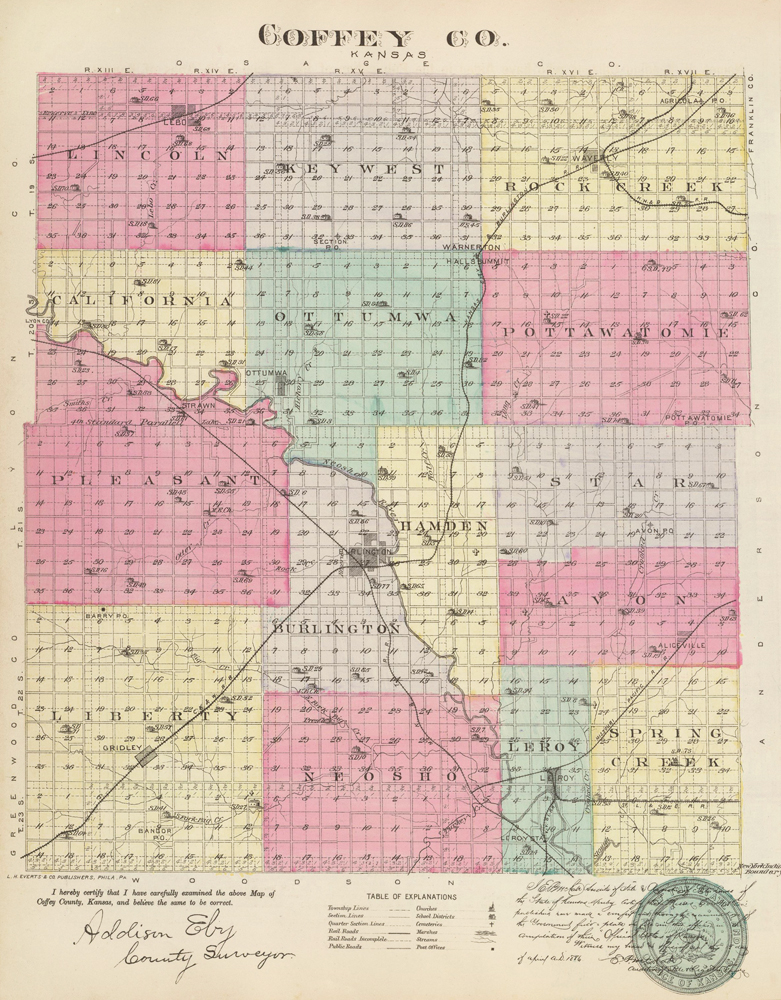
Coffey County, Kansas Map by L.H. Everts & Co., 1887
Ottumwa, Kansas, in Coffey County, no longer exists.
Located on the Neosho River in Ottumwa Township, the town was established in 1857.
The first to settle in the area was Dr. Hamilton Smith, who arrived with his family from Indiana in April 1855.
Two years later, more people arrived and settled around Smith’s home. These settlers mainly migrated from the Northern Midland states, which stretch from Delaware to Nebraska. Many were from Indiana, Ohio, Iowa, and Pennsylvania. Among these new arrivals was the Thomas Bowen family from Iowa. He soon built a cabin in the middle of the new settlement, which was first called Boonville. Other early settlers were J.G. Shaubell, James Harris, John T. Cox, Jonathan Lyman, and Dr. Joseph Jenks. When a town company was organized in 1857, Bowen insisted that the town be named Ottumwa in honor of his former residence.
On September 15, 1857, Jonathan Lyman issued the first issue of the Ottumwa Journal, the first paper printed in Coffey County. However, only two issues were published. The post office opened on October 9, 1857. These early residents shared many values and principles that made Ottumwa a tight-knit community. They firmly believed in the importance of education, Protestantism, anti-slavery, and equality for women and African Americans.
In those early years, there was no school or teacher, so Hamilton Smith’s wife, Rosette, taught the children at home.
The residents of Ottumwa also strongly supported Kansas becoming a “Free State” that outlawed slavery.
By an act of the Legislature, approved on February 25, 1860, Ottumwa was incorporated as a town. The Councilmen designated were: Ebner H. Hoult, William R. Smith, James Harris, J. W. Kerr, and Enoch Maudlin.
That year, the Methodist Church of Ottumwa decided to build an institution of higher learning to promote the value of education and Christianity. Plans were soon made to build the Methodist University on an unoccupied hill on the northern side of town. The site became known as “College Hill,” and the cornerstone of the first building was laid in 1862. However, there was some rivalry between the Methodist and Christian church members. The Christian church soon won many Methodists away from their original faith.
In 1863, the college’s operations were transferred to Ottumwa’s Christian Church. The college was then named the Western Christian University. A new two-story limestone building was erected, including a belfry that could be seen from many miles distant. The building cost about $8,000, which was raised by Ottumwa residents.
The school opened in the spring of 1863 under the leadership of Reverend John M. Rankin, who served as principal. All branches of science and the preparatory courses for college were taught to the 130 first-year students. It soon earned an excellent reputation.
The 1860s were the boom years for Ottumwa. It had a steam-powered sawmill that cut 7,000-9,000 feet of lumber per day, a grocery store, a salon, a drugstore, two hotels, and a stagecoach that ran from Ottumwa to Lawrence.
In previous years, the Jefferson City & Neosho Valley Railroad Company made plans to build tracks and a depot through Ottumwa. However, those plans changed with the outbreak of the Civil War in 1861.
While the Civil War halted much of the progress and advancement across the United States, Ottumwa still experienced growth. In line with their core beliefs, residents were pro-union and quite patriotic. When word reached Ottumwa in August 1861 that the Union Army needed assistance to fight the Confederate invaders of Fort Scott, Kansas, the citizens responded immediately. The following day, 104 men left Ottumwa for the battle, more than the number of registered voters in Ottumwa Township.
In 1866, Reverend John M. Rankin, who many credited with the school’s excellent reputation, resigned from his position at the college. Afterward, the school struggled. Although attempts were made to revive the college, insufficient funds led to its closure in 1868. Various factions attempted to reopen the school in the next several years, and it was set to reopen in September 1873. However, a month before classes began, unknown arsonists burned the building to the ground.
By then, Ottumwa had already begun to decline. Its population in 1870 was 833. The loss of the college, the town’s lack of a railroad, and its close proximity to the county seat of Burlington contributed. In 1878, the population had dropped to 651, causing many businesses to close or relocate, including the sawmill, which moved to Greenwood County, Kansas. By the early 1880s, Ottumwa had fewer than 200 residents.
By the turn of the century, the roads around the community had deteriorated, and on July 31, 1906, the post office closed. Afterward, the town still had a few houses and churches, along with a general store.
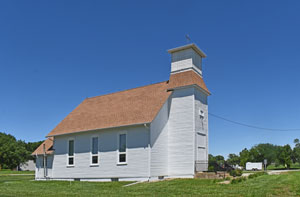
The old Ottumwa Christian Church now stands in New Strawn, Kansas, by Kathy Alexander.
During the 1960s, the building of the John Redmond Reservoir forced the Ottumwa Christian Church to relocate to New Strawn, Kansas, and the general store closed.
Today, some of the community’s original streets remain, as well as a few homes and buildings.
Ottumwa was located about nine miles northwest of Burlington,
©Kathy Alexander/Legends of Kansas, updated February 2026.
Also See:
Extinct Towns of Coffey County
Sources:
Blackmar, Frank W.; Kansas: A Cyclopedia of State History, Vol I; Standard Publishing Company, Chicago, IL 1912.
Cutler, William G; History of Kansas; A. T. Andreas, Chicago, IL, 1883.
Nickolas Wheeler, “Ottumwa, Coffey County,” Lost Kansas Communities