
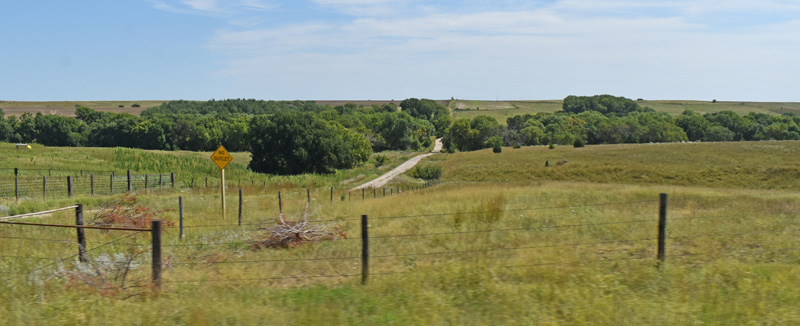
Phillips County, Kansas Landscape by Kathy Alexander.
Towns & Places:
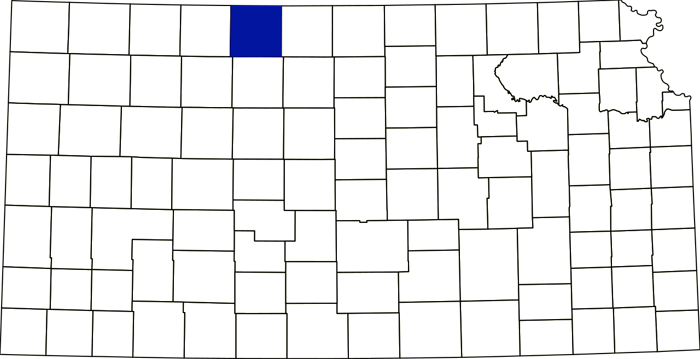
Phillips County, Kansas, location.
Agra
Glade – Extinct
Gretna – Extinct
Kirwin
Logan
Long Island
Phillipsburg – County Seat

Phillips County, Kansas Map, by L.H. Everts & Co., 1887.
Prairieview
Speed – Extinct
Stuttgart – Extinct
Extinct Towns of Phillips County
Kirwin National Wildlife Refuge
Kirwin Reservoir
Phillips County, Kansas, is located in the north-central part of the state. Its county seat and largest city is Phillipsburg. As of the 2020 census, the county population was 4,981, and it had a total area of 895 square miles, of which 886 square miles is land and 8.7 square miles is water. The county was named after William Phillips, a free-state martyr who was murdered at Leavenworth, Kansas, in 1856.
One of the northern tier, Phillips County, is the fifth county east of the Colorado line. It is bounded on the north by the State of Nebraska; on the east by Smith County; on the south by Rooks, and on the west by Norton County.
The general surface is gently rolling prairie, with limestone bluffs on the south sides of the principal streams. The bottomlands are narrow and cover about 15% of the area. The timber belts along the streams contain all the principal varieties of wood native to the soil of the state. The north fork of the Solomon River enters on the western boundary, six miles from the south line of the county, and flows east into Smith County. Its numerous north-flowing tributaries cover the central part of the county. Prairie Dog Creek flows across the northwestern corner. Magnesian limestone, potter’s clay, and brick clay were available in commercial quantities. Bricks manufactured in the county have been used in the best buildings, including the courthouse. A bed of fine sand suitable for glassmaking lay in the east, and gypsum was found in the south and northwest.
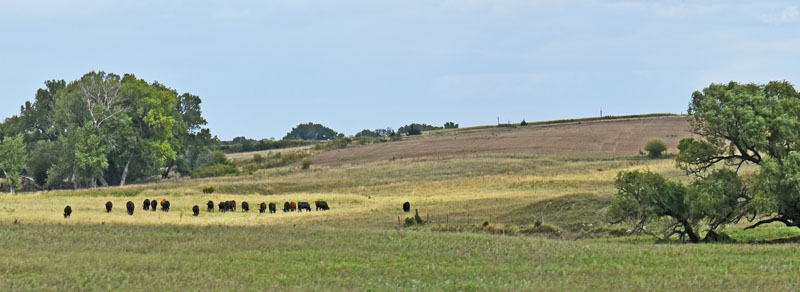
Phillips County landscape near Agra, Kansas, by Kathy Alexander.
In the summer of 1865, Camp Kirwan, a temporary encampment in Phillips County, Kansas, was established by Colonel John S. Kirwin and a company of Tennessee Cavalry volunteers. The soldiers were sent to provide an escort for a government survey team and protect the area from Indian raids. The site of the fort, with a stockaded corral, was near the confluence of Bow Creek with the North Solomon River. From here, the troops conducted patrols to scout the country for Indian predators.
In the summer of 1865, the U.S. government sent Colonel John S. Kirwin, who erected a stockade fort to prevent the encroachments of roaming bands of Cheyenne, Omaha, Pawnee, and other Indians and to protect overland California-bound emigrants. The fort was erected 1.5 miles southwest of Kirwin. The government abandoned this stockade upon the arrival of the early settlers.
Phillips County was created in 1867. There were no settlers in the county at the time.
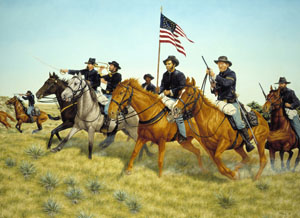
Kansas Cavalry.
On August 21, 1867, the Battle of Prairie Dog Creek occurred when Captain George A. Armes and his troops were attacked by about 300 Kiowa and Cheyenne Indians under the leadership of Chief Satanta and Chief Roman Nose. Outnumbered five to one, the U.S. troops dismounted and found refuge in a ravine. During the afternoon, they were subjected to a dozen assaults but managed to hold off the warriors due to the superior firepower of their Spencer repeating rifles. The soldiers were soon joined by the 18th Kansas Volunteer Cavalry, at which time, Captain Armes gathered the troops and, moving toward Prairie Dog Creek, charged the Indians, who broke and scattered. The cavalry suffered three men dead and 36 wounded; the Indians, 50 dead and 150 wounded.
The first settlement was made in 1869 by C.J. Van Allen, who built a log house and preëmpted a claim near the site of Kirwin. He built the first log house in the county, and his father-in-law, Samuel Bales, erected the first frame house in Phillips County.
In 1871, another fort was established a mile and a half southwest of Kirwin, Kansas, during an Indian scare. At that time, local settlers erected a 90-by-50-foot stockade within the town, which became known as Fort Kirwin, named after Colonel John S. Kirwin, who had earlier established Camp Kirwin in 1865.
That year, the first post office in Phillips County was established in Kirwin.
In the winter of 1871, a party from Kirwin, consisting of W.T. Belford, J.S. Shurtz, and several others, was hunting on Prairie Dog Creek, on the border of the county, when they encountered a roving band of the Indians who chased them many miles before they reached protection. The chase lasted one day and part of the night, and their lives were only spared by the trusty horses that took them from the place of danger.
A large number of settlers came in 1871 and in 1872.
By 1872, the resident population had grown to 681, and the county was organized for local government. At the election that fall Phillipsburg was chosen as the county seat and the following officers elected: Treasurer, Thomas Cox, Jr.; county clerk, Henry McDowell; register of deeds, J.W. Kidd; surveyor, H.W. Bean; probate judge, J.S. Shurtz; superintendent of public instruction, P.I. Hitchcock; county attorney, W.H. Gray; commissioners, Thomas Cox, Sr., A.W. Tracy and James Large. The first representative was Noah Weaver.
The county was initially divided into seven Townships. Subsequently, additional Townships were added, bringing the total to 25.
In 1874, the first courthouse was a frame structure rented from William Bissell, located on the northeast side of the public square. The second courthouse was a two-story frame building rented from Michael Beckley.

Grasshopper Plague
The first courthouse, a frame building, was constructed in 1877 and was owned by the city.
In 1878, the county purchased a frame building from Fred A Dutton as the third courthouse. The fourth courthouse was a two-story brick structure donated by the town to the county in 1880. The fifth and present courthouse was constructed in 1912 to 1913 at a cost 0f $66,110.
The first school houses were District No. 1, two and a half miles west of Phillipsburg, and District No. 2 at Kirwin.
The first schoolhouse was built in Kirwin in 1873, and the first business, a general store, was erected by Weaver & Weaver the same year. The Kirwin Chief newspaper was established in August 1873 by W.D. Jenkins under the direction of the Kirwin Town Company.
Skinner, of Kirwin, and McClellan and Hanson, in Logan, erected the first flour mills. Dustin & Cottrell at Kirwin and Dustin & Close at Phillipsburg were pioneers in the mercantile business. That year, immigration was very heavy and continued until it was curbed by the grasshopper scourge of 1874. Phillips County was among those that received state supplies during the following winter.

Kirwin Chief Newspaper.
In 1874, A.A. Thomas purchased the Kirwin Chief. That summer, the Sentinel, a Republican paper, was relocated from Cawker City to Phillipsburg but was discontinued within a few weeks.
That year, the first courthouse was a frame structure rented from William Bissell, located on the northeast side of the public square. The second courthouse was a two-story frame building rented from Michael Beckley.
In 1875, the season produced a large grain yield and encouraged settlement. At that time, the county had a population of 1,287.
The good years continued until 1880, when the population was 12,617 and 90,857 acres of land had been brought under cultivation. There were four newspapers and 104 school districts.
In 1876, a drought-induced depression occurred. Professor Robinson established the Kirwin Progress in the fall of 1876. It was politically Republican. At about the same time, the Kirwin Chief passed into the hands of A.G. McBride and was removed to Phillipsburg, but in the following spring, it was returned to Kirwin. It was Republican in politics.
The Phillipsburg Advance, a five-column Republican paper, was started in the spring of 1877 by C. Dickey and continued until July 1878, when J.D. Bradley purchased it. That year, the Phillips County Herald was published under the editorship of Charles F. Jenkins.was established in Phillipsburg in early 1878 was Republican in politics.
The Phillips County Democrat succeeded the Advance in July 1878, which was the first Democratic paper published in Northwestern Kansas.
In 1878, there were 63 organized school districts with 1,648 students. That year, there were 23 schoolhouses: 10 were log, nine were frame, and four were stone. The value of all school property was $5,165. The average monthly salary for male teachers was $20.60, and for female teachers, $13.47. At that time, no churches had been erected in the county; instead, schoolhouses were used for religious purposes.
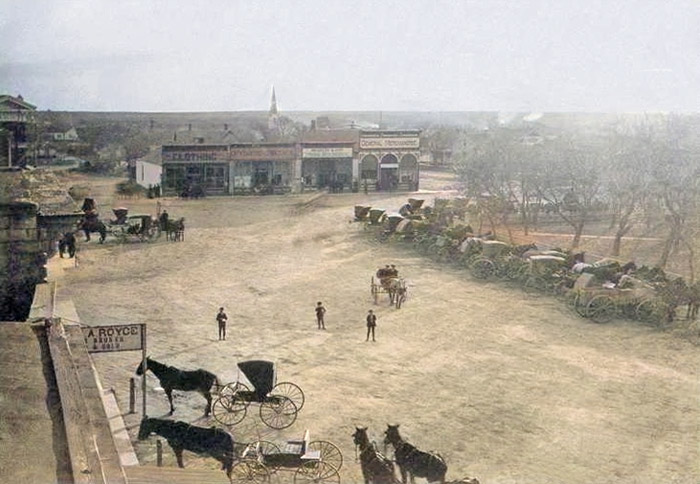
Kirwin, Kansas, Town Square.
That year, the county purchased a frame building from Fred A Dutton as the third courthouse.
The first church was erected in 1879 in Phillipsburg. That year, the first railroad station in the county was the Central branch of the Union Pacific Railroad, which reached Kirwin, Kansas, in November 1879.
In 1880, the Central Branch of the Missouri Pacific Railroad was extended through the southern part of the county, passing through Kirwin on the east and Logan on the west, extending beyond to Norton. This road was of incalculable benefit to the county’s residents, providing transportation to Atchison, Kansas, and to Eastern markets. As a goodly portion of the products of Phillips and other northwestern counties could find a profitable market in Colorado, it was hoped that the Central Branch would be extended to Denver.
That year, the fourth courthouse was a two-story brick structure donated by the town to the county in 1880.
At that time, the county had a population of 12,617, and 90,857 acres were under cultivation, with approximately 50 church organizations, 104 school districts, and four newspapers.
In 1881, the city built a new stone courthouse and turned it over to the county. That year, a drought discouraged many, and the population decreased perceptibly. However, good crops followed this temporary check.
A branch of the Chicago, Kansas, and Nebraska Railroad was established through Phillipsburg in 1887.
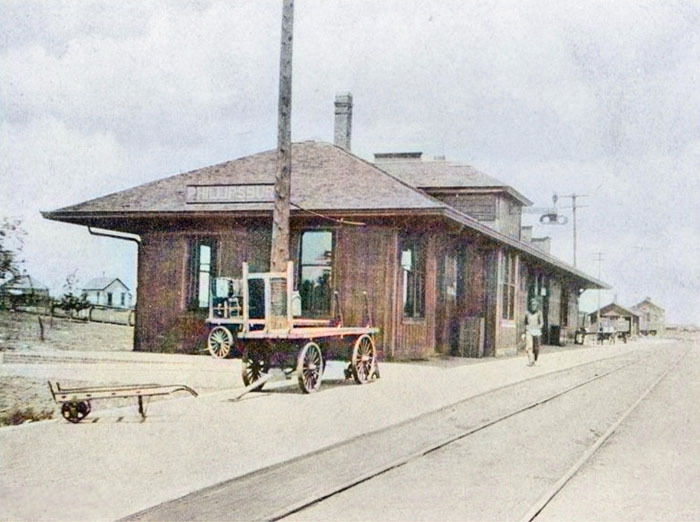
Chicago, Rock Island & Pacific Railroad depot in Phillipsburg, about 1895.
The population loss was reversed by 1890, when the population stood at 13,661.
The Chicago, Rock Island & Pacific Railroad crossed the central part of the county, west and northwest through Phillipsburg; the Missouri Pacific Railroad crossed in the southern part, following the course of the north fork of the Solomon River; and the Chicago, Burlington & Quincy Railroad crossed the northwest corner, following the course of Prairie Dog Creek.
The railroads brought growth and prosperity to the county. They contributed to the economy, and when the trains came, the markets improved. Grain, livestock, and produce moved out while eastern goods moved in. But most importantly, the trains brought more settlers to this rich land.
Phillips County’s population peaked at 14,442 in 1900.
The total value of farm products in 1910 was $4,169,735. The leading crop was wheat, which brought $935,928. Corn was worth $930,222; tame grasses, $373,790; oats, $178,226; prairie grasses, $133,770. Potatoes, millet, sorghum, and Kafir corn are other important field crops. Livestock sold for slaughter brought $1,046,846, and poultry and dairy products, $354,216. The value of livestock on hand was $3,277,604. The assessed valuation of the property was $22,419,895. The population in the same year was 14,150. According to these figures, the average wealth per capita was about $1,500.
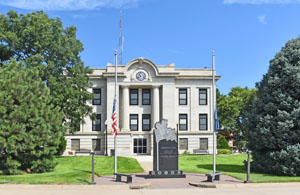
Phillips County Courthouse in Phillipsburg, Kansas, by Kathy Alexander.
The current courthouse was built in 1912-1913. Located at 301 State Street and 3rd Street. The Neo-Classical style building was designed by Louis Curtis of Kansas City, Missouri, and was built by Cuthbert & Sons of Topeka, Kansas, at a cost of $66,110.
The three-story white stone-and-concrete building is located on the landscaped grounds of Courthouse Square in the center of Phillipsburg. On each of the four sides of the building are projecting center sections with two large columns rising from the second to the third story, a clock, and a curved hood at the roofline. The main entrance is on the north side. The first story has horizontal white colored stone. The County District Court courtroom is located on the south side of the third story. The building houses the County District Court of the 17th Judicial District.
Oil was discovered in Phillips County in 1939. The Co-op Refinery Association opened its new facility in Phillipsburg shortly thereafter.
With an oil refinery opening in 1939, the 1940 population jumped to 2,140, making Phillipsburg a second-class city.
The Phillipsburg Refinery closed in 1992 and was eventually demolished in 2012 and 2013.
The Fort Bissell Museum in Phillipsburg, Kansas, features the county’s history. Fort Bissell was never a military fort; it was built for the settlers’ safety. All of the buildings are originally from Phillips County. Nearly all the items and artifacts were donated or loaned by county residents. The museum is a non-profit organization and is free for anyone to visit. The Fort Bissell Museum is open to visitors Memorial Day weekend through Labor Day weekend, Tuesday through Friday from 9:00 am until 4:00 pm, and Saturday from 9:00 am until 2:00 pm. The Museum is closed on Sundays, Mondays, and July 4. Phone – 785.543.6212
Today, Phillips County continues to prosper and flourish, with its communities keeping the northwestern Kansas heritage and hospitality alive.
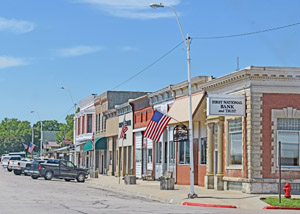
Main Street in Logan, Kansas, by Kathy Alexander.
©Kathy Alexander/Legends of America, January 2026.
Also See:
Sources:
American Courthouses
Blackmar, Frank W.; Kansas: A Cyclopedia of State History, Vol I; Standard Publishing Company, Chicago, IL 1912.
City of Phillipsburg
Cutler, William G.; History of Kansas; A. T. Andreas, Chicago, IL, 1883.
Fort Hays State University
Kansas State Board of Agriculture First Biennial Report -1878
Phillips County, Kansas
Wikipedia