
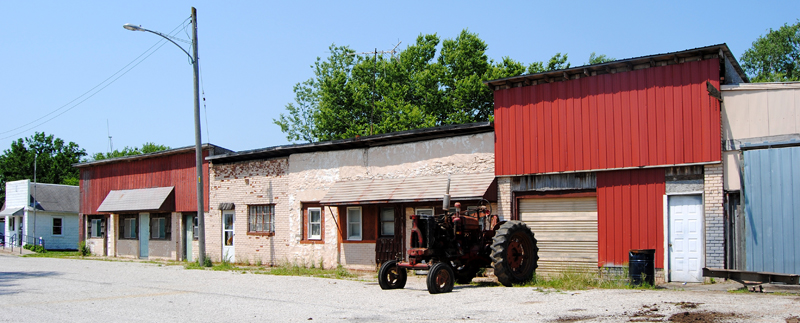
Princeton, Kansas Business District by Kathy Alexander.
Princeton, Kansas, is a small town in Franklin County. As of the 2020 census, the city’s population was 248, and its total area was 0.33 square miles, all land.
Princeton began in 1869 with the construction of the Leavenworth, Lawrence & Galveston Railroad through the area. It was named after the city of Princeton, Illinois. A railroad siding was built to serve farms and businesses of Ohio City, two miles to the northeast. On March 28, 1870, the post office was moved from nearby Ohio City to Princeton, and Thomas Fletcher was the first postmaster.
In October 1869, Thompson Jones donated a strip of land parallel to the railroad, 2,000 feet north and south and 100 feet wide. The land was platted, streets named, and in 1870, a townsite was established. Soon, families from Ohio City moved into Princeton, some moving their homes on rollers. The new town soon became the district’s supply and shipping center.
School District #63 was established in 1869, and a frame schoolhouse was built in the southern part of the town. The first teacher was Miss Linda Mayhew. Jacob Barnett is credited with establishing the first general merchandise store.
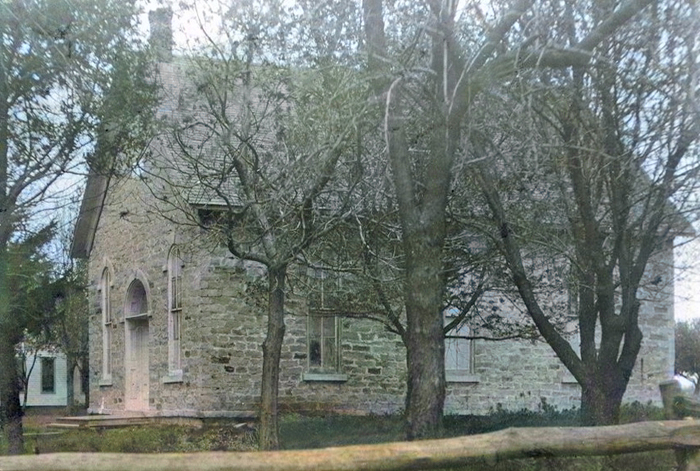
A church in Princeton, Kansas, in about 1890.
Ohio City vanished as Princeton grew and prospered.
A Methodist Church was built in 1872.
A two-story, four-room school building replaced the one-room school in 1878.
A Presbyterian Church was built in 1880.
By the early 1880s, Princeton had about 20 buildings and a number of enterprising and prosperous businessmen and mechanics.
The school was enlarged in 1886. That year, a Christian Church was built.
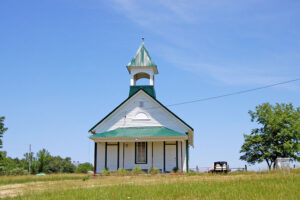
Acorn School near Princeton, Kansas, in Franklin County, by Kathy Alexander.
The town’s boundaries were enlarged to meet the town’s growth, east to Highway 59. A new depot was built, and stockyards and a feed yard east of the tracks were added for cattle buyers.
The Acorn Schoolhouse District #74 was established 3.5 miles west of Princeton in 1900, replacing an earlier structure built in the 1870s. The school closed in 1959 and is preserved by the Acorn Ladies Club and local landowners. It is located on John Brown Road, just east of the intersection with Iowa Road.
The Princeton Telephone Company was organized and operated by Miss Belle D. Davies in 1903-04 in her home.
Princeton was a busy, growing city from 1900 to 1910.
Early town social activities included the annual Woodman’s Picnic in Bingaman’s Grove, dances, bazaars, hayrides, sleigh rides, and performances by the circuit Chautauquas every summer from 1904 to 1920.
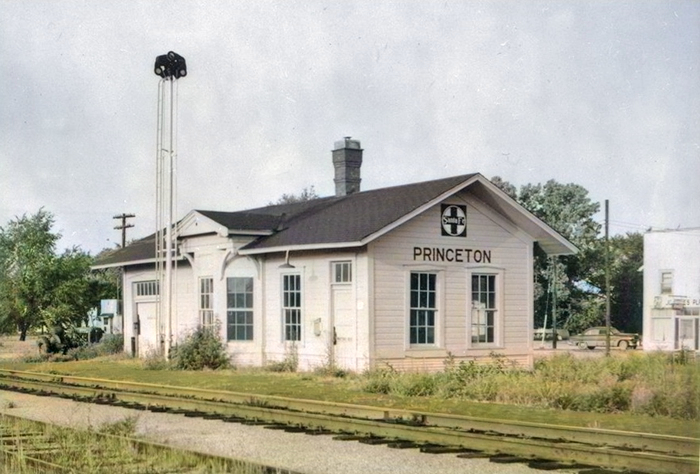
Atchison, Topeka & Santa Fe Railroad depot in Princeton, Kansas.
Princeton was a busy, growing city from 1900 to 1910.
People’s State Bank was organized in 1907 by George Harris, who operated it with Mark Walter for 53 years.
In 1910, Princeton, one of the larger towns in Franklin County, was located on the Atchison, Topeka & Santa Fe Railroad. At that time, it had general stores, hardware and implement houses, a lumber yard, a blacksmith and wagon shop, a money order post office, telegraph and express facilities, and a population of 240.
A new two-story brick school was constructed for the elementary grades, and a high school was built and opened in 1913.
The city was incorporated in 1921, and W.E. Stinebaugh was elected Princeton’s first mayor. City council action brought electricity, sidewalks, and traffic and safety regulations.
People’s State Bank was robbed in the late 1920s on a quiet afternoon by three strangers who were later captured in Ottawa and identified by Princeton bystanders.
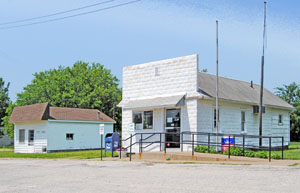
Old business buildings in Princeton, Kansas, by Kathy Alexander.
The Bingaman General Store was robbed in the early 1930s.
Even amid the adversity of three major fires that destroyed many buildings in the business district, World Wars I and II, the Great Depression, and crop failures, the town persevered. The school was enlarged, new businesses opened, and many residents returned after the wars.
People’s State Bank closed in 1960, and most accounts were transferred to Peoples National Bank in Ottawa.
Main Street was hard-surfaced in the 1950s.
In the 1960s, the Princeton Telephone Company was purchased by the Kansas Telephone Company. Around the same time, water and sewer systems were installed.
Princeton schools were closed through school unification in 1965. The Princeton High School mascot was the Princeton Orioles.
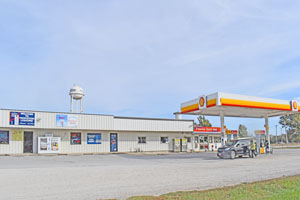
Businesses in Princeton, Kansas by Kathy Alexander.
The town celebrated its Centennial in September 1969.
A Citizens Improvement Committee was formed in the 1970s.
Princeton’s population peaked at 317 in 2000
The railroad no longer runs through Princeton, and the former tracks have been converted into the Prairie Spirit Rail Trail.
Princeton is a part of the Central Heights USD 288 school district, with its headquarters located in Richmond. The school mascot is the Central Heights Vikings.
Princeton is about nine miles south of Ottawa, the county seat.
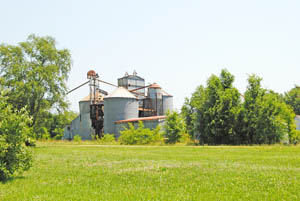
Silos in Princeton, Kansas by Kathy Alexander.
©Kathy Alexander/Legends of Kansas, updated December 2025.
Also See:
Sources:
Blackmar, Frank W.; Kansas: A Cyclopedia of State History, Vol I; Standard Publishing Company, Chicago, IL 1912.
Cutler, William G.; History of Kansas; A. T. Andreas, Chicago, IL, 1883.
Franklin County, Kansas History
Wikipedia