
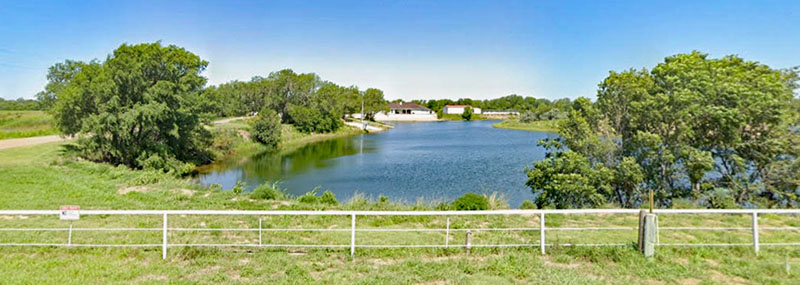
Edwards County, Kansas, Landscape, courtesy of Google Maps.
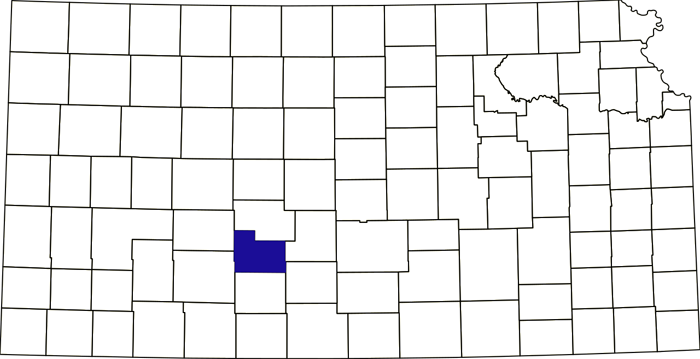
Edwards County, Kansas, location.
Towns & Places:
Belpre
Kinsley – County Seat
Lewis
Offerle
Extinct Towns of Edwards County
Arkansas River
Big Coon Creek
Little Coon Creek
Rattlesnake Creek
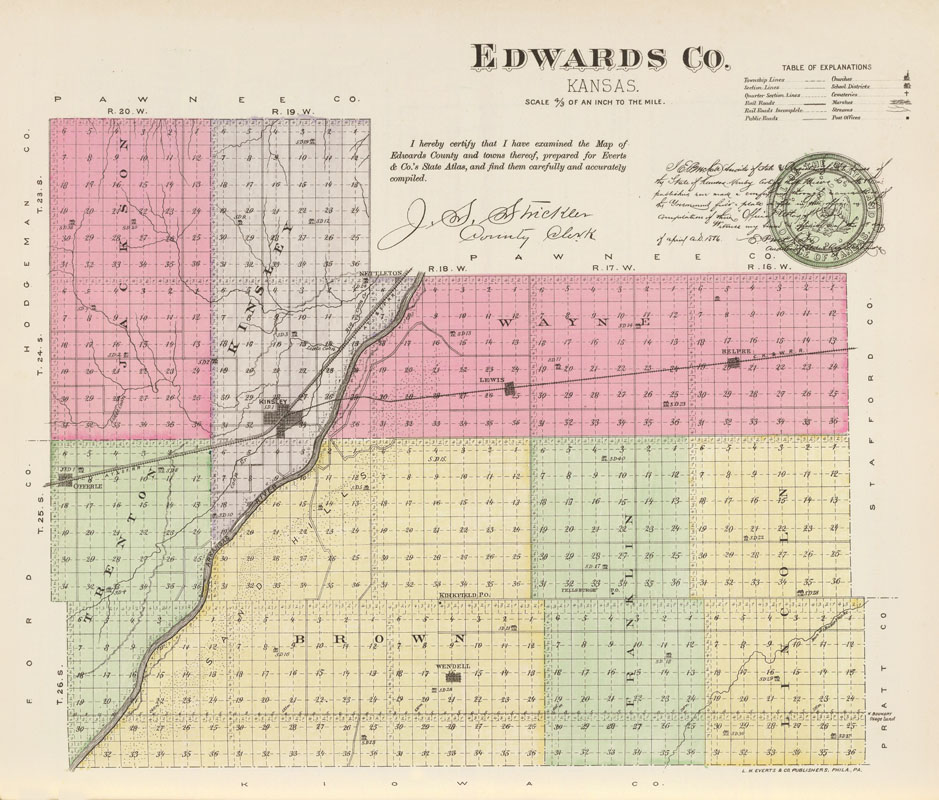
Edwards County, Kansas by L.H. Everts & Co., 1887.
Battle of Coon Creek
Santa Fe Trail in Edwards County
Edwards County, Kansas, is in the south-central part of the state. Its county seat and most populous city is Kinsley. As of the 2020 census, the county population was 2,907, and it covers 622 square miles of land and 0.1 square miles of water.
Lieutenant Zebulon M. Pike’s expedition passed through the county in 1806, following closely the route that later became known as the Santa Fe Trail.
In the fall of 1872, the Atchison, Topeka & Santa Fe Railroad was completed as far as Edwards County. In March 1873, a colony from Massachusetts settled where Kinsley now stands. The same year, Edwards County was established and named for W.C. and R.E. Edwards, of Hutchinson, Kansas, pioneer settlers who owned much land in the area.
Pawnee County formed its northern boundary and lay East of its two northwestern townships. Stafford and Pratt lay to the East; Kiowa to the South; Ford and Hodgeman to the West./div>
The county had little timber. The Arkansas River runs northeast through the northwestern part of the county. The headwaters of the Little Coon and the Big Coon Creeks are in Trenton and Jackson Townships. The Little Coon enters the Big Coon about midway between Kinsley and Nettleton, and the Big Coon Creek empties into the Arkansas River at Garfield, in Pawnee County. Rattlesnake Creek, the main stream of Stafford County, has its headwaters near the central portion of Franklin Township and runs only about six miles in Edwards County. Away from the Arkansas River, the country is an undulating upland prairie. The river bottom along the Arkansas River is about three miles wide, and sand hills are visible for many miles along the river at Kinsley. Several cattle and sheep ranches are in the county.
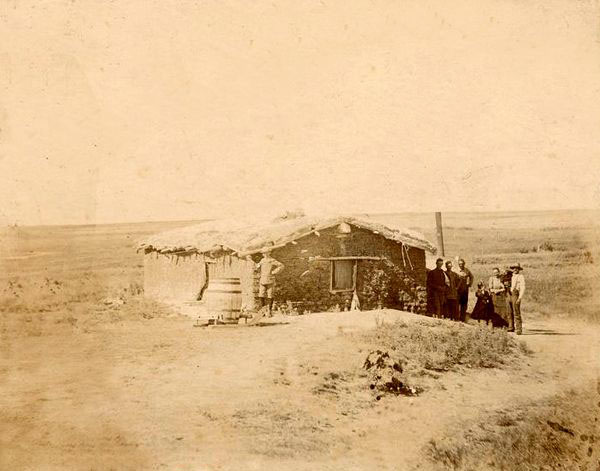
A sod house in Edwards County, Kansas.
The county attracted German and Swedish settlers. The large Catholic German population settled mainly northwest of Kinsley, near the St. Peter and Paul Catholic Church. German Methodists also settled in this part of the county and established the Salem Methodist Church. South of Offerle, German Lutherans established the Zion Lutheran Church. In the northeast part of the county, near the Pawnee County boundary, a group of Swedish settlers with close ties to Garfield helped establish the Lutheran church there.
Soon after the first settlers located there, E.K. Smart started a lumber yard, and a little later, T.L. Rogers opened the first general store. A post office called Peters in present-day Kinsley, Kansas, was established on April 23, 1873, with N.C. Boles as postmaster.
That month, settlers from Maine arrived in the county. N.L. Humphrey, Beza Blanchard, F.C. Blanchard, a son-in-law, and two or three daughters made up the number.
On September 16, 1873, the Kinsley Reporter was issued as a monthly newspaper. In April 1874, it became semi-monthly; in January 1875, weekly.
On January 19, 1874, the town and post office’s name was changed to Kinsley in honor of E.W. Kinsley, of Boston, Massachusetts, who generously funded the construction of the first church building for the Congregationalists.
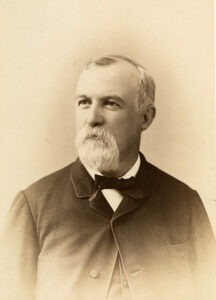
Governor Thomas Osborne.
On March 7, 1874, Governor Thomas Osborn approved an act creating several new counties and defining the boundaries of some previously created counties. This act created Edwards County.
On May 18, 1874, a memorial was filed with the governor, stating that the county’s population exceeded 600 and requesting its organization. The petitioners also asked for the appointment of Charles L. Hubbs, Nicholas L. Humphrey, and George W. Wilson as county commissioners; James A. Walker as county clerk; and Kinsley as the temporary county seat. Robert McCause was appointed to take a census, which showed the county’s population to be 633. On August 1, 1874, Governor Osborn issued his proclamation declaring the county organized, with the officers and county seat recommended in the memorial. One of the first acts of the board of commissioners was to divide the county into the townships of Brown, Kinsley, and Trenton, and designate voting places for the general election in November, when the following officers were elected: Charles L. Hubbs, representative; F.C. Blanchard, J.A. Brothers and T.L. Rogers, county commissioners; William Emerson, county clerk; J.H. Woods, clerk of the district court; E.A. Boyd, treasurer; V.D. Billings, sheriff; L.W. Higgins, register of deeds; Massena Moore, probate judge; Taylor Flick, county attorney; J.L. Perry, coroner; Frank A. White, surveyor; W.C. Knight, superintendent of public instruction.
In its early days, the county had little timber. The Arkansas River runs northeast through the northwestern part of the county. The headwaters of the Little Coon and the Big Coon Creeks are in Trenton and Jackson Townships. The Little Coon enters the Big Coon about midway between Kinsley and Nettleton, and the Big Coon empties into the Arkansas River at Garfield, in Pawnee County. Rattlesnake Creek, the main stream of Stafford County, has its headwaters near the center of Franklin Township and runs only about six miles in Edwards County. The country away from the Arkansas River was an undulating upland prairie. The river bottom along the Arkansas River was about three miles wide, and sand hills are visible for many miles along the river at Kinsley. Several cattle and sheep ranches were in the county.
The Edwards family constructed the county’s first brick building, which served as the courthouse for several years
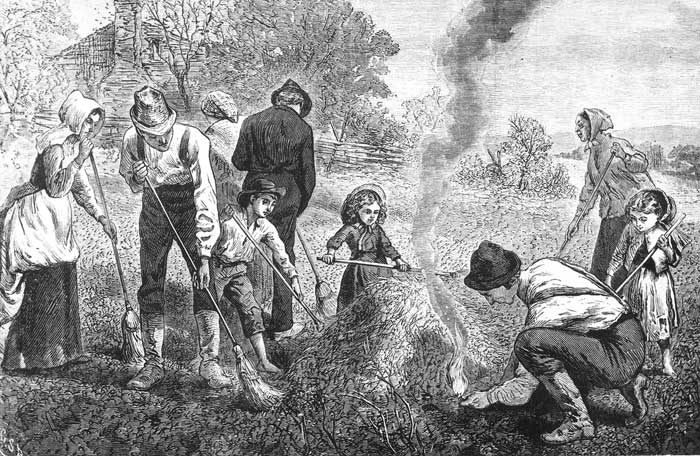
Grasshopper Plague in Kansas.
In July 1874, the infamous grasshopper raid decimated crops, leaving many residents without means to sustain themselves.
After investigating the conditions in the county, the commissioners met in special session on September 15, when they made out a report to the governor in which they said:
“Our crops are destroyed; not one bushel of vegetables or grain is being saved for man or beast. Our people are mostly poor people, without wealthy relatives or friends to assist them in their extremity. We have personally and carefully investigated each case and found six families, containing 22 persons, totally destitute; five families, containing eight persons, partially destitute. The above are the only persons in the county who will need aid to carry them to another crop. We believe $500, judiciously expended, will be sufficient with what they can earn, to keep them in the necessaries of life.”
The commissioners also suggested that, if aid was extended by the extra session of the Legislature then about to meet, the persons having charge of the distribution of such funds employ needy, non-disabled men to work on the public highways, etc.
By proclamation issued by Governor Thomas A. Osborne in August 1874, Charles L. Hubbs, Nicholas L. Humphrey, and George W. Wilson were appointed special County Commissioners of Edwards County, and James A. Walker was appointed special County Clerk. These men met at the Buffalo House in Kinsley on September 3, 1874, and appointed Charles L. Hubbs chairman of the Board of County Commissioners.
At the Commissioners’ Court meeting held October 5, 1874, W.C. Knight was chosen County Superintendent of Public Instruction; an order was passed providing for a vote on the location of the permanent county seat, and for a loan of the credit of the county for $1,000 for the purchase of books for county records, seals, etc.
One of the first acts of this Court was to divide the county into the municipal townships of Kinsley, Trenton, and Brown, and designate places for holding elections therein at the regular State election, on November 3, 1874. On the same day, County Commissioners were elected, including C.L. Hubbs, N.L. Humphrey, and G.W. Wilson. James A. Walker was made the first county clerk; E.A. Boyd, county treasurer; V.D. Billings, sheriff; Taylor Flick, Clerk of the District Court; Morsena Moore, Probate Judge; and L.W. Higgins, Register of Deeds.
School District No. 1 was organized on November 14, 1874. That month, the county elected W.C. Knight superintendent of schools. The County Commissioners chose T.L. Rogers as Chairman. At the session of December 17, 1874, the Commissioners appointed W.C. Reed and Miss Florence G. Blanchard as School Examiners. The commissioners contracted with W.C. Edwards for three rooms on the second story of his brick building, to be leased to the county for one year at $30 per month.
Pawnee County formed its northern boundary and lay East of its two northwestern townships. Stafford and Pratt Counties lay to the East; Kiowa to the South; Ford and Hodgeman Counties to the West.
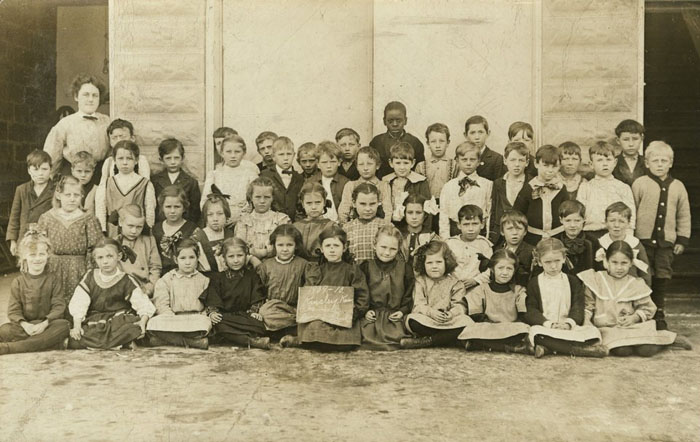
Grade School students in Kinsley, Kansas.
The Legislature of 1875 enlarged its territory by taking the North half of Kiowa County and making it the South part of Edwards County; the South half of Kiowa County then became the northern part of Comanche County. The county comprised 27 congressional townships and covered 972 square miles.
By an act of March 5, 1875, which abolished Kiowa County, two tiers of townships were added to Edwards County on the South, giving it an area of 972 square miles.
The Congregational Church was completed in 1875 for about $2,000.
The first school was taught in the fall of 1875 by Mrs. A.L. McGinnis in a room measuring 12 by 16 feet, with a little over $30 having been subscribed for a three-month term, the law requiring that three months of school be taught in the county before it was entitled to participate in the public school fund.
That year, the county’s population was 234.
Edwards County’s assessed valuation was $419,318 in 1876, $452,928.97 in 1877, $598,123.15 in 1879, and $607,552.72 in 1880.
The schoolhouse in Kinsley was completed in 1877.
In 1877, the Kinsley Reporter passed to W.T. Bruer and united with the Edwards County Leader; its first issue was March 29, 1877, with W.T. Bruer as editor and proprietor. It was Republican in politics. The Valley Republican, with Charles L. Hubbs as proprietor, began publication on November 3, 1877. It became the Kinsley Graphic on May 4, 1878, with Werter R. Davis as proprietor and M.M. Lewis as editor. As a party organ, it was Republican.
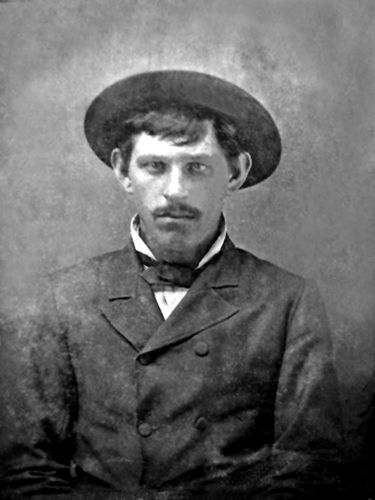
Outlaw Dave Rudabaugh.
Outlaw Dave Rudabaugh and a gang of “hard cases” attempted a train robbery in Kinsley, Kansas, on January 22, 1878. They were thwarted at the Kinsley Depot, and the gang fled empty-handed. After a significant manhunt, Deputy J.J. Webb and Sheriff Bat Masterson captured Rudabaugh in the spring of 1878. Afterward, Rudabaugh attempted to avoid hanging by pleading guilty to a different robbery, but was eventually involved in further crimes and lost his life in 1886.
The short crops of 1878 retarded for a time the settlement of the county.
On June 1, 1878, Mr. Hubbs started the Kinsley Republican. These papers became united as the Kinsley Republican-Graphic, under the management of C.C. Sellers, editor; L.A. Sauber, local editor; C.C. Moore, business manager. It is an eight-column paper and is well patronized in Kinsley and the surrounding country. On July 13, 1878, Dr. L. Rick ventured into the Staats Zeitung, a German paper. It was discontinued in 1880.
The county’s cultivated acreage continued to increase. In 1878, 2,205 acres were under Winter wheat, and in 1880, 4,465. Oats increased by 681 acres, broomcorn by 1,618 acres, and sorghum by 2,377 acres over 1878 levels.
In 1880, the county’s population was 2,409.
By the early 1880s, the Baptists, Congregationalists, Methodist Episcopalians, Presbyterians, and Roman Catholics were the county’s religious denominations. The Catholics had two church buildings and the largest congregation. The Methodists and Presbyterians were the next strongest. The Congregationalists, Methodists, and Catholics each had their own churches in Kinsley.
On December 9, 1882, the Edwards County Treasurer, J.W. Crawford, was implicated in a bank robbery of H.M. McCaddy & Son and removed from office. The stolen funds were soon recovered.
In 1883, the county offices were, for the most part, held in a frame building South of the Edwards County Bank Building, which had formerly served county purposes.
In 1883, the county had 22 school districts, including one joint district with Pawnee County. The County Superintendents have been W.C. Knight, W.F. Blanchard, George W. Milner, and Joseph Ferguson. Graded schools are in Kinsley and Offerle.
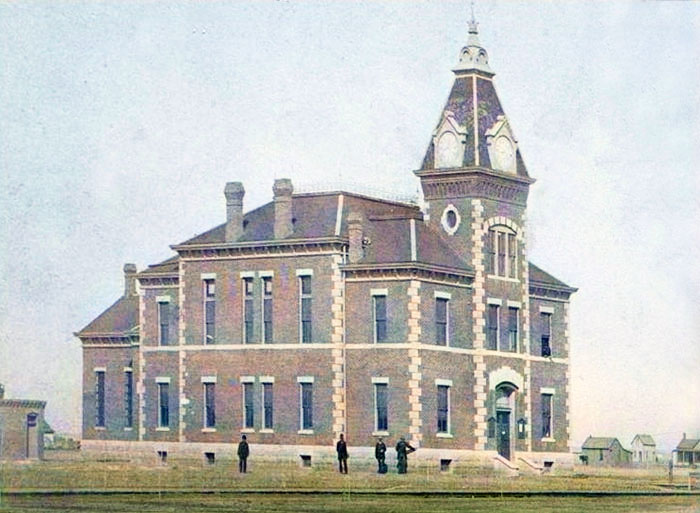
The second Edwards County Courthouse in Kinsley, Kansas.
Hopkins & Holland designed the second courthouse, and Virgil D. Billings constructed it in 1885.
Kiowa County was reestablished by the act of February 10, 1886, when the original boundaries of Edwards County were restored, thereby giving the county its present area of 612 square miles.
On December 9, 1882, Edwards County Treasurer J.W. Crawford was implicated in a bank robbery and removed from office.
By 1885, reports of abundant crops and cheap land had brought hundreds of new settlers to southwestern Kansas, and Edwards County’s population nearly doubled.
Edwards County’s population in 1910 was 7,033, a gain of 3,351, or more than 90% during the preceding decade. At that time, the property’s assessed valuation was $15,220,616. The value of farm products for the year was $2,137,608. The five leading crops in the order of value were: Wheat, $1,442,741; corn, $230,225; hay, $62,247; Kafir corn, $50,152; oats, $46,444.
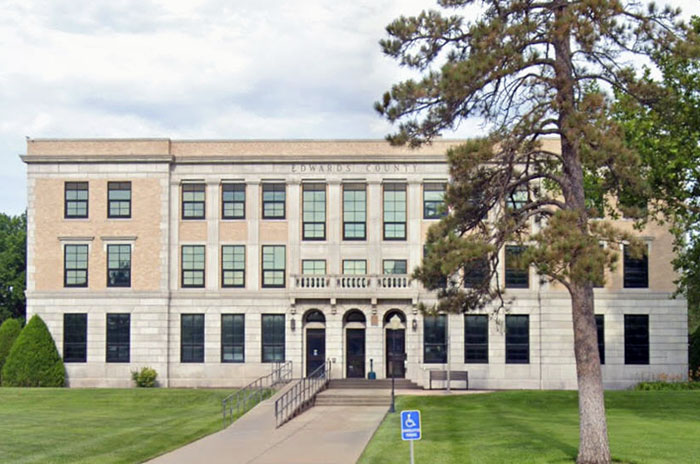
Edwards County Courthouse in Kinsley, Kansas, courtesy of Google Maps.
The third and present courthouse was constructed in 1928 to 1929 for $150,000. Located at 312 Massachusetts Avenue and West 4th Street, the Classical Revival style building was designed by Routledge & Hertz Architects & Engineers of Hutchinson, Kansas, and built by Roy Hatfield. The building faces East and is a three-story structure of buff-colored brick, gray limestone, and concrete. The rectangular building sits on spacious landscaped grounds in the center of Kinsley. The East front of the building has three arches at the center of the first story, with a small balcony above. A protruding cornice runs below the roofline. The first story is faced with gray colored limestone. Inside, the County District Court courtroom is on the West side of the second story. The building houses the County District Court of the 24th Judicial District, which includes Hodgeman County, Lane County, Ness County, Pawnee County, and Rush County.
Edwards County’s population peaked in 1930 at 7,295 and gradually declined in the next decades.
In 1939, Edwards County became famous when its road sign made the cover of The Saturday Evening Post and was nicknamed “Midway USA”. From its publication date, the location was recognized as the halfway point, equidistant from the East Coast state of New York and the West Coast city of San Francisco.
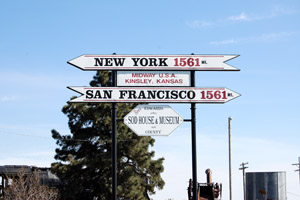
Kinsley, Kansas halfway point by Kathy Alexander.
Kinsley-Offerle USD 347 and Lewis USD 502 serve students in the county.
The Arkansas River flows through Edwards County from the Southwest corner to the Pawnee County line near U.S. Route 56.
©Kathy Alexander/Legends of Kansas, updated September 2026.
Also See:
Sources:
American Courthouses
Cutler, William G.; History of Kansas; A. T. Andreas, Chicago, IL, 1883.
Blackmar, Frank W.; Kansas: A Cyclopedia of State History, Vol. I; Standard Publishing Company, Chicago, IL, 1912.
Fort Hays State University
Wikipedia