
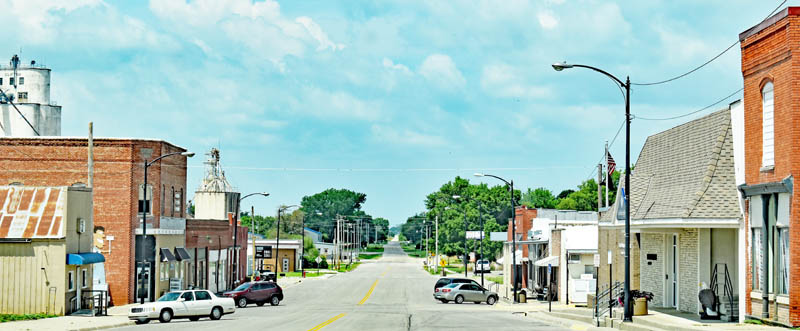
Clifton, Kansas Main Street by Kathy Alexander.
Clifton, Kansas, is a small town on the Republican River in Washington and Clay Counties. As of the 2020 census, the city’s population was 454, and it had a total area of 0.41 square miles, all land. It is located adjacent to the tiny town of Vining.
Clifton, between Clay and Mulberry Townships, was initially laid out by a company from Manhattan and St. George in Clay County, just over the line in 1859. It was named for the surveyor who platted the town. The company initially built a one-room log hut that served the pioneers who settled there as a fort during troubled times between them and the area Indians.
Afterward, the company that laid out the town abandoned its plan to build a city and passed the government of the “town” over to James Fox. The following year, James Fox abandoned Clifton in Clay County and started a new Clifton just to the north in Washington County, on the east side of Parson’s Creek. He opened a store and a blacksmith shop. Several log cabins were built there by the settlers so that they could take refuge there during Indian uprisings. In 1861 and 1862, school was held in one of the cabins.
A post office was established on August 26, 1862, with J.P. Fox as the postmaster.
Fort Clifton was built in August 1862 by local settlers to protect themselves from the Indians. It was near the old site of Clifton (west of the present town), and was occupied until 1863.
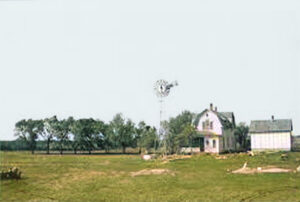
Clifton, Kansas Farm.
In 1863, J. Haines, who had obtained possession of the site, moved the town back into Clay County. Clifton did not prosper this time either, and William Funnell bought out Mr. Haines and moved the town back into Washington County. George Green built a hotel, and there the growth of Old Clifton ceased.
In the fall of 1863, the Reverend R.P. West, of the Methodist Episcopal denomination, of Republic County, began holding religious services. The following year, he organized a Union Church in Clifton, uniting all religious groups. This church has since become the Methodist Episcopal Church of Clifton.
The Catholics organized the county’s oldest church in the spring of 1866. J. Bowmaker, T. Kingsley, N. Eslinger, and P. Eslinger were among the first members. A log schoolhouse was built the same year, about three miles north of Clifton, and here services were held.
In 1870, another townsite, East Clifton, was laid out by Rufus Berry. Pleasantly situated, it occupied the high ground north of the big bend in the Republican River, where it turns south in Clay County.
In 1871, Mr. Funnell moved his store and post office to the new townsite. A. Green built a hotel, and George Miller and Thomas Dolan started a general store. That year, George W. Lang built the old “Parallel House” hotel.
In 1872, the Catholics erected a church building in the area. The same year, Baptists organized a society in the area.
West Clifton was laid out in the fall of 1877 by Amanda and Winslow Haynes and Olive Cooper, and building commenced the following spring. The two places were only about half a mile apart and eventually became one city.
Presbyterians organized a society in 1877. The Christians also had a small society.
The Central Branch of Union Pacific Railroad arrived in December 1877. The city was also on the Junction City & Fort Kearney Railroad in June 1878. These roads enabled the town to triple in size in four years.
A Methodist Episcopal Church was organized in January 1878 by Reverend J.H. Colt. In July, the society built a $400 parsonage.
The Pacific House, built by J.L. Miller, was a neat, well-kept hotel, opened in the summer of 1878. P.S. Carpenter bought the hotel in October 1878. The Pacific House accommodated about 30 guests, and the entire property was valued at $5,000. That year, Hoenan & Barlow opened a hardware store, C.C. Funnell started a lumber yard, a school was erected, and Clifton began to assume its present promising appearance.
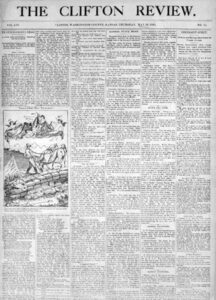
Clifton Review Newspaper.
John W. Chadwick, an attorney born in Greenup County, Kentucky, came to Clifton in May 1878 and began practicing. A few years later, he married, and the couple started a family.
The district schoolhouse, built to accommodate both Clifton and Vining, was a large two-story wooden structure erected in 1878. Bonds totaling $4,000 were voted on and approved. The students, numbering over 200, were divided into three departments. C.H. Rice was the principal of the school.
The Clifton Review newspaper was established on February 27, 1879, by William & Blake. In May, the paper passed into the possession of George Blake, and, in June, into the hands of C.H. Rice & Company. A. Dobbins & Company purchased the Clifton Review in October.
In 1879, J.A. Kern took charge of the Parallel House hotel and renamed it “The Atlantic House.” It measured 35 by 50 feet, contained 15 rooms, and was valued at $2,000.
That year, the Baptists removed to Clifton and built a church.
In the summer of 1879, chiefly through the well-directed efforts of its pastor, Reverend W.J. Mitchell, George Funnell, H. Rundle, G.D. Seaburry, and S.H. Hamilton, the Methodist society erected a house of worship at a cost of $3,000.
In April 1880, N.S. Hewett, editor and proprietor, assumed control of the Clifton Review newspaper. The newspaper was Republican in politics and was a six-column folio. Mr. Hewett was a native of Ohio before coming to Clifton and purchasing the review in 1880.
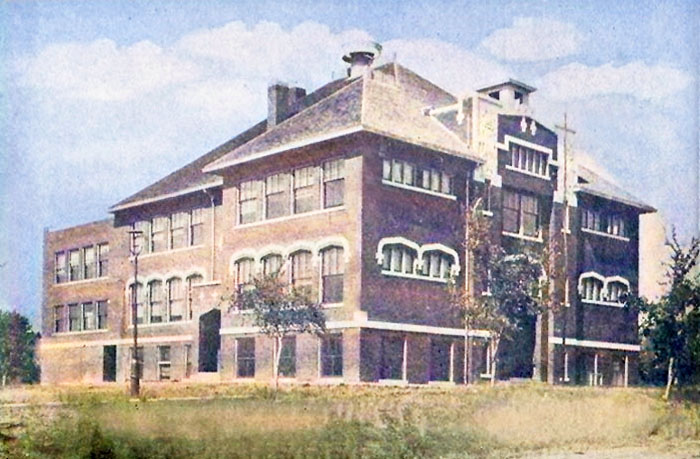
Old Public School in Clifton, Kansas.
The flour mills, operated by C.F. Sheppele and George H. Stegman, were built by these gentlemen in 1880. Afterward, the mills were overhauled twice and refitted with new machinery, achieving a daily capacity of 80 barrels of flour. They had four runs of stone and two rollers. The building was 36 by 56 feet, three stories and a basement in height, and the entire property was valued at $17,000. The best brand of flour manufactured by this firm was “The Belle of the West, I.X.L.”
The Bank of Clifton was organized on September 1, 1881, as the successor of the private bank established by Snider Brothers three years before. A substantial two-story brick building was erected in the fall of 1881. This is the only banking institution in Clifton. Its capital was $20,000, and average deposits were $15,000. The bank did a general banking and exchange business, its officers being: M. F. Southwick, president; E.W. Snider, vice-president; C.W. Snider, cashier.
Reverend Father John Loevenich, who assumed charge of the Catholic Church in the fall of 1882, began making arrangements to move the congregation to Clifton and intended to build a church there.
In 1910, Clifton was an incorporated city of the third class at the junction of the Union Pacific Railroad, the Chicago, Rock Island & Pacific Railroad, and the Missouri Pacific Railroad, which gave the city unsurpassed shipping facilities. At that time, Clifton had two banks, a money order post office with five rural routes, express and telegraph offices, telephone connections, churches of various denominations, some first-class mercantile houses, a hotel, a good public school system, and a population of 614.
Clifton’s population peaked at 746 in 1960.
Clifton’s schools were consolidated in 1981.
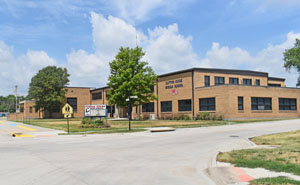
Middle School in Clifton, Kansas by Kathy Alexander.
Today, the community is served by the Clifton-Clyde USD 224 public school district, which has three schools:
Clifton-Clyde Senior High School, located in Clyde.
Clifton-Clyde Middle School is located in Clifton.
Clifton-Clyde Grade School, located in Clifton.
Today, Clifton has several churches, a good newspaper, a school, a bank, and other stores.
Clifton’s main street, Parallel Street, also known as Highway 9, divides the city between Washington County on the north and Clay County to the south. Also sharing the main street with Clifton is the City of Vining to the West. The combined population is 550.
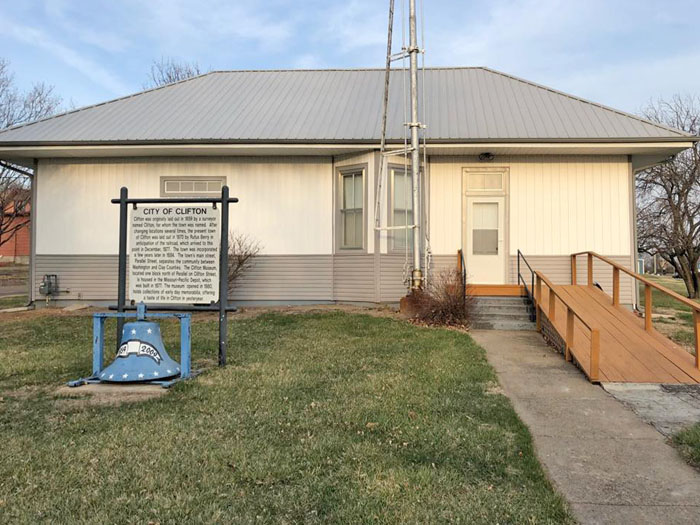
Historical Society in Clifton, Kansas.
Berner Memorial Park is located along Parallel Street and offers RV hookups, baseball/softball diamonds, and playground equipment.
LCL Buffalo Ranch offers visitors the opportunity to view the grazing herd of buffalo. Visitors can also tour the Heartland Museum located on the Ranch west of Clifton on KS Hwy 9.
Visitors can learn more about the history of Clifton and Vining and see artifacts from the past at the Clifton Community Historical Society Museum, located at 108 Clifton Street in Clifton, in an old railroad depot. The museum is open by appointment only; call 785-455-3763.
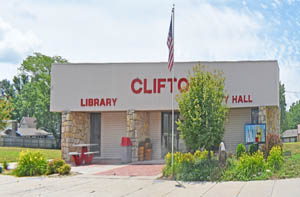
City Hall in Clifton, Kansas by Kathy Alexander.
Clifton is about 20 miles from Washington, the county seat.
©Kathy Alexander/Legends of Kansas, May 2026.
Also See:
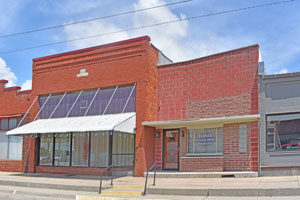
Main Street buildings in Clifton, Kansas by Kathy Alexander.
Washington County Photo Gallery
Sources:
Blackmar, Frank W.; Kansas: A Cyclopedia of State History, Vol I; Standard Publishing Company, Chicago, IL 1912.
City of Clifton
Clay County, Kansas
Cutler, William G; History of Kansas; A. T. Andreas, Chicago, IL, 1883.
Washington County, Kansas
Wikipedia – Clifton
Wikipedia – Fort Clifton