
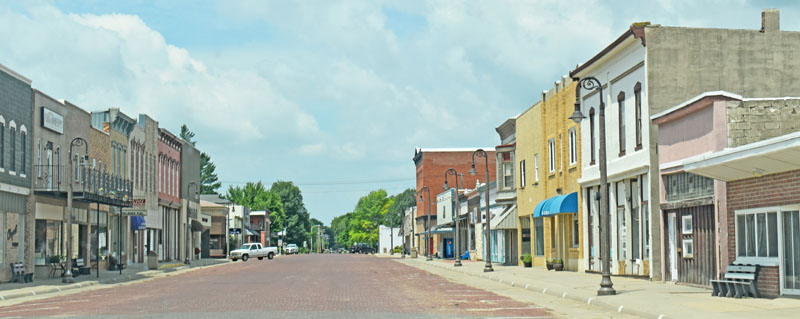
Clyde, Kansas Main Street by Kathy Alexander.
Clyde, Kansas, is a small town at the base of Elk Creek along the banks of the Republican River in Elk Township of Cloud County. As of the 2020 census, its population was 694, and it had a total area of 0.67 square miles, all land. It is the second-largest town in the county and is surrounded by a rich agricultural district. It is located East of Concordia along State Highway K-9.
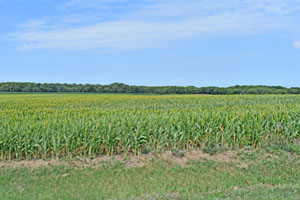
Cloud County, Kansas Agriculture by Kathy Alexander.
It was here, among beautiful shade trees and in the midst of one of the most magnificent farming countries in the world, that the first settlements of the county were made. It was for a long time the designated point of assembly for settlers headed West, when there were Indian raids. Many of the early settlers West of this point would leave their families here and go into Republic County as far up as White Rock to locate and work their claims.
It was also the first county seat when the area was originally organized in 1860. However, being on one side of the county, it had no hope of retaining it after the western part of the county had become settled.
In the fall of 1860, Moses Heller was alone on Elk Creek when he found himself surrounded by Indians. Heller was a large, imposing-looking fellow—perhaps the Indians approached him with a warning, thinking him a leader of the white man. He, along with August Fenskie, J.M. Thorpe, and James Hagaman, were the first settlers in Cloud County, and although their homesteads were East of the line imposed by the Indians, it was clear that before long, someone would push a little farther West.
Before the town was founded, Reverend R.P. West, of Republic County, affiliated with the Methodist Episcopal denomination, preached the first sermon at the house of Moses Heller in the fall of 1863. The organization soon built a church.
A post office called Elk Creek was established on April 20, 1864, with Moses Heller serving as the first postmaster.
Later, Chauncy Cowel and Charles Davis opened a country store in Moses Heller’s house. In this store, the first meeting was held to talk over the feasibility of establishing a town. Soon, a town association was formed, with several members. They held their first meeting on December 11, 1866, and elected officers. The shares were first held at $20 a piece. Officially founded, it became the first and oldest town in Cloud County. The original 40-acre townsite was purchased from W.H. Page early in 1866 for $300 by a townsite company.
In the spring of 1866, a meeting was held at Moses Heller’s residence to discuss the community’s educational interests and explore the possibility of building a schoolhouse. The settlers were committed to constructing a quality building, believing that their settlement would soon require it. They decided on a site for the building which would measure 16 by 22 feet, made of hewn logs, and feature a dirt roof and cottonwood flooring. Each settler agreed to contribute $4 worth of labor to help build the structure.
Although the plan called for the schoolhouse to be ready for use by early summer, it wasn’t until July 14 that the frame was finally raised. Dr. Rodgers served as the first teacher in the fall of 1866. This schoolhouse also functioned as a church, public hall, and courthouse, and it was here that the county commissioners first convened to conduct official business.
At a meeting held in January, 1867, three names were presented by which to christen the new town — Elkhorn, Shirley, and Colfax. The name Shirley was initially chosen, but the members thought it best to reconsider their action, and so they did so during the next month. They voted again and chose the name of Clyde. That year, the town was laid out.
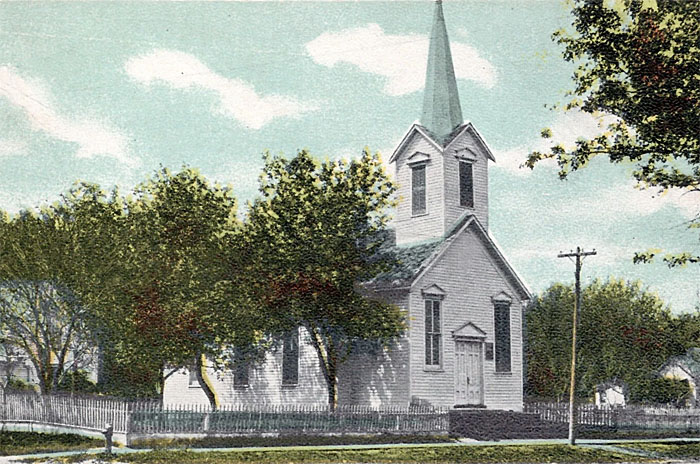
Baptist Church in Clyde, Kansas.
Reverend H.S. Cloud organized the Clyde Baptist Church on January 10, 1867. This church population grew steadily, and soon a spacious church was built.
Soon afterward, Simons & Peters opened a second store, but sold out to the first-named firm. The next store was established by Ed Neeley and S. Way in the spring of 1867, when the latter erected the first frame building.
On November 30, 1868, the town’s name was officially changed from Elk Creek to Clyde. It was named after the River Clyde in Scotland. Germans, Scandinavians, and French-Canadians settled it. The original French-Canadians settled primarily near St. Joseph, five miles to the south.
The Presbyterians organized in 1870, or at least steps were then taken in that direction by Reverend Mr. Chapin, who resided at Irving. The church had a good membership and a good church building.
In January 1871, A.G. Dersey opened a grocery and feed establishment. Later, his business grew to consist of a stock of general merchandise. In August 1871, F.K. Teeter opened another stock of general merchandise, which soon saw his share of public patronage, which rapidly increased with the population. That year, W. Burkall opened an extensive grocery store.
T.T. Chinnock opened a store in 1872. He started with somewhat limited capital but developed it into a well-selected stock of boots, shoes, and groceries. The same year, Bartlett & Crump opened a hardware store. In July 1872, J.H. Huff’s furniture store opened and was successful, also carrying a line of undertaker’s goods.
W.S. Crump, originally from Indiana, moved to Kansas in 1869 and moved to Clyde in 1872, opening a hardware store. Later, he became the Mayor of Clyde in 1875, and was elected a representative to the State Legislature in 1881.
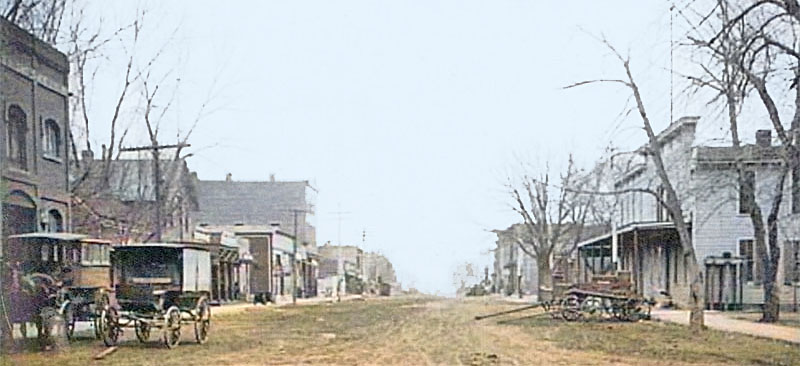
Clyde, Kansas, Main Street.
Clyde was incorporated as a city of the third class in the spring of 1873, with its first municipal election held on April 7 of that year. The First officers were George W. Bartlett, mayor; Peter McCord, police judge; Frank McNulty, A.W. Campbell, Moses Heller, S.M. Ransopher, and Henry Dobbs, councilmen.
In June 1873, E. Gardner established a general merchandise concern, and P. McDonald operated a drug store. M. Heller & Co., in October 1873, erected a handsome building and launched another general merchandise store. In the latter part of 1873, H.A. Dobbs opened a general store with a tailoring department, and about this time, James McIntosh opened a stock of drugs and groceries.
A picture gallery by Garraway & Taylor was established, and several other interests of more or less importance, among them the Clyde Hotel, by J.H. Huff, and the Michigan Hotel, by S.E. Stilson, both of which were prosperous. H. Fisher was a harness maker, and L.M. Rockwell and J. Frederick were blacksmiths.
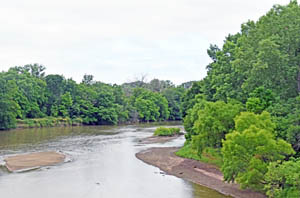
Republican River in Cloud County, Kansas by Kathy Alexander.
For several years, the citizens of Elk and Shirley Townships agitated over the question of building a wagon bridge over the Republican River West of Clyde. From time to time, the great advantages to Clyde and the outlying districts had been pointed out to the people, and ferry boats had been discouraged. The citizens were ready to acknowledge and sanction the benefit to be derived from a bridge being built, but demurred at the tax it would impose upon them. The citizens of Elk and Shirley Townships were requested to meet at Judge McCrea’s office in the city of Clyde to discuss plans to secure the bridge. December 30, 1873, an election was held in Clyde to determine whether a bridge should be built across the Republican River with the following results: For the bridge and bonds, 29; against the bridge and bonds, 84; majority against, 39.
On March 6, 1875, the legal voters of Elk Township were called to the polls to vote on bonds for the building of a bridge across Elk Creek at the foot of Washington Street in Clyde. The bonds carried by a handsome majority of 74 to 40 against.
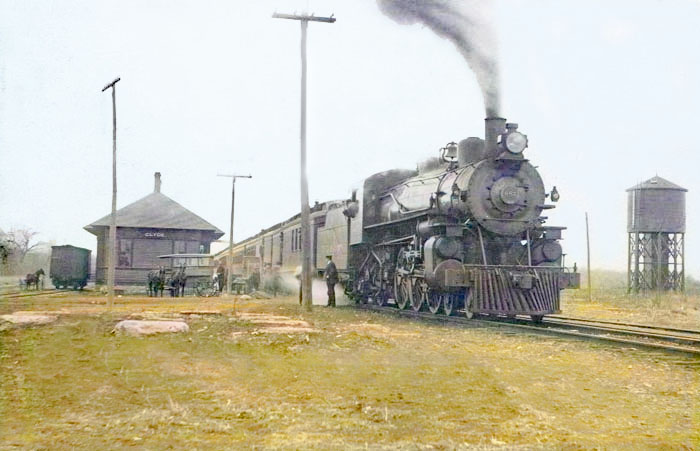
Clyde, Kansas, Railroad.
When the Central Branch Union Pacific Railroad came through Clyde in 1877, the town’s population increased from a few hundred to 1,800.
The election for bridge bonds was again held in Clyde on October 13, 1877, with a 45-vote majority in favor. The people of Clyde rejoiced, considering it necessary and important to the growth of their little city that the Republican River should be bridged. As time rolled on, the opposition rejoiced in the consummation of what had seemed to them an extravagant proposition. An effort was made to secure Shirley Township’s assistance in building the bridge, but they could not be persuaded to see it that way, so it was built without their help.
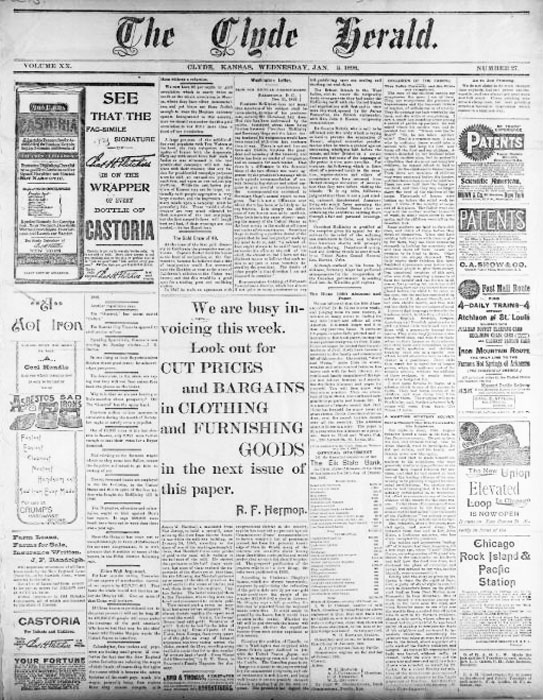
Clyde Herald Newspaper.
The Clyde Herald was established at Clyde in 1878 by Batty & Bachelder.
C.W. Van De Mark, an attorney, originally from Seneca County, New York, came to Clyde in 1878. In 1880, he and his brother entered the banking business under the firm name Van De Mark & Brothers, later known as the Bank of Cloud.
Travelers found the hotel accommodations of Clyde superior to those of most towns of its size. The leading hostelries were the Pomeroy House and the Commercial Hotel. The Pomeroy House came into possession of F.E. & J.H. Barona in November 1879. The hotel had 30 neatly furnished rooms, and its accommodations were first-class. These gentlemen also owned a fine grain elevator with 100 acres of valuable land adjoining. The Commercial House, conducted by George H. Wilkes, was opened in April, 1879.
The only manufactures of note were those of flour and pottery. The Clyde Mill Co. had just completed a steam flouring-mill, costing about $15,000. Sohlinger & Mosier were the proprietors of the pottery that produced excellent, durable ware.
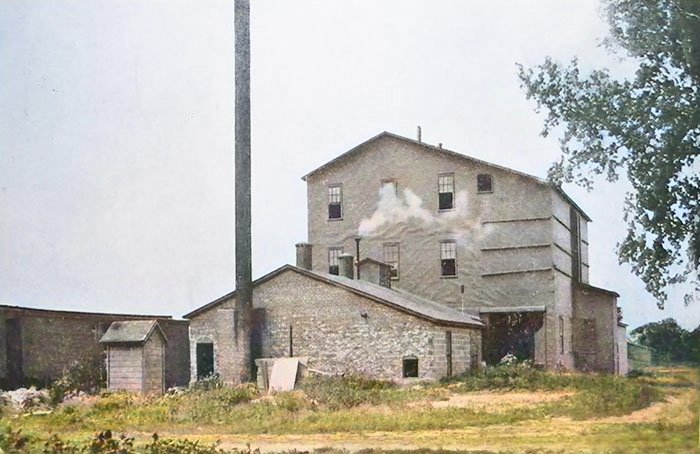
Roller Mill in Clyde, Kansas.
Harry Fuglet, originally from Germany, came to America with his parents in 1852, first settling in Ohio. He moved his family to Clyde Inn in March 1879 and opened a store carrying boots, shoes, and clothing. He also served on the City Council.
A new red-brick modern schoolhouse, with a well-selected library, was built in 1879 for $20,000 and contained six rooms. School opened in the new building in February 1880, with F.E. Burke as principal and Clara Hay, Carrie Borton, and Mary E. Turner as assistants. The term was five months, and the enrollment was 220.
E.T. Peck, initially from New York, came to Clyde in 1880 and engaged in the lumber business. In July 1880, Thomas Owen, Jr., originally from North Wales, established the Clyde Democrat.
In June 1881, Thomas Owen, Jr., purchased an interest in the Clyde Democrat newspaper. It was at first a six-column folio, but changed to seven in November 1880. It had a fair circulation, was Democratic in politics, and was for prohibition.
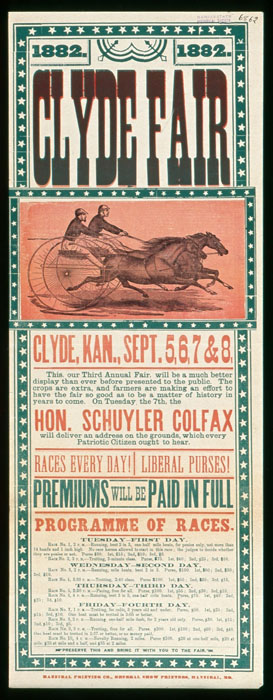
Clyde, Kansas Fair Poster, 1882.
The first fair was held in the fall of 1880. The association had 40 enclosed acres, supplied with necessary buildings and an excellent half-mile race course.
The Clyde Herald newspaper office burned in February 1881 and was suspended until July.
In March 1882, the Clyde Herald newspaper was purchased by J.S. Paradis. It was a seven-column folio, Republican in politics, newsy, and well-edited paper.
By the early 1880s, Clyde had a population of 912.
F.A. Griffin established the Clyde Exchange Bank, an individual concern, in 1882, with a capital stock of $5,000, and conducted a banking business continuously for the next 20 years.
A creamery was established in 1883 by C.H. Armstrong, comprising a main factory and eight skimming stations. The milk was gathered from their various customers, separated by power separators, and the cream was shipped to central stations, where it was churned. The capacity was limited only by the amount of milk or cream received. It was one of the most important industries in the Clyde vicinity. By the early 1900s, the creamery could readily handle 4,500 pounds of butter daily.
Two rooms were added to the school in 1884, bringing the total to eight large rooms with spacious halls. The school comprised four divisions: the primary, intermediate, grammar, and high school.
By 1885, the number of school students had increased to 470, the city having doubled its population within five years.
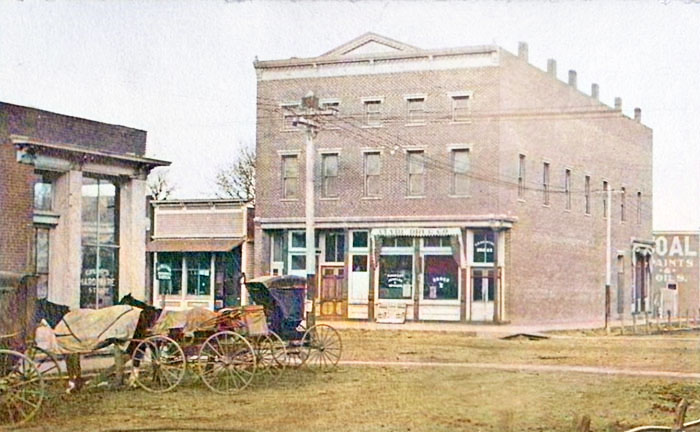
Substantial buildings in Clyde, Kansas.
That year, more money was expended on building than in any previous year in Clyde’s history, and it added much to the city’s general appearance. That year, James Turner bought a small wooden structure, which he dismantled and used to erect a large, handsome brick building, furnishing it. Phillip Longton and A.G. Dersey put up another fine brick building. The upper story was converted into a capacious hall, measuring 44 by 80 feet, which housed an opera house, fitted with all modern improvements, and many good troupes were attracted there.
Mr. X. Manna erected another substantial brick structure, and G.W. Knapp added a large brick addition to his livery stable. The same year, Dr. Ransopher erected a splendid brick building for a drug store.
On June 10, 1885, Clyde witnessed the first-ever delegation of women assembled in Cloud County. It was the occasion of the convention of the Women’s Christian Temperance Union for the purpose of establishing a county organization. Mrs. G.W. Allen was honored to be the first president of this convention and impressed everyone with her rare executive ability. Mrs. Dr. Dabney performed the duties assigned to her as secretary in an able manner.
Clyde’s standpipe waterworks system furnished an abundant supply of pure water and an adequate supply for fire protection. It was established in the winter of 1886 through the issuance of $2,600 in bonds, voted by the city of Clyde. There were about four miles of pipe and 35 hydrants. The standpipe was 119 feet high from the surface at the base. The pipe, when full, carried 71 pounds of water pressure, had a capacity of 170,000 gallons, and was 12 feet in diameter.
The water was furnished from an open well 35 feet deep and 12 feet in diameter. The appliances of the power house were modern, and a skilled engineer, J.L. Doster, was supplied. The power house was an imposing one-story brick structure, measuring 40 by 60 feet, beautifully located just over the Elk Creek bridge at the foot of Washington Street.
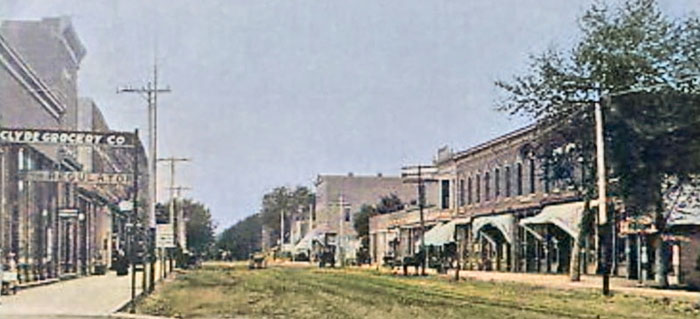
Clyde, Kansas Street Scene.
On January 19, 1888, one of the most tragic accidents in Clyde’s history occurred. That night, the livery stable of Mr. Brownlee on Green Street caught on fire. The citizens, along with the fire company, quickly arrived to combat the flames. Although initially skeptical, the crowd was informed that a man was trapped inside the burning barn. This claim was supported by J.E. Toot and others, who testified that they had seen him crawl from a stall on the north side to the south side, engulfed in flames.
Once the fire was extinguished, a horrific scene was revealed. In the second stall to the south, the severely disfigured remains of the unfortunate man were found. The incident was directly attributed to alcohol, as Mr. Brownlee and some associates were intoxicated, which led to their reckless behavior. Mr. Brownlee had entered the burning building, supposedly to rescue some of his livestock. Tragically, 20 horses and two cows perished along with the stable.
The Elk State Bank, a solid institution of Clyde, was established n 1897, with a capital stock of $10,000.
Clyde’s population peaked at 1,157 in 1900.
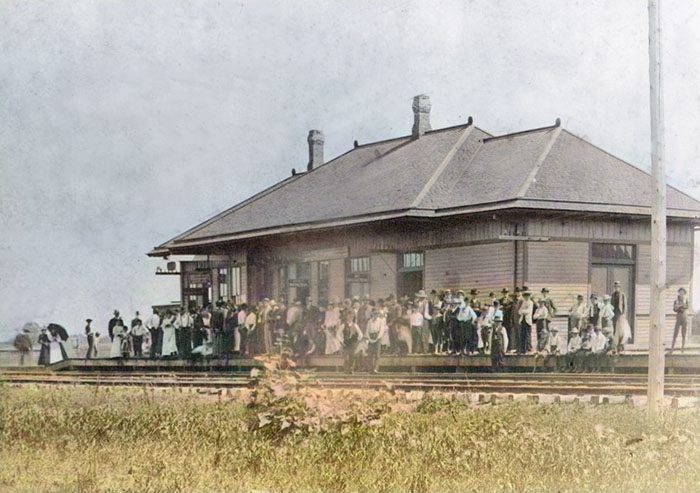
Chicago, Rock Island, & Pacific Railroad depot in Clyde, Kansas, 1914.
The new wagon bridge over the Republican River was completed in June 1901 for $7,300.
In 1910, Clyde was an incorporated city at the junction of the Chicago, Rock Island & Pacific Railroad, the Missouri Pacific Railroad, and the Union Pacific Railroad. For a city of its size, Clyde was among the most progressive and metropolitan in character in the state at the time. It had well kept streets, an electric light plant, waterworks, a fire department, a sewer system, two banks, two theaters, two weekly newspapers — the Republican and the Herald, a commercial club, good hotels, a graded school system, several fine church buildings, a flour mill, a creamery, grain elevators, marble and granite works, and annually shipped large quantities of grain, live stock, watermelons and alfalfa. Its international money order post office had five rural routes that supplied a large district with daily mail, and the city’s mercantile establishments enjoyed substantial and profitable patronage. Telephone connections were maintained with the surrounding towns. In 1910, the population was 1,057.
Cloud County Schools were unified in 1981.
Today, the community is served by the Clifton-Clyde USD 224 public school district, which has three schools:
Clifton-Clyde Senior High School, located in Clyde.
Clifton-Clyde Middle School is located in Clifton.
Clifton-Clyde Grade School, located in Clifton.
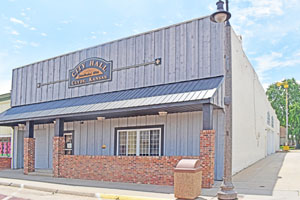
City Hall in Clyde, Kansas by Kathy Alexander.
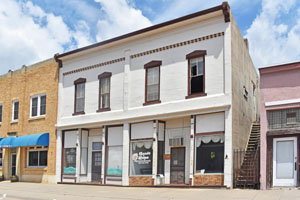
Business Buildings in Clyde, Kansas by Kathy Alexander.
Today, there are many substantial and ornamental business buildings, and the residential part of the town contains several well-kept homes.
The area offers abundant habitat for deer, turkey, pheasant, and quail, providing hunters with ample opportunities. People enjoy fishing on the river and at nearby reservoirs.
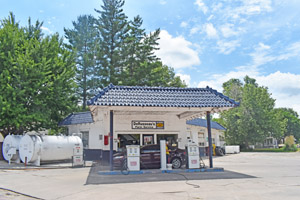
Gas and garage in Clyde, Kansas by Kathy Alexander.
Clyde hosts numerous annual events to draw families, friends, and visitors to enjoy the simplicity of this charming rural community. These include: Clyde Watermelon Festival, Homecoming Parade and Pep Rally, Halloween Parade and Hayrack Ride, Christmas Craft Fair, Holiday Open House, Christmas Day Dinner, Easter Egg Hunt, Memorial Day Service, Alumni Weekend Celebration, Slow Pitch Softball Tournaments, and Golf Tournaments.
Clyde is located 15 miles East of Concordia, the county seat, and not far from the eastern boundary of the county.
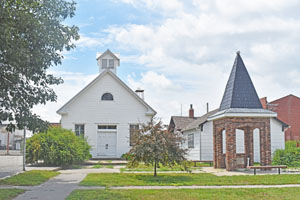
Church in Clyde, Kansas by Kathy Alexander.
©Kathy Alexander/Legends of Kansas, updated June 2026.
Also See:
Sources:
Blackmar, Frank W.; Kansas: A Cyclopedia of State History, Vol I; Standard Publishing Company, Chicago, IL 1912.
Hollibaugh, E.F.; Biographical History of Cloud County, Kansas, 1903.
City of Clyde
Cutler, William G.; History of Kansas; A. T. Andreas, Chicago, IL, 1883.
Wikipedia