
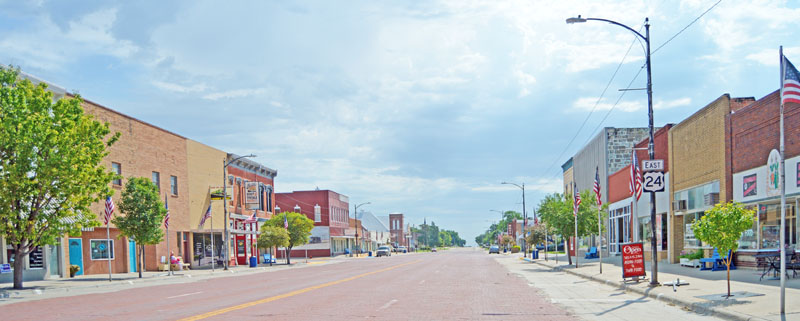
Main Street in Stockton, Kansas, by Kathy Alexander.
Stockton, Kansas, is a small town and the county seat of Rooks County. As of the 2020 census, the city’s population was 1,480, and it had a total area of 2.23 square miles, all land.
In 1871, five McNulty brothers, including Joseph, Frank, Thomas, James, and John, who had scouted the area when they were with the militia in 1861, came back to the area to homestead. Having earlier seen the wide-open area that was perfect for cattle grazing, the abundance of surface water for survival, and a large amount of limestone that could be used as building material, they chose to homestead there. They arrived with five other men from Washington County, Kansas, including John R. Wells, Tunis Bulis, John Powell, Seal Northup, and Captain J. Owens.
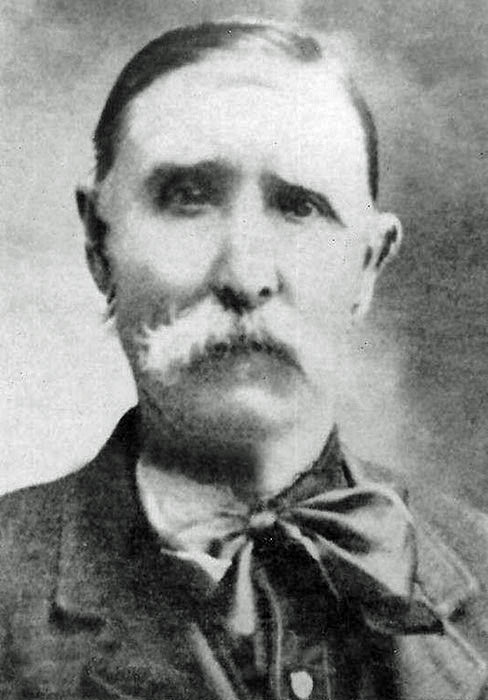
Joseph McNulty.
Joseph McNulty built a log home on his property, which would adjoin the townsite on the West near the juncture of the two trails, using it as a trading post and soon enlarging it for a hotel. It was located on the natural trail up the South Solomon River Valley, where the military supply trail from Fort Kearney, Nebraska, to Fort Hays, Kansas, crossed the river. George Beebe opened the first general store to supply soldiers and buffalo hunters. Stockton’s post office was established on April 25, 1872, with James Finnigan as postmaster. Mail was carried on horseback from Cawker City by way of Bull City (Alton) and then on to Stockton. W.H. Barnes taught the first school that year. The first Catholic services were held in Joseph McNulty’s home that year.
As stock raising was the only industry, Stockville and Stocktown were suggested as the names of their town, but all agreed to John R. Well’s proposal for the name Stockton. The Stockton Town Company was chartered in August of 1872, with officers Joseph, Frank, and J.C. McNulty, John Russell, and G.E. Beebe.
The importance of education to the settlers of Stockton was shown by how quickly they established schools. The first recorded school was established in 1872 in a one-room frame building.
When Rooks County was officially organized on November 26, 1872, both Stockton and Rooks Centre near Medicine Creek wanted to be the county seat. Early newspaper reports alluded to the fact that underhanded dealings helped establish the county and county seat. J.W. McConnell, one of the first homesteaders, stated, “600 residents were required to organize a county, so a census had to be taken. Sufficient names were obtained by listing cats, dogs, and buffalo.”
Thomas McNulty recalled: “The census taker accidentally enumerated 12 citizens of Osborne County to help out the number.” John Wells said, “I sacrificed much to help organize the county and to make Stockton the county seat, at least six or seven votes, as we voted early and often and nearly all night to do it.
The election showed 52 votes for Rooks Centre and 95 for Stockton, ending a bitter controversy. The small vote showed how few settlers actually were in the county.
The first town officers were elected in 1873, which included: Trustee, Charles Stuart; clerk, D.K. Dibble; treasurer, John Park; justices, G.W. Patterson and P.G. Green; constables, G.W. Norcutt and W. Dickson.
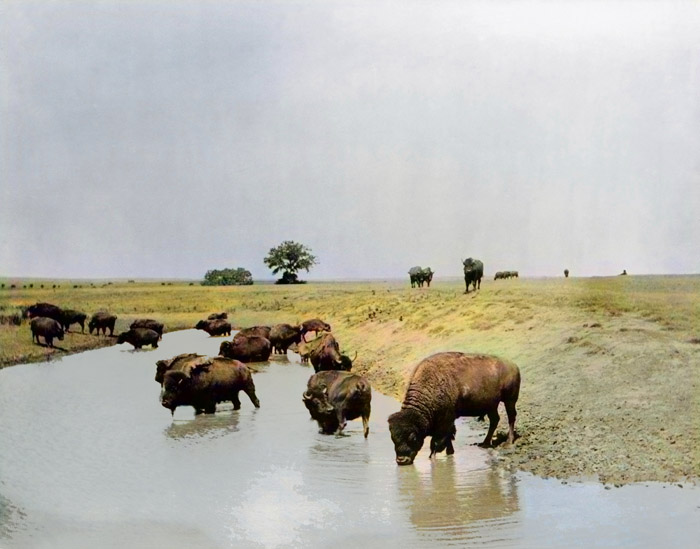
Buffalo on the Great Plains.
The Stockton Common School District #6 was organized in 1873, and a two-story frame structure called the Common School was built.
Between 1872 and 1875, the destruction of the vast buffalo herds left the Great Plains open to open-range operations for cattle and sheep.
Afterward, the next few years were chaotic, with the county’s population growing from 567 to 8,112, with people living in crude dugouts, hastily thrown-up soddies, in businesses, or on the floor in crowded hotels. Stockton had a population of 400 and was the only place of any size in the county.
The Congregational Church, organized in 1876, held services in any available building.
In 1878, Stockton’s first church, St. Thomas Catholic Church, was built of native stone.
When families began to come during 1878 and 1879, two great years of immigration, they were of an unusually high class; most of the young men were college-educated and unmarried, who had followed Horace Greeley’s advice to “go West, young man, go West” and had come to homestead the free land. The local newspaper editor of the Rooks County Record noted one day in 1879 that he counted “83 unmarried young men sleeping in stores and offices on Main Street.”
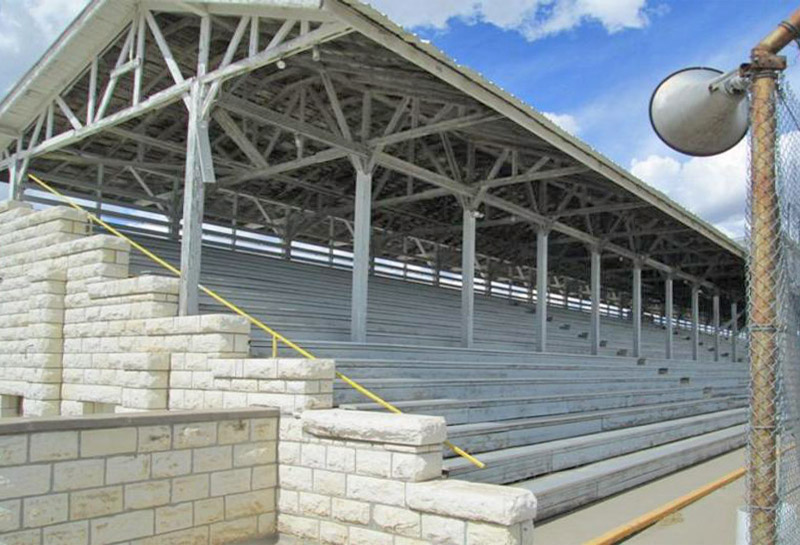
Grandstand at the Rooks County Fairgrounds in Stockton, Kansas.
In 1879, the town was incorporated as a city of the third class, and the following were the first officers under the new form of government: Mayor, C.E. Maynard; councilmen, C.E. McDaniel, Jewell Elliott, and M.M. Stewart. James Moore and John Saver; marshal, D. Washburn; police judge, W.A. Ecker; clerk, T.C. McBreen. That year, the Methodist Church was organized.
A County Agricultural Fair Association was organized in June 1879, and the first Rooks County Fair was held October 8, 9, and 10 of that year. This later became an annual affair and is an important institution in the history of Rooks County and Stockton.
The Methodist Church was organized in 1879.
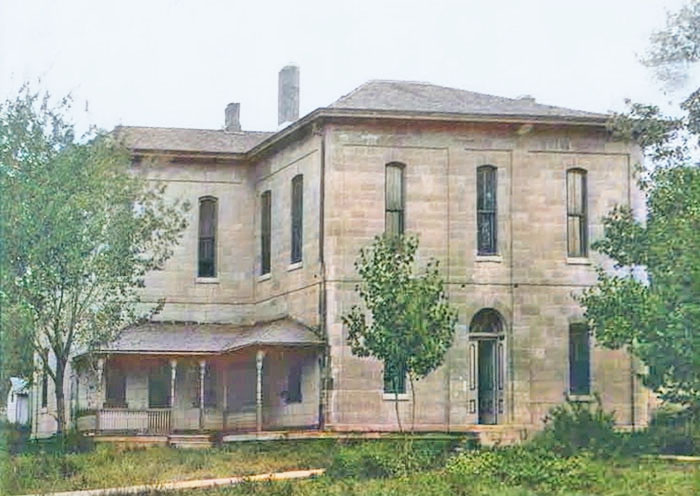
First Rooks County Courthouse in Stockton, Kansas.
After Stockton was incorporated in April 1880, one of the first acts was to provide a courthouse in 1881, made of magnesium limestone quarried just across the street to the north.
In 1881, a native limestone two-story school with a cupola for a bell was built, called the Stone School, with 127 students that year. When the school needed more room, the school board purchased and remodeled the two-story frame Globe Hotel just north of the railroad tracks, which it renamed the Globe School.
A native stone building was built for the Congregational Church in 1881. The same year, the Methodists purchased an old frame school building.
Building activity slowed after 1881. However, an 1884 article noted that there was not a single vacant building in town. The population was estimated at 700, and there was a need for a bridge across the Solomon River south of town.
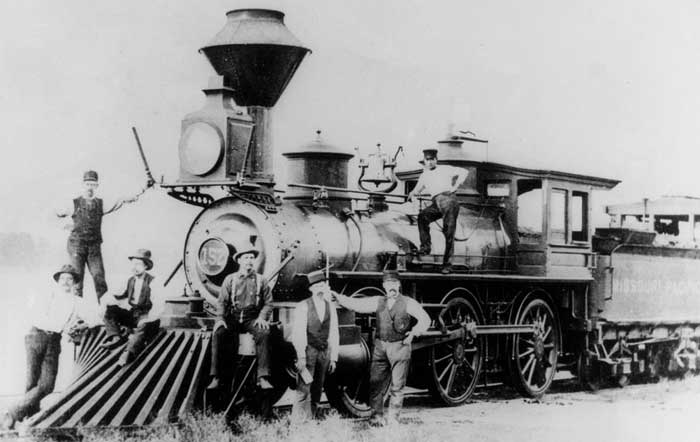
Missouri Pacific Railroad Locomotive.
Stockton’s future was secured with the completion of the Missouri Pacific Railroad to Stockton from Alton, Kansas, in November 1885, marking the end of the line for this branch.
Most of Stockton’s first buildings were one-story ramshackle affairs built of cottonwood, which tended to warp badly. But several substantial Main Street structures were built, such as the limestone businesses in the Opera Block on Main Street, erected by Thomas McNulty, and the Higgins Business Block, built in 1885, the first business block made of locally made brick.
That year, the Methodists built a native stone church. The Christian Church was organized in 1885, with meetings initially held in the courthouse. A new frame church was constructed of lumber hauled from Alton, Kansas. It was dedicated in 1886.
The Commercial Block was also built of brick in 1886. The Bank Block was built in 1887 and is the largest and most impressive block, including eight brick businesses of the same design. Many other fine homes, businesses, churches, and schools were built during this time.
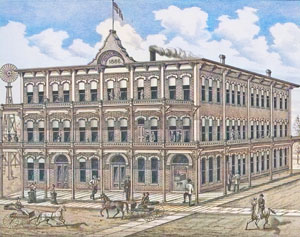
Hicks Hotel in Stockton, Kansas by L.H. Everts & Co., 1887.
It was a time of great optimism in Stockton when the Hicks Hotel was built in 1886. Henry A. Hicks, initially from Indiana, came to Stockton with his family in 1875 from Nemaha County in northeast Kansas. He and J.R. Hicks operated a blacksmith and wagon shop until March 1881, when Henry became the proprietor of the Randall House and managed it until he built the Hotel Hicks in 1886 at the corner of Cedar and North First Streets. It was built at an estimated cost of $11,000, with another $5,000 for furnishings. Approximately 300,000 bricks, all locally manufactured in Stockton, were used in the construction. It contained 44 sleeping rooms, display rooms for salesmen, a large dining room lit by gas (later electric) fixtures, and heated by steam. A windmill was put up in the back and mounted on a 50-foot tower.
The hotel formally opened on February 22, 1887, with a grand ball and supper. The ball was held at the Opera House, and approximately 100 couples danced to the orchestra’s music. The hotel hosted between 200 and 300 people for supper in the elegant dining room. It catered to mostly commercial travelers, including traveling salesmen and railroad crews. It was claimed to have the best accommodations West of Atchison, Kansas.
The original city well was located at the intersection of Main and Cedar Streets before the establishment of the new waterworks in 1887, when the City of Stockton issued $33,000 in waterworks bonds. The 100 feet of standpipe, four miles of mains, 24 hydrants, and the brick pumping station were completed, and the water was turned on on July 4 of the same year.
In 1888, the Stockton Cemetery Association purchased land adjoining the town on the northeast.
The first light plant was built by Charles Woods and purchased by the city in 1889, via a $13,000 bond issue.
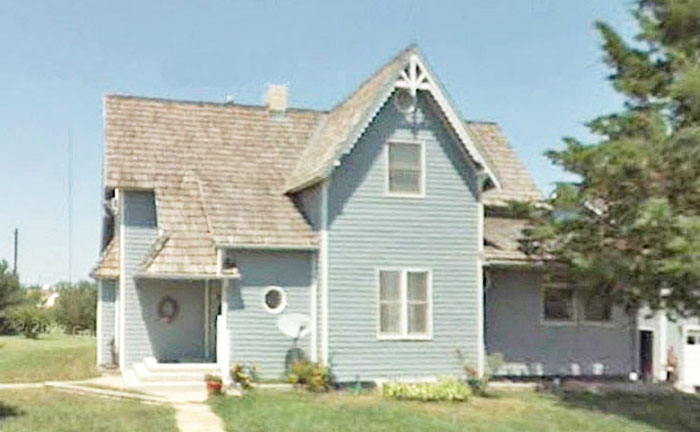
Stockton Academy Dormitory in Stockton, Kansas.
The Stockton Academy was built between 1887 and 1889 by the Congregational Churches of Kansas as a preparatory extension of Washburn College in Topeka, Kansas. It also offered three years of normal school, a teacher-training state program. The City of Stockton donated the land and $10,000 toward the cost of construction. The Academy had water and electrical systems, which were not available in some of the contending towns. Classrooms, an office, and a chapel were on the main floor, the women’s dormitory on the second, the men’s dormitory on the third, and the kitchen, dining room, and laundry in the basement. In the 1890s, it provided the only business college and music conservatory in Northwest Kansas.
Stockton High School was established in 1891. The first seven years were spent in the Common School, renting the Academy for a year, then returning to the Stone School for a year, and finally purchasing the Stone School.
Stockton once operated as a sundown town, where African Americans living in Nicodemus were unwelcome after dark.
In April 1892, a strong wind blew down the Hicks Hotel’s windmill, tower, and tank, crashing into trees, smashing the board fence, and demolishing the hotel in the process.
During a time of drought and economic depression, as local high schools were opening, the Stockton Academy graduated its last class in 1896.
Stockton’s African-American families first held services in their homes. In 1897, they organized the Pleasant Green Baptist Church with services in a small building south of the railroad depot.
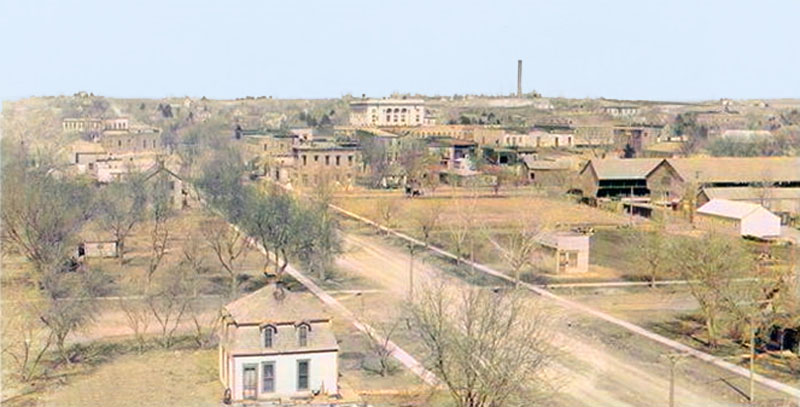
Early day, Stockton, Kansas.
W.R. McNutt was the owner of the Hicks Hotel in 1905 when “a great wind” went through the area. The tin roof and the upper timbers were ripped off and blown as far as a block away, and the structure was completely stripped of roof, cornice, chimneys, and layers of brick. The damage to the building was estimated at $1,200 to $1,500.
The Congregational Church building was destroyed by a storm in 1906, and a new brick church was built in the same location in 1907.
In 1907, the old Globe School was sold and moved to make way for the New Globe School, a two-story brick structure with three classrooms on each floor.
A new Christian Church was begun in 1910, with the cornerstone laid in March, and on July 24 of that year, it was dedicated with R.C. Harding as pastor. The church was valued at $18,000, and $15,000 of that amount was raised on dedication day.
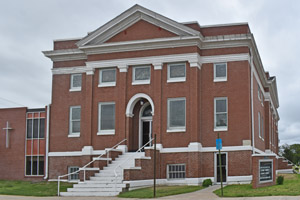
Methodist Church in Stockton, Kansas by Kathy Alexander.
By that time, the Methodists had outgrown their stone church, and it was torn down. In the meantime, services were held in the courthouse until a 70-by-90-foot structure could be built.
In 1910, Stockton was a centrally located third-class incorporated city. It was on the south fork of the Solomon River at the terminus of a branch of the Missouri Pacific Railroad. It was the shipping point for about half the county, which was a prosperous agricultural area. There were two banks, a public library, waterworks, a fire department, an opera house, hotels, a flour mill, a feed mill, two grain elevators, two weekly newspapers — the Record and the Western News, daily stagecoaches to Alcona, Nicodemus, and Bogue, telegraph and express offices, and an international money order post office with five rural routes. The population in 1910 was 1,317.
The Methodist organization built a fine new church in 1911 and dedicated it the following year.
Highways were developed with the advent of the automobile. The Beloit to Colby Cutoff was built in 1913, passing through Rooks County and Stockton following the South Solomon River. It was called the White Way as markers were white bands painted around the telephone poles.
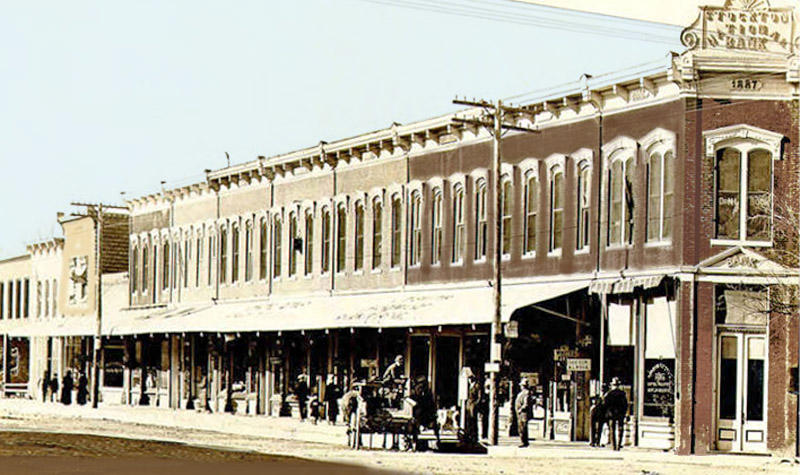
Stockton, Kansas Business District, early 1900s.
In 1917, the highway was renamed the Midland Trail.
In 1918, the Pentecostal Assembly held prayer meetings in members’ homes and later rented a storefront on South Cedar.
In 1921, the Midland Trail was changed to the Roosevelt Midland Trail. That year, the current city manager form of government was implemented, and the Sanitary Sewer System was established.
In the 1920s, with only 20 members, the African Americans built a church in the 400 block of South Second.
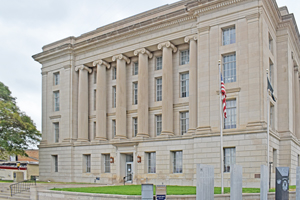
Rooks County Courthouse in Stockton, Kansas, by Kathy Alexander.
The dedication of the present courthouse was held on April 20, 1923. The completed structure is a four-story neoclassical Revival constructed of granite blocks, the exterior made of Bedford stone backed with vitrified brick. Wainscoting and stairs are marble, and floors are concrete covered with tile. Its Ionic columns combine to make it one of the most outstanding courthouse designs in Kansas.
A new high school was built in 1923.
The old hotel was razed in 1924, but in 1961, a replica was built and still stands across the street from the original location as a memorial to the pioneers who founded Stockton.
In 1926, the Roosevelt Midland Trail was renamed U.S. 40-N. Not until 1931 was an asphalt surface laid on the highway. The same year, bricks were laid on Stockton’s Main Street, which are still in use.
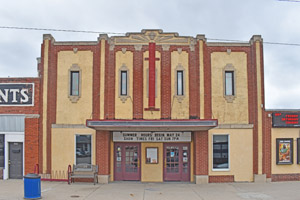
Nova Theater in Stockton, Kansas by Kathy Alexander.
The Art Deco style Nova Theater was built by E.G. and Merle Swank as a movie theater in 1933. The building was remodeled in the 1970s. Serving as a multi-purpose facility today, it provides a very attractive venue for meetings, receptions, stage presentations, musical productions, and still shows movies periodically.
In 1935, the Hicks Hotel was renamed the Beck Hotel. Other owners of the Hick Hotel during its many years of operation included George M. Nobel, Dartmouth Saving Bank, Perry H. Cooper, Leslie C. Wilson, E. and Sophie Christensen, James E. Adams, Larry S. Beck, Marion R. Larson, and Stockton National Bank.
The Kansas Pipe Line & Gas Company was established in Stockton in the late 1930s.
The new Stockton Grade School was built in 1941 of native limestone by the Works Progress Administration.
The Stockton City Building, made of native limestone, was a Works Progress Administration project completed in 1940, which included the city clerk’s office, fire department, and city hall. Before that time, the clerk’s office was housed in the basement of the Carnegie Library. The fire, police, and ambulance departments were in another building.
In 1944, the Pentecostal Assembly purchased land and the old grade school to use as materials for building their church. In 1955, the Pentecostal Assembly became affiliated with the Kansas Councils of the Assemblies of God and became an Assembly of God Church, with the Webster Church merging with them. In the 1970s, they purchased the property to the south across the street and remodeled the house into a Church Annex with a Fellowship Hall and classrooms.
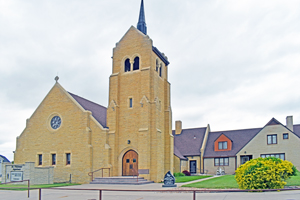
St. Thomas Catholic Church in Stockton, Kansas, by Kathy Alexander.
During World War II, members of the St. Thomas Catholic Church bought war bonds to start a building fund for the native-rock building, completed in 1947.
Stockton’s population peaked in 1950 at 1,867.
A new electric plant was built in the early 1950s, and the old plant was converted to the Street Department shop.
In 1953, due to the building of the Webster Dam, most of the 278 bodies moved from the Webster Cemetery were interred in the Stockton Cemetery.
During the 1950s, it was decided to use the middle school for grades four through eight and to build a new high school just to the south, which was completed in 1957.
In 1960, the African Americans disbanded their church, sold the building, and gave the money to the Southern Baptist Church, which was organized in Stockton in 1954 as a mission church when the Webster Dam was being built. They met in the Legion Hall until the former Christian Church building from Osborne was purchased and moved to Stockton that same year.
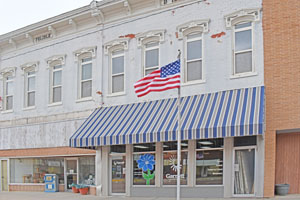
Business building in Stockton, Kansas, by Kathy Alexander.
The old hotel building was demolished in 1963 to make way for a new Stockton National Bank building.
That year, stone from the old Catholic Church was used to build a replica of it in the Catholic cemetery.
The St. Paul Lutheran Church was organized as a mission in 1963, with services held in the Legion Hall on Sunday evenings.
A new St. Paul Lutheran Church was built in 1965.
In 1972, a vocational agriculture, woodworking, and auto mechanics building was added north of the high school. In 1980-1981, a practice gymnasium was added. In 1994, the auto mechanics area was converted to a technology lab. In 1992, plans were made to build a new middle building and connect it to the stone-clad limestone grade school building, cafeteria, and industrial arts, all with a central library. The work was completed for school to start in the fall of 1994.
Today, the community is served by the Stockton USD 271 public school district.
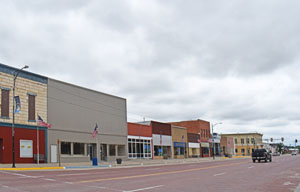
Business District in Stockton, Kansas by Kathy Alexander.
©Kathy Alexander/Legends of America, updated July 2026.
Also See:
Sources:
Blackmar, Frank W.; Kansas: A Cyclopedia of State History, Vol I; Standard Publishing Company, Chicago, IL 1912.
Cutler, William G.; History of Kansas; A. T. Andreas, Chicago, IL, 1883.
Fort Hays State University
Solomon Valley Highway 24 Heritage Alliance
Wikipedia