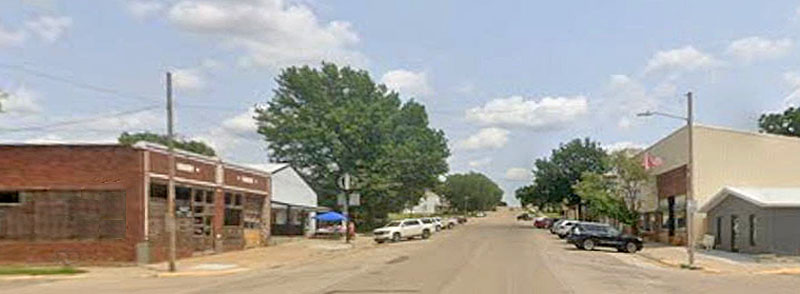
Hanover, Kansas, courtesy of Google Maps.
Hanover, Kansas, is a small town in Washington County. As of the 2020 census, the city’s population was 690, and it had a total area of 0.54 square miles, all land. It is approximately 7.5 miles south of the Nebraska-Kansas state line.
The local area had a significant Native American population. The Pawnee Indians Indians resided west of Hanover; the Kanza Tribe lived to the south; and the Otoe Indians were located to the north.
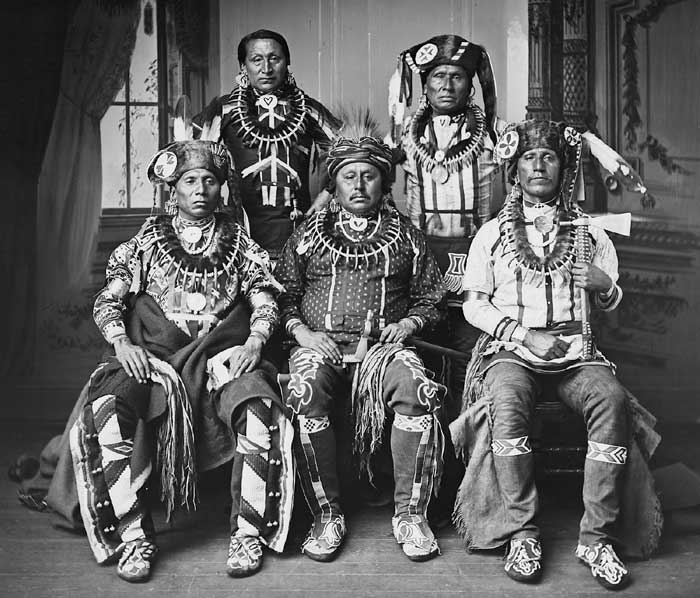
Otoe Men.
As early as 1834, the Otoe Tribe relinquished land to the government in fulfillment of a treaty. Although the Otoe were originally located throughout southeastern Nebraska, their main town was once on the Platte River near present-day Plattsmouth in eastern Nebraska. The Moses Merrill Mission was located in this area. When the Nebraska Territory was formed in 1854, the Otoe resigned their remaining land claim, except for a section near the Big Blue River. This became the Otoe Reservation. The Otoe Reservation was a 24-square-mile section straddling the Kansas-Nebraska state line. Comprised of 160,000 acres, it extended two miles south of the state line, its full length, into Washington and Marshall Counties, Kansas. In Nebraska, it extended into Jefferson County and Gage County. Altogether, it comprised 250 sections totaling 160,000 acres.
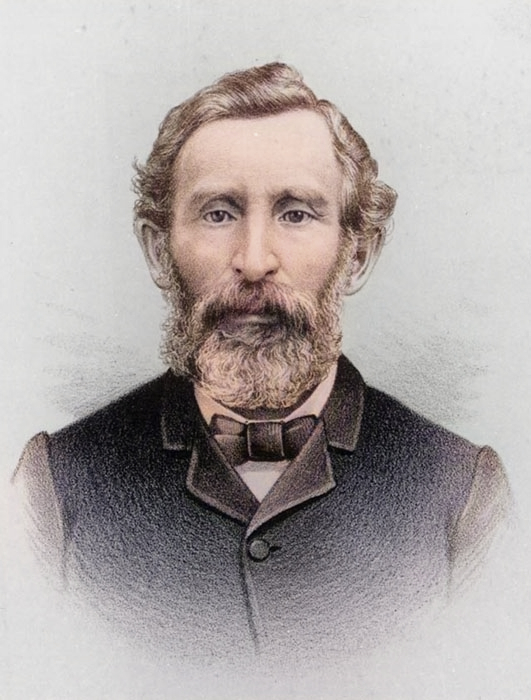
Gerat Henry Hollenberg.
Before the town began, the founders, Gerat H. Hollenberg and Sophia Brockmeyer, settled on a farm originally called “The Cottonwood Ranch” along the Little Blue River in the fall of 1858. Hollenberg had first come to Kansas in the spring of 1854, first settling on the Black Vermillion River in Marshall County at a place later called Bigelow Station. It was here that he met and married Miss Sophia Brockmeyer.
They built their home and ranch on the Fort Kearney Road, where they established a stage depot as a way station, housing nine boarding rooms, a grocery store, a tavern, and an unofficial post office on the Oregon-California Trail.
The region was especially attractive to German speakers and settlers, and when the town was established, Hollenberg continued to draw settlers of German and Czech origin. German settlers often encountered Native American groups such as the Pawnee and Kanza Tribes. Contact between the German settlers and the natives was mainly nonviolent, and few conflicts were reported between the groups. In fact, a substantial amount of trade took place between the settlers and the native groups.
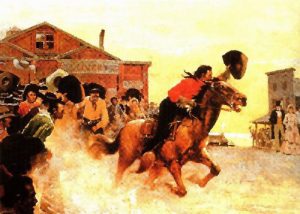
Pony Express.
In April 1860, when the Pony Express service was inaugurated, running 2,000 miles from St. Joseph, Missouri, to Sacramento, California, it established a “home station” where riders switched mounts, picked up, and delivered mail. It was called “Hollenberg Station“. It was the largest stop along the Pony Express route, and it became an important hub for Pony Express travelers.
The station also served the Butterfield Overland Mail. Hollenberg traded with emigrants on the trails, operated the westernmost Pony Express station in Kansas, and provided relay services for the Overland Mail.
The station operated for only 18 months, closing in October 1861. Amazingly, these young riders carried approximately 35,000 pieces of mail over more than 650,000 miles and only lost one sack of mail during this time.
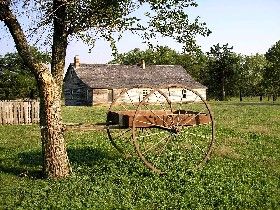
Hollenberg Pony Express Station by Kathy Alexander.
Its success as a business attracted more people to the area in the decade leading up to the establishment of the nearby town of Hanover.
Hollenberg was still running his ranch during the raids by Indians on travelers and ranchmen in the valley. At this time, he was a Colonel of a Regiment of State Militia and was frequently called upon to lead an expedition against marauding parties of Indians.
Milling was an important industry in those early days. As early as 1863, a sawmill was erected, and the following year, a burr was added for the purpose of grinding corn.
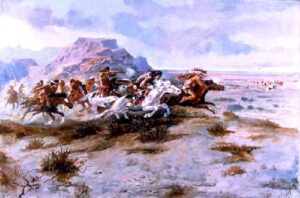
Indian Attack by Charles Russell.
In August of 1864, a brutal raid took place when a party of Cheyenne and Arapaho, who were waging war on the whites in western Kansas and Colorado, extended their raids into the valley of the Little Blue River, near a place called Oak Grove, six miles above where Hanover now stands. A family of 10 named Eubanks was murdered and scalped; a man named Kelly was killed at Pawnee Station; Patrick Burk and a man named Butler were killed three miles above Oak Grove, and two other men were killed, and a young lady named Laura Roper was carried into captivity. Colonel Hollenberg and his Regiment of State Militia chased the raiding parties out of the state, toward the head of the Republican River.
Before the Hanover’s establishment in 1868, a school district was formed to educate the children of settlers who continued to arrive in the area.
Hanover gained a post office on January 20, 1868, in Hollenberg’s store, with Gerat Hollenberg’s clerk, George Perkins, serving as the first postmaster.
Hanover was laid out in the spring of 1869 by Gerat Hollenberg, who named it after his hometown in Germany. It was handsomely situated on the north bank of the Little Blue River on an elevated slope overlooking the valley. William Kalhoefer and August Jaedicke were the first to settle upon it, and Jaedicke built the first building, a frame structure, on the south side of what is now the City Park. The building served as living quarters, a general store, and a drug store.
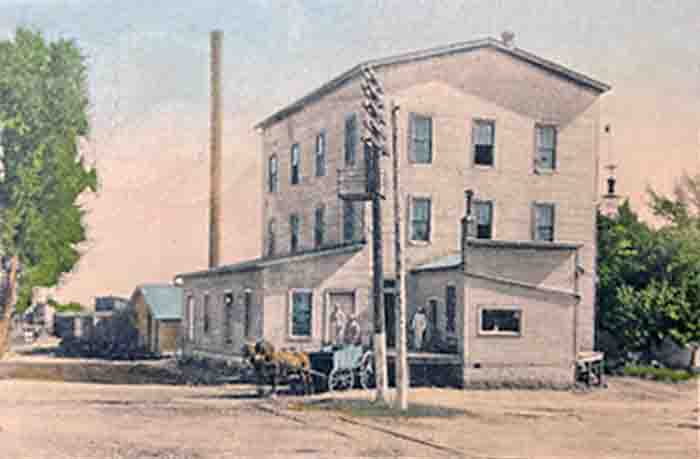
Flour Mill in Hanover, Kansas.
A contemporary of Hollenberg wrote at the time that Hanover represented “just a little bit of Germany” in Kansas Territory.
Emigration to the new townsite was abundant from the start. Among the first arrivals was a wagon train from Fort Madison, Iowa, led by stone mason Joseph Herynk, his wife, and their 8-year-old daughter, Rosina. Joseph and his son, Jerry, drove a team of small mules, while the other wagons were pulled by oxen, as noted by Rosa Munger, Rosina’s daughter.
The wagon train included drivers Tom Hora, John J. Schwartz, Ignatz Masat, Martin Kemper, John Turk, Wenzel Bestak, and Thomas Klecan. In total, twelve families formed this initial group of settlers, with more arriving soon after.
The Evangelical Association of North America in Hanover was formed in 1870. Meetings had been held in the members’ homes or in the schoolhouse since 1862.
Missionaries had been preaching for a year, but at that time, Jacob Warner and his wife, Jacob Gehring and Conrad Geothring, C. Berner, and others organized the first class in Hanover. All services were held in German. Reverend Mortell, Troyer, P. Fricker, and Schesser had charge from 1870 to 1873.
In 1870, the Herman Brothers and others established a Catholic Church, and the eastern half of the old church was built. Occasional mass was held, but a resident priest did not come until 1874, when Father Weickman took charge.
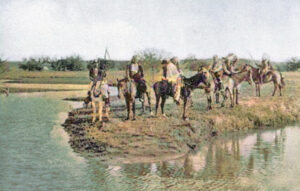
Otoe Indians in Kansas.
That year, following the relocation of some Native groups to Oklahoma from the nearby Otoe reservation, some land was annexed by Hanover Township, allowing further expansion as more white settlers moved into the area.
W. Wendell, Jr., started a blacksmith shop, his uncle having taken a homestead in the spring and returned East for him. In the same year, the Hanover House was built by H. Marguard, Charles Jockers started a brewery, Deviman & Smith started a lumber yard, and other notable improvements were made. The first term of school was also taught this year, which had been erected the previous fall. John Turk was the teacher.
At that time, Hanover had a population of nearly 700 and, besides its business, was blessed with several churches and societies, as well as a weekly newspaper. The Democrat, established by A.B. Bowman, was the first paper published in Hanover. Its first number was issued on November 7, 1871. In January 1872, he removed it to Canon City, Colorado. Baker & Moore started the Caucasian soon after.
In 1871, the St. Joseph & Denver City Railroad was extended to Hanover. Up to this time, it had been serviced only by stage. On September 14, 1871, the railroad staged one of the biggest, most widely advertized land auctions ever known in this part of the country, running daily excursions to bring people in for the sale.
The editor of the Hanover Independent wrote, “Standing on the platform when the Excursion train came in on Wednesday morning, one would have thought he was in New York City. Some 440 people from Hanover. were there.”
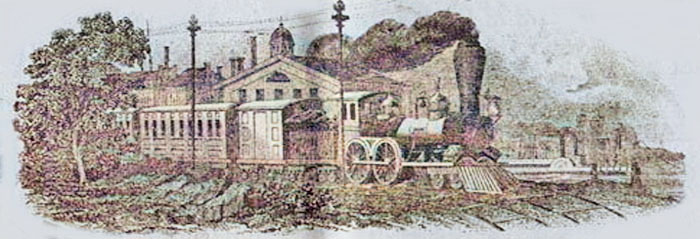
St. Joseph & Denver City Railway.
With the coming of the railroad, emigration to the rapidly developing community received a real boost. A Catholic missionary, Father John Pichler, a genius at colonization, wrote letters to friends in the eastern states describing the needs of the infant town–perhaps a carpenter, a miller, a stone mason–whatever requirement appeared imminent. They came, and many had families. Father Pichler’s letters praised the advantages of the community, its beautiful setting, its fertile land, which could be bought for $2.00 to $3.00 an acre. And emigrants from the East responded by arriving in great numbers.
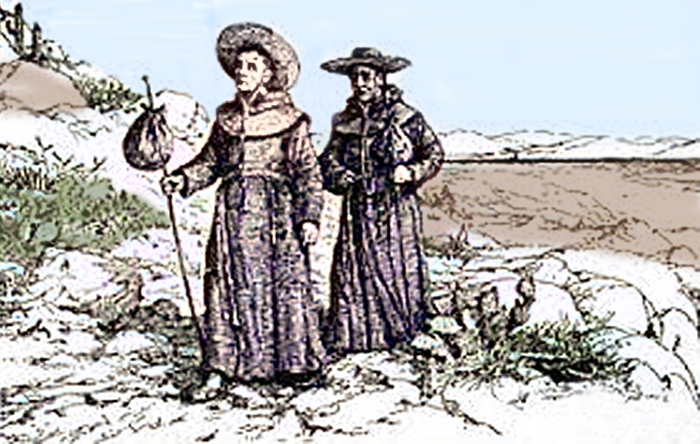
Catholic Missionaries.
In 1872, Hanover was made the terminus of the first division of the St. Joseph & Western Railroad, and a roundhouse and machine shops were erected here. Located at the junction of two railroads, it was an important shipping point. Access to the railroad greatly contributed to Hanover’s economic growth, enabling the expansion of the local grain elevator. The grain elevator’s close connection to the railroad contributed to the town’s growth and initial success.
The Hanover German Society was organized on March 1, 1872, with August Jaedicke, August Neugebauer, William Brandt, W. Wendell, Jr., and H. Marguard as charter members.
In May 1872, Gerat H. Hollenberg purchased the Caucasian newspaper, and it was renamed Enterprise. When P.D. Harman purchased it in August 1872, it became the Western Independent.
Hanover was incorporated as a city of the third class in July 1872.
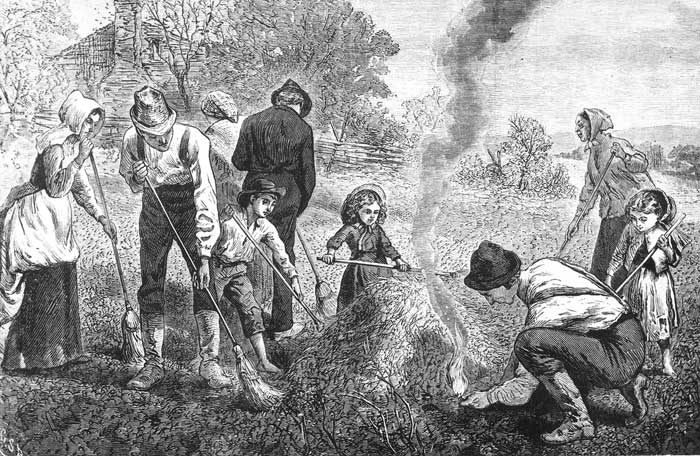
Grasshopper Plague in Kansas.
In 1874, the calamitous grasshopper invasion occurred. This affected not only Hanover but also this entire area of the country. The hungry hoppers descended suddenly, darkening the entire landscape and devouring everything in sight–crops, clothing, even the handles of the pitchforks, axes, and other implements. The land, for miles around, was devastated.
That year, the German Lutheran Church was organized by Reverend Henry Roeoer, William Kalhoefer, and August Jaedicke. In 1875, they began building a church, which was commenced and completed in 1883 for $1,500. Reverend Charles Hawes was the first pastor. The membership was about 30.
In 1874, the Hanover German Society partially built a hall, adding to it and completing it in 1881. It was of brick, and its substantial appearance was an index of the society’s condition. About 30 regular members formed the society.
Gerat Hollenberg died on July 1, 1874, at the age of 51 from a hemorrhage of the lungs while on a trip to Germany and was buried at sea. He left $600 to build a city hall, provided the citizens would raise $1,000. The money was secured without difficulty, and the hall was built in 1875. A fire company was organized the same year. Afterward, the Hollenberg was used as a farmstead until 1941.
Under William Kalhoefer’s several administrations as Mayor, the town greatly prospered. It had eight general stores, two hardware stores, three butcher shops, three harness shops, two drug stores, three livery stables, two boot and shoe stores, a jewelry store, a marble yard, a bakery, two restaurants, two hotels, a brewery, two furniture stores, a land office, a barber-shop, an elevator, two lumber-yards, two tailors, two grain buyers, a brick yard, four blacksmith shops, and a paint shop. W.A. Gilson, proprietor of the Washington House, also ran the stage line and carried the mail between Washington and Hanover.
Hanover’s first city hall was built in 1875, and in its basement was the town’s first jail.
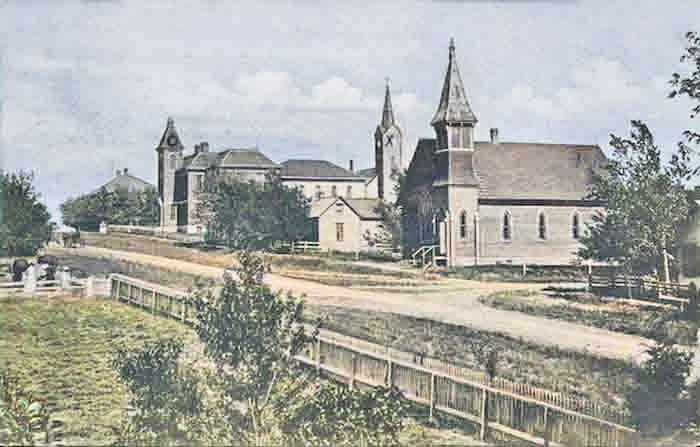
North Street, in Hanover, Kansas.
In July 1876, Father John Pichler assumed control of the Catholic Church. Through his energy, a schoolhouse and residence were built during the summer and fall. The school opened in November. In 1877, the old church was enlarged to twice its regular size. Soon, a new fine brick church began to be built. The structure was not entirely completed until the fall of 1880, and Bishop Fink of Leavenworth, Kansas, dedicated the building. Father Pichler’s congregation is the strongest in the county, numbering about 250 families.
The Hanover News, established in 1877, reported current events in the Hanover area. It was published weekly for more than 140 years.
In November 1877, E.N. Emmons purchased the Western Independent newspaper and rechristened it the Sun. J.M. Hood came into possession in April 1878 and named his purchase the Democrat. The paper was a neat six-column paper, is of home print, and was well patronized as a local and a county paper.
A new schoolhouse was built in 1878 for $3,000. About 200 students attended it, under Principal J.G. Binder.
St. John’s church was built in 1879.
The Evangelical Church building was erected in the same year.
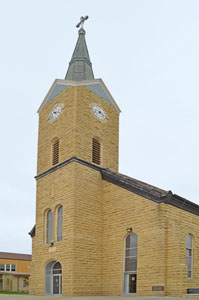
Hanover, Kansas Catholic Church by Kathy Alexander.
That year, a new treaty with the federal government granted the Otoe legal authority to sell the reservation for tribal annuities and relocate to “Indian country” in Oklahoma.
Father Pichler built a larger school and the present limestone church, which was dedicated in 1880 by Leavenworth Bishop Louis Fink before a crowd of 700. The church was enlarged with transepts in 1883, and a limestone rectory was built in 1884.
The Methodists had a good society and erected a brick church in 1880. Reverend J.N. McNulty, of Hollenberg, was their pastor. The Baptists also had an organization and worshipped in the Methodist Episcopal Church building.
By the early 1880s, a new schoolhouse was built for $8,000.
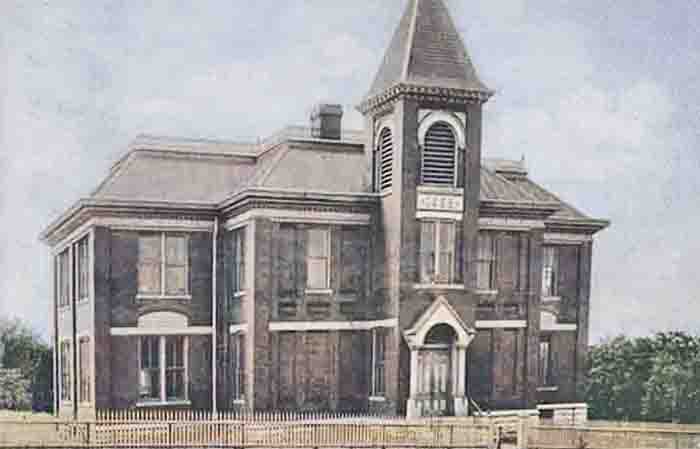
Public school in Hanover, Kansas.
In the fall of 1882, the Otoe Reservation was disbanded, and the “undeveloped” land was put for sale. The few remaining Otoe were of mixed backgrounds and quickly integrated with the new settlers, most notably the Barneses, of French and Otoe backgrounds.
On May 31, 1883, 50,000 acres of the Otoe and Missouri Indian Reservation in Kansas and Nebraska were opened for settlement at a public sale.
When the Otoe tribal lands were sold in 1883, the land sold for a record-high average of $12.22 per acre. By comparison, most other Native American tribes in the central and northern Great Plains were paid only 10¢ per acre. Some Otoe Indians were relocated to Red Rock, Oklahoma, while many mixed-race Otoe Indians were integrated into the local German community.
In 1885, a roller mill was built.
In 1890, Hanover was on the St. Joseph & Grand Island Railroad, 127 miles from St. Joseph, Missouri.
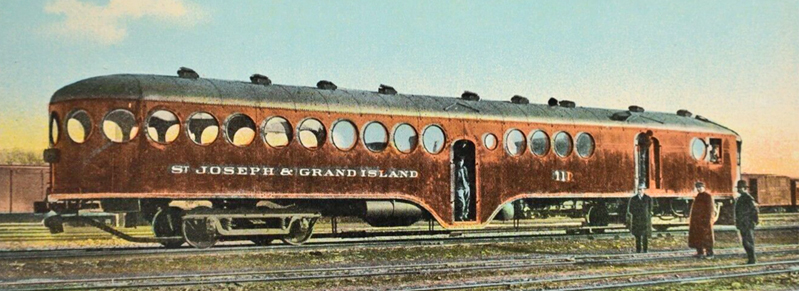
St. Joseph & Grand Island Railroad.
In 1895, the first water system was built. Afterward, it was improved and enlarged several times, and a water softener was installed.
In 1899, Mueller & Co. and H.O. Janicke organized the city’s first telephone company, the Hanover Telephone Company.
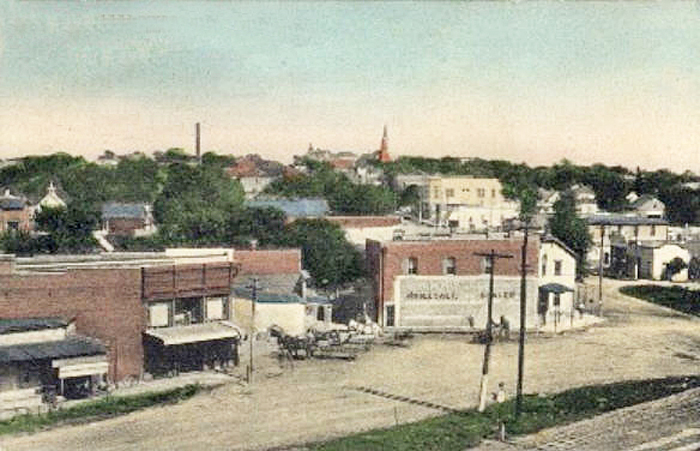
Hanover, Kansas, 1909.
By 1901, the town had grown to a population of 1,148, including 325 school-age children. Among its businesses were eight general stores, two furniture stores, three drug, stores, three hardware stores, two undertakers, three implement firms, two banks, four millinery stores, three harness shops, two jewelry stores, three hotels, three restaurants, two lumber yards, two grain and coal firms, two shoe shops, three barber shops, two livery barns, one photograph gallery, one pop factory, eight ice houses, a marble and granite works and three real estate firms. There were also a dray line, two railroad depots, two stock yards, a fine city hall and park, one Turner Hall and park, one Woodman Insurance hall, three private halls, a railroad roundhouse and machine shops, two pump houses, a post office, three school houses, four churches, and 22 benevolent societies.
In 1904, reins of the Telephone Company were turned over to August Jaedicke, Jr.
Hanover had its first electric lights in 1910. The city built its first powerhouse and street lighting system, making electricity available to its citizens, and maintained the system until 1927, when it was sold to the Kansas Power & Light Co., which continues to serve the city today.
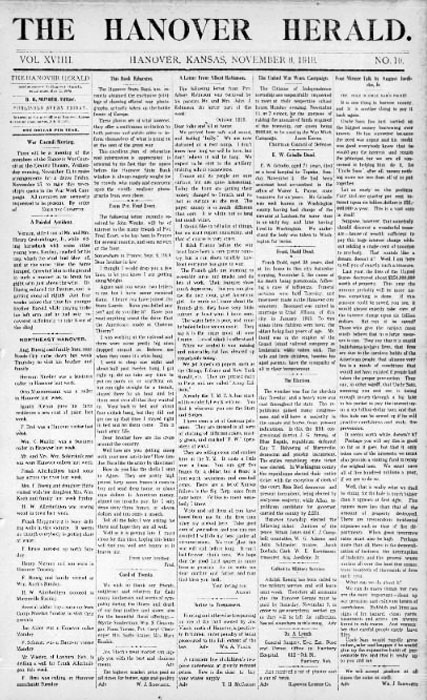
Hanover Herald newspaper.
In 1910, Hanover was at the junction of the Chicago, Burlington & Quincy Railroad and the St. Joseph & Grand Island Railroad, which made it an important shipping point for a rich agricultural district. At that time, the city had electric lights, waterworks, public and Catholic schools, two banks, two weekly newspapers — the Democrat-Enterprise and the Herald, an international money order post office with four rural routes, express, telegraph, and telephone facilities, a bottling works, several good mercantile establishments, hotels, and its population peaked at 1,039.
Until World War I, many residents of Hanover and the surrounding area continued to speak their native languages. However, the war abruptly changed the status of the German language. Its use did not die out entirely, but it became socially unacceptable in public, and the community’s youth had little opportunity to practice it. However, to this day, many German traditions remain an important aspect of the town’s identity.
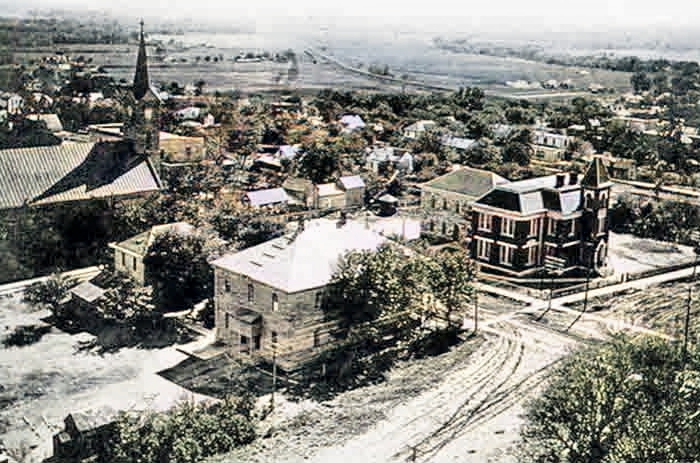
Hanover, Kansas, 1912.
In 1919, the city council, believing that the health of the community could best be maintained by installing a sanitary sewer system, passed an ordinance calling for the construction of a modern sewer system capable of accommodating a large increase in the town’s population.
In December 1921, Hanover residents were surprised to hear local musicians broadcast on their radios. This was made possible by William Ellis, the manager of the local telephone exchange, who had built a radio broadcasting set. For the next few years, Hanover citizens enjoyed programs featuring local talent, including musicians like O.D. Welch and his son, as well as Marvin Koeneke and various local bands. At one point, a Palm Sunday service was even aired live from the Evangelical United Brethren Church. This local entertainment continued until 1923.
The Telephone Company remained privately and locally owned until 1927, when the Western Telephone Company bought it. The Hanover Telephone Exchange later became part of the Southwestern Bell Telephone Company.
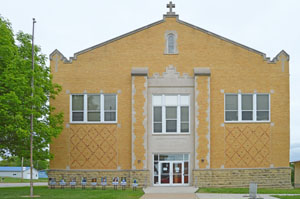
St. John’s School in Hanover, Kansas by Kathy Alexander.
In 1931, a Catholic grade school was built near St. John’s Church.
In February 1937, Ben Dingman opened the Kaw Theatre. John Jacoby operated it for eight months, until September 1937, when Ollie Flaherty took it over.
In 1941, Hollenberg Station was purchased by the state of Kansas. It was designated a National Historic Landmark in 1961. In 1963, it was turned over to the Kansas State Historical Society for maintenance and management. It was listed on the National Register of Historic Places on October 15, 1966. The site is open between March and October.
The Hollenberg Pony Express Station is the only remaining building along the 2,000-mile route, and it continues to stand one mile northeast of Hanover. The building has never been moved and retains its original dimensions.
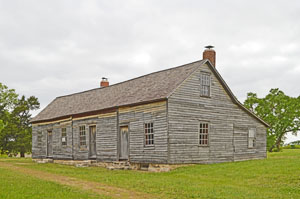
Hollenberg Pony Express Station by Kathy Alexander.
The station consists of a one-and-a-half-story rectangular Cottonwood frame building with a gabled roof, a wooden shingled exterior, and a stone foundation. The building is organized into six rooms: four served as the Hollenberg family residence, one as a shop, and the last as a bar and tavern. The loft area served as a sleeping area for riders of the Pony Express and guests. The building was historically accompanied by a stable and a blacksmith’s shop. The Hollenberg Pony Express Station is located about two miles East of Hanover, Kansas, along Kansas Highway 243.
In 1947, Hanover’s only physician died of a heart attack, prompting citizens to try to attract a new doctor the following year unsuccessfully. In December 1948, the Hanover Businessmen’s Club held public meetings and concluded that establishing hospital facilities was essential to attract a physician. They decided to create a hospital district rather than rely on voluntary investments to fund modern medical facilities.
A committee was formed to explore the legal issues related to creating a hospital district extending four miles from Hanover. Subcommittees contacted eligible voters to gather signatures for a petition. Over 80% of voters signed the petition, and on March 14, 1949, the County Commissioners approved it, establishing Washington County Hospital District No. 1.
The board of directors successfully persuaded a young doctor to come to town. He was Dr. Daniel S. Roccaforte, age 27, a graduate of the medical school of Creighton University, Omaha, Nebraska, who had practiced for about two years in the Cornazzo Surgical Clinic in Omaha. He opened his office here on March 1, 1949, and consulted with the board on plans for a clinic.
When the Korean War broke out, Dr. Roccaforte served in the military. During the ensuing months, numerous meetings were held, the first of which was to select a suitable location. Lots were selected, west across the street from the northwest corner of the City Park, and architects and engineers were contacted to determine the type, size, and cost of a suitable building.
On May 14, 1949, a Special Election was held to vote on a bond issue of $35,000.00, which carried by a vote of 448 to 176. Bids for the construction of the building were received in August 1949, ranging from $34,513 to $47,600. The low bidder was C.W. Strand of Marysville, Kansas, who was awarded the contract.
When complete, an Open House was held on March 13, 1950, with nearly 2,000 people inspecting the new building. That day, over $800 was donated to the hospital fund. The building was 38 feet by 59 feet, with a 10-bed hospital unit on the main floor. This included an operating room, two 3-bed surgical and medical wards, one 3-bed obstetrical ward, and a single-bed isolation ward. Additionally, a reception room, business office, nurse station, medical laboratory, nurses’ dressing room, public restroom, and surgeon’s dressing room were provided. On the lower floor were the kitchen, heating plant, offices, examination rooms, X-ray department, reception room for patients, and two dentist operating rooms with an office.
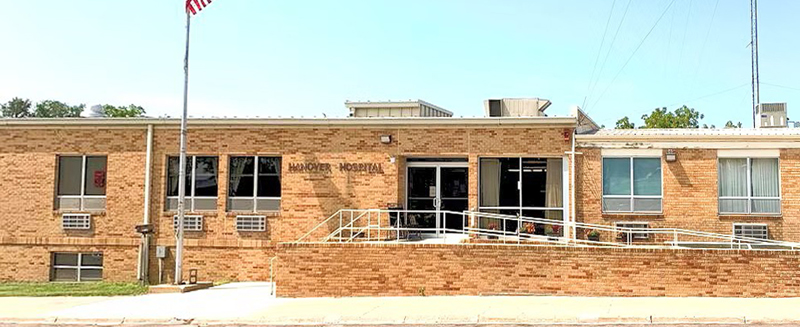
Hanover, Kansas Hospital.
When the Korean War ended in 1953, Dr. Roccaforte returned and served at the hospital, as did other Korean War veterans: Doctors White, Haley, Gerald Mowry, Roger Warren, and Berkley.
In December, 1953, the city voted to build a high school auditorium and add more classrooms.
In August 1958, it was proposed to construct an addition to the Hanover Hospital, measuring 36.5 feet long by 38 feet wide. In addition, a 16.5-wide ambulance driveway would be provided at the south end. The estimated cost of $50,000 would provide all the facilities that the State Board of Health then required.
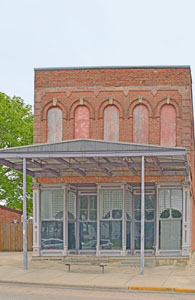
Business building in Hanover, Kansas, by Kathy Alexander.
On November 14, 1958, voters approved the $50,000 Bond Issue by a vote of 321 to 115, and in April 1959, it was announced that the Hospital Addition was scheduled to be completed by August 25, 1959, for $46,636.36 plus architects’ fees of 6%.
On August 6, 1960, Hanover Hospital employed eight people.’
More recent improvements include a new post office in 1961, the city swimming pool in 1963, and new buildings built by Bruna Brothers, Sedlacek’s, and the Farmers Co-op Elevator, all of which have altered and improved the business district.
On April 18, 1967, voters approved a $198,500 Bond Issue to help finance a 33-bed long-term care addition to the present 12-bed hospital by a vote of 357 to 332. The total cost was $360,000.
Late in 1968, the American Legion completed a new hall, and an 18-unit low-cost housing development is now under construction at the East edge of town.
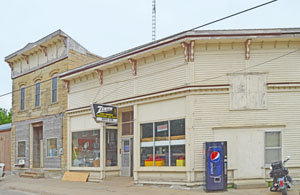
Business buildings in Hanover, Kansas, by Kathy Alexander.
In 1969, as Hanover celebrated her 100th birthday, it boasted a business community of two railroads, a bank, a hospital with two doctors and a dentist; a furniture and two appliance dealers, two electric shops, a barber shop, three beauty shops, a shopping center, which included both groceries and dry goods; a grocery market; a lumber yard, three filling stations, a locker plant, two ceramic shops, two cafes, a grain elevator and a feed and seed store; a sand and gravel company, a laundromat, a cleaning establishment, a plumber, two insurance agencies, five garages, a car wash, a tavern, a liquor store, a construction company, a drug store, one newspaper, an implement dealer, two produce dealers, a cabinet maker, three kennels, and a salvage company.
Since 2016, Hanover Hospital has continued to grow and improve its facilities, equipment, and services. On March 1, 2018, Warren Clinic was converted to a Provider-Based Rural Health Clinic while keeping its name.
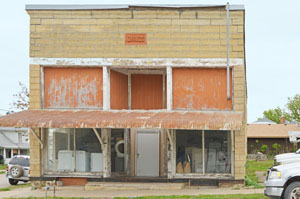
An old building in Hanover, Kansas, by Kathy Alexander.
Today, Hanover Hospital has about 80 on its payroll—from specialists and physicians to registered nurses, nurse anesthetists, office staff, accountants, and anesthesiologists.
The Hanover News went out of business in 2019.
Today, the community and nearby rural areas are served by the Barnes–Hanover–Linn USD 223 public school district.
Hanover has a preschool, Hanover Public School (K-12), and St. John’s Catholic School (1-8).
After eighth grade, children attend Hanover High School, a small 1A high school with 79 students. Many Hanover students complete dual-credit courses at Cloud County Community College during high school.
Hanover has a small public library located in the basement of the city hall.
Hanover is about 12 miles northeast of Washington, the county seat.
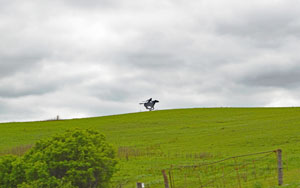
Pony Express in Hanover, Kansas by Kathy Alexander.
©Kathy Alexander/Legends of Kansas, updated May 2026.
Also See:
Haunted Hollenberg Station, Kansas
Washington County Photo Gallery
Sources:
Blackmar, Frank W.; Kansas: A Cyclopedia of State History, Vol I; Standard Publishing Company, Chicago, IL 1912.
Cutler, William G; History of Kansas; A. T. Andreas, Chicago, IL, 1883.
Hanover Centennial – 1869-1969
Hanover Hospital
Wikipedia – Hanover
Wikipedia – Hollenberg Pony Express Station
Wikipedia – Otoe Reservation