Guerilla Warfare in Kansas.
The word “guerrilla” comes from the Spanish “guerra,” which means “war,” and a guerrilla is someone who engages in irregular warfare. During the early years of the Civil War, the border line between the Union and the Confederate states was infested by guerrillas. In a few instances, these irregular soldiers favored the Union cause. Still, in the vast majority of cases, they were secessionists, and sometimes they cared more for plunder than for principle.
William C. Quantrill was the great guerrilla leader in western Missouri and Kansas, all the others in that section of the country acting under him or in conjunction with him. Among the most notorious guerrillas of the western border were Upton Hays, John Thrailkill, Coon Thornton, Bill Anderson, Archibald Clements, Jesse and Frank James, Cole Younger and his brother, Bill Todd, Si Porter, William C. Haller, George Todd, William H. Gregg, Cy Gordon, John Jarrette, Dave Poole, Lee McMurtry, George Shepherd, George and Dick Mattox, Dick Yeager, Peyton Long and Fletcher Taylor.
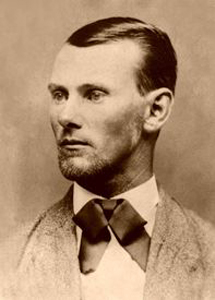
Jesse James.
Several of these men were only privates, but by their daring and bloodthirsty deeds, they won a notoriety that has carried their names into history, even though, in a way, it is unworthy of emulation. Frank James was never a leader among the guerrillas. He and the Youngers were at Lawrence in August 1863. Jesse James had not yet joined Quantrill. After the war, the James boys and the Youngers became noted outlaws.
Upton Hays went with Quantrill to Utah in 1858. He was in command of the “Partisan Rangers” in western Missouri until he was succeeded by Quantrill in 1862. He then left that part of the country for a time, but later in the year returned to Jackson County, Missouri, to raise a regiment for the Confederate service. Quantrill made a raid to attract attention while Hays was recruiting. Hays joined Colonel John T. Hughes for an attack on Independence, Missouri, in August, and in the action, was wounded in the foot. He succeeded, however, in capturing enough arms and ammunition to equip his 300 men.
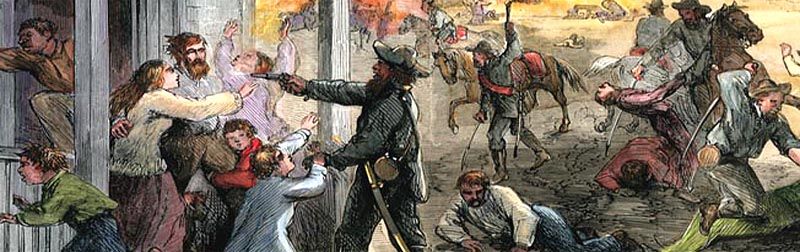
Guerrilla gangs made several raids into Kansas. In October 1861, the town of Humboldt was raided by Colonels Williams and Matthews, who sacked nearly every house and store in the place. About the same time, the little town of Gardner, Johnson County, was plundered. On March 7, 1862, Quantrill raided Aubrey, a little town in the southeast corner of Johnson County, where he killed three men and destroyed considerable property. In June, Bill Anderson made a foray as far west as Council Grove, killing two men and burning at least one house. On September 6 and 7, Quantrill visited Olathe, where he destroyed or carried off much property. In October, he made a descent upon Shawnee, Johnson County, and killed seven citizens. Just before visiting the town, he attacked the camp of a Santa Fe-bound wagon train and killed 15 members of the escort. Humboldt was again visited in 1862—this time by Colonel Talbot, who burned several buildings, plundered right and left, and killed four or five citizens who tried to defend their homes.
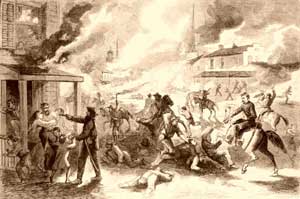
Lawrence Massacre, by Harper’s Weekly.
On August 15, 1862, Quantrill was commissioned captain in the Confederate service and placed in command of a company of 150 men. William C. Haller was made first lieutenant; George Todd, second lieutenant, and William H. Gregg, third lieutenant. Whatever the acts of these men had been before that time, after that date, they were supposed to be acting under the authority of a power that was engaged in warfare according to the rules adopted by civilized nations. In May 1863, Jarrette, Younger, Clifton, and some other minor guerrilla leaders united their gangs with Quantrill’s command for the big raid on Lawrence in August.
In May 1863, Dick Yeager left Missouri on the Santa Fe Trail, crossed over into Kansas, and on the 4th, encamped near Council Grove. That night, he raided the little village of Diamond Springs, where he killed one man and wounded a woman. On the return trip, he stopped at Rock Springs, a stage station near the line of Osage and Douglas Counties, where he met and killed George N. Sabin, a soldier of Company K, Eleventh Kansas, who had been at his home in Pottawatomie County on furlough and was on his way to rejoin his regiment. Seven miles farther on, Yeager’s men shot and seriously wounded David Hubbard, then passed through Baldwin and Black Jack, where they robbed the stage, and then returned to Missouri, via Gardner.
Just after the raid on Lawrence, Quantrill passed through the old town of Brooklyn, where he did some damage, and on October 6, 1863, his men ruthlessly massacred some Federal troops at Baxter Springs. Other depredations by guerrillas were in the vicinity of Mine Creek, where several settlers were driven from their homes, and at the towns of Potosi and Spring Hill. By the fall of 1863, the Union troops were so well organized along the eastern border of the state that guerrilla raids practically ceased.
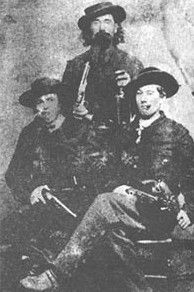
Missouri Border Ruffians.
Compiled & edited by Kathy Alexander/Legends of Kansas, June 2026.
Also See:
Border War & Civil War Battles
Territorial Kansas & the Struggle For Statehood
Source – Blackmar, Frank W.; Kansas: A Cyclopedia of State History, Vol I; Standard Publishing Company, Chicago, IL 1912.