
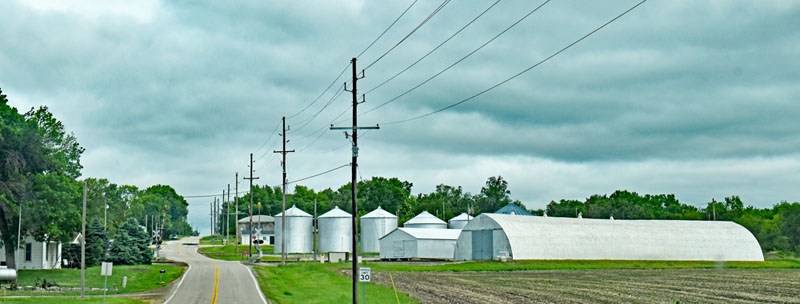
Entering Oneida, Kansas by Kathy Alexander.
Oneida is a tiny town in Gilman Township of Nemaha County, Kansas. As of the 2020 census, its population was 61, and it had a total area of 0.24 square miles, all land. It is also an “extinct” town as it no longer has a post office.
When this place got its start near the St Joseph & Western Railroad, it was first called Lappin. A post office was established on August 8, 1872, at the farmhouse of Henry Kerns.
In 1873, Colonel Cyrus Shinn bought 400 acres of land in the vicinity, part of which he platted for a town. The town’s streets were named after the main thoroughfares of Chicago, Illinois.
The town and post office name was changed to Oneida on January 19, 1876. It was named after the Oneida Indians. That year, Colonel Shinn erected a store building, which he first leased to John Mitchell and subsequently to J.O. Steinbaugh, who succeeded Kerns as postmaster.
In 1878, Colonel Cyrus Shinn gave an acre of land to George W. Buswell, who built the Oneida Cheese Factory. That year, a blacksmith shop and harness store were built. Colonel Shinn opened a land office and began publishing the Oneida Real Estate Journal. Hyde Park, comprising ten acres of densely timbered land, was opened in 1878, with a refreshment building known as the Rialto and a platform and pavilion measuring 40 by 40 feet constructed.
The Oneida Real Estate Journal was sold to J.F. Clough, of the Nemaha County Republican, in October, 1879, the new owner giving it the name Oneida Journal. That year, the two-story Lindell House was erected by Colonel Shinn, who immediately sold it to B.F. Chamberlain. It was later owned by J.N. Conger, J.M. Claypool, and David Kautz.
W.C. Hamlin, a druggist and native of St. Joseph County, Michigan, came to Nemaha County in 1879 to start a drug store, which was established in the fall of 1880.
J.B. Elliott, born in Indiana, came to Oneida with his family in 1879, and the following year, he bought the Oneida Cheese Factory. He managed it with his four sons. The two-story building was 24 by 60 feet in size and was fitted with the most up-to-date machinery, including two vats, a boiler, curd cutters, improved presses, tube testers, etc. Its capacity was rendering 10,000 pounds of milk into 1,000 pounds of cheese each day. It was one of the best-known, most popular, and most successful factories of its kind in the State. Its sales extend from St. Joseph to Denver, Colorado, and as far North as Grand Island, Nebraska.
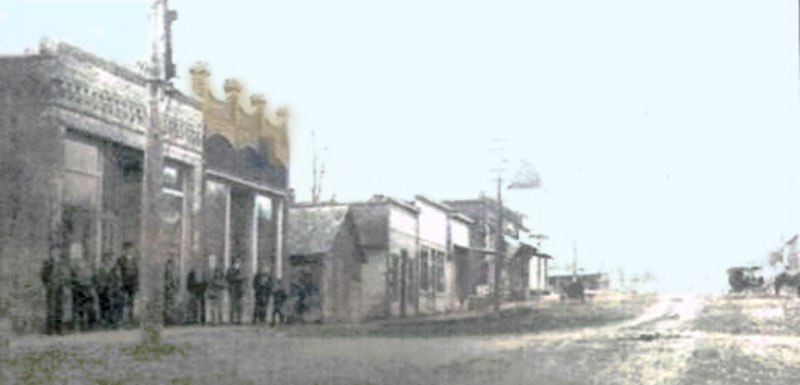
Early day Oneida, Kansas.
With the town underway, Colonel Shinn made extensive trips through Illinois and Missouri distributing handbills and lecturing on the possibilities of his town. He gave everyone in Oneida a free lot, promised to do the same for anyone who came to build and stay permanently, and said they would not sell liquor on their property.
“I am bound to boom the town if I don’t make a cent.”
— Colonel Cyrus Shinn
George W. Head, from Ohio, came to Nemaha County with his family in 1875; engaged in farming here until 1880, when he bought J. Conlin’s stable from William Bellin. The Buckeye Livery Stable, a model of its kind, was built in 1882. It measured 36 by 60 feet, and in it were half a dozen elegantly matched and lively teams. He had a 140-acre farm in Gilman Township, which was prosperous.
In 1881, two churches were built: the Randolph Street Christian Church and the Fifth Avenue Presbyterian, the latter used by both the Presbyterian and Congregationalist societies. In the spring of the same year, the two-story Lake Street Schoolhouse, measuring 34 by 66 feet, was built and was immediately divided into four departments. The Opera Hall was also erected on Monroe Street, with the lower floor of the building, measuring 24 by 60 feet, used by J.H. Mayhew’s furniture and hardware store, the proprietor of which succeeded Steinbaugh as postmaster.
By the early 1880s, Oneida had never had a saloon, nor a drunken brawl within its limits. At that time, it had two general stores, a hardware store, a furniture store, two drug stores, a hotel, a lumber yard, a livery stable, various industrial shops, one restaurant, and a population of 163.
The Oneida Journal suspended publication in May 1882.
The railroad emerged from bankruptcy in June 1885 as the Union Pacific Railroad-controlled St. Joseph & Grand Island Railroad.
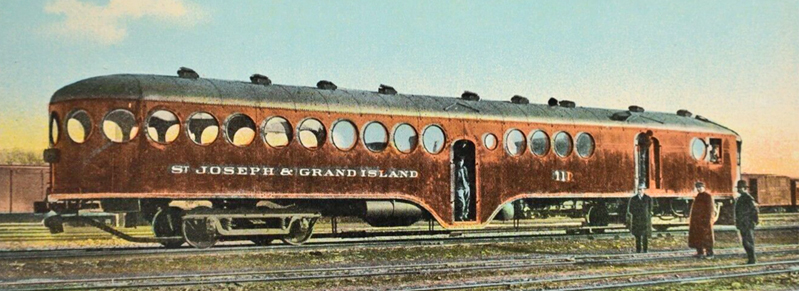
St. Joseph & Grand Island Railroad.
By the end of the 1880s, at least six trains were passing through the town every day, with some express runs.
Oneida’s population peaked at 311 in 1890.
In the early 1900s, Oneida built a public school. It was a large two-story wooden-sided building that held grades K-12,
In 1910, Oneida was on the St. Joseph & Grand Island Railroad. At that time, it had banking facilities, telegraph and express offices, a money order post office with two rural routes, and a population os 211.
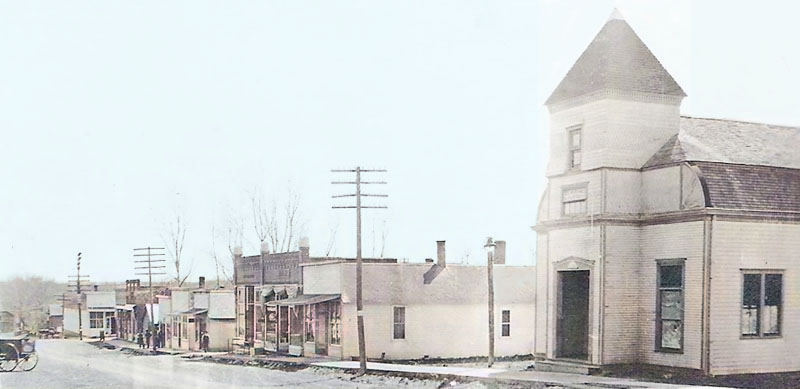
Oneida, Kansas in 1910.
In 1917, the school was torn down, and a new brick school was built in its place.
As the populations and expansions of the nearby towns of Seneca and Sabetha grew, more and more people began driving to those towns to do their trading and buying of supplies. Being nestled between these two towns hurt Oneida’s population and businesses. The rerouting of Highway 36 also hurt the town.
Despite declining population in Oneida, a summer movie theater opened in the 1940s and continued for 20 years.
In 1961, Oneida’s school was closed during school consolidation, forcing major change. The children were sent to different schools, with the children who lived in the North part of Oneida sent to school at Bern. The children who lived on the East side of Oneida went to Sabetha, and the children from the West side went to Seneca.
Oneida’s post office was discontinued on March 30, 2013.
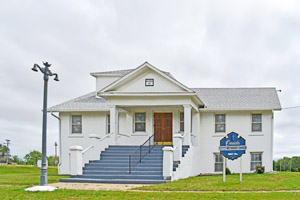 Methodist Church in Oneida, Kansas by Kathy Alexander. |
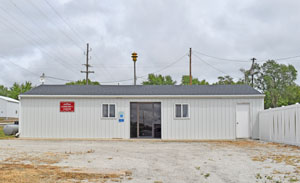 Oneida, Kansas Community Center. |
Today, Oneida still has a Methodist Church, a community center, and the Union Pacific Railroad continues to pass through.
The community is served by Nemaha Central USD 115 public school district.
Oneida is nine miles Northeast of Seneca, the county seat.
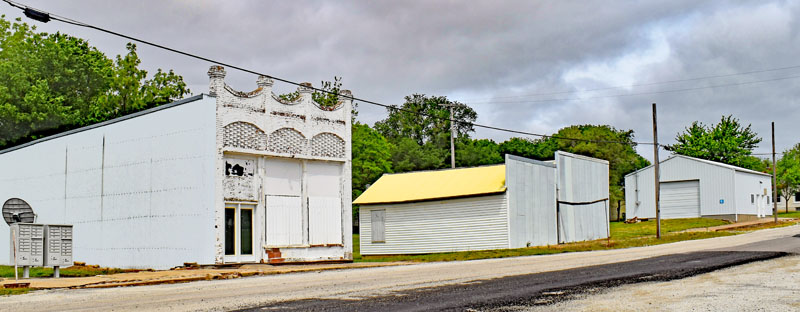
Oneida, Kansas Main Street Buildings by Kathy Alexander.
©Kathy Alexander/Legends of Kansas, updated July 2026
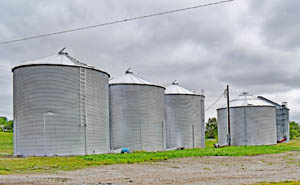
Silos in Oneida, Kansas by Kathy Alexander.
Also See:
Extinct Towns of Nemaha County
Sources:
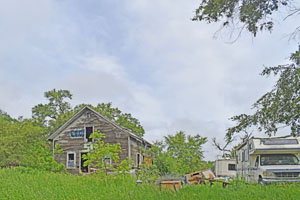
An old building and junk in Oneida, Kansas by Kathy Alexander.
Blackmar, Frank W. Kansas: A Cyclopedia of State History, Vol. I. Standard Publishing Company, Chicago, IL, 1912.
Cutler, William G. History of Kansas; A.T. Andreas, Chicago, IL, 1883.
Oneida – Lost Kansas Communities
Wikipedia