
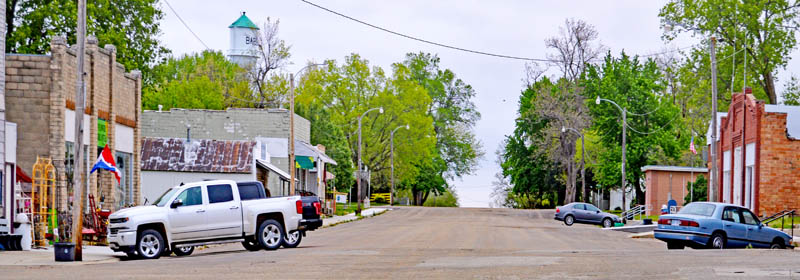
Barnes, Kansas Main Street by Kathy Alexander.
Barnes, Kansas, is a small town in the Flint Hills near the head of North Coon Creek in Barnes Township of Washington County. As of the 2020 census, its population was 165, and it had a total area of 0.18 square miles, of which 0.17 square miles is land and 0.01 square miles is water.
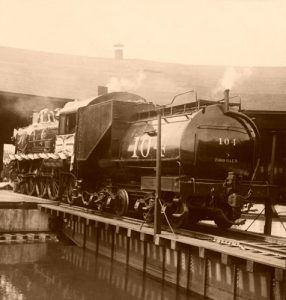
Union Pacific Railroad Engine by H.C. White, 1905.
This place got its start as a small station when the Central Branch of the Union Pacific Railroad reached that point in November 1876. It was named in honor of A.S. Barnes, a stockholder of the Central Branch.
Barnes was on the main line of the Central Branch, unlike the town of Washington, which was on a spur. Being on the main line provided greater access to materials and transportation, a key factor in Barnes’s formation.
Henry Ober erected the first building on the town site and opened a store. On February 5, 1877, the post office was moved from Elm Grove, about a mile and a half north of Barnes’ current location, with J.R. Ober as the postmaster.
The Maplewood Grange erected a grain warehouse, in which the Congregationalists held services for a time in 1877 and 1878. Besides the grain elevator, there were two general stores and a boarding house.
Henry Ober also erected the English Lutheran Church in August 1879. The building was also used for Methodist worship on every other Sunday.
In the 1880s, Barnes began to boom. In 1884, a writer for the Palmer Weekly Globe speculated as to why Barnes was growing so quickly, writing:
“Many people wonder why Barnes has taken such a wonderful start, and what is the cause. There is no new railroad, no gold mine or mineral springs discovered, but simply a plain quarter section of Kansas sod fast being covered with houses.”
He then summarized by stating: “In addition to her splendid agricultural advantages, Barnes is represented by genuine businessmen, who encourage every enterprise beneficial to the town.”
Over the years, Henry Ober’s first store became a grocery store, a post office, a church, a dance hall, and a dwelling.
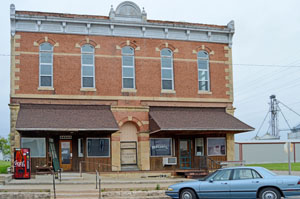
The upper story of this business building, once an opera house in Barnes, Kansas, is by Kathy Alexander.
In 1895, Hiram Dearborn built a large brick-and-stone building at 10 N. Center Street. Allegedly, the Dearborn family decided to build the Opera House to rival the one in nearby Waterville. On the lower level, numerous shops were rented to various vendors. The upstairs featured the old opera house, complete with a stage, ticket booth, and gas lamps. As the center for entertainment, presenting various shows, plays, and musical entertainment. It also served as an event venue. The building, with its ornate window hoods, corbelled brickwork, molded cornices, and arched windows and doorways, still stands today, complete with its original stage.
By 1910, the incorporated town of Barnes was a station on the Missouri Pacific Railroad. At that time, it had a money order post office with three rural routes, express and telegraph offices, telephone service, a bank, a weekly newspaper called the Barnes Chief, Methodist, Lutheran, and Christian Churches, good schools, and its population peaked at 454. It was the principal trading and shipping point for Barnes Township.
Barnes’ business district was a big destination for people in the surrounding areas. Many townspeople, as well as newspapers, were proud to boast that the town was home to three grocery stores, three blacksmiths, five filling stations, three car dealerships, and three telephone companies, among a host of other businesses.
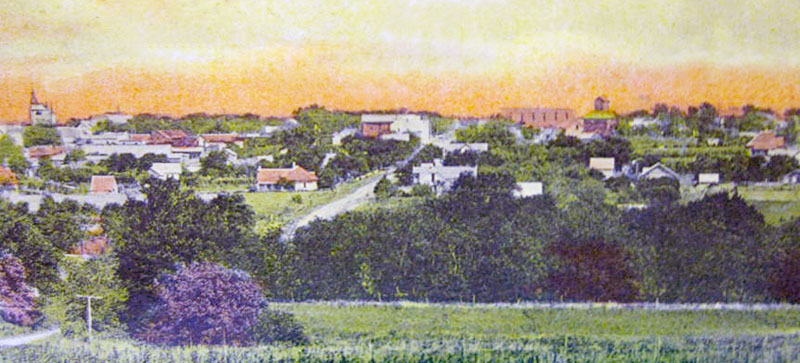
Barnes, Kansas, in about 1911.
People also went to the pool hall or hung around Mike’s Cafe, which served as both a restaurant and a poker house. There was also a Fox movie theater. Unfortunately, the Fox burned down years later and was replaced by outdoor film screenings. These outdoor films were held on a lot just north of the telephone office on summer evenings. These screenings were free to the public.
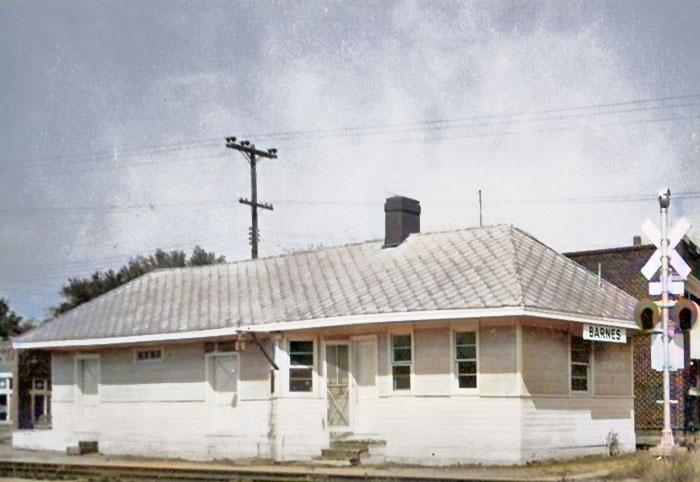
Missouri Pacific Railroad Depot in Barnes, Kansas.
Afterward, Barnes began to experience a slow population decline, likely due to the automobile’s widespread mobility. The Great Depression, the drought that plagued cropland in 1934 and 1935, and the floods in 1936 had a significant effect on the population. Though some townspeople chose to stay on their families’ land, many left, either to attend school or to seek work and opportunities elsewhere. As a result, the railroad slowly shifted from passenger trains to cargo trains, to no trains at all.
Barnes schools were closed in 1965 as part of school unification.
The depot was shut down in 1973.
The railroad tracks were torn out in about 2004.
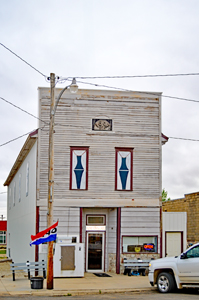
Barnes, Kansas Cafe by Kathy Alexander.
Today, the community and nearby rural areas are served by the Barnes–Hanover–Linn USD 223 public school district, headquartered in Barnes, Kansas. Barnes is still a gathering place. One of its main events is the lighted horse parade the weekend after Thanksgiving. Afterward, a soup supper gives people a chance to visit and catch up.
The Hometown Cafe still serves Barnes in a historic building that was once Mike’s Cafe. It was bought by the Barnes Community Development Corporation, which is committed to preserving Barnes’ traditions and community. They also own the gym.
Barnes is 13 miles southeast of Washington, the county seat. It is nestled between the towns of Greenleaf and Waterville along Highway 9.
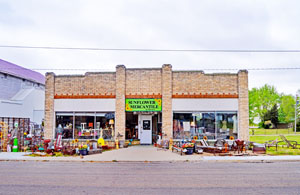
Mercantile in Barnes, Kansas by Kathy Alexander.
©Kathy Alexander/Legends of Kansas, updated May 2026.
Also See:
Washington County Photo Gallery
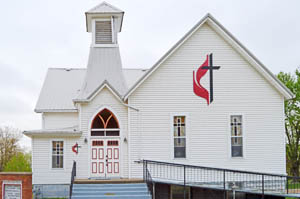
Methodist Church in Barnes, Kansas, by Kathy Alexander.
Sources:
Blackmar, Frank W.; Kansas: A Cyclopedia of State History, Vol I; Standard Publishing Company, Chicago, IL 1912.
City of Barnes
Cutler, William G; History of Kansas; A. T. Andreas, Chicago, IL, 1883.
Tanner, Caroline; Chapman Center for Rural Studies, Barnes In Full Boom
Wikipedia