

Franklin County, Kansas by L.H. Everts & Co., 1887.
Greenwood Township, in Franklin County, was organized in 1865. It was initially part of Ohio Township and was first called the Sac & Fox Agency when a post office was established on March 3, 1855. Its early agent was Burton James.
Perry Fuller succeeded Burton James as agent and brought about the treaty by which the Indians received their lands in severalty. This treaty provided for the building of houses for the heads of families. Robert S. Stevens secured the contract and built the houses of stone, which was the most abundant material suited to the purpose. Upon the completion of the houses, the Indians converted them into stables for their horses, themselves sleeping in tents as before, except Keokuk, their chief, and a few others. Several traders were located at the agency, including H.S. Randall, William Pennock, and Thomas McCage.
In 1859, the agency was moved to Quenemo in Osage County, with Perry Fuller as agent. The agency also employed an interpreter, John Goodell, to assist in government negotiations with the tribe.
After the Indians were removed, the town of Greenwood was laid out by Perry Fuller, William Pennock, Thomas McCage, H.S. Randall, H.B. Denman, and Thomas Connelly in the vicinity of the former agency at the junction of county roads, seven miles West of Ottawa. It was named after Judge Alfred Greenwood, the commissioner of Indian Affairs in the U.S. Department of the Interior.
The post office’s name changed from Sac & Fox Agency to Greenwood on February 27, 1861.
The Greenwood school opened in 1862 under the direction of the Moravians. The Moravian Missionary Society, an evangelical sect, focused on converting American Indians, including the Sac and Fox of Kansas.
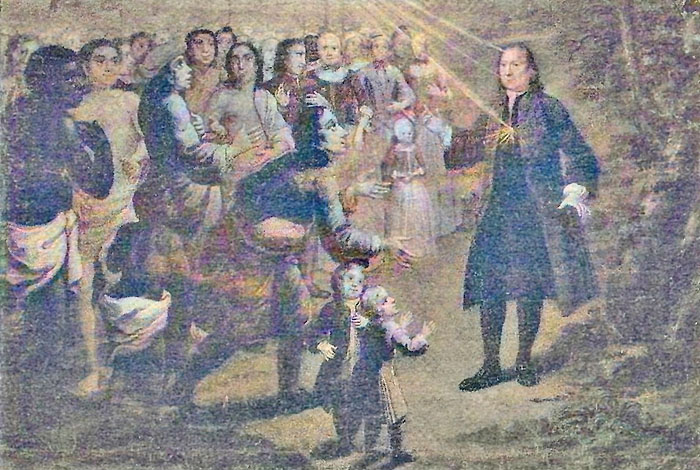
Moravian Missionary.
Moravian missionary Joseph Romig was an early missionary in Franklin County and the last to serve at the Greenwood Church from 1862 to 1871.
Harrison Reed and his wife came from Littleton, Illinois, to Franklin County, Kansas, to live on a farm which they had bought from a woman named Thorp of the Sac and Fox Indian Tribe. This farm consisted of 640 acres of land located on the South Bank of the Marais des Cygne River in Greenwood Township.
The Reeds were members of a Baptist church in Littleton, and Mr. Reed, an ordained deacon, immediately began seeking Christian people so they might organize a church in Greenwood. Deacon Reed gladly opened his new house to the community, and Sunday School was held there. Later, preaching services were started. In fair weather, services were held under the shade of an Oak tree, West of the house.
The Greenwood Church began in October 1865.
The first election was held at William Nightingale’s tavern in 1866, and the first schoolhouse, a log building, was constructed that year.
The first log cabin home was built in 1866, and a second one soon followed.
The Greenwood Baptist Church was organized on July 10, 1870, by Reverend I. Hetrick, who served the church as pastor for 19 years. The weather was no deterrent to the converts, who were baptized in the Marais des Cygnes River regardless of conditions. Sometimes the ice was thick enough for the congregation to stand on. On one occasion, a team of horses and wagons was driven on a pond for the singers, and a hole was cut in the ice for the baptism. The preacher and candidates descended a ladder into the water.
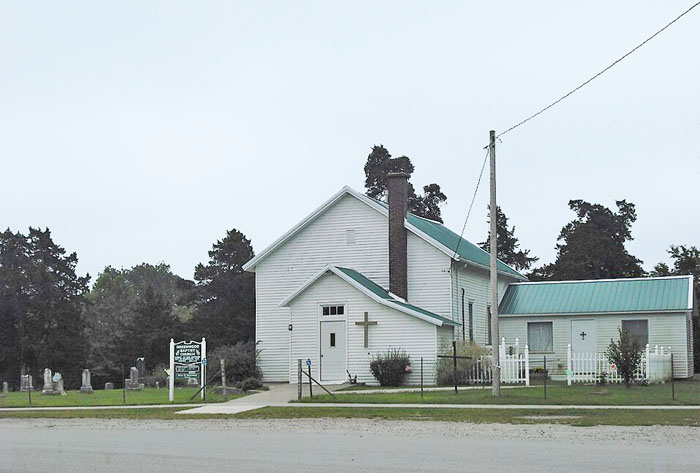
Greenwood Church & Cemetery, courtesy Wikipedia.
Deacon Reed gave the land for the church and cemetery, and the church was erected in 1871. Supervised by Fred Miller, the lead carpenter, it was built mostly with volunteer labor and from native lumber, which was sawn a short distance up the river at the sawmill. It was valued at $1,200.00.
The church had splendid growth and made an excellent showing in the first 20 or 25 years. Records show the highest number of members was 164 in 1894. After 1900, it was weakened by continued transfers or deaths.
Despite the residents’ best hopes, the town never prospered and passed rapidly out of existence. Greenwood’s post office closed on September 3, 1872.
Moravian missionary Joseph Romig served again from 1900 to 1905.
Later, the Greenwood school served for many years as District School #49 and as a community meeting place.
In about 1940, Mr. and Mrs. George Young presented the church with the pulpit and bell from the old Moravian Mission Church on their farm. A belfry was built and the bell installed. It was dedicated on Easter Sunday, 1942. Due to leakage around the belfry, the belfry was taken down in 1968, and both the bell and the pulpit were presented to the Historical Museum in Ottawa by the Greenwood Church.
For many years, the church was pastored by students from Ottawa University. Many of these students became prominent Baptist pastors and leaders throughout the nation, and others became missionaries to foreign fields.
Most of the early-day church members are buried in the cemetery, including Deacon Reed and his wife, Reverend Hetrick and his wife, the Graves, Millers, Conners, Luttons, Reeds, Pruetts, Fitzgeralds, Davis, and the Lawsons.
The Greenwood Cemetery, Greenwood Community Church, and Greenwood Community Building still survive.
©Kathy Alexander/Legends of Kansas, July 2026.
Also See:
Extinct Towns of Franklin County
Sources:
Blackmar, Frank W.; Kansas: A Cyclopedia of State History, Vol I; Standard Publishing Company, Chicago, IL 1912.
Cutler, William G; History of Kansas; A. T. Andreas, Chicago, IL, 1883.
History of Franklin County, by Jane Richards, 1992, and Deborah Barker, 2011.
Kansas Post Office History
Wikipedia