
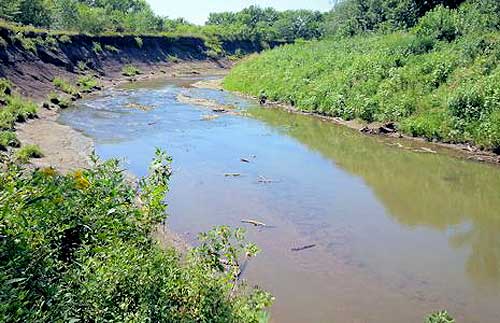
Black Vermillion River, Kansas.
The oldest settlers in the Vermillion Valley of Marshall County said that when they came there, they found two families — the head of one a Sioux half-breed named Louis Tremble, whose wife was a full-blooded Sioux. The other family consisted of a Frenchman named Julian Changreau and his wife, a Sioux woman; her sister, a girl of 15, and numerous small children. Tremble built a bridge across the Black Vermillion River and charged the Western pilgrims a toll for crossing. He also opened a farm of about 15 acres, raising vegetables and produce, which found ready sale among travelers.
The Kanza, or Kaw Indians, as they were commonly called, are a branch of the Sioux, as are also the Otoe, Omaha, and Ioway. The country encompassing all of northeastern Kansas was occupied by the Kanza when, in 1825, the Government opened negotiations with them to purchase part of their territory. Between the Kanza and the Sioux, the parent tribes, there was an implacable hatred. Whenever the bands of the two tribes met, no matter where, there was a war to the knife, and whoever was not killed but captured suffered death by cruel and devilish torture. “No Sioux or Kanza could meet each other and live.” These two Sioux families were aware that they had located in the old territory of the Kanza, and that the residence of their perpetual foes was not far distant, but trusted their neighbor Sioux for protection.
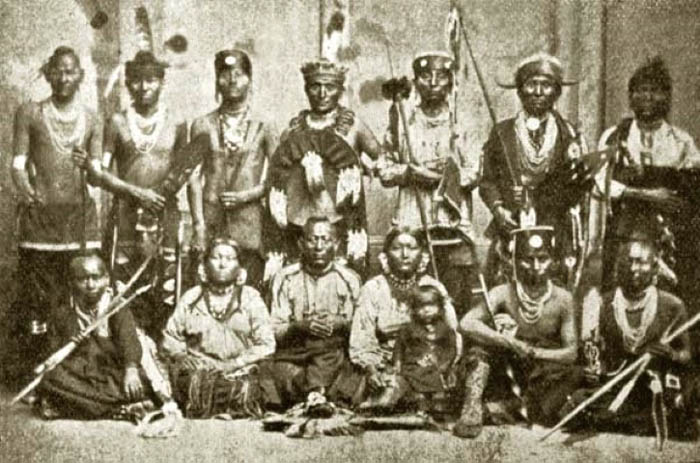
Kanza Indians.
One spring day, while Julian Changreau was in the field plowing, the house was suddenly surrounded by a band of mounted Indians, numbering 100 or more. The women made an effort to conceal themselves, but failed. The Indians professed friendship, but helped themselves to everything that they fancied. After reckless pillage, the chief suddenly seized the young girl, bound her to his pony, and, mounting, they all disappeared.
Changreau, who was at once notified by his frantic wife of what had occurred, suspected who the visitors were, and knowing that a fate worse than death would await the helpless prisoner, made a most pressing and urgent appeal to his white neighbors to go with him to the rescue. A few responded, and John D. Wells and a few others started with Changreau and followed the trail for many hours. However, fearing an ambush, they turned back, except for Changreau, who pushed on alone. Changreau followed the band for many days, until they camped on the Neosho River, near Council Grove. The Frenchman, who had kept himself concealed, saw that unusual preparations were being made and then knew that the worst was to come. But what could one man do against one hundred? He had followed without hope, in utter despair as to the accomplishment of any good so far as the captive was concerned.
Soon after the lodges were erected, the Indians had a feast, which they devoured with unusual dispatch. Then the fires were relighted and made to burn with great brilliancy, lighting up the demoniacal group, and glaring in the darkness upon the distant and rounded hill slopes. At last, Changreau saw an Indian, whom he had observed had his sister in his keeping, lead the helpless and devoted captive into the semicircle and bind her to a tree.
The Frenchmen could witness no more. Mounting his pony, he turned his face on the scene and rode away in the darkness. He was soon miles and miles away, and all that night circled the Indian camp, not seeing but knowing what was being transacted there. In the gray dawn of morning, he rode back to the camp and, creeping almost among the lodges, saw seated by the warning campfires a row of Kanza women, talking of what had happened, and pointing their fingers at a figure, rendered indistinct through the smoke and darkness, bound to a tree trunk. As it grew lighter, he saw that his sister was dead — her lifeless body covered with gore; whips and scourges lay at her feet, which showed that the girl had been whipped to death amid the war dances and battle orgies of the night. What he dreaded as the worst he now was sure of, and with his sad and fearful tale, he returned to his family and hastened to move them to a place of greater safety.
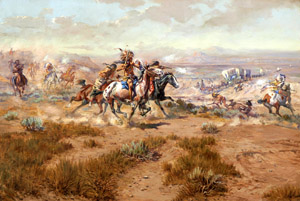
Wagon train attacked by Indians by Charles Marion Russell.
Marshall County, during the war, was one of the border counties and was several times the seat of panics arising from depredations committed by the Indians. Emigrants and ranchmen on the overland road were often driven in, as were also the new settlers, who had taken up claims west of Marshall County. At times, apprehensions were felt that the Indians would extend their devastations to the older settlements, depleted as they were of able-bodied men from enlistments in the army.
The first panic occurred in May, 1862, being occasioned by an Indian raid made into Washington County. In consequence, a detachment of recruits being raised at Marysville was sent out on a reconnaissance, but no Indians were seen.
The greatest panic was created on August 10, 1864, by a raid made by Indians on the Little Blue River. Refugees from the scene of the massacre began to pour into Marysville. Teams with wagons filled with settlers, station-keepers, and ranchmen, with their families, flowed into the town, each bringing stories of the outrageous murders and torture of men, women, and children, and beseeching aid in recovering their captured friends.
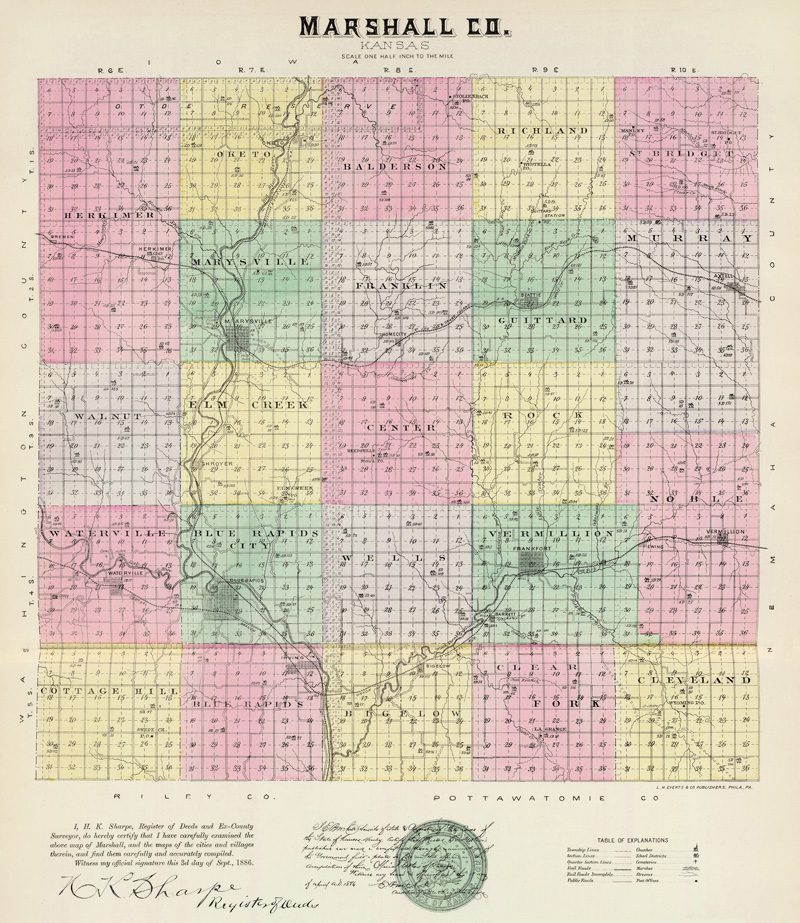
Marshall County, Kansas Map by L.H. Everts & Co., 1887.
The militia companies were immediately mustered, and after making hasty preparations, left for the scene of trouble. One company under the command of Captain Frank Schmidt and one under the command of Lieutenant James McCloskey were on the march the day after the first intelligence arrived. They were also joined by a company from Vermillion, under Captain James Kelley, and one from Irving, under Captain T.S. Vaile. The Marshall County troops were under the command of Colonel E.C. Manning. They were followed by a brigade expedition composed of portions of the Nemaha, Riley, and Washington County regiments, under the command of General Sherry of Seneca. Both expeditions, after traveling and seeing evidence of Indian warfare, but meeting none, returned to their homes. Many of the refugees from the overland road and the counties west remained in Marshall County two or three weeks before returning to their homes.
Compiled and edited by ©Kathy Alexander/Legends of Kansas, May 2026. Source: Cutler, William G.; History of Kansas; A. T. Andreas, Chicago, IL, 1883.
Also See: