
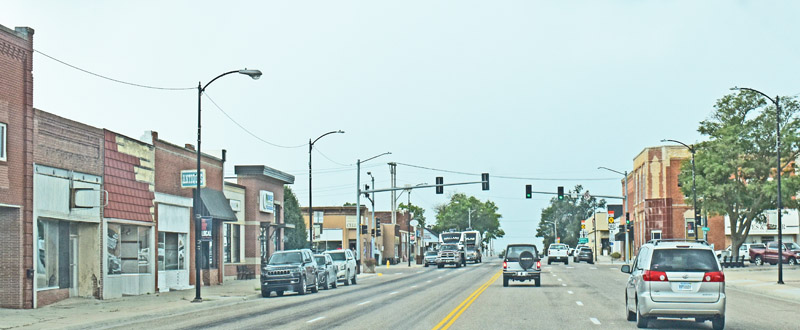
Phillipsburg, Kansas Main Street by Kathy Alexander.
Phillipsburg, Kansas, is a city in Phillipsburg Township, Phillips County, and the county seat. Nicknamed “City Of The Hills,” Phillipsburg sits in the uplands of Deer Creek in northwestern Kansas on the western edge of the Smoky Hills region of the Great Plains. Approximately 20 miles south of the Nebraska border, it sits on the north side of Deer Creek, a tributary of the North Fork of the Solomon River. Plotner Creek, a tributary of Deer Creek, flows south along the western edge of the city. As of the 2020 census, its population was 2,337, and it had a total area of 1.67 square miles, all land.
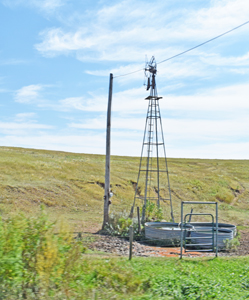
Phillips County landscape.-
John Mercer was the first settler in Phillipsburg Township in 1871 and continued to reside there for several years
The first flouring mills were erected by Skinner, of Kirwin, and McClellan and Hanson, in Logan. Dustin & Close, at Phillipsburg, were the pioneers in the mercantile business
In 1872, Phillips County was organized and named after William A. Phillips, who served in the army during the Civil War and later served in the Kansas Congress.
Phillipsburg was also organized at that time, and in April, a Charter of Incorporation was obtained, even though there were no buildings or houses at the site. The town was founded and laid out by settlers from Doniphan County, Kansas, consisting of Samuel Plattner, J.H. Close, and E.S. Dean. Mr. Plattner erected the first house in the place, hauling the lumber from Doniphan County, a distance of over 250 miles. This was the only building erected in 1872 and was used as a residence, hotel, and store. Messrs. Sayer & Dutton opened the first stock of goods brought to Phillipsburg.
Governor James Harvey declared Phillipsburg the “temporary county seat” on July 26, 1872. The first family to settle in Phillipsburg was Mr. and Mrs. F.J. Dutcher, who arrived in the fall of 1872. That year, Phillipsburg had a real estate business that also acted as a loan office.
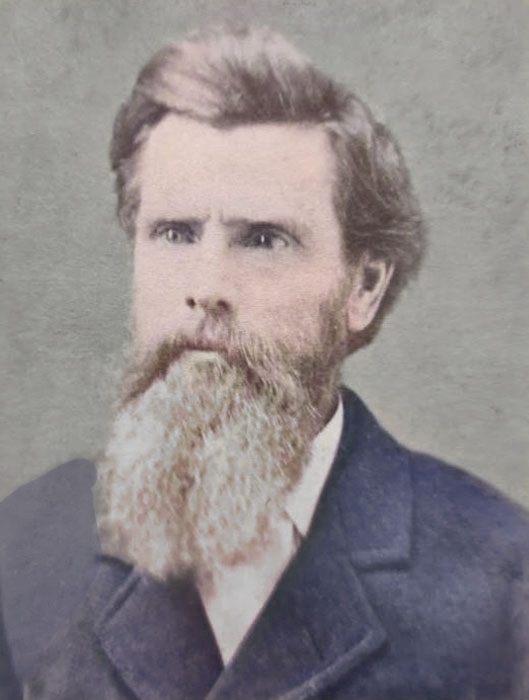
John Bissell.
Fort Bissell was built in 1872 near Phillipsburg on land owned by John Bissell, one of the earliest settlers in the area. At that time, there were still roving bands of Indians in the area. Never a Federal Military Post; it was built by early settlers, many of whom were Civil War veterans, for protection against Indians.
The first election for county officers was held in the fall of 1872, and the following named persons were elected: Treasurer, Thomas Cox, Jr. Clerk Henry McDowell; Register of deeds, J.W. Kidd; Surveyor H.W. Bean: Probate Judge, J.S. Shurtz; Superintendent of Public Instruction, P.I. Hitchcock; Commissioners, Thomas Cox Sr., A.W. Tracy and James Large; County Attorney, W.H. Gray. The last-named gentleman, George W. Stinson, failing to qualify, was appointed and discharged the duties.
At about the same time, the first sermon was preached in Samuel Plattner’s house by Reverend A. Hitchcock.
The first post office was established on December 23, 1872, with Fred A. Dutton as the first postmaster. By the end of the year, there was one building on the site, for which the lumber was hauled over 250 miles. The home was used as a general store and later as a hotel.
Due to its central location in Phillips County, Phillipsburg was eventually named the official county seat. The land office originally was in Kirwin, then in Colby, before moving to Phillipsburg.
In the spring of 1873, Jacob Close built a sawmill on the west edge of town. That year, a frame building was constructed on the northeast side of the public square for use as a schoolhouse. The first teacher was Cyrus Hickenlooper. The building was also used when the District Court needed a place to meet. In fact, the court was in session one day when people sighted a herd of buffalo. Court adjourned – except for the judge – while the town’s people gave chase. When sufficient buffalo had been taken, the court resumed.

Grasshopper Plague
Crops of Phillips County were mostly wiped out by a plague of grasshoppers that year. It was said that when the grasshoppers settled on the ground, it looked as though the ground was moving. This discouraged many families, and many left the area.
By the end of the year, nearly every business class was represented. Anything from merchandise stores, hardware stores, drugstores, banks, bakers, and so many more could be provided in the community.
In 1874, it rained, and the population of Phillipsburg grew again. That year, the first courthouse was a frame structure rented from William Bissell, located on the northeast side of the public square.
The last herd of buffalo seen in the vicinity of Phillipsburg was in July 1875. That year, the county had a population of 1,287.
The second courthouse was a two-story frame building rented from Michael Beckley.
The first jail was located at 245 State Street in 1876.
The Sentinel newspaper was the first paper in Phillipsburg, but it lasted only a few weeks. It was followed by the Phillipsburg Advance in 1877.
The Phillipsburg Advance, a five-column, Republican, continued until the following year, then stopped.
The Phillipsburg Herald \was established in the early part of 1878, with Charles F. Jenkins as editor. In September following, G.W. Stinson purchased the office and again started at No. 1, Vol. 1. Soon afterwards, Ed. F. Korns purchased a half-interest
That year, 1878, the county purchased a frame building from Fred A Dutton as the third courthouse.
The Phillips County Democrat succeeded the Advance in July 1878 and was the first Democratic paper to be started in northwestern Kansas. After a fitful existence of one year, its publication was discontinued.
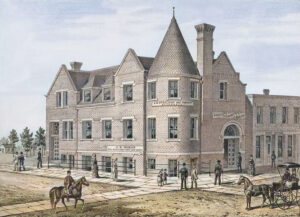
Phillips County Bank in Phillipsburg by L.H. Everts & Co., 1887.
Fort Bissell closed in 1878. That year, Phillipsburg had a hardware store, a flour mill, a druggist, a dry goods store, a blacksmith and wagonmaker, two general stores, a harnessmaker, a boots and shoe store, and a millinery. That year, the Phillips County Fair Association held its first meeting. The town’s population was 1,286.
On March 19, 1879, the Close family established the first cemetery, and on June 4, 1889, it was purchased by the Fairview Cemetery Association. All 25 interments were moved to the current site on the east edge of Phillipsburg.
That year, the Baptist Church was the first church to be built.
The first benevolent organization established in Phillipsburg was the Masonic Lodge in 1879, followed by the IOOF in 1880 and the Knights of Pythias in 1881.
That Phillips County Bank was organized in 1880 with $50,000 in capital. The first president was B.L. Harding, and O.M. Millard was the first cashier. The bank was located on the east side of the public square. Its primary purpose was to make farm loans. The same year, an abstract office opened, and Hardman Lumber began business.
The town was also organized as a third-class city that year, and the following were the first officers: Mayor, H.L. Sprague; city marshal, William Featherly; clerk, E. Korns; councilmen, C.H. Leffingwell, G.A. Spaulding, F.A. Dutton, D.B. Bailey, and Frank Strain.
Around 1880 and 1881, the county suffered from drought, and more families moved away. Gradually, the population returned.
The fourth courthouse was a two-story brick structure donated by the town to the county in 1880.
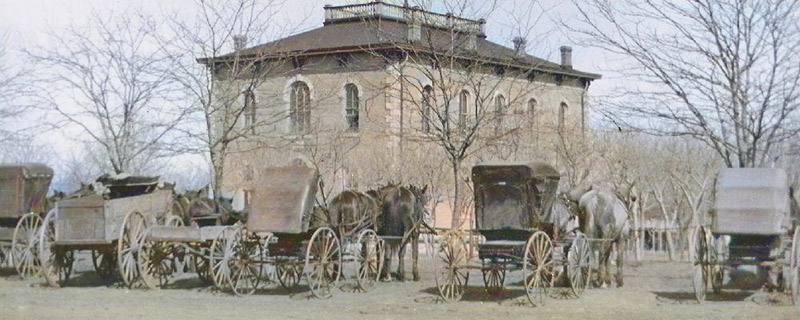
Phillipsburg, Kansas’ fourth courthouse.
On June 23, 1882, a severe electrical storm struck the city, destroying property valued at $12,000. Fifteen buildings were blown down, among them the Baptist Church, a handsome and commodious frame structure measuring 40 by 50 feet. There were injuries but no loss of life. That year, the jail was moved into the courthouse.
The Chicago, Kansas, and Nebraska Railroad came through Phillipsburg in 1887. That year, complete telephone systems were installed in the city.
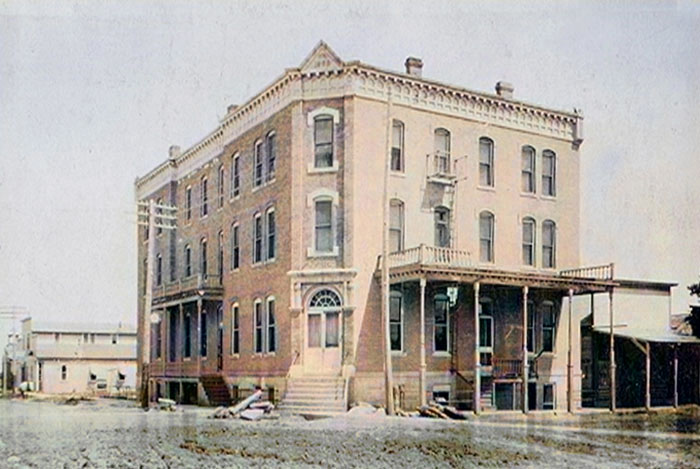
Bissell Hotel in Phillipsburg, Kansas.
Until 1888, Phillipsburg was second in population in the county, behind Kirwin. That year, its population was 631. The advent of the railroad raised the population to 1,235.
In 1889, John Bissell built the Bissell Hotel for $20,000 in Phillipsburg.
In 1891, the Chicago, Kansas, and Nebraska Railroad was taken over by the Chicago, Rock Island & Pacific Railroad. Phillipsburg was a division point with 5.26 miles of sidetrack, a roundhouse, turntable, stockyard, boiler house, repair shop, freight house, and passenger depot.
On June 14, 1893, the spelling of the town’s name changed from Phillipsburgh to Phillipsburg.
A very bad storm in 1903 blew down the town’s wooden water tower.
Unfortunately for the town, a 1906 fire almost completely destroyed the south side of the square. Except for the building housing the newspaper office, which suffered considerable damage, and a bank with less damage, all buildings were destroyed. The only equipment available to fight this fire was a hose cart with a hand pump.
<div.
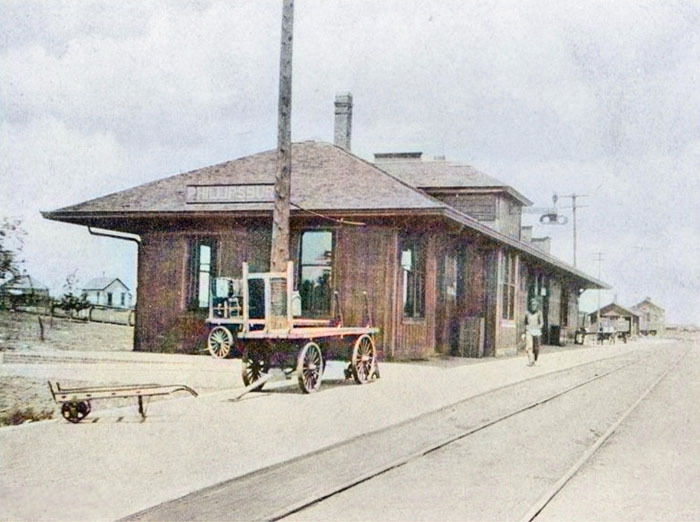
Chicago, Rock Island & Pacific Railroad depot in Phillipsburg, about 1895.
In 1907 the following businesses existed in Phillipsburg: a flour mill, shoe store, produce house, dentist, brick plant, book store, bowling alley, auto garage, shoe shop, carpenter shop, two banks, lumberyards, meat markets, jewelry stores, furniture stores, billiard parlors, fine hotels, blacksmith shops, machine shops, three drug stores, coal yards, clothing stores, livery barns, barber shops, newspapers, five general merchandise stores, churches, six restaurants, eight physicians, nine attorneys, public schools, a thriving farm community, and an opera house. A new water tower with a steel standpipe was also completed that year.
In 1910, Phillipsburg was still on the Chicago, Rock Island & Pacific Railroad. At that time, it had waterworks, a fire department, a flour mill, a grain elevator, an opera house, two banks, two weekly newspapers — the News-Dispatch and the Post, a daily stage to Glade, telegraph and express offices, and an international money order post office with five rural routes. The population in 1910 was 1,302.
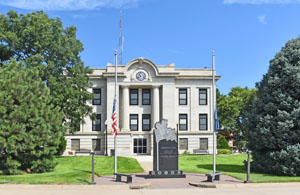
Phillips County Courthouse in Phillipsburg, Kansas, by Kathy Alexander.
On March 16, 1912, a snowstorm covered the city with several feet of snow. On March 14, 1935, a dust storm hit town in mid-afternoon. By 7:00 p.m., it was pitch dark, and with the electricity off, people were reduced to using candles to see inside their homes.
The fifth and present courthouse was built from 1912 to 1913. The Neo-Classical building was designed by R.A. Curtis of the Curtis Engineering Company in Kansas City, Missouri. It was built by Cuthbert & Sons of Topeka, Kansas, at a cost 0f $66,110.
The three-story, white-stone-and-concrete structure is located on landscaped grounds in Courthouse Square, in the center of Phillipsburg. On each of the four sides of the building are projecting center sections with two large columns rising from the second to the third story, a clock, and a curved hood at the roofline. The main entrance is on the north side. The County District Court courtroom is located on the south side of the third story. The building houses the County District Court of the 17th Judicial District, which includes Decatur, Graham, Norton, Osborne, and Smith Counties. It is located at 301 State Street and 3rd Street.
In 1923 and 1924, a group of cowboys came through town, finding that several farmers in the area had horses that needed to be broken, and offered to put on a wild west show using the animals and breaking them in the process.
In August 1929, the Phillipsburg Rodeo was born, with events held at the site now used as the high school athletic field. This event continues today at the arena north of town on the first Saturday in August, with a parade through downtown. It follows the Phillips County Fair, once held at the National Guard Armory, and now takes place in the area east of the rodeo grounds. Although “Kansas’ Biggest Rodeo” officially began in 1929, there were earlier events.
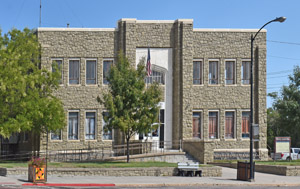
Community Building in Phillipsburg, Kansas by Kathy Alexander.
The Phillipsburg Community Building was built in 1936-1937 during the Great Depression as a Works Progress Administration (WPA) project, established by the federal government and the administration of President Franklin D. Roosevelt in 1935 to provide relief to the unemployed.
The local newspaper reported this project to be “the biggest WPA project in the sixth district, involving an expenditure of $107,205, exclusive of the rock quarrying project to provide building stone.” Local architect Owassa J. Jennings worked on the project, Dr. Guy Innes served as the project superintendent, and H.C. Townsend was the foreman. 74 men were working at the limestone quarry south of Glade, Kansas, in November 1935. A crew of 58 men began excavating at the building site in February of 1936, and construction of the 9,200-plus-square-foot building began on March 24, 1936. The community building was formally dedicated on Tuesday, October 26, 1937. The building was listed on the National Register of Historic Places in 2010.
Oil was discovered in Phillips County in 1939. That year, the Consumers’ Cooperative Association opened the world’s first cooperative oil refinery on the northern edge of town. It was the first cooperative refinery in the United States.
In 1940, Phillipsburg’s population jumped to 2,140, making it a second-class city.
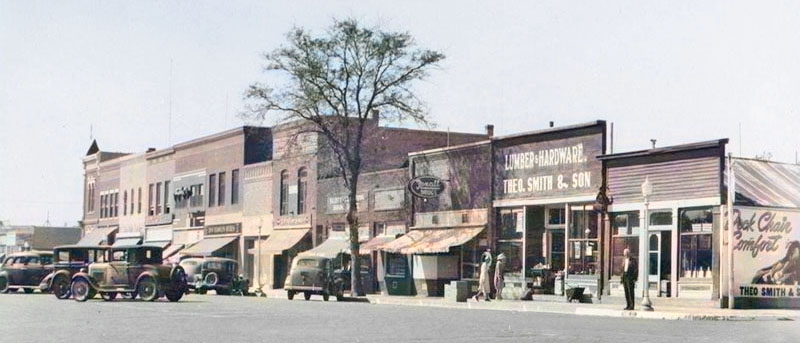
Phillipsburg, Kansas, in about 1947.
Fort Bissell was reconstructed in the city park in 1962 and today serves as a museum.
In 1969, TAMKO Building Products’ roofing shingle plant was constructed on the north side of Phillipsburg, and it is now the city’s largest manufacturer.
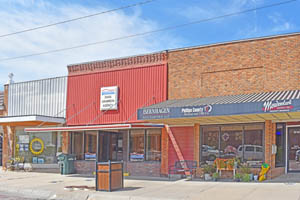
Phillipsburg, Kansas, business buildings today by Kathy Alexander.
Phillipsburg’s population peaked in 1970 at 3,241.
After standing for 87 years, the Bissell Hotel was razed in 1976.
The Phillipsburg Refinery closed in 1992 and was eventually demolished in 2012 and 2013.
In 2006, the Amber Wave ethanol plant was built on the east side of Phillipsburg.
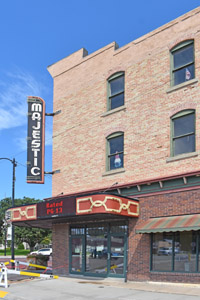
Majestic Theater in Phillipsburg, Kansas, by Kathy Alexander.
The Riverless Festival is held in June and is inspired by other communities that host river or lake festivals. Since Phillipsburg is a dry-land area, the city celebrates its lack of rivers in a tongue-in-cheek way at its annual Riverless Festival. The courthouse square hosts craft booths, and food stands line the roads, while children line up for games and rides sponsored by local businesses.
The community is served by the Phillipsburg USD 325 public school district.
Phillipsburg is located near the center of the county, about 65 miles south of Overton, Nebraska, on the Union Pacific Railroad, and 55 miles north of Hays.
©Kathy Alexander/Legends of America, January 2026.
Also See:
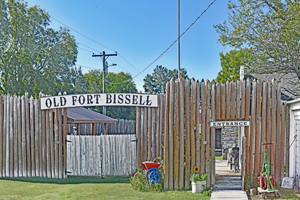
Fort Bissell Museum in Phillipsburg, Kansas, by Kathy Alexander.
Sources:
1878 Polk’s Gazetteer and Business Directory
American Courthouses
Blackmar, Frank W.; Kansas: A Cyclopedia of State History, Vol I; Standard Publishing Company, Chicago, IL 1912.
Cutler, William G.; History of Kansas; A. T. Andreas, Chicago, IL, 1883.
City of Phillipsburg
Fort Hays State University
Phillips County, Kansas
Wikipedia