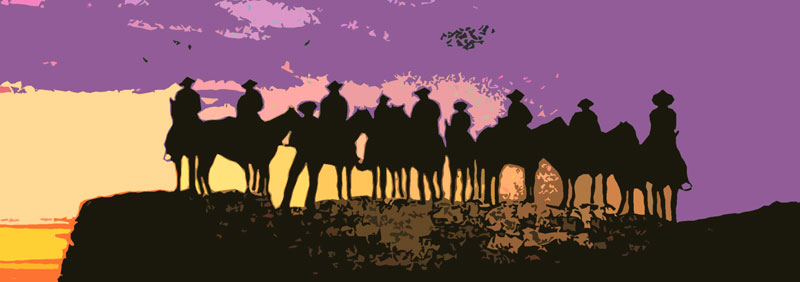
Dodge City, Kansas Cowboy Silhouette by Kathy Alexander.
Wild West Country, in Southwest Kansas, is one of the Midwest’s hidden treasures, featuring wide-open spaces, magnificent sunrises and sunsets, and diverse, sometimes rugged, landscapes.
Southwest Kansas comprises three physiographic areas in the southwestern quarter of the state. In its western half, the region is primarily the High Plains, dominated by intensive dryland and irrigated farming, native shortgrass prairie, and feedlots. At the heart of the region lies the Arkansas River Lowlands, which follows the Arkansas River and features sandhill grasslands. The southeastern corner of the region lies within the Red Hills, a rugged, hilly mid-grass prairie landscape that remains largely intact. The mix of physiographic types and farming in this region offers outstanding hunting opportunities for pheasant, quail, white-tailed and mule deer, lesser prairie-chicken, and Rio Grande turkey.
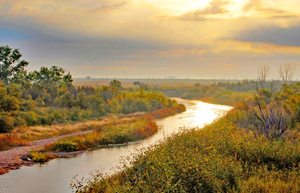
Arkansas River near Lakin, Kansas by Kathy Alexander.
Surface water resources are limited; however, groundwater from the Ogallala aquifer has historically been abundant and relied upon exclusively for drinking water. The southwest district covers significant portions of the major river basins: the Upper Arkansas, the Lower Arkansas, and the Cimarron.
This district is semiarid and largely agricultural, with the notable exception of oil and gas production.
There are two state parks in the region, both on state fishing lakes: Meade State Park, in an area once known for its artesian wells, is a 400-acre paradise shaded by tall cottonwoods, with an 80-acre lake of cool, crystal-clear water described as the “Oasis of the Plains.” Historic Lake Scott State Park features a stunning canyon nestled among the prairie and natural springs just north of Scott City.
Cheyenne Bottoms Wildlife Area, the largest wetland in the interior of the United States, is in Barton County. Clark State Fishing Lake, in Ford County, is nestled in the deep Bluff Creek canyon and is located less than an hour from Dodge City. Lake Coldwater in Comanche County is a wonderful, scenic place for water-related sports, including swimming, bird-watching, wildlife observation, hiking, and camping.
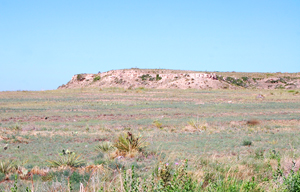
Point of Rocks in Morton County, Kansas by Dave Alexander.
Geologic sites of interest include two large sinkholes, Big Basin and Little Basin; Point of Rocks, a high outcrop once important to travelers on the Santa Fe Trail’s Cimarron Cutoff because it signaled that water was nearby.
There are three Scenic Byways in the region, including:
Gypsum Hills Byway
Historical Sites include:
Boot Hill Museum in Dodge City, where visitors explore the legendary, lawless days of the Old West with exhibits of outlaws, lawmen such as Wyatt Earp and Doc Holliday, and frontier life.
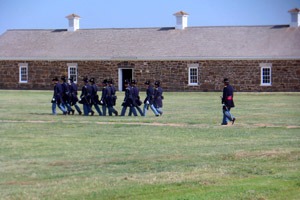
Fort Larned, Kansas, on the Santa Fe Trail. Photo by the National Park Service.
Fort Larned National Historic Site is a preserved 1860s U.S. Army post on the Santa Fe Trail, which was vital for protecting travelers and interacting with Plains Indians.
El Cuartelejo in Scott County is a National Historic Landmark. This site preserves the ruins of a 17th-century Taos Pueblo dwelling in Kansas, showcasing an early Native American presence.
The Santa Fe Trail National Historic Trail, a commercial highway connecting Missouri and Santa Fe, New Mexico, marks segments of this iconic trail that run through Southwest Kansas, representing the era of Westward Expansion.
Natural & Geological Wonders are represented at:
Monument Rocks in Gove County, also known as Chalk Pyramids, are towering chalk formations that served as landmarks for early travelers and are a unique geological marvel.
Cimarron National Grassland in Morton County encompasses historic crossings and trails along the Arkansas River.
Wagon Bed Spring in Grant County, Kansas, on the Cimarron Cutoff of the Santa Fe Trail was well known to travelers because it was the first reliable water supply they encountered after leaving the Arkansas River in present-day Gray County. This 60-mile stretch between the two rivers was known as the “Jornada,” meaning a desert journey without water.
History:
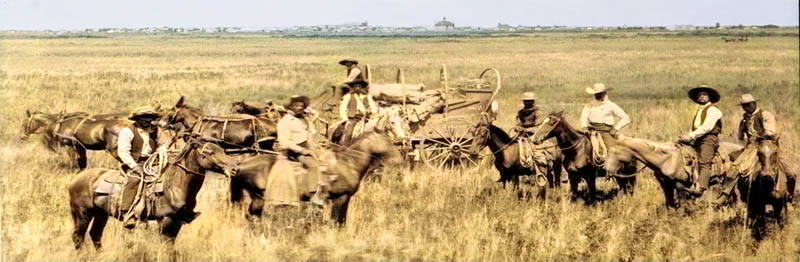
Cowboys in Finney County, Kansas, about 1890.
For several years after Western Kansas was opened to settlement, the region’s counties remained unorganized, except for a small population of cattlemen. These cattlemen were predominant, but their interest was solely in the grass and water it provided for their livestock. They roamed their cattle over thousands of acres without fences. However, their dominance was short-lived.
The railroad company, which had been instrumental in establishing the cattle industry, also served as the primary incentive for people to come in and homestead the land. As soon as it became known that the Indians had vacated this territory, people across the nation began to examine the maps of Western Kansas closely.
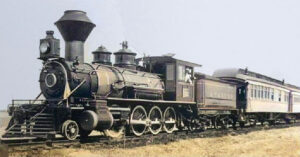
Atchison, Topeka & Santa Fe Railroad in Kansas.
The spring of 1878 began with abundant moisture. As far as the eye could see, the short-grass plains were covered with a lush carpet of green, untouched by roads or highways. The only sign of civilization was the iron rails of the Atchison, Topeka & Santa Fe Railroad. There were no trees or shrubs to break the wide-open view—nothing in sight except the large herds of Texas cattle grazing freely in this expansive “backyard” of Kansas.
However, the cowboys guarding the herds began to notice the distant horizon with growing concern, for they had heard rumors of incoming settlers. As days passed, tiny dust clouds appeared far to the east and slowly intensified until they could make out covered wagons steadily advancing along the maze of cattle trails. With each passing hour, the cowboys could hear the shouts of the drivers above the creaking of the wagons, urging their tired horses, oxen, and domestic cattle towards the valleys of the Pawnee and Arkansas Rivers. The canvas tops of the wagons bore crude letters proclaiming, “Western Kansas or Bust.”
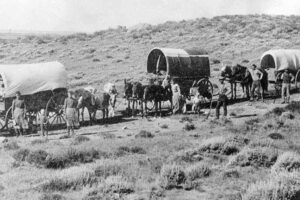
Wagon Train.
When the farmers arrived, they were seeking a home, a place to settle and raise their families. Recognizing the land’s potential despite its sparse water supply, supplied by a few creeks and the Arkansas River, which often ran dry for several months each year. As they journeyed west, the timber grew increasingly scarce, with only a few trees remaining on islands in the river, sheltered from the annual prairie fires.
The land before these pioneers lay bare under the relentless sunshine, devoid of trees or the shelter of ancient forests. Their eyes wandered in every direction, and they felt no dismay as they saw only the anthills and prairie dog towns rising in small mounds above the buffalo grass. They envisioned a future when the buffalo grass would be replaced by cultivated grasses and fields of golden grain. They dreamed of cities that would emerge to replace the remnants of animal and insect structures that had littered the landscape for centuries.
To those without land, the opportunity to settle on government land and acquire full ownership of a quarter-section seemed like a great blessing. Even many who owned farms or businesses in the East decided they could improve their circumstances by selling their properties and moving to the affordable yet fertile lands of the West. Under the acts of Congress, it can be stated that heads of families or individuals over 21 years of age were entitled to 480 acres of land: 160 acres as a homestead, 160 acres as a preemption, and 160 acres as a timber claim. However, only 320 acres could be claimed at one time. A five-year residence on a homestead claim was required before a patent could be issued. Settlers had six months after filing to establish their residence and make improvements.
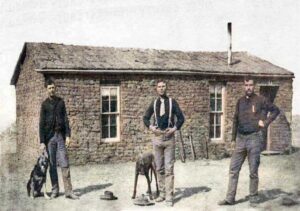
A sod house in Ness County, Kansas, around 1886. (colorized)
They could also be temporarily absent for six months. Immediate settlement was required for preemption. After six months, a patent could be secured by paying $1.25 per acre for land; for railroad land, the cost was $2.50 per acre. No settlement was required under the Timber Culture Act. Claimants had to break five acres of land during the first year, another five during the second, while cultivating the initial five, and in the third year, plant five acres with trees, tree seeds, or cuttings. An agent could fulfill these requirements, and a non-resident could acquire land under this act. Since only one timber claim was allowed in each government township and a non-resident could own it, this type of claim was quickly taken. However, the work of plowing and cultivating timber claims provided some settlers with the money they needed to remain on their homesteads. In many cases, as compensation for their labor, they were granted ownership of the timber claim.
In 1878, there was a sprinkling of homesteaders scattered over the prairies.
Naturally, the cattlemen were resentful of the arrival of settlers and homesteaders, who continued to arrive in increasing numbers in 1878 and 1879. Coming in wagons or dropping off the trains along the railroad sidings of the Atchison, Topeka & Santa Fe Railroad, they were met by the cowboys, who did their best to discourage them from settling here.
From that time on, there was a struggle between the grangers and the cattlemen as to who would occupy the land.
Nature seemed to favor the efforts of those first settlers, even if the cattlemen didn’t. Everything planted that first year yielded bountifully, and the country gave out every promise to those desiring to make permanent settlement. Towns were established, and dugouts and sod houses of homesteaders dotted the plains.
However, a period of dry weather began in the early 1880s, and the country appeared like a parched desert. At the end of four years, few of the first enthusiastic participants who had taken claims remained. Before long, the first settlers unfolded their old canvas tops and spread them back in place over the weather-beaten wagon bows. Beneath the old sign “Western Kansas or Bust,” they scrawled in bright new letters, “Busted by God”, and the heads of the famished horses that were hitched to those “ships of the Great Plains” were headed back east.
“There were times when flowers did not bloom, grass did not grow green, and the pantry was nearly empty. If it had not been for the jackrabbits and the wild ducks and geese, many early settlers would have found their situation much harder.”
— Reverend A.C. McKeever, a pioneer of Finney County.
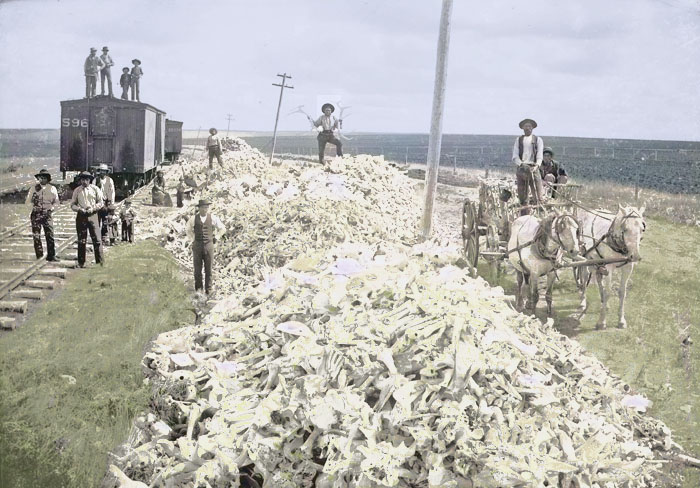
Buffalo Bones.
For those who stayed, the chief industry was collecting buffalo and cattle bones, of which there appeared to be an inexhaustible supply all over the prairies. Hundreds of loads were brought to points along the railroad for shipment, for which the settlers received 50¢ to 60¢ per ton. They also hauled in “buffalo chips” and stacked them up like hay stacks to keep them dry for winter fuel. Another source of income, obtained through difficult means, was the capture of wild horses, which were shipped east. Others hunted antelope, shipping them to Topeka or Kansas City, receiving $4 or $5 apiece. Men also hunted deer and buffalo.
The elements seemed to favor the cattle industry, and the cattlemen viewed with satisfaction the clearing of the range. The free range law was still in effect, and there were cattle and cowboys everywhere.
The few remaining settlers found it challenging to homestead on the open range. George W. Finnup recalls conditions of the winter of 1880-81:
“That winter was just one snowstorm after another. The antelopes were thick in those days and drifted into the edge of town. Cattle drifted down here from the Smoky Hill River and other localities in northwestern Kansas, western Nebraska, Colorado, and Wyoming. Many cattle companies had representatives in Garden City to oversee their cattle. After a severe storm, there would be some nice weather for several days, and the boys would say, ‘Well, we’d better get out and look after the cattle.’
“It was also necessary to keep the range cattle on the south side of the river on account of the Atchison, Topeka & Santa Fe Railroad tracks. They would get on the tracks and bunch up in the cuts, and the trains would plow through them and kill many every few days. The Atchison, Topeka & Santa Fe Railroad paid out thousands of dollars for cattle killed in this way during the winter of 1880-81, and in order to protect themselves in the future, they fenced their right of way. They fenced the roadbed that spring on both sides from Dodge City to La Junta, Colorado, a distance of 200 miles, using heavy round cedar posts eight feet apart and four strands of galvanized wire. “After the cattle were crossed to the south side of the river, they would travel day and night, up and down, and you could hear them bawling by the thousands. In a few days, another storm would come, and every head would be gone, drifting on south with the blizzard, but a fresh bunch would come down from the north to again torment the settlers, and the whole crossing process had to be repeated. Thousands died that winter from starvation, as many had been brought up late from Texas and were pretty thin, and they were not used to such a severe climate. Many of the cattle companies went broke that winter.
After the long drought ended in 1882, climatic conditions improved, enabling farmers to produce large crops from 1883 to 1885. C.M. Johnston came to this county in the spring of 1882, and he recalls the climatic conditions of that year:
“Never having been in a semi-dry climate, I could not get accustomed to the dryness. There was scarcely anything here but distance, and that was only half clad in short grass and buffalo grass. However, when fall set in, it was followed by abundant rainfall, and moisture persisted throughout 1883. In the summer months of that year, I would ride up on the flats, carrying a large basket, and return with it filled with mushrooms, some as large as saucers. That year, along the railroad right-of-way, the horse weeds, cockle burrs, etc., grew to immense proportions, requiring constant attention of section hands to clear the track for vision. Draws and fertile spots were miniature forests. We tenderfeet were at a loss to figure out how, if the country were put under the plow, the crops would be. I have only seen a few seasons like it since.”
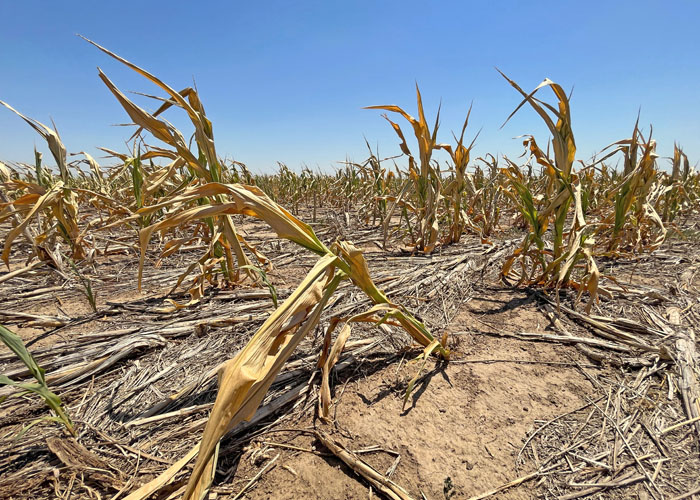
Kansas Drought.
The word that Western Kansas would produce a significant yield of grain and vegetables traveled swiftly. Homesteaders came by thousands, and in a short time, there was a shanty on every claim, and speculators began arriving from every state in the Union.
This was acceptable for the country and the settlers, but it was a setback for the cattlemen. Many of the ranchers had, by this time, fenced large areas of government land. The following article appeared in a Dodge City newspaper in the spring of 1885:
“It cannot be denied that the present season thus far has been favorable to the growth of agricultural products. Ranchmen must assess the situation squarely and prepare to address it. The days of free range in Kansas are numbered among the things of the past. Ranchmen must hereafter own their grazing lands. All of the government land in Kansas will soon be occupied by settlers or owned in fee simple by individuals. The stock industry will, in the future, as it has in the past, be the primary source of support for our people. Its character, however, must change. The herds must be in smaller numbers and the cattle of a better grade, and shelter must be provided during the winter months, and stock feed should be raised here.”
On July 28, 1885, the land commissioners decided that people must remove all wire and posts from the government land.
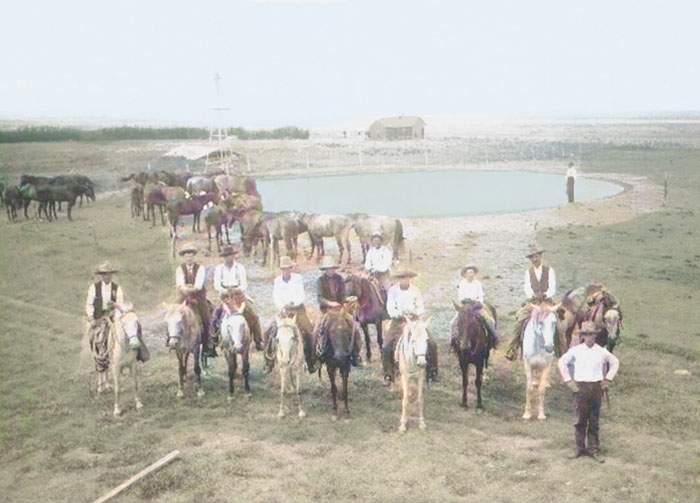
Kansas Cowboys.
An article which appeared in a Garden City newspaper in the spring of 1885 gives a little idea of the intensity of feeling which existed between the settlers and cattlemen:
“Many newcomers are building and plowing on the south side of the river who are hoping that Major Falls will be persuaded not to bring his 20,000 head of cattle here to be branded this summer, but keep them on the Cimarron range. The stock will annoy the settlers and destroy their crops, leaving them discouraged and likely to leave soon. It is said that stockmen are setting the prairie on fire so we will have a dry season, and the *cussed granger’ will be a thousand miles away.” By the spring of 1885, the settlers were arriving so rapidly that they were breaking up and destroying the range, making it impossible to manage large herds. Boom towns sprang up all over the old range and boasted of populations they have never had since. John H. Whitson says, “The spring we moved in, 1885, the big cattle ranches were almost gone, and the settlers had a song which they sang gleefully: ‘It was the May 10, bless the day, When the X Y cowboys went away.”
“There was no good feeling between the cowboys and the newcomers. And the cowboys of the big XY ranch, getting intoxicated in Garden City, would race their horses past the sod houses or humble homes of the settlers, emit blood-curdling yells, and fire off their revolvers in order to scare the women and children and intimidate the settlers into leaving.”
The final blow to the free-range cattle industry was the blizzard of 1886, which destroyed thousands of livestock and financially ruined many of the largest cattle dealers. It seemed as though the elements and the law had joined forces, which brought about a complete victory for the homesteader, as the herd law became operative in Finney County and others of this region on June 24, 1886. The effect of this law was to prevent the running at large of all cattle, horses, sheep, and other domestic animals. This law is still in effect.
The day of open range and that wildlife had passed, but not yet had the last of those old-time cowboys ridden his bronc into the “sunset”.
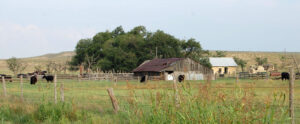
An old Homestead near Lakin, Kansas, by Kathy Alexander.
©Kathy Alexander/Legends of Kansas, updated February 2026.
Also See:
Sources:
Blanchard, Leola Howard; The Conquest of Southwest Kansas, Wichita Eagle Press, 1931.
Kansas Department of Health and Environment
Kansas Department of Wildlife & Parks
Kansas Geological Survey
Wild West Country