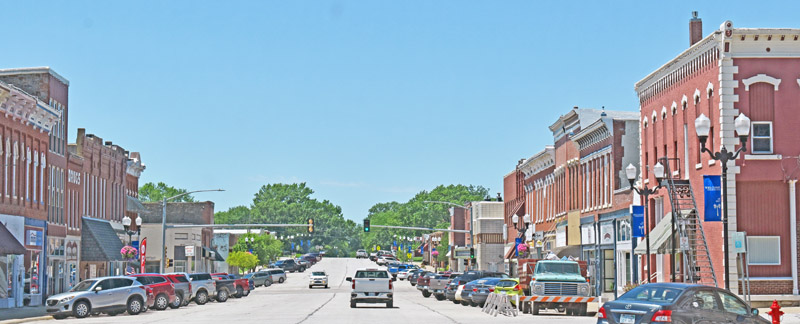
Burlington, Kansas Main Street by Kathy Alexander.
Burlington, Kansas, is a city in and the county seat of Coffey County on the Neosho River. As of the 2020 census, its population was 2,634, and it had a total area of 2.21 square miles, of which 2.20 square miles is land and 0.01 square miles is water.
The Burlington Town Company was organized in Lawrence, Kansas, in the fall of 1856 by C.W. Babcock and B.W. Woodward.
In January, 1857, Oscar E. Learnard, F.A. Atherly, A.H. Vince, Edward Murdock, H.W. Watrous, John Bishop, and others arrived. They were the first occupants of the townsite. They boarded with Charles Morse, across the river, three miles distant.
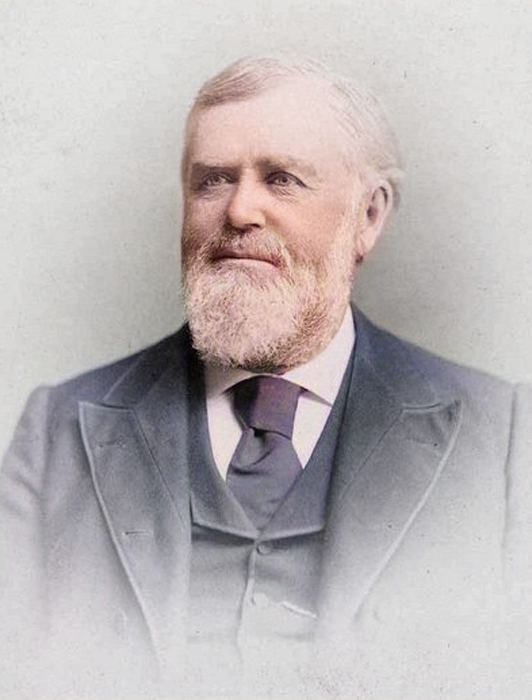
Oscar E. Learnard.
The act incorporating the Burlington Town Company was approved on February 20, 1857. The first president of the company was C.W. Babcock, and the first secretary was B.W. Woodward. The town was named after Burlington, Vermont, the native home of Oscar E. Learnard, the principal promoter. The original townsite consisted of 320 acres.
The first building was a combination of two small buildings brought from Hampden and was used as a store where James Jones kept a stock of goods. The second building was a wagon shop erected by Edward Murdock, and the third was the Burlington Hotel, constructed by F.A. Atherly under contract with the town company. During the building of the hotel, in May, 1857, Reverend Peter Remer and family arrived. Mrs. Remer, the first woman who had ever appeared on the townsite, was greeted with cheers by the workmen at the hotel. The Burlington Hotel was designed simply as a boarding house and was located near the river to accommodate millhands. The first landlord of the hotel was Francis Britton.
The first steam sawmill in the county was built in Burlington in the spring of 1857. It was removed from Hampden, to which place it had been sent by the Emigrant Aid Company. It was moved because it could not be operated at Hampden due to the lack of water.
At about the same time, Dr. Samuel G. Howe, the philanthropist and husband of Julia Ward Howe, acquired a section of 640 acres, adjoining the townsite on the west. Part of it was surveyed into lots, sold, and incorporated into the town. Several houses and businesses were built, and a bridge was constructed across the Neosho River.
In the summer of 1857, Dr. Manson and Dr. Venard arrived and took claims near town. Dr. Manson erected an office for himself on Hudson Street. George W. Stevens erected a store building. A Methodist Episcopal Church was organized in July 1857 by Reverend M. Fennimore, with seven members. Judson A. Walkling erected a storehouse that opened on August 7, 1857, to stock general merchandise.
The first county seat of county government was established in LeRoy in 1857, and it was moved several times between Burlington, LeRoy, and Hampden.
On February 16, 1858, the post office was moved from the now-extinct town of Hampden to Burlington.
The bridge over the Neosho River was carried away by a freshet in 1859. Burlington was organized as a village that year.
In September 1859, S.S. Prouty arrived in Coffey County with his family and a printing press, having arranged with Burlington’s citizens to establish a newspaper there. In return for publishing a newspaper for one year, he was promised 25 town lots, a guarantee of 300 subscribers at $2.00 each, and free rent for a house and office. However, when he arrived on September 6, the houses were not ready. Prouty was allowed to temporarily store his belongings in a vacant first story of a small building that would later become part of the Central Hotel. However, Mr. Slayton, who lived in the second story, ordered him to leave. Prouty planned to camp outside the town and consider moving to Le Roy instead, where he had received better offers.
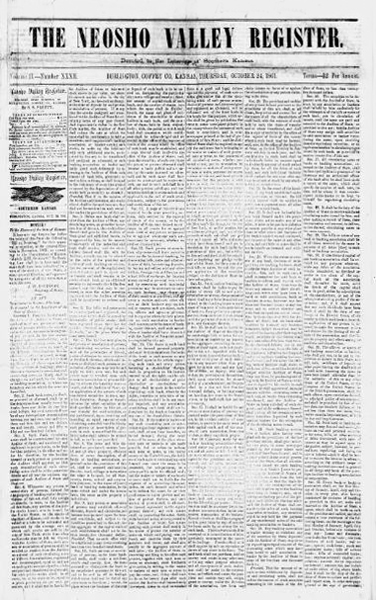
Neosho Valley Register in Burlington, Kansas.
On October 4, 1859, the first issue of the Neosho Valley Register was printed in Burlington. That was also the day when the present constitution of the State of Kansas was adopted by a vote of the people. The press on which this paper was printed was brought to Kansas in 1834 by Reverend J. Meeker, a Baptist missionary among the Ottawa Indians. Mr. Prouty published the Register until December 1862, when, being then First Lieutenant and Quartermaster of the First Indian Regiment, he leased the office to I.E. Olney for one year. At the expiration of Mr. Olney’s lease, the paper again appeared, with Mr. Prouty’s name as publisher and H.N. Bent as editor.
The first agricultural fair was held in Burlington in 1860.
The Baptist Church at Burlington was organized in about 1861 by Reverend J.B. Taylor. It had a church building that cost about $2,000.
During the Civil War, everything was at a standstill, the men having all enlisted in the army or being engaged in protecting the border. In the meantime, no new settlers came into the county.
The Church of the Ascension was organized on December 8, 1862, under the name of St. Andrew’s Church by Reverend W.H. Hickcox, Deacon. A church building was erected in 1866 for $3,000. St. Andrew’s Church was renamed the Church of the Ascension in 1871.
On May 19, 1863, the county seat was removed to Hampden by an overwhelming majority vote. The next day, S.S. Prouty, who was then at home, temporarily absent from the army, said he would put up $500 for the purpose of erecting a building for a woolen carding mill and purchasing the machinery necessary to put it in operation. This gave the struggling town renewed hope and convinced her enemies that Burlington was not yet ready to die. That year, the Burlington Volunteer Militia was formed.
In March, 1864, William Payne leased the newspaper office and about a month later bought Mr. Prouty’s office, as he was still in the army. Mr. Payne died in July, following, and the office then fell into the hands of Silas Fearl, who discontinued the newspaper. On September 3, 1864, S.S. Prouty commenced the publication of the Kansas Patriot at Burlington
Orsen Peck, a farmer on North Big Creek, realized $800 for his cotton crop in 1864, and 18,000 pounds of lint were ginned at the Burlington factory in 1865.
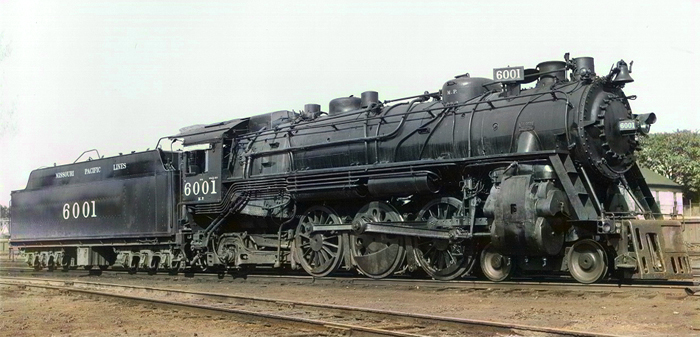
Missouri Pacific Railroad.
In 1865, it was voted that Burlington would become the county seat again. The following year, the county seat was moved to Burlington, and the first courthouse was erected. Afterward, Burlington began to grow.
The Congregational Church of Christ was organized on November 25, 1868. The first Pastor, Reverend J.M. McLain, held services in the Episcopal Church and at the town hall. A wooden church building was erected in the fall of 1879. Value of church property, $3,000.
The Missouri Pacific Railroad, Neosho Division, began work at Junction City, Kansas, to build south to Coffee County in the winter of 1868-1869
In 1869, the Excelsior Water Mill was built by Cross & Sons for $55,000, including the dam and races. The Kansas Patriot continued to be published until April 15, 1869, when S.S. Prouty sold the office to J.F. Cummings and removed to Topeka, Kansas, to discharge the duties of the office of State Printer, to which he had been elected by the Legislature of the previous winter. On May 29, 1869, J.F. Cummings sold the Kansas Patriot to A.D. Brown. On January 1, 1870, A.D. Brown changed the name of the Kansas Patriot newspaper to the Burlington Patriot.
In January 1870, the Missouri Pacific Railroad locomotive entered Coffey County. On February 22, 1870, the completion of the road to Burlington was celebrated by an assemblage of 2,000 people. A portion of the multitude was an excursion party of 600 people from Topeka, Kansas, and intervening points, which came on a special train of 12 cars. The entire legislature, including its officers, and all State officers, were in the excursion party, and a band of music accompanied them from Topeka. Upon its arrival at Burlington at 4:00 p.m., the excursion party was greeted at the depot by the thundering of artillery and shouts. The hungry excursionists were immediately ushered into an immense tabernacle, where dinner was served, and addresses were made. The excursionists remained in the village that night and departed at 8 o’clock the next day.
The Atchison, Topeka & Santa Fe Railroad was not, at that time, completed to Emporia.
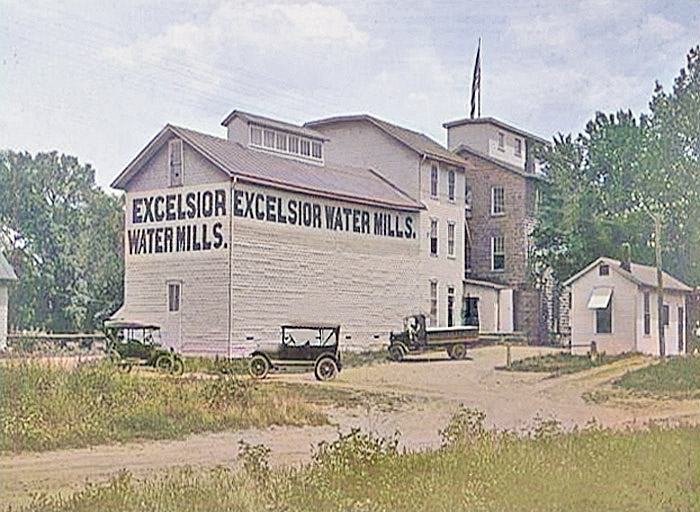
Excelsior Water Mills in Burlington, Kansas, 1915.
Burlington became a third-class city in 1870, with F.A. Atherly elected its first Mayor. The early business section was located on North Third Street. That year, new life was evident in the town’s progress. A small carding mill, started in 1863, grew into a woolen mill, with a cotton gin added. A water mill had been built by Cross & Son at a cost of $55,000, and the Burlington Steam Mill was built in that year at a cost of $16,000. F.A. was connected with the factory. Atherly, Levi P. Heddens, Henry W. Atherly, and James Davidson. Cotton growing was attracting some attention in the county at that time.
The first bank in the county, Jarboe, Garretson & Co., began business on April 16, 1870. The firm consisted of H.L. Jarboe, N.P. Garretson, D.W. Stormont, and M. Bailey, the latter two of Topeka. The bank was managed by N.P. Garretson.
The First Presbyterian Church of Burlington. was organized on June 26, 1870, by Reverend R.M. Overstreet, with a membership of seven. Its first pastor was Reverend S.G. Fisher. A frame church building was erected during the summer of 1881 at a cost of $3,500.
St. Francis Xavier Catholic Church was organized in the spring of 1871 by Reverend Father Francis Heller. By the early 1880s, it had about 50 families, with the church property valued at $2,500.
The bank was reorganized as the Burlington National Bank on April 29, 1872, with a capital of $50,000, with H.L. Jarboe as president, and N.P. Garretson, as cashier.
The Burlington schoolhouse was completed in 1873 for $28,000.
On May 5, 1874, Peter Bell began publishing the Voice of the People, which lasted only until the following November. It advocated J.C. Cusey for Governor and J.K. Hudson for Congress, and then discontinued.
On February 11, 1875, the first number of the Independent newspaper appeared in Burlington, with A.H. Smith named as editor and publisher.
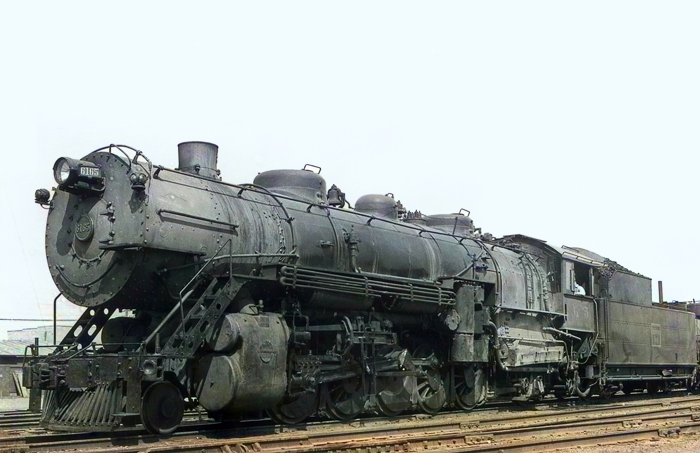
Burlington Locomotive.
On March 31, 1877, bonds of Coffey County in the amount of $ 100,000 were issued to the Kansas City, Burlington & Santa Fe Railway Company in exchange for stock. On June 29, 1877, B.F. Smythe bought out A.H. Smith and published the Independent newspaper until October 19, 1877, when he sold a half-interest to John E. Watrous.
The Kansas City, Burlington & Santa Fe Railway Company was completed to Burlington on April 1, 1878. It arrived enthusiastically to the citizens of that city. An excursion party from Kansas City, numbering about 100 people, including the Board of Trade of that city, participated in the celebration. A 12-pound Parrott gun burst during a salute honoring the excursionists. On the return of the excursion party to Kansas City the next day, they were accompanied by several hundred people from Burlington and neighboring localities.
On June 7, 1878, Mr. Smythe sold his interest to LeRoy Armstrong, when the firm name became Armstrong & Watrous. Mr. Armstrong retired from the paper on July 16, 1880, since which time it was owned and published solely by John E. Watrous. Previous to the date of the retirement of Mr. Armstrong, the politics of the paper had always been independent. Since it has been under Mr. Watrous’s sole management, the paper has been Democratic. The politics of the Neosho Valley Register was Republican; that of the Voice of the People Reform was Republican; and the Patriot has always been Republican.
On January 17, 1881, the Kansas City, Burlington & Santa Fe Railway was sold at Sheriff’s sale, at Ottawa, to a company of men, who formed the Ottawa & Burlington Railroad Company. It was later operated by the Kansas City, Lawrence & Southern Kansas Railroad Company, which was a part of the Atchison, Topeka & Santa Fe Railroad system.
The Burlington Republican was started on January 4, 1882, by George Sweesy and W.S. Hebron, under the firm name of Hebron & Sweesy. After a few weeks, Mr. Sweesy retired, and Mr. Hebron has since been the sole proprietor and editor. Republican in politics.
In 1882, the Methodist Church had 190 members, and its church building was valued at $5,000, and the parsonage at $1,000. At that time, it was led by Reverend J.A. Hyden.
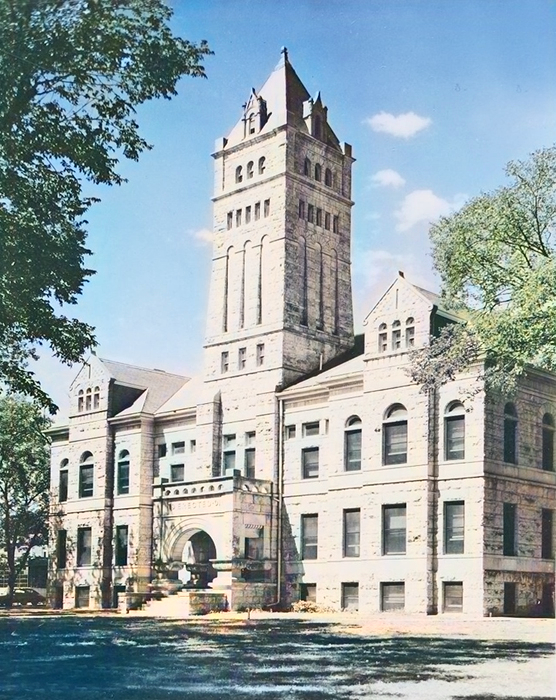
Second Coffey County Courthouse in Burlington, Kansas.
In February 1899, a voter-approved levy funded a new courthouse that represented a significant upgrade in scale and durability. It was designed by prominent architect J.C. Holland of Topeka, Kansas, in the Free Classic Romanesque style. Constructed by Betts & Company, with the cornerstone laid in 1901, it was completed in 1903 for $55,000, which included the cost of the furniture and interior fixtures. The contractor hired to build the courthouse complained that the plans didn’t specify enough concrete, and by 1911, the walls were already cracking under the windows and over the doors. It was also stated that this was because it was constructed on a weak foundation. This initial structure functioned for approximately 35 years, accommodating the modest needs of the growing county until it proved inadequate for expanding operations.
During its tenure, the second courthouse hosted several high-profile cases, notably the 1925 murder trial of John Knoblock, accused of killing his wife, Florence Knoblock, in their Burlington home. The first trial, held there, resulted in a hung jury, leading to a second proceeding in neighboring Lyon County that ended in Knoblock’s acquittal; no one was ever convicted in the unsolved case.
In 1910, Burlington was at the junction of the Atchison, Topeka & Santa Fe and the Missouri, Kansas & Texas Railway. At that time, it was a progressive little city, with waterworks, fire department, electric lights, and a number of commercial and manufacturing interests, including two banks, a daily and a tri-weekly newspaper, flour mill, grain elevators, tile factory, three cigar factories, creamery, carriage and wagon factory, and all lines of mercantile enterprises. It also had excellent grade schools, high schools, and churches of all denominations. There were telegraph and express offices, an international money order post office, with six rural routes, and a population of 2,180.
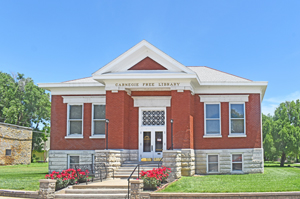
Old Carnegie Library in Burlington, Kansas, by Kathy Alexander.
The Burlington Carnegie Free Library was built in 1912 with a $9,656 grant from the Carnegie Foundation. Architect George P. Washburn designed the library in a Classical Revival style with three bays. The one-story brick library sits atop a limestone foundation. The library was added to the National Register of Historic Places on June 25, 1987. The library was vacated after the Burlington branch of the Coffey County Library opened in 1994. It was later restored and now serves as a business building. It is located at 201 N. Third in Burlington, Kansas.
Burlington’s Company C, 137 Infantry, 35th Division, was mobilized on August 5, 1917.
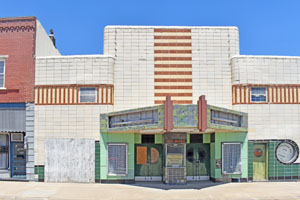
Old Plaza Theater, Burlington, Kansas by Kathy Alexander.
The Plaza Theater, at 404 Neosho St., was built in 1942. It replaced a 1941-built Plaza Theater, which was destroyed in a flood. Designed by architect Al Hauetter, the two-story brick building is notable for its Moderne-style facade, which features glass block, pigmented glass panels, and glazed ceramic tile. After closing as a movie house in 1989, the Plaza Theatre later became the Flint Hills Opry, a live performance space. It later operated as The Music Box Theatre, another live performance venue, which closed in about 2010. It was listed on the National Register of Historic Places in 2005.
Work began on the present courthouse in 1963. By that time, the walls of the 1901 building were being propped up by long poles. The project was strategically sited directly in front of the existing courthouse, enabling government functions to continue seamlessly during construction. The architectural firm Kiene & Bradley of Topeka, Kansas, designed the building in a Modern style emphasizing efficiency and contemporary functionality. The main contractor, Cornelius & Associates, oversaw the project’s execution. To honor the county’s history, elements from the demolished 1901 courthouse were integrated into the new structure, including salvaged stone used in the foundation and walls. The building was completed in 1964, making it the county’s third courthouse, and the old one was torn down.
The east-facing building is a one-story red brick-and-concrete structure. Inside, a corridor runs along the glass-panel wall on the building’s east side. The County District Court courtroom is located on the south side of the building and is named the Phillip M. Fromme District Court. The building houses the County District Court of the 4th Judicial District, which includes Coffey, Anderson, Franklin, and Osage Counties. It is located at 110 South 6th Street and Neosho Street.
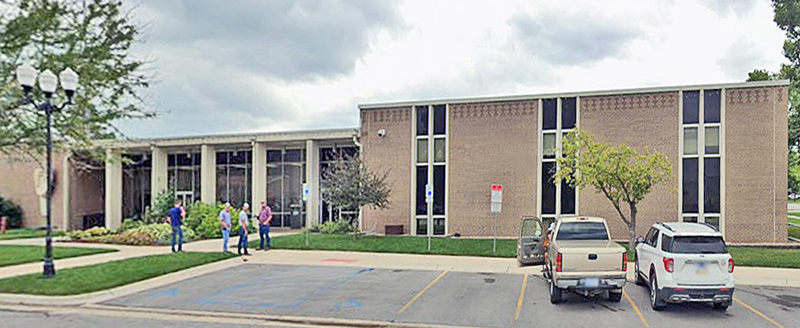
Current Coffey County Courthouse in Burlington, Kansas, courtesy of Google Maps.
The construction of the John Redmond Reservoir, northwest of the city, from 1960 to 1965, for flood control of the Neosho River Valley, had a major impact, shifting the community from a purely agricultural to an industrial one.
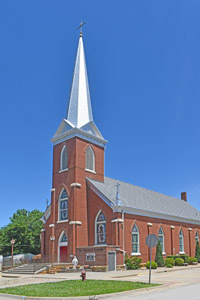
Catholic Church in Burlington, Kansas by Kathy Alexander.
Burlington’s population increased significantly during the construction of the Wolf Creek Nuclear Power Generating Station, which began in 1977. Its population peaked at 2,901 in 1980.
The generating station was completed in 1985, having a tremendous economic impact on the area.
Located northeast of Burlington, the Wolf Creek Generating Station opened the Wolf Creek Lake (later renamed Coffey County Lake) to provide a source of cool water for the nuclear power plant. It was opened to the public for fishing in 1996, and it also offers the Wolf Creek Ecological Education Area.
Today, the City of Burlington is a second-class city.
Burlington is home to several bodies of water that are perfect for fishing, with catfish particularly prevalent in the muddy waters. Running north-south along the eastern side of town is the Neosho River; a couple of parks along it are popular fishing spots. Drake Park has a large waterfall created by an old dam on the river. Along with the Neosho River are John Redmond Reservoir and Coffey County Lake.
For those who love to camp, there are a couple of excellent sites nearby, such as John Redmond. Riverside east and west hug the Neosho River. They are a well-shaded campsite with a couple of sweet walking trails. The Dam Site Park sits north of the latter two campsites and also has nicely shaded campsites with easy access to the Cross Country Course, perfect for an evening walk or run.
Burlington is located on Highway 75, about 22 miles north of Yates Center, and about 41 miles southeast of Emporia.
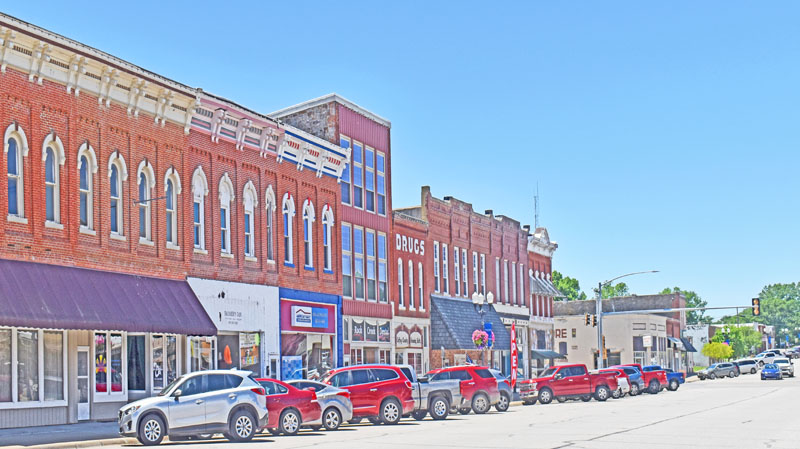
Main Street Buildings in Burlington, Kansas.
©Kathy Alexander/Legends of Kansas, updated February 2026.
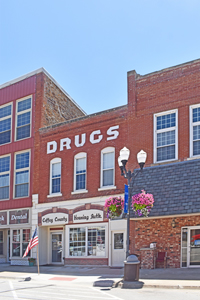
Business buildings in Burlington, Kansas, by Kathy Alexander.
Also See:
Sources:
American Courthouses
Blackmar, Frank W.; Kansas: A Cyclopedia of State History, Vol I; Standard Publishing Company, Chicago, IL 1912.
Cutler, William G; History of Kansas; A. T. Andreas, Chicago, IL, 1883.
City of Burlington, Kansas
Diana Staresinic-Deane
Grokipedia
Travel Kansas
Wikipedia