
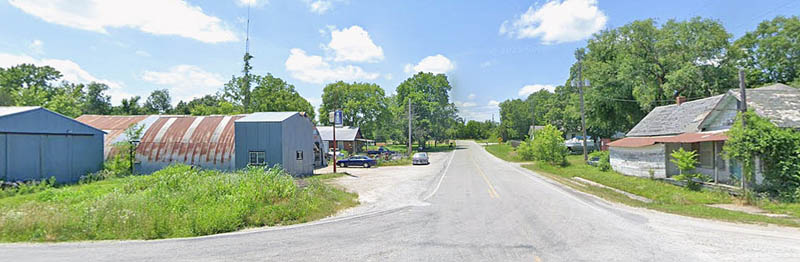
Centropolis, Kansas, courtesy of Google Maps.
Centropolis, Kansas, is an unincorporated community in Franklin County and is officially designated as an extinct town as its post office closed decades ago. As of the 2020 census, the community’s population and that of nearby areas was 100.
The area was included in a 1808 treaty ceding land to the Osage Nation, but was returned to the federal government in 1825. Afterward, several treaties were made with other Indian nations, which set off parts of what was later to become Franklin County for their use
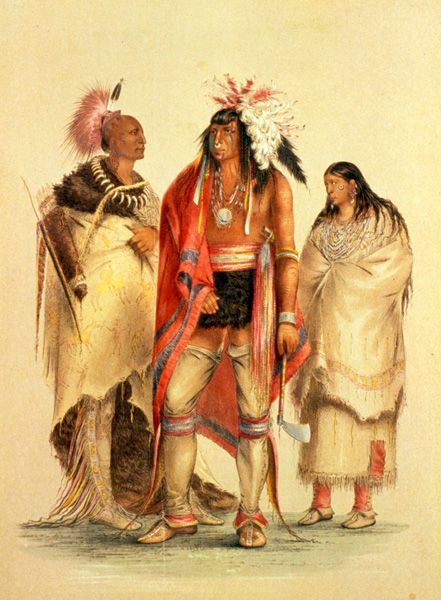
Osage indians by George Catlin.
Centropolis is considered the first town in Franklin County, although it shares a date of settlement with Lane.
Perry Fuller first settled in the area in 1855 and established a large frame store to trade with the nearby Ottawa Indians. His stock of goods was supplied to him by West & James of Kansas City. The store prospered, resulting in annual sales of $50,000. The same year, the first school in Centropolis was taught by William Cator. Cyrus K. Holliday, later one of Topeka’s founders, laid out the townsite before 1856.
In 1856, Fuller partnered with William Moore, and the new firm bought out West & James and continued the business. The same year, Fuller established the Centropolis Town Company along with John F. Javens, Franklin Barnes, George Powers, Samuel T. Shores, William Moore, J.K. Goodin, George W. Smith, Benjamin C. Westfall, Samuel Mewhinney, Ralph Mayfield, Cyrus K. Holliday, William Y. Roberts, and Cyrus F. Currier. The town’s name was derived by combining the words “central” and “metropolis”.
The Town Company had big plans, wanting to make Centropolis the county seat, the Territorial capital, and the future capital of the State of Kansas. The Town Company began selling lots, and, with buyers’ high hopes, they sold for exorbitant prices, up to $500 per lot. Soon, several businesses and dwellings were erected. Dr. Hall opened a dry goods and grocery store, and Jacob Long built a trading house and, among other commodities, sold liquor to the Indians. In order to break up this traffic, Messrs. Fuller & Moore purchased Long’s stock of liquor and, knocking in the heads of the barrels, let it flow out onto the prairie. The Indian women, however, sorry to see so much valuable “fire water” wasted, gathered up as much of it as possible with buckets as it flowed away.
The Methodist Church was organized that year, with Reverend Kilpatrick serving as the first minister. The community also boasted a number of residences and businesses, including a grocery store, hotels and boarding houses, a restaurant, livery stables, harness shops, four saloons, and a prosperous gambling house. Franklin County’s first newspaper, the Kansas Leader, started the same year.
George Powers started a boarding house and, in 1857, erected a building for a restaurant. That year, the Town Company built a large steam sawmill, which was operated the first year by J.A. Marcell and the second year by J. M. Loos. That year was the most prosperous for Centropolis, which had about 30 buildings, including four saloons and a prosperous gambling house. The Kansas Leader was established and published by W.H. Austin. It was the first commercial newspaper in the county. However, the newspaper did not last long; it was sold to the Minneola Town Company, moved to Minneola, and renamed the Minneola Statesman by General James Lane. When it was decided that Minneola was not to be the Capital, the Statesman was suspended.
In 1858, Dr. Hall sold the dry goods and grocery store to H.H. Bliss. By this time, three church denominations were listed as having been organized: the Methodist, Christian, and Union Baptist. A post office was established on August 4, 1858. However, it closed on November 21, 1859.
The town’s population was 175 in 1860. However, that year, a severe drought affected farmers in this area. Many packed their belongings and moved away. By that time, it was apparent that none of the Founding Fathers’ dreams would come to pass. Ottawa was named the county seat; the townsite of Minneola had beaten out Centropolis as the capital of the Kansas Territory, even though that proved to be a “one-day wonder,” and the railroad bypassed the new town in favor of Norwood, Le Loup, and Baldwin City. From that time on, the small town found growth almost impossible to achieve. However, even in the face of adversity, the townspeople continued to hold the faith.
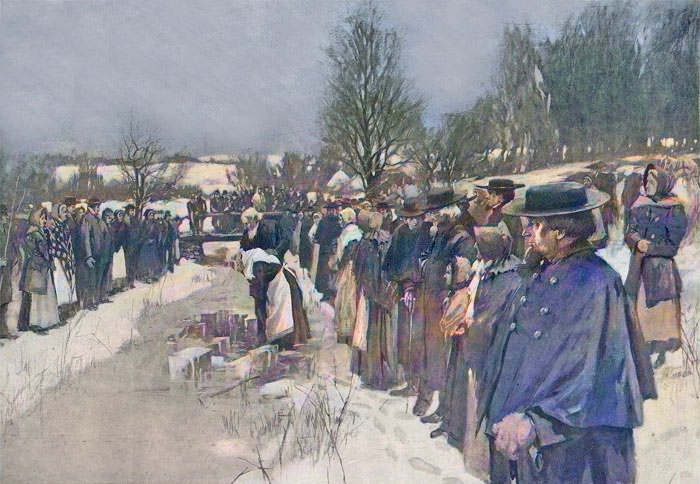
Duncards.
On February 21, 1863, the Minneola post office was moved to Centropolis. But it didn’t stay long. It was moved back to Minneola on November 25, 1863.
The Journal newspaper was established in Centropolis on March 9, 1864, by Charles W. Goodin. The small paper, measuring 4×6, acquired a circulation of about 500. It was suspended on September 3, 1864.
The first mail service in the area was between Ottawa and the Centropolis post office, with the route carried out by a horse-drawn wagon several times a week.
A religious group known as the Dunkards was organized in 1865. In this county and the adjoining counties of Douglas and Osage, there were approximately 60 members in the organization. Similar to the Amish, they were very devout, industrious, and reasonably prosperous. In dress, they were plain but neat. They were also clannish and exclusive, seldom marrying outside the church.
The post office relocated from Minneola to Centropolis for the final time on December 8, 1865.
In 1877, a neat one-story frame schoolhouse was built for about $1,200. It seated 80 students.
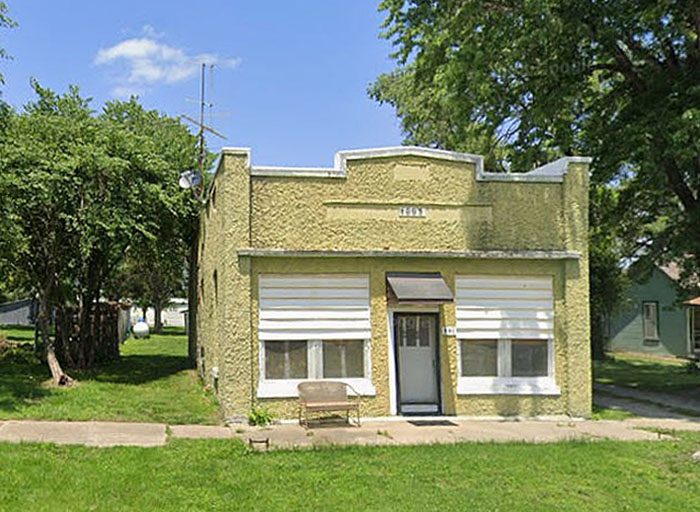
Old business building in Centropolis, Kansas, courtesy of Google Maps.
In 1880, the Methodists built a new church exclusively for their use at a cost of about $1,000. At that time, the town boasted two general stores, one hardware store, two blacksmith shops, a wagon shop, a machine shop, a grist mill, a cabinet shop, a hotel, a schoolhouse, and 23 families comprising about 175 inhabitants.
In the early 1900s, the Centropolis Telephone Company provided service to outlying areas, using barbed-wire fences to carry the line. The switchboard was located in the front of a home, and calls were “put through” from 7:00 a.m. until 8:00 p.m. Only emergency calls were allowed after hours. This system, surprisingly, lasted until 1969, when the company was sold to Contel Telephone. It was one of the last independent telephone companies in Kansas to “go modern.”
The Centropolis post office closed on January 15, 1930. The Great Depression of the 1930s was hard on the town. One of its doctors left, the harness-making shop closed, and the bank failed. Afterward, only two general stores, a blacksmith and garage, a barbershop, and a restaurant remained. The restaurant, named “The June Bug,” was a favorite gathering place for the townsmen.
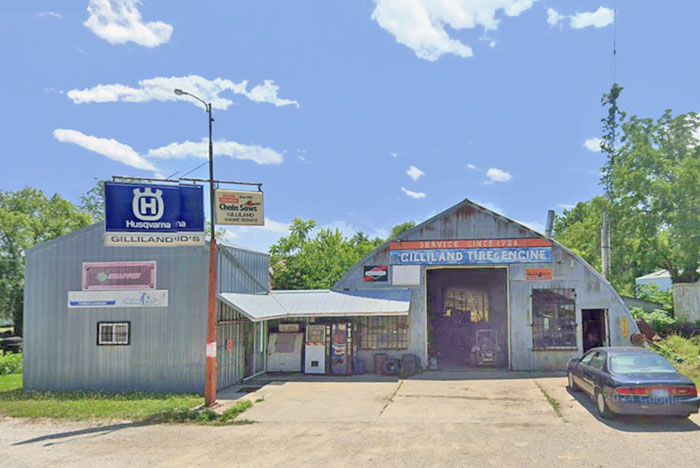
Gillilands Tire & Engine in Centropolis, Kansas, courtesy of Google Maps.
The years following the Depression found little change in the town.
Two businesses survived the fluctuations of the small town. One was Gilliland’s, a garage and tire shop that was established in 1926 by Elmer Gilliland. For a time, it also included a sawmill and an icehouse. It provided electricity for 14 homes in the town before selling out that portion to Kansas City Power and Light in about 1940.
The school closed in the 1960s, and the students attended Appanoose Grade School, which was part of the USD 287 in Pomona, Kansas.
The other mainstay of the town was the Farmers Union Mercantile, fondly called “Olga’s” after Miss Olga Simmons, who came to work there in 1924. She continued to work, first as a clerk and then as proprietor, for 57 years—until illness forced her retirement in 1981. The old store was auctioned off in 1983 and purchased by Leland & Mabel Gilliland, owners of the garage and tire shop across the street. For a time, new life was breathed into the old store when Gilliand’s daughter, Robyn Bownam, reopened it. She operated the store until the fall of 1988, when difficulties with supplier delivery services and a lack of assistance forced her to close again. Since then, the building has stood empty, giving mute testimony to the echoes of a boisterous past and an almost forgotten dream.
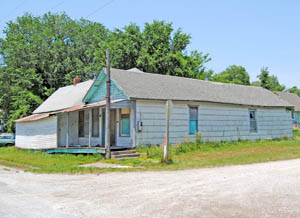
An old business building in Centropolis, Kansas, by Kathy Alexander.
The Centropolis Christian and Baptist Churches continue to serve a congregation, and several buildings and dwellings remain in Centropolis.
Centropolis is located about 11 miles northwest of Ottawa, Kansas.
©Kathy Alexander/Legends of Kansas, December 2025.
Also See:
Extinct Towns of Franklin County
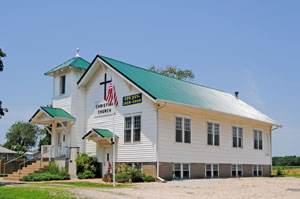
Christian Church in Centropolis, Kansas by Kathy Alexander.
Sources:
Blackmar, Frank W.; Kansas: A Cyclopedia of State History, Vol I; Standard Publishing Company, Chicago, IL 1912.
Centropolis
Cutler, William G.; History of Kansas; A. T. Andreas, Chicago, IL, 1883.
Facebook – Old Depot Museum
Franklin County History
Wikipedia