
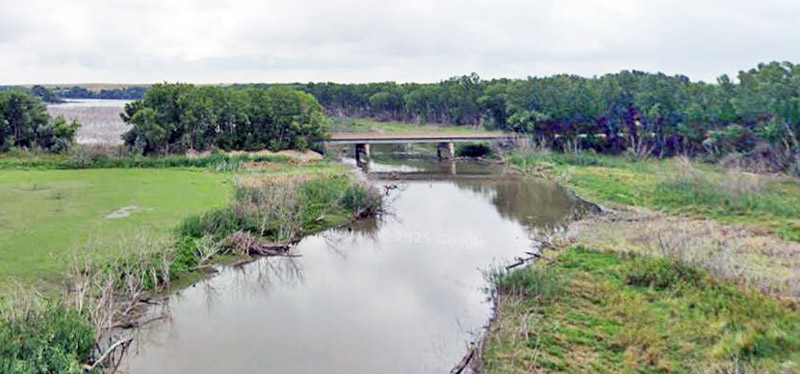
Prairie Dog Creek in Norton County, Kansas, courtesy of
Google Maps.
Prairie Dog Creek is a stream that is a tributary of the Republican River. Originating in the High Plains of northwest Kansas near Colby, it flows for 246 miles through Kansas and Nebraska.
The stream begins in west-central Thomas County, about five miles southeast of Brewster, Kansas. It then flows northeast across northwestern Kansas through Thomas, Sheridan, Decatur, Norton, and Phillips before crossing into Harlan County, Nebraska, where it joins the Republican River to feed Harlan County Reservoir.
The Prairie Dog Creek watershed has open areas of flatlands and gentle rolling hills that were once covered by short-grass prairie.
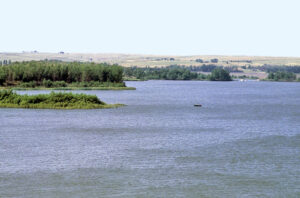
Keith Sebelius Lake, Norton, Kansas, by the Kansas Geological Survey.
The creek supports local wildlife habitats and is dammed to form Keith Sebelius Lake southwest of Norton, Kansas. The creek’s upper reaches, from its headwaters to the Keith Sebelius Lake, drain approximately 640 square miles.
The region of Prairie Dog Creek in northwestern Kansas was part of the traditional hunting grounds and migration routes of several nomadic Plains Indian tribes, including the Cheyenne, Lakota Sioux, and Kiowa, who traversed the area to access bison herds and seasonal resources before intensive European contact.
The first documented European incursion into the Prairie Dog Creek area occurred under Etienne Veniard, sieur de Bourgmont, a French officer who ventured southward from the Missouri River around 1714–1720 to establish trade and alliances with local tribes, marking initial contact amid the creek’s watershed.
American exploration advanced the documentation of Prairie Dog Creek during John C. Fremont’s second expedition in June 1843, as his party traversed northern Kansas en route to the Rocky Mountains. Fremont named the stream “Prairie Dog River” upon observing dense colonies of black-tailed prairie dogs along its banks, which covered extensive bottomlands for nearly two miles. Fremont’s group, guided by scouts including Kit Carson, bartered for provisions and intelligence along the way.
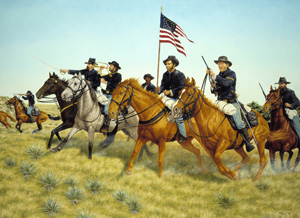
The Battle of Prairie Dog Creek In Phillips County, Kansas.
Prairie Dog Creek holds historical significance as the location of the Battle of Prairie Dog Creek, which occurred on August 21, 1867. During this battle, elements of the 10th Cavalry Regiment engaged with Cheyenne and Kiowa warriors amid rising tensions over westward expansion. This conflict marked the end of the U.S. Army’s offensive operations against Native Americans on the Kansas frontier for that year. The battle site is situated three miles east of Long Island, Kansas.
Permanent settlement along Prairie Dog Creek in northwest Kansas began in the early 1870s, following the resolution of significant Native American conflicts through treaties.
In 1964, the U.S. Bureau of Reclamation completed a dam on the creek southwest of Norton, Kansas, for flood control, irrigation, and municipal water supply, creating Keith Sebelius Lake.
©Kathy Alexander/Legends of America, updated January 2026.
Also See:
Sources: