
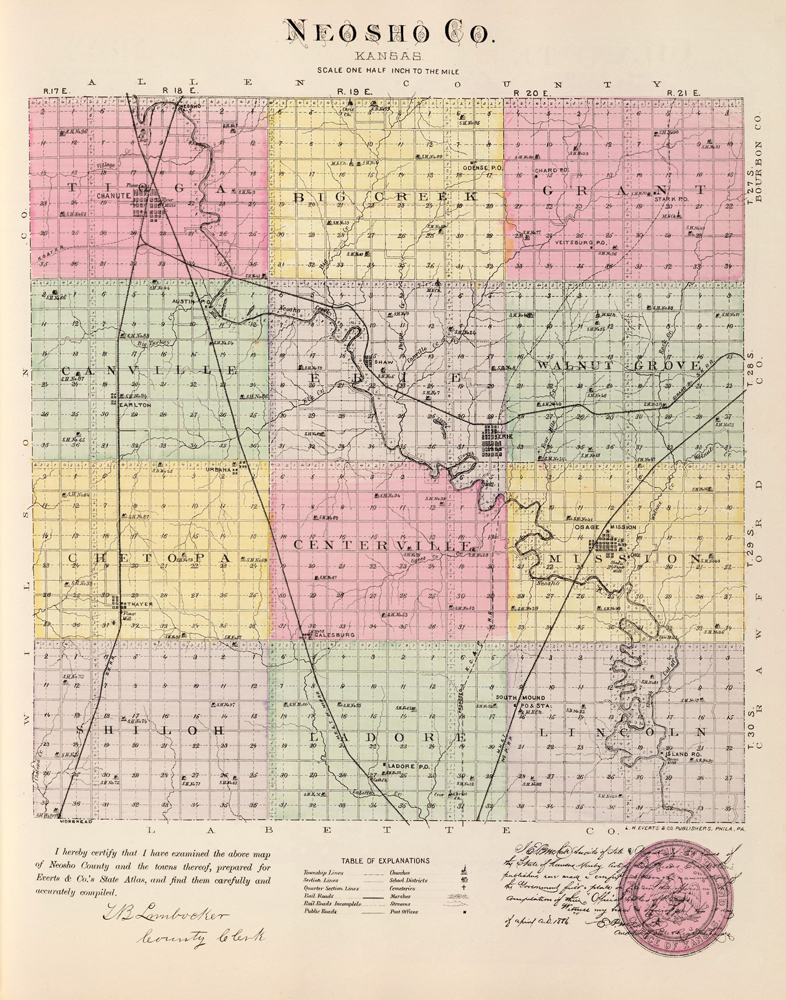
Neosho County, Kansas map by L.H. Everts & Co., 1887.
Shaw, Kansas, is a long-abandoned town in Erie Township of Neosho County.
Long before Shaw was established, this area had been claimed by Chief White Hair and his band of Great Osage about the time of the War of 1812. The tribe migrated from Missouri to Kansas in about 1815, and Chief White Hair built a village about four miles down the Neosho River from present-day Shaw, Kansas. The village was known as White Hair’s Town and contained eight log houses and 100 bark-and-grass houses. It was a pretentious Indian town with flagstone sidewalks and a grist mill. The village is on the West side of the river. The Osage had been induced to come to their new home by Pierre Chouteau, an Indian trader, who had established a trading post sixteen miles down the river from White Hair’s village.
Continuing the program of work among the Osage, the United Foreign Missionary Society established Neosho Mission in 1824. In September of that year, Reverend Benton Pixley, from Harmony Mission in Missouri, accompanied only by his wife and two small children, entered the wilderness. Pixley was a college graduate, a Latin and Greek scholar.
The family arrived by wagon and moved into a vacant cabin built by one of Chouteau’s traders. Pixley selected a site for the mission in a stately oak grove about one-half mile West of the Neosho River and forty rods from a small natural lake near what is now Shaw, Neosho County. He set to work felling trees to build a log house for his home in the coming spring. He continued this work during the fall and winter while also providing wild game for his family’s sustenance. In the spring, white men from Harmony Mission came to assist him in erecting a large log house. Another log house was built at the time as a schoolroom for the Osage children, and hewn-log seats were installed. This room was also used as a church for Osage adults on the Sabbath. The Osage built seven log houses near Pixley’s for permanent homes.
A product of the New England puritanical religious beliefs, Missionary Pixley held a rigid distinction between right and wrong, and there was no room for compromise. Several Osage bands were located nearby, and some of the chiefs and the Indian agent were antagonistic to him. Some religious meetings were disrupted, and the school failed to attract students.
Pixley antagonized everyone in the area except the missionaries. However, some Jesuit letters contained more than a few harsh words about him…”
“With all things considered, it had a reasonably long life considering Reverend Pixley’s tendency to agitate. While many of Pixley’s opinions and actions were probably correct, his manner of expressing himself raised the fur on many necks.”
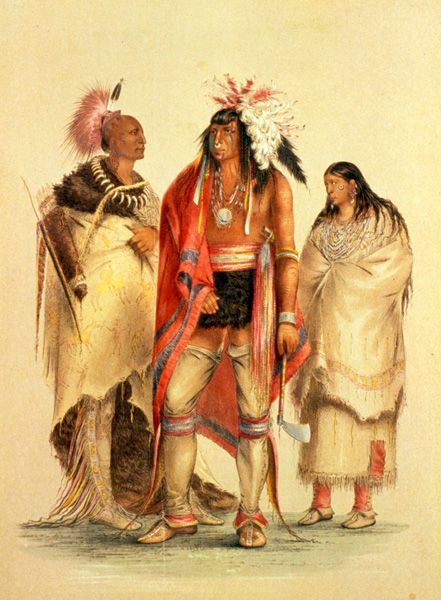
Osage indians by George Catlin.
The government also maintained a station for several years, and the American Fur Company operated a trading post.
When the Osage signed the 1825 treaty at St. Louis, Missouri, they ceded all their lands to the United States, including all of Oklahoma North of the Arkansas and Canadian Rivers, northwestern Arkansas, western Missouri, and nearly half of Kansas.
Afterward, Father John Shoemaker established the Osage Mission in the present-day St. Paul, Kansas, in Neosho County. It became one of the most influential Roman Catholic Schools in the West. It was attended by many Osage boys and girls as well as children from other Indian tribes.
From 1825 to 1828, Neosho Mission was a busy place. The Indian children came to the school daily for two months each year, and Missionary Pixley was expected to ensure that they received a noonday lunch. Here, too, came Indian women with their small children to beg for food, while the Indian men gambled in their tents and bark houses in the Indian villages.
Strange bands of Indians frequently came to pilfer, steal, and wage war against the Osage. Amid these surroundings, 80 miles from the nearest white settlement, this lone missionary labored, prayed, preached, and taught the untutored Indians.
Pixley’s demeanor prompted an avalanche of letters to the government Board of Commissioners, which led to his removal in early 1829, when the mission closed. Reverend Benton Pixley and his family moved to Independence, Missouri, where he was retained as the first Presbyterian minister there. The mission and school were located on the West bank of the Neosho River, near Shaw, Kansas.
Mission Neosho, from the Indians’ perspective, was a failure. It did not succeed in converting them to Christianity, nor did it revolutionize their habits of living. The Indians were not exactly indifferent to the agricultural skill of white men, but they could not be induced to devote themselves to such pursuits. This was especially true of the men. They were content with the efforts of the Osage women, who on small tracts of land along the creeks, cultivated and produced beans, pumpkins, watermelons, and corn sufficient for the family’s needs.
The Osage reservation was disposed of under the terms of a treaty made with the Osage at the Canville Trading Post, near Shaw, on September 29, 1865.
The Osage left Kansas in 1870. They settled on land bought from the Cherokee, East and North of the Arkansas River, in Oklahoma. By an act of Congress of July 15, 1870, the remainder of the Osage lands in Kansas passed to the Government to be disposed of for their use.
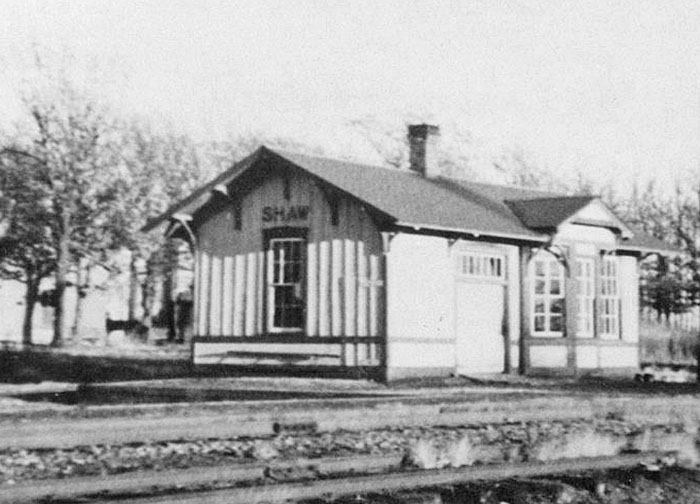
Railroad Depot in Shaw, Kansas, 1950s.
Several years later, the construction of the Chanute-Girard branch of the Atchison, Topeka & Santa Fe Railroad spurred efforts to establish a town at Shaw. At that time, area farmers wanted a market closer than Chanute or Erie and heartily joined in the promotion. The leaders at the start of Shaw were members of the Arkansas Town & Land Company, who were composed at least partly of railroad men who expected to make a profit from the new townsite. The incorporation papers were signed on February 24, 1885, by William G. Dickinson and William A. Coats. William A. Robinson and H.W. Davidson. The town was laid out in March 1885.
A post office was established on August 14, 1885, with Harvey Eckley serving as the first postmaster.
Most of the early settlers there were from Walnut. M.E. Beman opened the first general store; Mr. Boyle opened the first hardware store; and Jack Freeman was the first druggist. Over time, a lumber yard was established, an elevator was erected, and business was brisk for several years. Guffey & Galey drilled several oil wells, starting a small boom.
The Shaw Society United Brethren in Christ was organized in Shaw almost before there was a Shaw. It was chartered for an indefinite period by the state of Kansas on March 27, 1886.
A.A. Liggett had a large general store there in 1891. Two churches had been established, and a good school had opened.
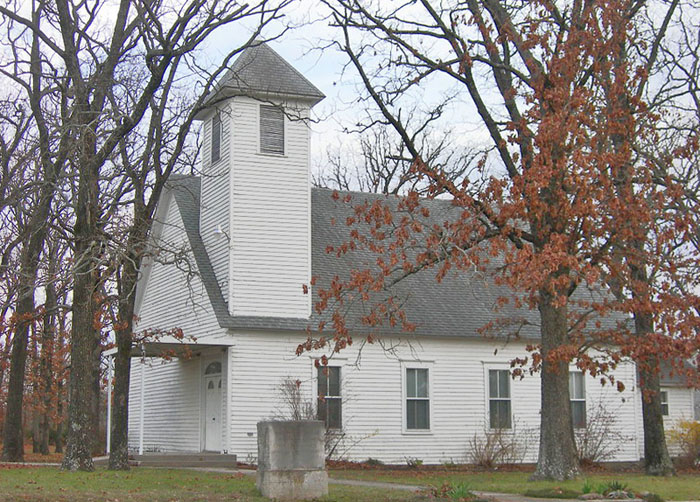
Christian Church in Shaw, Kansas, courtesy of Jimmy Emerson, Flickr.
The Congregation of the Church of Christ appears to have been the only denomination to erect a building in Shaw. An organization was started in the early days of Shaw, but it was not incorporated until August 12, 1895. Soon after the charter was received, a lovely building was erected for church services. It was dedicated in October 1896.
Shaw gained a telephone connection with the Erie system in 1901.
In 1906, Shaw had two grain dealers, two general stores, a lumber yard, two grain buyers, a hotel, a restaurant, a livery, and a barber shop.
E. John opened a hardware store in 1910, and E.E. Eckley was the postmaster and proprietor of a General Store. At that time, the village also had telegraph and express offices, a good local trade, a money order post office with one rural route, and a population of 125.
The Shaw State Bank was chartered on October 1, 1920. The Shaw State Bank merged with the Bank of Erie and the Allen State Bank at Erie on August 6. 1927.
Shaw’s post office closed on December 31, 1954.
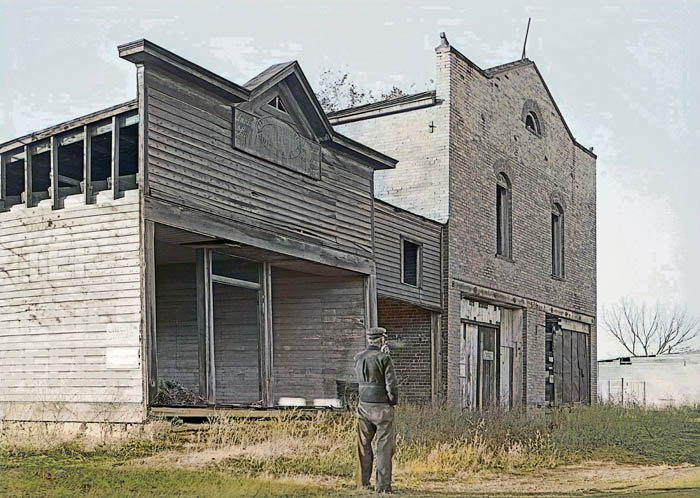
Abandoned stores in Shaw, Kansas, by John Vachon, 1940.
Today, there are still a few buildings in the area, as well as the Shaw Cemetery. It was four miles West of Erie.
©Kathy Alexander/Legends of Kansas, updated July 2026.
Also See:
Sources:
A Catholic Mission
Historic Marker Database
Kansas Genealogy
Kansas Historical Quarterly
Kansas Mediocrity