
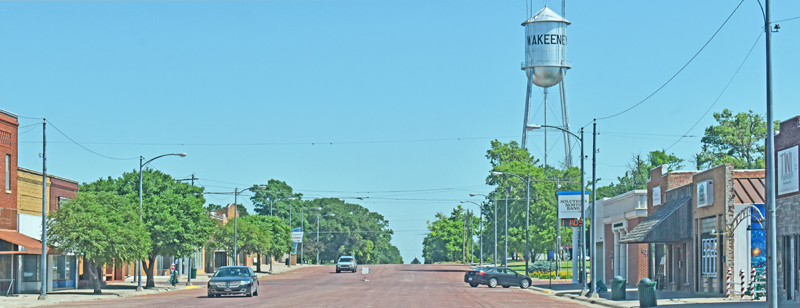
WaKeeney, Kansas Main Street by Kathy Alexander.
WaKeeney, Kansas, is a city in north Trego County in the northwest part of the state, and is the county seat. As of the 2020 census, the city’s population was 1,799, and it had a total area of 1.71 square miles, all land.
Lying in the High Plains region of the Great Plains, Trego County, with its rolling prairies and striking bluffs, has a rich history. It began in the early days of the first white men in the area, with an exploration party led by John C. Fremont in the 1840s, and continued through the region’s expansion with the Butterfield Overland Despatch in 1865.
Situated between the Saline and Smoky Hill Rivers, it was surrounded by rich bottomlands. It was approximately two miles north of Big Creek, a tributary of the Smoky Hill River. A small tributary of Big Creek flows south from near the center of the city.
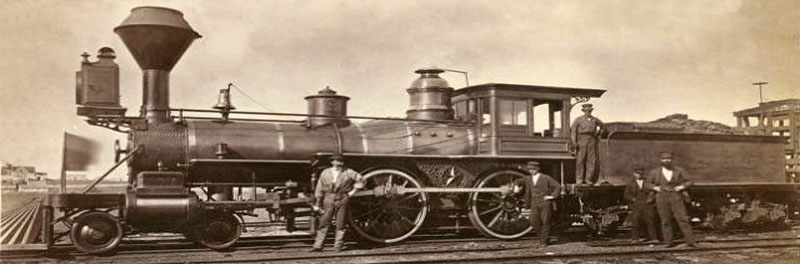
Kansas Pacific Railway Train
The development of the Kansas Pacific Railroad through the county brought growth to the area, along with the homesteaders and pioneers who built the towns and settled this country.
James Keeney and Albert E. Warren, land speculators in Chicago, Illinois, purchased two entire townships at the site of modern-day WaKeeney from the Kansas Pacific Railway in December 1877. At that time, there were few settlers in the county, not more than a dozen permanent settlers in all. John Henry was located on the claim about a mile west of WaKeeney. George Pinkham was located about 1.5 miles northwest. Arthur Pratt and family were also located on a claim; the other settlers were Harlow Orton, Earl Spaulding, J.K. Snyder, O. Adams, George Brown, George McCaslin, and Peleg Richards.
Before the townsite survey was completed, people began flocking to WaKeeney, mostly from Chicago. The first house built on the townsite was erected by Peck & Ellsworth late in 1877 and used as a real estate office. W.S. Harrison, a dealer and shipper of livestock, sold fresh and smoked meats in 1877. At that time, new arrivals lived in a “dug out” at Trego Station about one mile west of the new townsite. The WaKeeney post office opened on February 6, 1878.
The business partners formed Warren, Keeney, & Company, and had the site surveyed and platted in March 1878 by Peck and Ellsworth. The plat was filed for record on April 3, 1878. Afterward, the depot at Trego was moved to WaKeeney. The first business house in the town was erected by C.P. Keeney at the foot of Franklin Street, and was a two-story frame building, occupied as a general merchandising store by Thomas Caddick. He sold dry goods, clothing, boots and shoes, tobacco, produce, groceries, feed, etc. Had a Stock Farm 3/4 Miles from WaKeeney.
About the same time, Warren & Keeney put up the Commercial House, directly across the street from Caddick’s store. This frame building was the first hotel built in the town. Merchants by the score, professional men by the dozen, mechanics and tradesmen by the hundreds, and speculators, all rushed to WaKeeney.
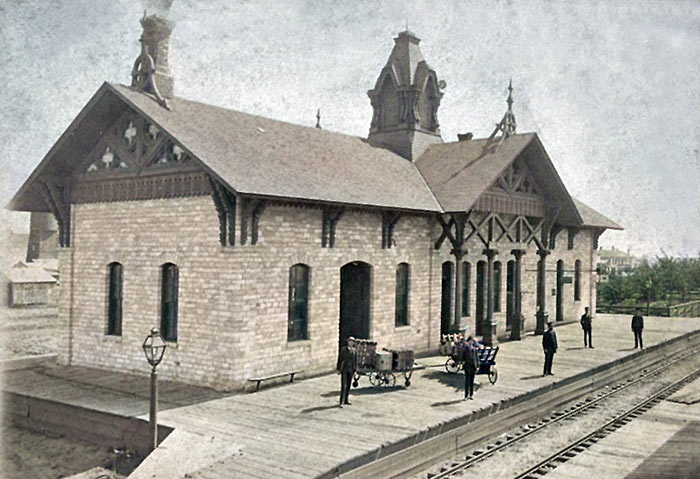
Kansas Pacific Railway Depot in WaKeeney, Kansas.
The train depot was built that year from limestone quarried from the Saline River and Big Creek. George Baker established a stock ranch and meat market five miles Southwest of WaKeeney in 1878. He later served as the Sheriff of Trego County.
That year, an immense crop added to the craze, and by early spring 1879, many settlers had arrived. That year, WaKeeney (a contraction of their names) was established. Billed it as “The Queen City of the High Plains”, the partners began advertising and holding celebrations to attract settlers. About 100 carpenters were kept busy night and day, and yet houses could not go up fast enough to accommodate the people.
The first newspaper, the WaKeeney World, was first issued on March 8, 1879, under the proprietorship of W.S. Tilton. It started as a six-column paper, but in August 1879, it was enlarged to seven columns.
At that time, there were three church organizations in the town: Presbyterian, Congregational, and Methodist. Only the Presbyterians, who had purchased the old Trego depot in 1879 and converted it into a church, had a building.
The Osborn, Monroe, and Henkel Land Company, Real Estate Dealers and Loan Agents, was established that year, as was James Kelley’s General Hardware & Implements.
On June 21, 1879, Governor John P. St. John signed the proclamation of the organization of Trego County. At that time, WaKeeney became the county seat, and the county initially used rented premises.
The rush of people to WaKeeney continued, and the town grew rapidly. The Oakes House was built that year by D. Barclay. It was a very fine building, measuring 30 by 100 feet, with a large ell on the north end. It was built of sawed stone and finished in good style. The Grand Central Hotel was also built in 1879 by B.W.S. Huffaker. It was a two-story building, half stone and half wood. The two-story frame Union House hotel was established by W.C. Olson.
Throughout this year, all these hotels were constantly crowded to overflowing, and landlords were put to their wits’ end to furnish accommodations for all the guests that arrived. Aside from the hotels built in 1879, many good, substantial improvements were made. Lawrence & Hall put up a very fine two-story building on the east side of Franklin Street, finished in very elegant style, with large plate-glass windows in front, and the whole building, apparently, fitted up regardless of expense. The first floor was used as a store by Mr. Thorpe, and the upper floor was used as the United States Land Office.
The Leader newspaper was started in September 1879 by H.P. Stultz. It was a six-column, folio, and Republican in politics.
Some very fine business blocks were erected and fitted up in a metropolitan style, with plate-glass windows. One of these, belonging to a Mr. Thorpe, burned down in February 1880, and the loss was $40,000. The United States Land Office, which had been established here in October 1879, was also burned in the fire.
The Kansas Pacific Railway was consolidated with the Union Pacific Railroad in 1880. That year, WaKeeney was incorporated as a city. However, the crop failures that year drove settlers to leave as quickly as they had arrived.
At about three o’clock on the morning of February 3, 1880, a fire alarm was raised, and people rushed from their houses to see the cause. The fire were first discovered issuing from the basement of Thorpe’s new building, and might have been readily extinguished before it spread to the building above, but when the bystanders attempted to enter, Thorpe told them there were several kegs of powder in the basement, which caused those who came to help, to give the place a wide berth, and let the fire take its course. No attempt was made to save anything, and the building, with all its contents, including all the books and records in the Government Land Office, with ten other framed buildings, was totally destroyed. The loss was estimated at $40,000, and though everybody, during the progress of the fire, was expecting to hear a loud explosion, none occurred, so that the powder, if any there was, must have possessed the extraordinary quality of being non-combustible.
A.B. Jones, a physician and surgeon, established his practice in 1880.
The Leader newspaper ceased publication in December 1880.
Unfortunately, crop failures of 1879 and 1880 had generally convinced people that Trego County was altogether unreliable for agricultural pursuits, and people began to leave about as rapidly as they had come, and the zenith of WaKeeney’s glory was reached.
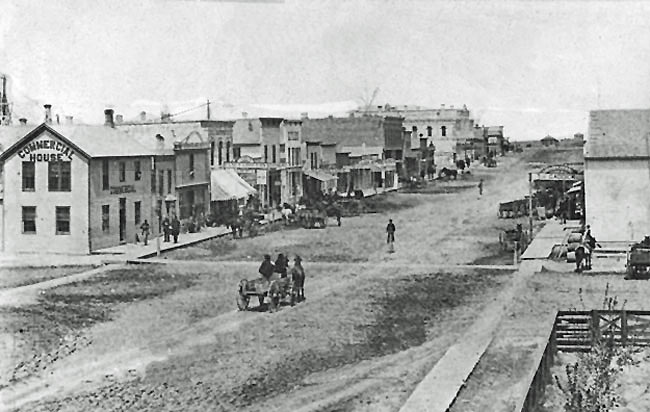
WaKeeney, Kansas, in the 1880s.
The Leader newspaper was revived in May 1881 by A.J.R. Smith, but only lived a few months, expiring again in August 1881.
In the summer of 1881, Verbeck & Blair, whose store had been swept away by the fire of February 1880, erected a very fine two-story stone building on the site of the one that had been destroyed, and which was occupied as a general store.
A.C. Frick established a Livery, Feed, and Sale Stable in 1881.
In October 1881, the WaKeeney World newspaper was enlarged to eight columns and had a circulation of 400.
By 1882, all that was left were “five poorly patronized retail stores”.
The Opera House was the next major building, completed by J.F. Keeney in 1884 with ceiling murals, a Rochester electric brass chandelier, and seating for 400. The building had an east front of 100 feet and a south front of 80 feet. It was two stories high, with a basement; the walls of the latter rose about two feet above ground level. The walls of the building were constructed of chalk limestone, sawed into blocks of uniform dimension, while the steps, caps, and sills are made from hard limestone, all the material having been taken from quarries adjacent to town. The lower story was divided into four storerooms, and the upper story was intended for an Opera Hall and offices.
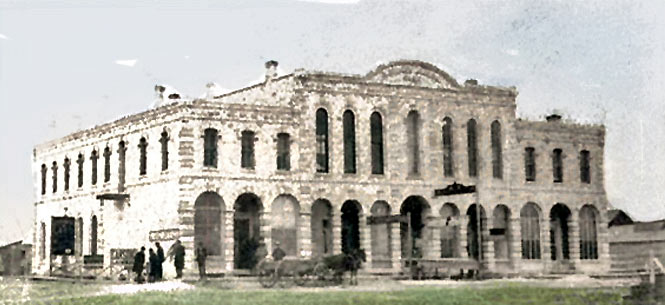
Opera House in WaKeeney, Kansas.
That year, WaKeeney was a good business point, with the usual complement of hotels and business houses, a Union church, good schools, and a weekly newspaper called the World. A brickyard was built at that time. George I. Verbeck owned a lumberyard, and Marshall and Ufford established a general merchandise store.
The nearest bank was in Hays, 32 miles east. Grain, livestock, and wool were shipped, and stagecoaches ran to Utica and south to Dodge City, tri-weekly. Stages also ran daily to Fremont and Lenora, and north to Logan, with mail semi-weekly. At that time, the town’s population was 400.
Jones and Ferris established a drug store in 1885.
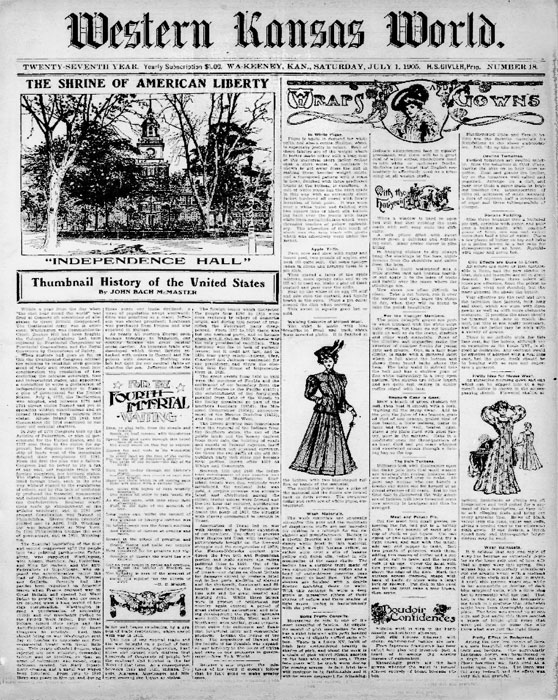
Western Kansas World Newspaper.
In 1886, land was still the biggest business in WaKeeney. The Western Kansas World of July 17, 1886, listed about 20 firms: dealers, surveyors, attorneys, land agents, etc, that had to do with the sale of land. W.F. Watson established a Wholesale and Retail Staple and Fancy Groceries that year.
The First National Bank was established in Wakeeney in 1887.
The Trego County Courthouse was built in WaKeeney from 1888 to 1889. The two-story coursed stone structure was designed in the Romanesque Queen Anne style by George R. Ropes of Topeka, Kansas, and built by George Barrett and George Pinkham at a cost of $26,994. Facing west, the building is located on the spacious, landscaped grounds of Courthouse Square, in the center of WaKeeney. They had a 100-ft cupola and a European tin roof, and an eagle outline carved into the stone above the west entrance. In the interior, the original stairs flank the east and west entrances, and the space is rich in dark wood. The County District Court courtroom is located on the south side of the second story and has the original judge’s bench. In the basement is the former jail with unique flat bars and specially designed locks. The building houses the County District Court of the 23rd Judicial District, which includes Ellis, Gove, and Rooks Counties. The courthouse is located at 216 North Main Street and Russell Avenue.
WaKeeney’s population in 1890 was 439.
The First National Bank was liquidated in 1893.
Unfortunately, the Opera House was destroyed by fire in 1895.
In 1900, WaKeeney’s population was 394.
The first Volga Germans began settling in the area northwest of WaKeeney in the late 1890s.
In 1910, WaKeeney was an incorporated third-class city and was still on the Union Pacific Railroad. At that time, it had a handsome $40,000 court house, two banks, hotels, two weekly newspapers — the Independent and the World, tri-weekly stagecoaches to Bosna and Banner, telegraph and express offices, and an international money order post office with two rural routes. All professions and all lines of retail trade were represented. It was a shipping point for livestock, grain, and dairy products. Its population in 1910 was 883, an increase of more than 200%. over that of 1900.
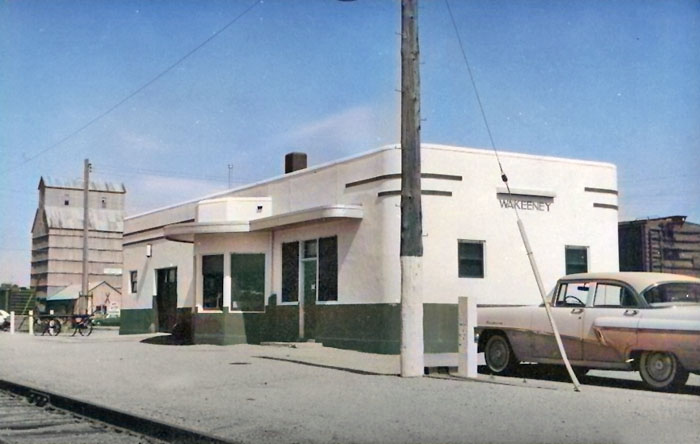
Steamline depot in WaKeeney, Kansas.
The Union Pacific Railroad depot remained in use until the 1930s.
The Union Pacific Railroad depot was razed in 1941 to make way for a “streamline” depot.
Since 1950, WaKeeney has hosted an ornate civic Christmas lighting display featuring over 6,800 lights, a 35-foot live greenery tree, a snowman and elves, and a Santa house, so visitors can celebrate Christmas year-round. This traditional display is considered one of the largest Christmas displays between Denver and Kansas City.
The cupola and the European tin roof of the Trego County Courthouse lasted until 1952. Afterward, the original tin roof and the clock tower were removed to create a modern appearance. The architect was Wilson & Company, and the contractor was Val Borden Construction Company of Salina.
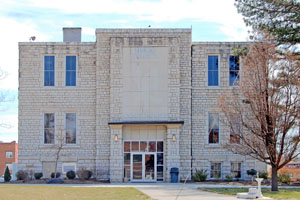
Trego County Courthouse in Wakeeney, Kansas by Kathy Alexander.
WaKeeney’s population peaked in 1960 at 2,808.
In 1966, the courtroom was remodeled. In 1967, the exterior was sandblasted and sealed. The contractor was Masonry Restoration of Nebraska. The building was remodeled in 2012, adding a hipped roof.
The Trego County Historical Society was founded in 1969, with the first building dedicated in 1975. The Pleasant Valley Schoolhouse was relocated to the site in 1997. The groundwork for the new addition began in 2014, and the first event was held there in 2015 without electricity.
The green-and-white “streamline” depot in Wakeeney was razed in 1985.
Today, the community is served by the WaKeeney USD 208 public school district, which provides primary and secondary education through two schools in WaKeeney: Trego Grade School (Pre-K-8) and Trego Community High School (9-12).
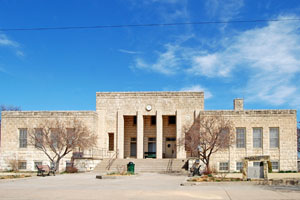
City Hall in WaKeeney, Kansas by Kathy Alexander.
Trego WaKeeney Airport is located on the west side of U.S. 283, immediately south of I-70. Publicly owned, it has one concrete runway and is used for general aviation.
The Union Pacific Railroad continues to operate one freight rail line, the Kansas Pacific line, through WaKeeney, running east–west through the city. The local newspaper published in WaKeeney is the weekly Western Kansas World.
K231BG, a translator of radio station KJIL in Copeland, Kansas, broadcasts from WaKeeney on 94.1 FM playing a Contemporary Christian format.
WaKeeney visitors can get an old-fashioned soda or sweet treat at the Soda Fountain at Gibson Health Mart Pharmacy, which has been a staple at 125 N. Main Street t since 1892.
The Main Street Nature Trail was completed in 2009 in downtown WaKeeney. The nature trail surrounds the railroad tracks, with benches for relaxing, a gazebo for lunching, sidewalks for walking, a geocache, and, in season, beautiful wildflowers native to the region.
Located at an elevation of 2,447 feet, WaKeeney is at the intersection of Interstate 70 and U.S. Route 283. It is 162 miles northwest of Wichita, Kansas; 281 miles east-southeast of Denver, Colorado, and 284 miles west of Kansas City, Missouri.
The Trego County Historical Society Museum and One-Room Schoolhouse is located at 128 N. 13th Street. Here, visitors can learn about Trego County’s history, its founders, and its residents. On the grounds, visitors can see the Fairgrounds, the one-room schoolhouse with antique farming equipment and tools, and a large mural painted in collaboration with local artists and depicting the local history.
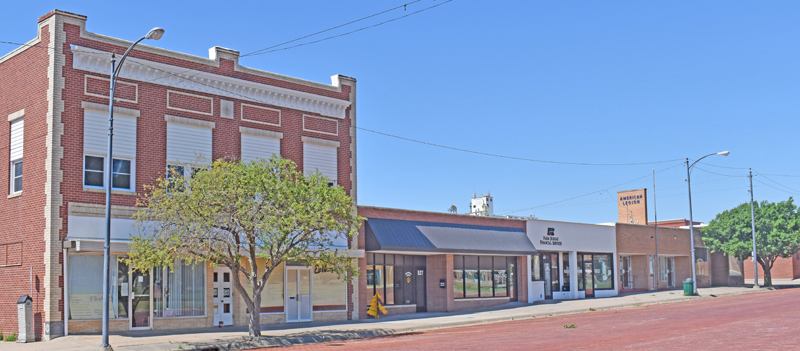
Main Street buildings in WaKeeney, Kansas, by Kathy Alexander.
©Kathy Alexander/Legends of Kansas, January 2026.
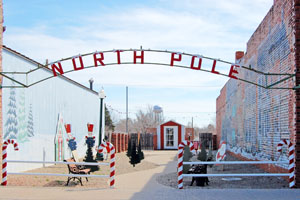
The North Pole in WaKeeney, Kansas by Kathy Alexander.
Also See:
Butterfield Overland Despatch – Staging on the Smoky Hill Trail
Sources:
American Courthouses
Blackmar, Frank W.; Kansas: A Cyclopedia of State History, Vol I; Standard Publishing Company, Chicago, IL 1912.
Cutler, William G.; History of Kansas; A. T. Andreas, Chicago, IL, 1883.
City of WaKeeney
Kansas GenWeb
Trego County Directory, 1884-1885
Trego County Directory, 1887
Trego County Historical Society
Trego County, Kansas
Wikipedia