Atchison & Pike’s Peak Railroad.
The Central Branch Union Pacific Railroad was a railroad in Kansas that was originally planned as a line from Atchison westward into Colorado. The Kansas Territorial Legislature incorporated the Central Branch as the Atchison & Pike’s Peak Railroad on February 11, 1859, with the power to build from Atchison, on the Missouri River, West to the Kansas-Colorado line in the direction of Pike’s Peak or Denver, Colorado. It was to be one of the branches of the Trans-Continental Railroad, of which the Union Pacific Railroad constituted the main line between Council Bluffs, Iowa, Omaha, Nebraska, and Ogden, Utah, where it connected with the Central Pacific Railroad.
Land was acquired through an 1862 treaty with the Kickapoo Indian Tribe and the U.S. government. The railroad company purchased 24,000 acres from the Kickapoo Tribe at $1.25 per acre. The railroad acquired additional land under the land-grant provisions of the Pacific Railway Act of 1862, which included a line to be built by the Hannibal & St. Joseph Railroad of Missouri, extending West from Atchison.
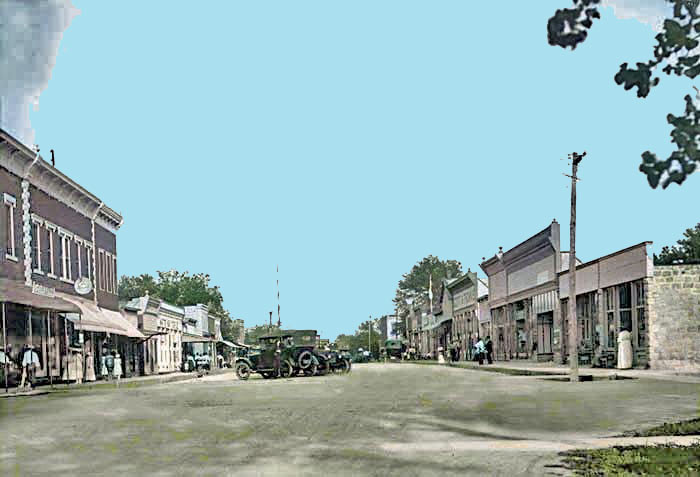
Early 1900s Waterville, Kansas by Leslie Parsons. Colorized
Land was only obtained for the first 100 miles, leaving Waterville, Kansas, as the end of the railroad when the Union Pacific Railway, Eastern Division, with which it was to connect, changed its route. The company received from the Government 187,608 acres of land and bonds at a rate of $16,000 per mile for the first 100 miles.
The West end of this branch would be at an intersection with the Leavenworth, Pawnee & Western Railroad, a planned connection from Kansas City, Missouri, to the main transcontinental line. The company would receive land only within the first 100 miles of Atchison. The Hannibal & St. Joseph Railroad transferred its rights under the act to the Atchison and Pike’s Peak in January 1864.
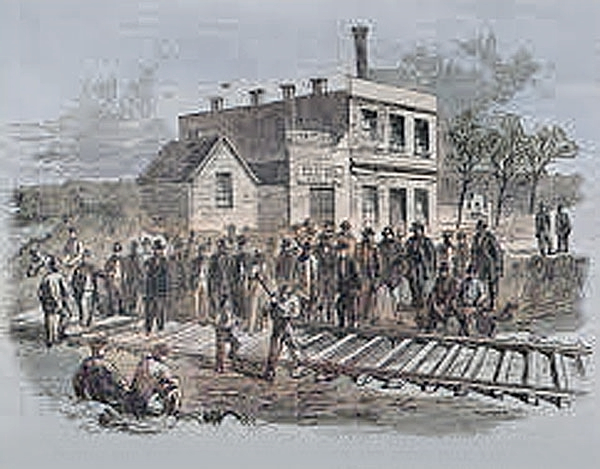
Construction began in 1865. Unfortunately for the Central Branch, the Union Pacific Railway, Eastern Division, formerly the Leavenworth, Pawnee & Western Railroad, was authorized in 1866 to extend westward into Colorado, leaving the Central Branch with a hanging end at Waterville.
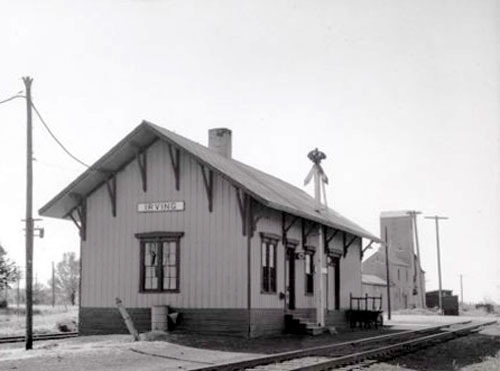
Railroad Depot in Irving, Kansas.
The line was completed from Atchison, West, for 40 miles in January 1867. At that time, the company changed its name to Central Branch Union Pacific Railroad, better reflecting its purpose. By February of 1867, track had been laid to mile marker 79.5 at Frankfort. Having completed the bridge over the Big Blue River, the first locomotive arrived in Irving, Kansas, on December 22, 1867.
The remaining 100 miles to Waterville were completed on January 20, 1868.
In the 1870s, the Central Branch owned six locomotives and passenger cars, with two in Atchison and two in Waterville. Increased demand led the railroad to convert two flatbed cars to “open air” cars with benches and tree branches for a roof. Reportedly, 500 Sunday School children rode the train in these cars.
After failing to get land grants for an extension along the Eastern Division’s original route into Nebraska, the Central Branch turned its sights to local traffic.
Several extensions and branches were built and leased in the late 1870s, beginning with the Waterville & Washington Railroad, which was completed to Washington and leased to the Central Branch in December. Afterward came the Republican Valley Railway from Greenleaf to Concordia, the Atchison, Solomon Valley & Denver Railway from Concordia to Cawker City, and the Atchison & Denver Railway from Cawker City to Kirwin, with grading to Lenora. The Atchison, Solomon Valley, & Denver Railroad also built a branch from Downs to Alton, and the Atchison, Republican Valley, & Pacific Railway began construction of a branch into Nebraska, leaving the main line at Yuma and initially ending at Scandia. All five companies were merged in December 1879 as the Atchison, Colorado & Pacific Railroad, a non-operating subsidiary of the Central Branch that subsequently completed the line to Lenora and extended the branch from Scandia to Warwick. Completing the system of branches in Kansas was one more company: the Atchison, Jewell County & Western Railroad from Jamestown to Burr Oak.
Despite its name, the Central Branch Union Pacific was not associated with the Union Pacific Railroad until 1880, when the line was acquired by the Union Pacific Railroad through a stock purchase by Jay Gould and leased to the Missouri Pacific Railroad.
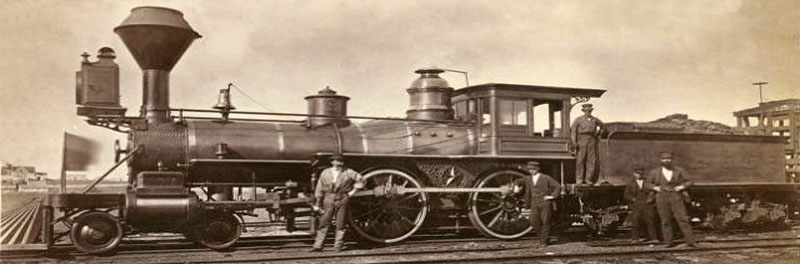
Kansas Pacific Railway Train
Jay Gould, who controlled the Kansas Pacific Railroad (the new name for the old Leavenworth, Pawnee & Western Railroad), desired control of the Central Branch to avoid competition between eastern Kansas and Denver. He acquired a majority of the stock in the Central Branch and its leased lines from Oliver Ames, the primary shareholder. In January 1880, he turned it over to the Kansas Pacific, which was immediately merged into the Union Pacific Railway. In December 1880, Gould leased the system to the Missouri Pacific Railroad, another company that he controlled, which had a north-south line through Atchison.
The final extension of the Central Branch in Kansas was the Rooks County Railroad from Alton to Stockton, incorporated in March 1885 and owned by the Missouri Pacific Railroad, which leased it in November 1885. To extend the Warwick branch into Nebraska, the Missouri Pacific Railroad incorporated the Pacific Railway in Kansas and the Pacific Railway in Nebraska in March 1887, and in September, the former was sold to the latter. The Missouri Pacific Railroad began operating the line from Warwick to Superior, Nebraska, in October 1887, and completed it to Prosser in April 1888. A separate Pacific Railway was incorporated in Nebraska in December 1887 to continue the line northwest to the western boundary of the state in Sioux County, but this was never built, and Prosser would remain the end of the line.
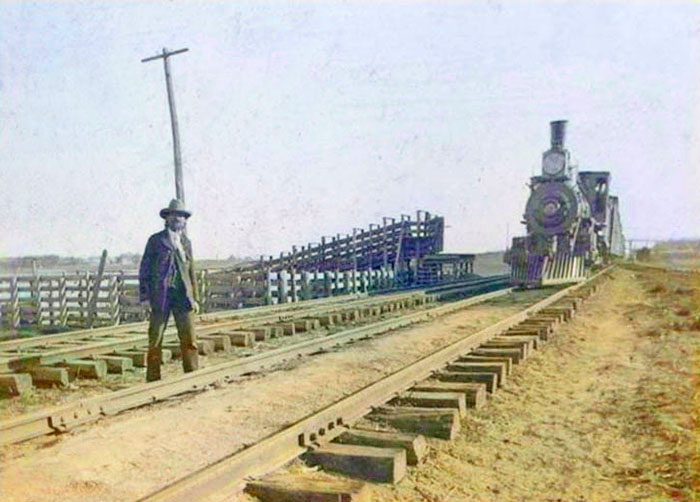
Missouri Pacific Railroad and cattle pens in Greenleaf, Kansas.
The Union Pacific Railroad went bankrupt after the Panic of 1893, and the Central Branch immediately followed, entering receivership in October 1893. It was sold under foreclosure in June 1898 to a new Central Branch Union Pacific Railway (replacing the old Central Branch Union Pacific Railroad), and the other two UP subsidiaries were similarly reorganized in December 1898 as the Atchison, Colorado and Pacific Railway and Atchison, Jewell County and Western Railway. The three were consolidated in July 1899 as the Central Branch Railway, now owned by the newly independent Missouri Pacific Railroad. Finally, on May 29, 1909, the Central Branch Railway and the Rooks County Railroad were merged, along with several other subsidiaries, into the Missouri Pacific Railroad. On August 12, 1909, the board of directors authorized, and on January 18, 1910, the stockholders ratified, the purchase of the Pacific Railway’s property in Nebraska (which began at Warwick, Kansas). For many years, the Missouri Pacific Railroad operated the system as the Northern Kansas Division, with a main line from Atchison to Downs, but in 1991, the Union Pacific Railroad, which had acquired the Missouri Pacific Railroad, leased, among other lines, the old Central Branch West of Frankfort to the Kyle Railroad.
The Missouri Pacific Railroad returned to the Union Pacific system in 1982.
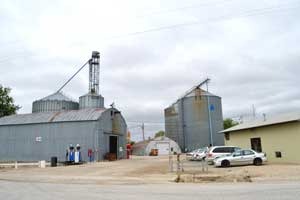
The Co-op elevators continue to operate in Vliets, Kansas, Kathy Alexander.
The Union Pacific Railroad abandoned the line East of Vliets in 1990, and the short stub from Frankfort to Vliets in 2004; Kyle operations between Frankfort and Ames were discontinued in 2001. The line from Ames West to Stockton remains, owned by the Union Pacific Railroad and operated by the Kyle Railroad.
In 1991, the remaining trackage West of Frankfort was leased to the Kyle Railroad.
When citizens realized that the historic tracks of the Central Pacific Railroad from 12th Road in Marshall County, Kansas to the Washington County line were to be abandoned by the Union Pacific Railroad in 2000, a group of concerned citizens and railroad enthusiasts immediately began the process of delaying that action in an attempt to preserve these historic tracks and, in doing so, preserve railroad history in Waterville and Blue Rapids, Marshall County and the State of Kansas. The Society was established as a nonprofit organization and raised the necessary funds within seven days to prevent the abandonment. The Society became the owner of 11.89 miles of Central Branch railroad track in 2001.
The purpose was to acquire rail lines eligible for abandonment to preserve railroad history, allowing small communities to cultivate their history and provide tourism attractions that help them remain viable. The Society also provides an educational experience for young people unfamiliar with railroads and their history.
©Kathy Alexander/Legends of Kansas, updated June 2026.
Also See:
Railroads & Depot Photo Gallery
Sources: