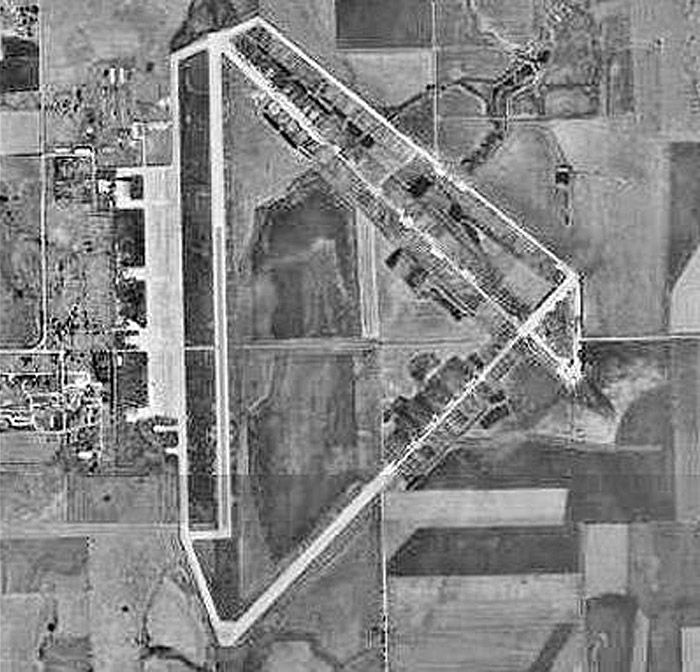
Herington Army Air Field near Herington, Kansas.
Herington Army Airfield was a World War II staging base for the United States Army Air Forces Second Air Force (2 AF), supporting the overseas deployment of heavy bombers and their crews. These bombers included B-17s, B-24S, and B-29s. Facilities at the field included runways, hangars, fuel storage tanks, barracks, administration buildings, and other related structures necessary for airfield operations.
It is currently the city-owned Herington Regional Airport.
Herington Army Air Field was located eight miles from Herington, Kansas, on a 1,700-acre tract of land which the United States government had purchased. It was planned as a satellite of Topeka Army Airfield, a Second Air Force installation situated about 70 miles to the northeast and serving as the headquarters of the 21st Bombardment Wing. The station contained about 100 buildings, electric transmission lines, and all the other things one could expect to find in a town of 2,500 people.
The construction of Herington Army Air Field was carried out under contract and supervised by the Air Service Command. It began in September 1942 and lasted for 14 months. Construction work of a general nature relative to the site chosen for the army airfield near Herington included a water storage and distribution system; a sewage collection and disposal plant; an electric distribution system; two gasoline storage and distribution systems, 128,000 square yards of paved roads and streets; 14,000 square yards of paved walks; and a swimming pool. Three runways were built, each measuring 150 feet wide and 6,750 feet long, with a gross load capacity of 74,000 pounds and a wheel load capacity of 37,000 pounds. Additionally, an apron measuring 500 by 4,750 feet was created with a ten-inch gravel base laid in layers over a six-inch compacted earth subbase, and it was surfaced with one-and-a-half inches of asphalt cement.
The 80-foot-wide service strip was constructed from a six-inch concrete slab, which was thickened to nine inches at the expansion and construction joints. The runway system was completed with three 50-foot-wide taxiways. At the front of the airfield, three squadron hangars were built, each measuring 120 by 80 feet.
On November 1, 1942, Major Harold Painter, who was slated to become the first commanding officer, arrived to take over the field.
In the ensuing weeks, a Base Signal Office was created, a Base Operations Section was organized, a Finance Department was set up, and a Base Chemical Service was inaugurated.
For the first 11 months of the active program, Herington was primarily a B-24 Liberator staging field, with a few B-17 Flying Fortress crews and aircraft being assigned there for processing.
On January 26, 1943, Major Painter formally assumed command of Herington Army Airfield. He appointed an adjutant, a provost marshal, a post engineer, a quartermaster(Captain Arthur J. Sand), and a medical officer. On the same day, the 503rd Base Headquarters and Air Base Squadron, the 1161st Guard Squadron, and the 399th Army Air Forces Band were also activated.
This processing of heavy bombardment crews and equipment, sometimes called staging and also preparation for overseas movements, proved to be the principal function of Herington Army Airfield. A preliminary step in the development of the program was the assignment on January 25, 1943, of the 47th, 48th, 49th, and 50th Airdrome Squadrons.
On February 17, the 6th Heavy Bombardment Processing Headquarters was activated at Herington.
The number of military personnel on the field grew to 12 officers and 145 enlisted men by March 1, 1943.
By June, there were 103 officers and 1,768 enlisted men. By the end of the month, the first combat crews and aircraft arrived at Herington for processing, and the program immediately got underway. Spread out over a period of approximately five days, the schedule involved the performance of the following functions on all such crews and aircraft that were temporarily assigned to the field:
- Auditing and processing of personnel records, orders, and allied papers of each person, and bringing payments up to date.
- A physical fitness examination.
- A clothing and equipment inspection.
- The issue of certain critical items of equipment.
- The assignment of the final-type aircraft and the conduct of specified vital inspection tests thereon.
- A prisoner of war lecture.
- Communications instructions.
- The assignment of crews and aircraft to scheduled overseas projects.
- Briefings on routes to be traveled.
- Arranging the schedule for departure to the port of embarkation.
The 21st Bombardment Wing was responsible for the final processing of heavy bombardment crews and equipment just before they departed for overseas assignments. To carry out that program, the Wing utilized Topeka Army Airfield, and three satellite fields (Herington Army Air Force, Bruning Army Air Force, and Fairmont Army Air Force) in Kansas and Nebraska.
The 6th Heavy Bombardment Processing Headquarters’ dominant role was evident in January 1944, when its commanding officer assumed command of the entire field. That move, in effect, consolidated three units that existed there: the Processing Headquarters itself; the 503d Base Headquarters and Air Base Squadron; and the 406th Sub-Depot, whose jurisdiction the Second Air Force had recently taken over from the Air Service Command. Two months later, the whole was organized as the 274th Army Air Forces Base Unit.
The first contingent of Women’s Army Corps, consisting of one officer and ten enlisted women, arrived in June 1944.
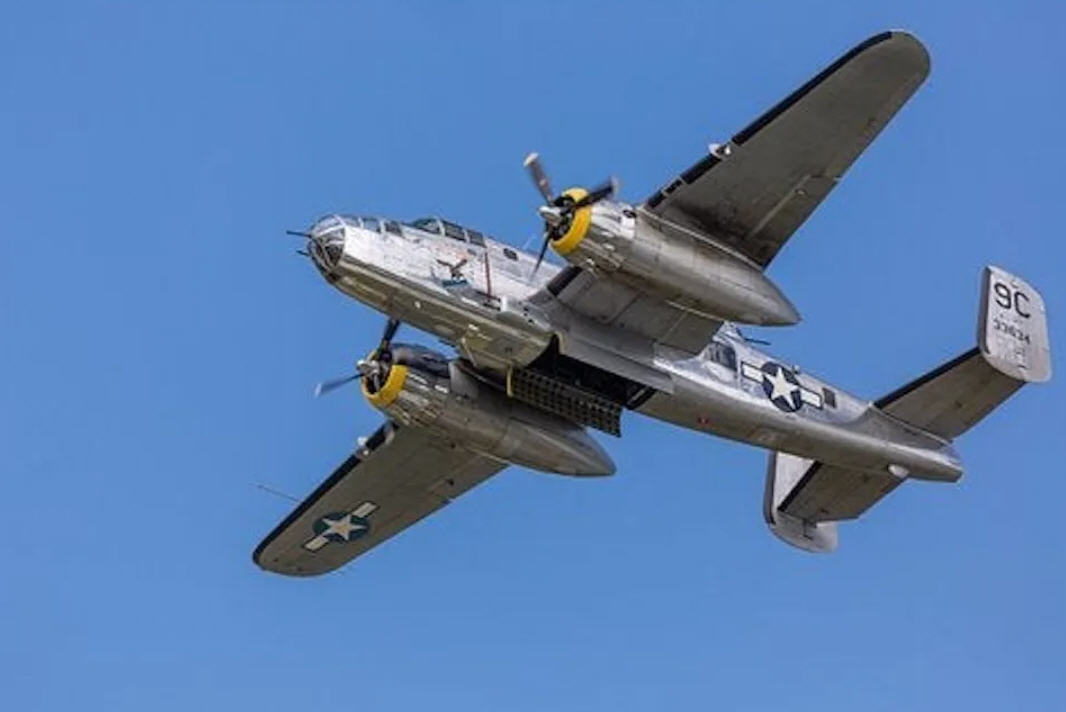
B-29 Bomber.
By working around the clock during rush periods, the 274th Army Air Force Base Unit at Herington processed an average of nine combat crews per day. Normally, however, the processing rate was much more moderate. Figures for the year ending June 30, 1944, may be regarded as typical. They reveal that during that interval, an average of just over 86 crews and 76 aircraft were processed each month. With some slight diminution, this rate was maintained until the end of World War II. Overall, most of the crews involved left Herington with their own aircraft. Some of the others traveled by train to the ports of embarkation. The remainder, along with a few aircraft, were transported to ports of embarkation by the Air Transport Command.
During June, July, and August 1944, the base was converted into a B-29 Superfortress staging field. That meant, of course, the processing of very heavy bombardment crews and aircraft just before they departed for overseas assignments.
The peak in the strength of the permanent party military personnel was reached in August 1944, with totals of 113 officers and 2,123 enlisted men and women.
In May 1945, the Continental Air Forces assumed jurisdiction of Herington Army Air Force from the Second Air Force. On July 18, Herington Army Airfield and the entire 21st Bombardment Wing were placed under the direct supervision of Headquarters, Continental Air Forces. In September, Herington became an installation of the Level I Staging Command, with the 21st Wing adopting that designation. Soon thereafter, Headquarters I Staging Command was moved from the Topeka Army Airfield in Kansas to the Merced Army Airfield in California. There was no further change in Herington’s status until its inactivation on November 14, 1945. Afterward, its formal jurisdiction passed from the Continental Air Forces to the Oklahoma City Air Service Technical Command. The installation was then placed in inactive status and declared surplus on October 18, 1946.
After all remaining property had been disposed of and a final audit had been completed, jurisdiction over Herington Army Airfield was transferred to the Army’s District Engineer, Seventh Service Command, at Omaha, Nebraska, who assumed jurisdiction over the field on March 19, 1947, pending disposition. Excess buildings and demilitarized equipment were sold or transferred to other bases. Some were torn down, and sales were held for scrap lumber from the torn-down buildings, fence posts, barbed wire, and other items that no longer had a useful purpose.
The War Assets Administration eventually turned the air base over to local government officials. Since then, the installation has been operated by the City of Herington as its municipal airport.
The airport maintains a small portion of the North-South runway and a small portion of the parking apron for aircraft use. Otherwise, the remainder of the wartime airfield is abandoned. The Northwest/Southeast and Southwest/Northeast runways were reduced to a single-lane concrete road, with cattle feeding yards on the east and west sides of the road. About half of the North/South runway is abandoned, along with most of the large-aircraft parking apron and associated taxiways. Two of the wartime hangars remain in use: one as part of an open storage yard, and the other for non-aviation use.
Most of the station area is unused, with many concrete foundations of the former wartime station buildings evident. A few wartime buildings appear to be standing, though they are in severe disrepair. The station area has some light industrial companies, and some wartime streets are evident.
Herington Regional Airport is a welcoming site for industrial and commercial purposes. Water, electricity, gas, sewer hook-ups & acreage are all available. Herington Regional Airport serves Herington and Morris County and is owned by the City of Herington. The All-New Concrete runway extends for 4,200 feet. The facility is at an elevation of 1,480 feet and is about seven miles from Herington.
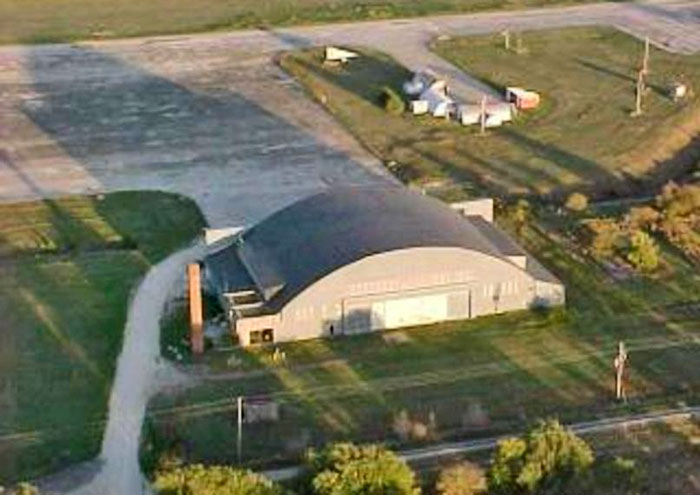
Herington, Kansas Army Airfield.
Airport services open to the public include: Aviation Fuel, Pilots’ Lounge, Parking, Public Phone, Hangers, and Tie-Downs.
The former wartime airfield can be reached by traveling east on U.S. Route 56 from Herington.
©Kathy Alexander/Legends of Kansas, May 2026.
Also See:
Dickinson County Photo Gallery
Sources:
City of Herington
Kansas Department of Health & Environment
Travel Kansas
We are the Mighty
Wikipedia