
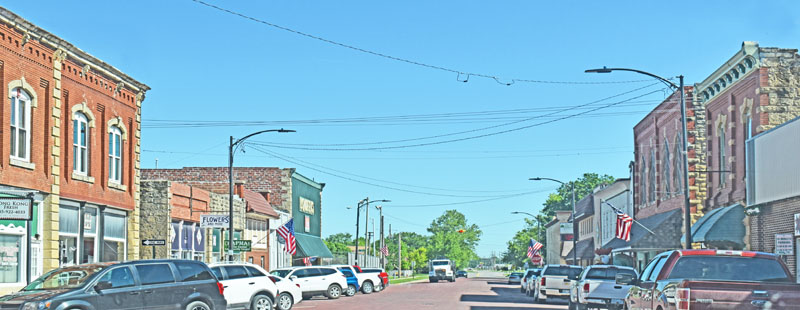
Chapman, Kansas Business District by Kathy Alexander.
Chapman, Kansas, is a small town on the north bank of the Smoky Hill River in the eastern part of Dickinson County. As of the 2020 census, its population was 1,377, and the city had a total area of 0.86 square miles, all land.
A post office was established on July 30, 1866, which was first called Chapman’s Creek.
George Snyder, a merchant born in Philadelphia, Pennsylvania, married Miss Mary L. Scott, a native of Virginia, with whom he had four children. In 1865, he moved his family to Fort Riley, Kansas, where he was a clerk in the Quartermaster’s Department for one year. He then moved to Ellsworth, where he remained for one year, then to Chapman, where he began general merchandising and soon did a business of $15,000 per year. In 1867, he was appointed Postmaster.
The town was first settled in 1868, and the same year, Jackman’s Mill was built on Chapman Creek, a little northeast of the present town.
James Streeter and S.M. Strickler laid out the town in 1871.
The land thus described belonged to James Streeter and S. M. Strickler, who, in 1871, had it surveyed and platted into blocks, lots, streets, and alleys, with the surveying and platting done by E.C. Smeed. In its first years, the community’s growth was slow.
On May 16, 1872, the town’s name was changed from Chapman’s Creek to Chapman.
In the late 1870s, a very fine stone schoolhouse was built at a cost of about $4,000. While it is not a large building, it was sufficiently commodious for the wants of the community.
In 1878, Chapman was a station on the Kansas Pacific Railroad. At that time, it had a grist mill, a saw mill, a Catholic Church, and a public school. Its principal shipments were grain, butter, and eggs. It had a Western Union Telegraph office and a stagecoach that ran weekly to Wakefield, from which the mail was delivered. Businesses included two saloons, three blacksmiths, three hotels, a wagon maker, a barber, a stone mason, a miller, and a grain, lumber, and coal dealer.
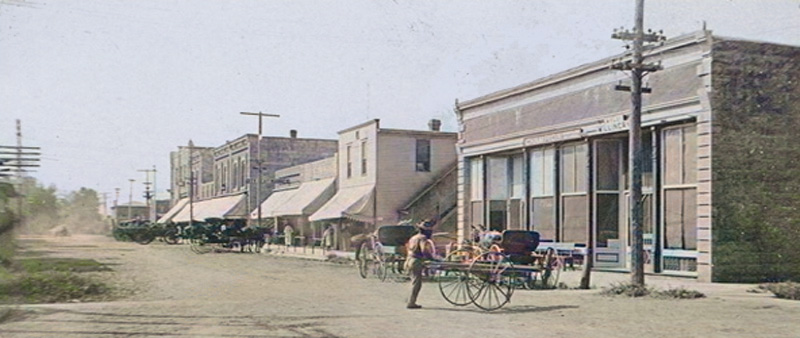
Early day Chapman, Kansas.
In 1880, the Methodists erected a church, which was blown down and destroyed in the spring of 1882, along with considerable other property in town. However, the congregation lost no time and immediately began to erect another, which was dedicated on Sunday, November 26, 1882, by Reverend E.W. Van Deventer of Abilene, who preached the sermon. The Catholics also built a stone church in 1883 for $20,000. At about that time, the town had four mercantile retail stores that did general business, and, considering the number of competing points surrounding it, did a very fair business. It also had a drug store, a hardware store, a lumber yard, a hotel, a good livery stable, and a grain elevator with a capacity of about 10,000 bushels.
F.B. Lillie, a druggist born in Erie County, Pennsylvania, came to Abilene, Kansas, in May 1855 and was employed as a teacher for some time. In 1880, he settled in Chapman, where he taught school for two years. He married Miss Elizabeth Tyler in December 1880. In 1882, he purchased a stock of drugs and opened a first-class drug store.
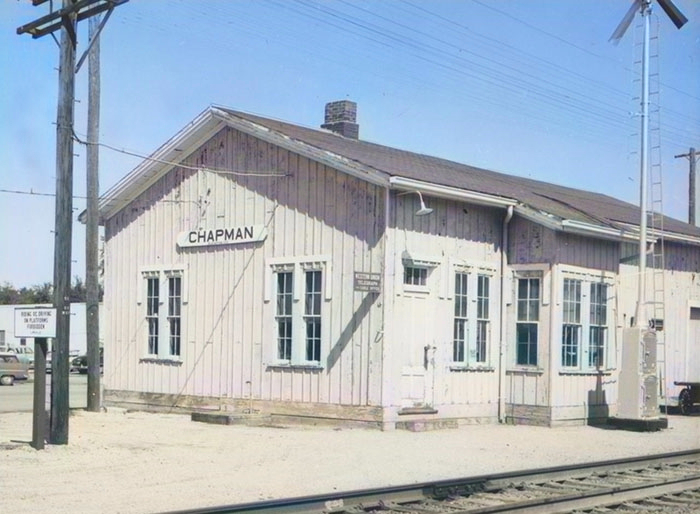
Union Pacific Railroad in Chapman, Kansas by H. Killam, 1956.
In 1910, Chapman was incorporated and was a station on the Union Pacific Railroad. At that time, it had two banks, a weekly newspaper called the Advertiser, a flour mill, some well-stocked mercantile establishments, churches of the leading denominations, an international money order post office with four rural routes, express and telegraph offices, telephone connections, a fine public school system, including the county high school. It was the most important shipping point between Abilene and Junction City, and had a population of 781.
On the evening of June 11, 2008, a ½-mile wide tornado swept through Chapman. It moved from the southwest side of town, through the central business district, and then out of town, damaging many buildings and structures and obliterating most of the downtown area. It destroyed 75% of homes, killed at least one person, and critically injured three others. School buildings and two churches were extensively damaged, and at least 200 people were displaced from the town.
Chapman’s population peaked in 2010 at 1,393.
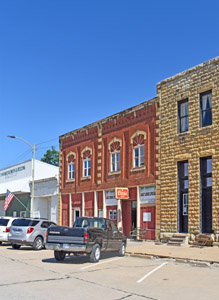
Business buildings in Chapman, Kansas, by Kathy Alexander.
On May 25, 2016, a large tornado tore through southwestern Chapman, which was placed under a tornado emergency. The violent and long-lived wedge tornado was on the ground for 25.09 miles and lasted for at least 90 minutes, producing damage at least at mid-range EF4 at its most intense point. The tornado began to weaken as it passed south of Chapman, causing extensive tree damage and inflicting low-end EF3 damage to a large farmhouse. To the southeast of Chapman, a home was shifted off its foundation before the tornado dissipated shortly after 8:30 p.m. The tornado reached a maximum width of one-half mile along its path and damaged or destroyed roughly 20 homes in Dickinson County. No fatalities were incurred, but eight people suffered minor injuries.
The community is served by the Chapman USD 473 public school district.
Chapman is 12 miles east of Abilene, the county seat, and the same distance east to Junction City, the county seat of Geary County. It is 83 miles from Topeka, Kansas.
©Kathy Alexander/Legends of Kansas, updated May 2026.
Also See:
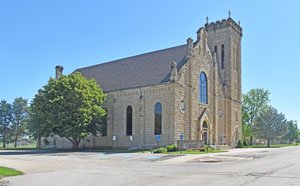
St. Michaels Church in Chapman, Kansas by Kathy Alexander.
Dickinson County Photo Gallery
Sources:
1878 Gazetteer and Business Directory
Blackmar, Frank W.; Kansas: A Cyclopedia of State History, Vol I; Standard Publishing Company, Chicago, IL 1912
Cutler, William G; History of Kansas; A. T. Andreas, Chicago, IL, 1883.
Wikipedia