
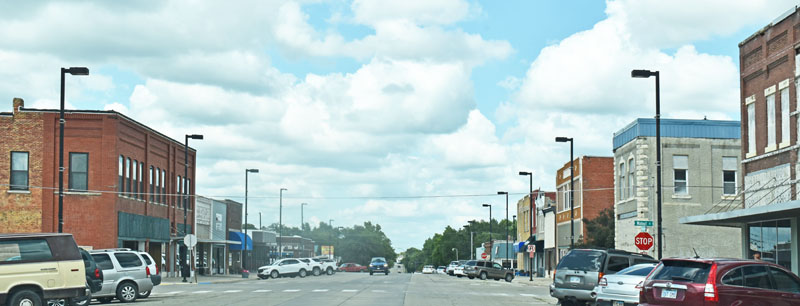
Herrington, Kansas Business District by Kathy Alexander.
Herington, Kansas, is a city in the southeastern part of Dickinson County. As of the 2020 census, the city’s population was 2,109, and it had a total area of 5.09 square miles, of which 5.06 square miles is land and 0.03 square miles is water.
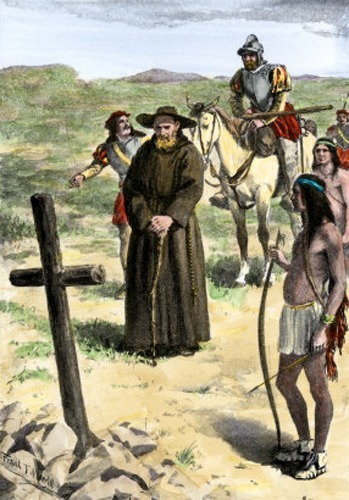
Father Francisco Juan De Padilla.
Herington is associated with Father Juan de Padilla, Kansas’ first Christian martyr, who accompanied the Coronado Expedition of 1541. He lost his life in this area trying to convert the local Indians. A monument was erected in the North City Park of Herington to commemorate the event. The park was later named Father Padilla Park.
Some German immigrants settled along Lyon Creek, three miles southwest of Herington, in September of 1859. The Tonkawa Indians of the Kanza tribe were in the area, but were few and friendly. The Cheyenne tribe also passed through the area on hunting parties, as did a few others.
The United States government granted the Herington site to the railroads as an incentive to expand into the new territory. Sales of the land were managed by the Union Trust Company of New York, which operated a land office in Emporia, Kansas.
On October 31, 1879, George M. Noble and his wife, Eva, purchased land at the future site of Herington from the Missouri, Kansas & Texas Railway Company. Little is known about the Nobles, except that they established a cattle ranch. On May 8, 1880, they sold the land to Count Charles E. Alioth and his wife, Anna. He was believed to be the son of a Swiss nobleman, and under their ownership, the cattle ranch operation was expanded.
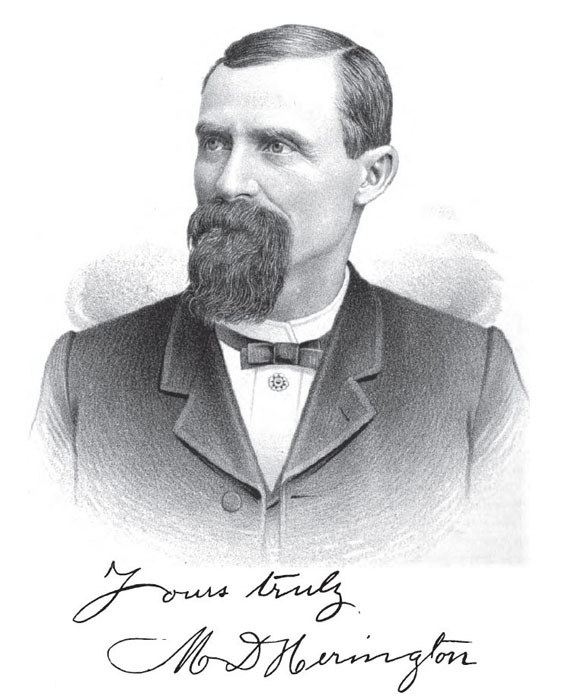
Monroe Davis Herington.
Monroe Davis Herington first saw an ad in the Bloomington, Illinois, newspaper. Wanting to trade his Illinois businesses for land in the west, he visited the Alioth ranch in July 1880, and arrangements were made for him to buy the 1,400-acre ranch. The closest neighbors were the Germans and, later, some Scottish immigrants, southwest and northwest of the ranch. Mr. Herington received a warranty deed from the Alioths on August 2, 1880. He and his family moved to the ranch on March 4, 1881.
Herington was founded in January 1884 and named after its founder, Monroe Davis Herington. The site was selected chiefly because of a beautiful natural grove there. A post office was established on February 21, 1884.
The first building was erected by Risley & Lincoln for a hardware store in March, 1884. Among the early businessmen and firms was M.D. Herington, F.S. Mitchell, CC. Thompson, Tusten & Caldwell, Calkins Bros., J.W. Chandler, B.F. Hartman, Risley & Lincoln.
One year after the town was founded, the value of the buildings was estimated at $75,000, and the Herington Tribune of January 22, 1885, reported the first-year volume of business at $485,300.
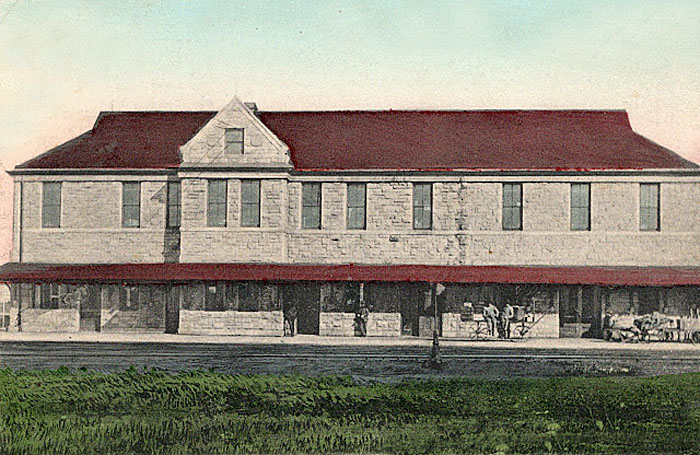
Rock Island Railroad Depot, Herington, Kansas.
In 1887, Monroe Herington successfully secured the Chicago, Kansas, & Nebraska Railway to build a line through Herington. He gave the land and right-of-way for Herington to become a division point, with shops, two roundhouses, a freight house, bridge yards, a telegraph office, and many other buildings. He also furnished the limestone for the freight house and a two-story depot measuring 28 by 66 feet, later enlarged to 28 by 105 feet. That same year, the Chicago, Kansas & Nebraska Railway built a main line from Topeka to Herington. The Chicago, Kansas, & Nebraska Railway also extended its main line from Herington to Pratt. This line was called the “Golden State Limited”. The railway also built a branch line north-south from Herington to Caldwell. The resulting boom to the town that year is recognized by the city as its real founding.
In 1891, the Chicago, Kansas & Nebraska Railway was foreclosed and taken over by the Chicago, Rock Island & Pacific Railway.
By 1893, the Chicago, Kansas, and Nebraska Railroad branch line from Caldwell had been incrementally extended to Fort Worth, Texas. This line is called the Oklahoma, Kansas, and Texas Railroad.
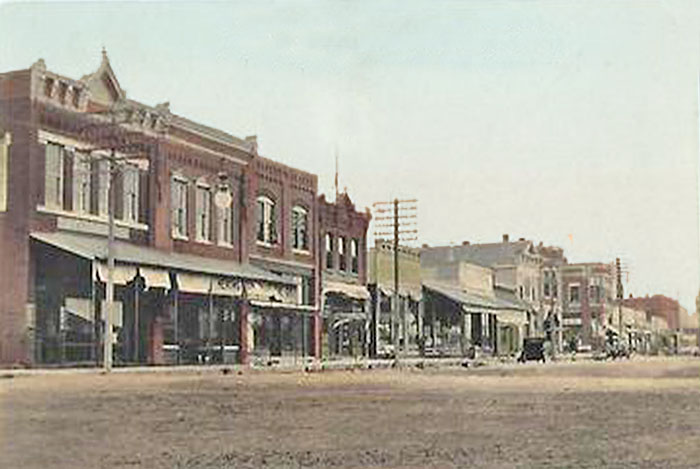
Herington, Kansas, in 1909.
In 1910, Herington was at the junction of the Missouri Pacific Railroad and the Chicago, Rock Island & Pacific Railway. At that time, it had two banks, an international money-order post office with four rural routes, telegraph and express service, a telephone exchange, two weekly newspapers, including the Sun and the Times, electric lights, waterworks, graded and high schools, and churches of various denominations. Among the industries and commercial enterprises were flour mills, an ice and cold storage plant, a creamery, the Chicago, Rock Island & Pacific Railroad shops, good hotels, and several well-stocked and substantial mercantile concerns. At that time, Herington was an incorporated city of the second class and had a population of 3,273, a gain of 1,666, or more than 100% during the preceding ten years.
That year, the Herington Public Library opened with a paid librarian. A reading room was established in a building on Main Street, and patrons were charged a $1 annual fee to use the library.
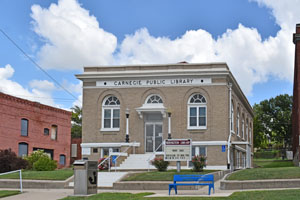
Carnegie Library in Herington, Kansas by Kathy Alexander.
When a separate library building was desired, Mayor W.M. Koons contacted the Carnegie Corporation to request funding to build a library in Herington. On June 9, 1913, the city council passed a resolution agreeing to raise the needed $1,000, and the Carnegie Corporation agreed to participate. Crowell and Van Meter, of Wichita, the architectural firm engaged to design the building, sent off the first set of plans in October 1913; however, the final plans were not approved until February 1915.
In the meantime, the National Old Trails Road, also known as the Ocean-to-Ocean Highway, was established in 1912 and was routed through Herington, Delavan, and Council Grove. The American Discovery Trail also passes through Herington.
Herington’s Public Library was completed by the end of December 1915 and officially opened on New Year’s Day 1916.
The city’s population peaked in 1930 at 4,519.
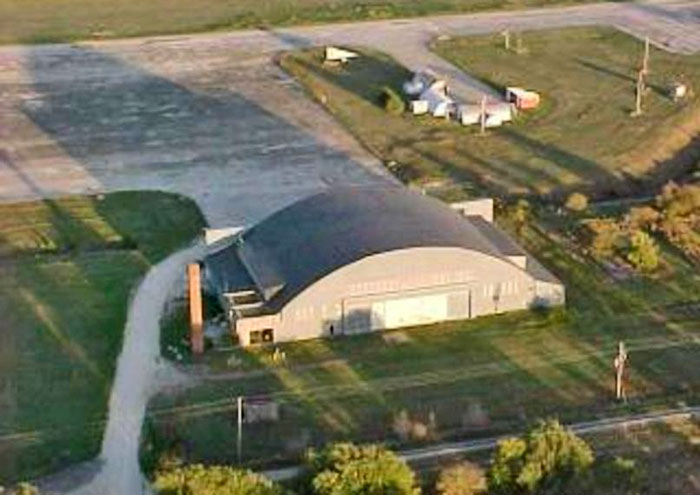
Herington, Kansas Army Airfield.
During World War II, Herington Army Air Field was one of only two fields that processed heavy bombardment crews and staged equipment for overseas duty along the coasts. The field was later turned over to the City of Herington and is currently used as a municipal airport and industrial site.
The Oklahoma, Kansas, and Texas Railroad shut down in 1980.
On June 25, 1987, Herington’s Public Library was placed on the National Register of Historic Places.
The Oklahoma, Kansas, and Texas Railroad merged with the Missouri Pacific Railroad in 1988.
In the predawn hours of March 23, 1988, the 101-year-old Chicago, Rock Island & Pacific Railroad depot building in Herington was demolished. It had remained in use as an office building by the Chicago, Rock Island & Pacific Railroad after the last passenger trains ceased operating in the 1960s. Ownership of the building went to the St. Louis Southwestern Railway Company (Cotton Belt) in 1980 after the railroad acquired the Golden State Route from the estate of the bankrupt Chicago, Rock Island & Pacific Railroad. However, the St. Louis Southwestern Railway abandoned the stone building, relocating its offices to other buildings in the nearby yard.
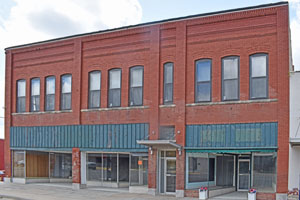
Business buildings in Herington, Kansas, by Kathy Alexander.
After the old depot was completely abandoned, there was some talk in the community about saving the structure, but no organized effort was made. By early 1988, St. Louis Southwestern Railway Company officials outside of Herington decided to have the building demolished, but no formal announcement was made in the community. The St. Louis Southwestern Railway hired a private contractor to handle what many called a “dastardly deed.”
Under the cover of darkness, a large hydraulic backhoe was brought in and started knocking down the structure while most townspeople were sleeping. By sunrise, the building was reduced to a pile of rubble. A minor controversy erupted. Editorial writers across the state were critical of the St. Louis Southwestern Railway Company and its parent company, the Southern Pacific Railroad, for destroying such a long-standing community landmark — one that was on the Kansas Register of Historic Places and was being nominated for the National Register of Historic Places.
In 1997, the Missouri Pacific Railroad merged with the Union Pacific Railroad.
The Herington Municipal Hospital officially closed all services on October 9, 2023, following 104 years of operation. Severe financial struggles and low patient volume prompted the closure.
Currently, the Union Pacific Railroad still uses Herington as its system hub.
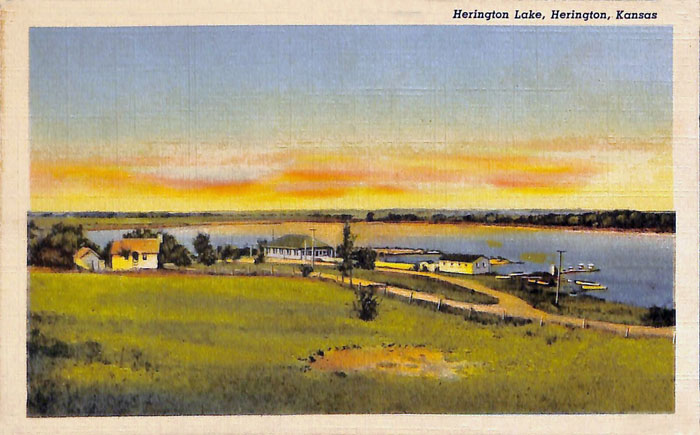
Herington Lake, Kansas.
Herrington is the western terminus for the Flint Hills Trail. This state park stretches for 118 miles across east-central Kansas, from Osawatomie in the east to Herington in the west, and passes through communities including Rantoul, Ottawa, Pomona, Vassar, Osage City, Miller, Admire, Allen, Bushong, and Council Grove.
Local attractions include the Herington Historical Museum and the Herington Lake & Reservoir.
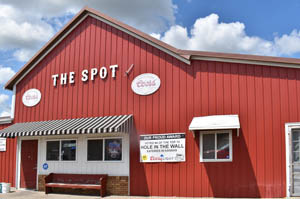
Herington, Kansas Bar by Kathy Alexander.
The community is served by the Herington USD 487 public school district. The Herington High School is a member of T.E.E.N., a shared video-teaching network among five area high schools. Other schools include Herington Middle School and Herington Elementary School, and the Herington Little Railer Preschool.
Herington is 33 miles southeast of Abilene, Kansas.
©Kathy Alexander/Legends of Kansas, May 2026.
Also See:
Dickinson County Photo Gallery
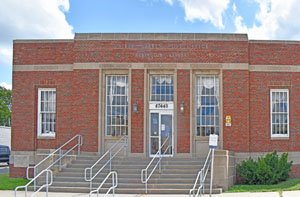
Herington, Kansas Post Office by Kathy Alexander.
Sources:
Blackmar, Frank W.; Kansas: A Cyclopedia of State History, Vol I; Standard Publishing Company, Chicago, IL 1912.
Herrington Public Library
Wikipedia
City of Herington