
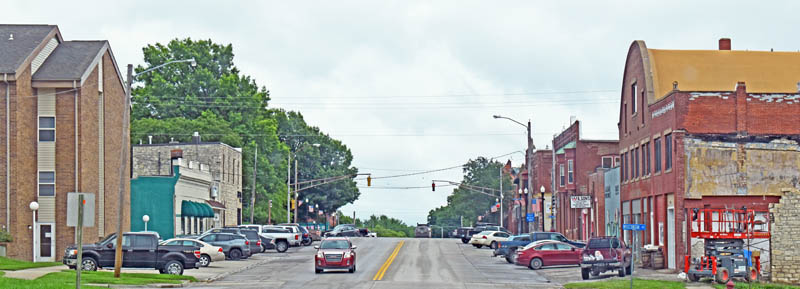
Holton, Kansas Business District by Kathy Alexander.
Holton, Kansas, is a city in and the county seat of Jackson County, located northeast of the county’s central part. As of the 2020 census, the city’s population was 3,401, and it had 2.78 square miles, of which 2.70 square miles is land and 0.08 square miles is water.
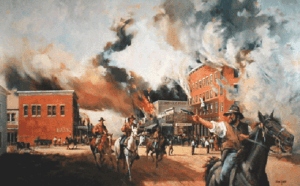
Bleeding Kansas.
The Kansas-Nebraska Act, introduced by Stephen A. Douglas and passed by Congress on May 30, 1854, was the impetus that turned Kansas into Bleeding Kansas. Pro-slavery and Free State forces merged upon the state to promote their causes and ensure the popular decision in their own favor.
In 1854 and 1855, Milwaukee, Wisconsin, like the rest of the country, had its share of excitement over the passage of the Kansas-Nebraska Act and the troubles in Bleeding Kansas. A Kansas society was organized as the outgrowth of this sentiment, and to support it, several hundred dollars were raised.
In May 1856, a wagon train composed of six wagons, with two yoke of oxen to each wagon, left Milwaukee and began the long trek to transport Free-State settlers to Kansas. It was financed by the Kansas Society of Milwaukee, headed by Edward Dwight Holton, a Milwaukee abolitionist.
The emigrating families were those of John B. Coffin, four members; Edmund G. Ross, six; John B. Hutt, four; Mr. Earl, eight; Mr. Lathrop, four; and six single men in the “Bachelor’s wagon.” Edmund Ross was chosen captain of the train. On arriving at Janesville, Wisconsin, the band was joined by the family of Mr. Ross’s father, five members; Andrew Smith’s family, five; and Mr. Lyme’s family, five.
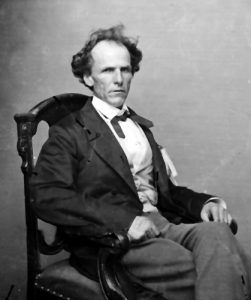
James Lane.
Iowa City and Oskaloosa were made objective points in Iowa. When they reached Missouri, they were robbed and warned to turn back. They altered their course and went to Nebraska City, Nebraska, a rendezvous for Free-State men, which was the point West of the Missouri River. Here, they met General James H. Lane with 200 men, who joined them, and took the Lane Trail to Kansas. The train now included 82 wagons.
Kansas was entered at Range 15, and Plymouth was soon reached, where Mr. Stowell of Massachusetts had a colony of about 30. Lexington was the next point after leaving the headwaters of Pony Creek, and the Lane Trail was then followed southward for approximately 30 miles.
Arriving at Elk Creek, they spent nearly a day building a bridge across it, and after crossing, they found a beautiful location. They liked Banner Creek, Elk Creek, and the pleasant grassy hills, so they decided to stay. A company was organized, and a civil engineer who was with them began the survey. They named the new town in honor of Edward Holton. With them, a civil engineer surveyed the outlines of a town they named Holton.
The party met others on the route, including abolitionist John Brown and Samuel C. Pomeroy.
N.D. Lewis was the first settler in Franklin Township, 4 1/4 miles East of the present Holton.
Before long, all the heads of families had selected claims and laid foundations.
A 20-by-30-foot log house was erected; it was designed to serve as a fort and was known as Jim Lane’s Fort.
In February 1857, J.B. Ingersoll surveyed the town into lots, and soon after, William F., Lewis Creitz, and his brother erected a building and opened a small grocery store.
The census taken in April 1857 recorded 291 people in Holton. That year, several buildings were erected, including the Holton House by T.G. Walters and another, the Banner Hotel by E.M. Parks. Squires & Stafford put in a small stock of goods, and J.W. Gordon & Bro. started a general store. A schoolhouse was built with contributions.
Supplies in the early years were purchased in Leavenworth and Topeka. Teams of oxen or horses brought the supplies. The first mail came from Valley Falls and later from Topeka.
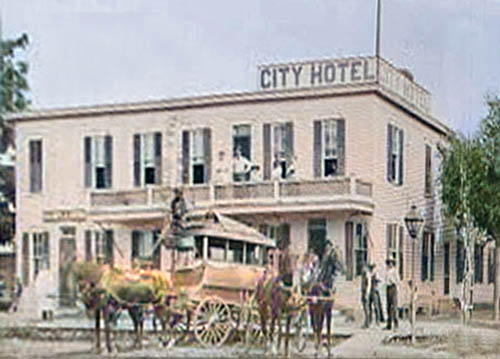
City Hotel in Holton, Kansas.
During the summer, Thomas G. Waters built the first hotel, the Holton House, which stood in the center of the block of 400 New York Avenue. Later, E. M. Parks built a house called the Banner Hotel on the corner of 5th and New York Avenue. It was later enlarged into the “City Hotel.” On the south side of the Square was a building erected known as “Old Uncle Tom’s Cabin,” built by Henry S. Westlake for a grocery and a saloon.
Robert J. Waterhouse came to Holton, bought a claim, and erected a building, which was occupied as a store by Edward A. Squires and Lewis Stafford. Ira I. Taber and Edward Olmsted built a small building on the southwest corner of the Public Square. They erected the first schoolhouse, in which Miss Anna Parrott taught two terms.
Factional differences were closely drawn in early times, with the Free-State men and Republicans doing business on the North side of the public square and the pro-slavery men and Democrats on the South side. There were two flag poles, one Republican and the other Democratic. Their differences often came to blows, and sometimes to shots. Major Thomas J. Anderson was attacked at a convention at one time and injured by a blow to the head. He was also fired upon several times.
Holton was chosen as the county seat in 1858. A frame building served as the first courthouse on the East side of the square, near the middle of the block. That year, William Morrison put up the first steam saw and gristmill at the northwest corner of the town. He moved the mill from Tecumseh in Shawnee County and was given five shares in the town. However, after obtaining the deeds, he relocated it to Southern Kansas. Dr. R.S. Craft moved his steam sawmill from Missouri to this place, attached a pair of burrs to it, and, after operating it for some years, sold it to parties who converted it into a first-class flouring mill.
In 1858, the Methodist Episcopal Church was organized by the Reverend Eli H. Robertson, assisted by James Lawrence, and at the time formed a part of a very large circuit. The Church’s first parsonage was built in 1866. Construction of the Methodist Episcopal Church began in 1868. It was dedicated in 1871.
In the fall of 1858, Thomas G. Watters, without either a type or a press, started the Cricket. It ran for about two months. The articles were written in ink, and political events were illustrated with colored pencils.
The county that contains Holton was previously named Calhoun County for the pro-slavery South Carolina Senator John C. Calhoun. In 1859, the name was changed to Jackson County.
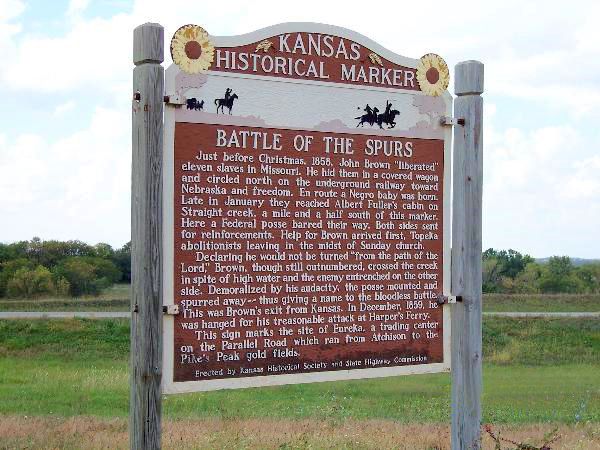
Battle of the Spurs Historic Marker.
That year, the abolitionist John Brown took a group of escaped slaves through Holton, leading to an incident known as the Battle of the Spurs. At that time, Holton had seven dwellings, a store, a blacksmith shop, and a steam sawmill. That year, the city was incorporated. Dr. James Waters was the first mayor, and George L. Hamm was the city clerk.
The Commercial Hotel was also established in 1859 and was very successful.
In 1860, J.W. Gordon opened a stock of general merchandise in a 13-by-14-foot room, and his business grew to large proportions. That year, Holton’s population was 1,936.
The Christian Church was organized by Mr. and Mrs. Allen B. Scholes, Mr. and Mrs. J.P. Nichols, Miss Jane Walters, and two others on July 13, 1862. The first services were held in the old courthouse by Elder A.J. Francis in 1862. In 1872, a church was built for $2,000. Its membership in 1882 was 755. The Pastor was Reverend J.H. Bauserman.
Reverend Charles Parker organized the First Presbyterian Church on March 9, 1867, and a church building was erected in 1868 at a cost of $2,000. In 1869, a parsonage was built.
J.C. Lillie, of Leavenworth, Kansas, started the Holton Argus as a Democratic newspaper on April 1, 1867, and it was published for eight months.
One mile West of Holton was the Holton Cemetery. It contained six acres, and in 1867, it was surrounded by a nice board fence, neatly capped. The site is a nice dry locality sloping to the south. There is a small building near the entrance where all excavation requisitions are safely stored. Ira I. Taber was President of the Cemetery Association, and W.T. Scott was in charge of the grounds.
In October 1867, A.W. Moore brought the first press and type to Holton and began publishing a seven-column newspaper. A Republican in politics, it was called the Jackson County News.
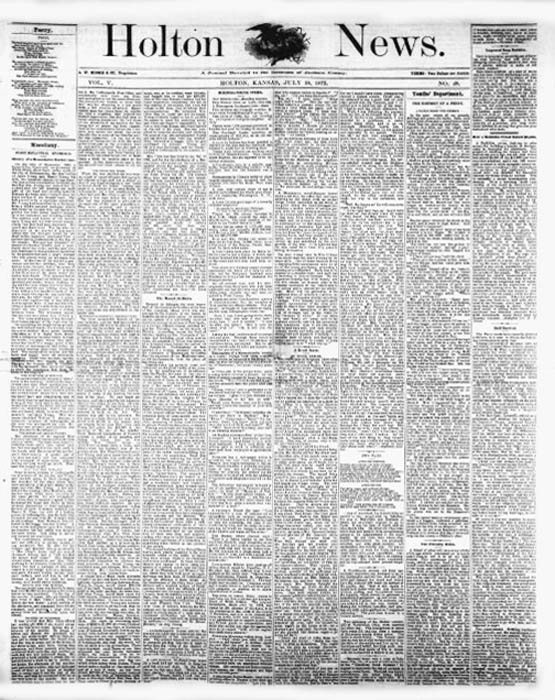
Holton News.
The Jackson Democrat was established in May, 1868, with T.G. Williams as editor. J.W. Fox purchased it in 1869, renamed it the Holton Leader, and published it as an independent paper for about a year before moving it to St. Mary’s, Kansas.
Holton became a city of the third class in 1871 and, some years later, was made a city of the second class.
In October 1871, Frank H. Stout became the owner of the Jackson County News, but he sold out his interest. On January 4, 1872, Mr. George S. Irwin became a half-owner in the News, which he sold on November 7, 1872. On June 4, 1872, the paper was enlarged to eight columns and renamed the Holton News. After Irwin’s withdrawal, Moore continued publishing the paper until February 6, 1874, when Frank A. Boot purchased the goodwill and consolidated it with his paper, the Express, which had been in existence for nearly two years. Mr. Moore moved his printing materials to Dodge City and began publishing the Messenger.
Ira I. Taber published the Real Estate Bulletin, a monthly publication, in 1871 and 1872, devoted to the landed interests of Holton and Jackson Counties.
In March 1872, the Baptists of Holton met at the Christian Church and organized with seven members. Reverend Granville Gates, State Missionary, was the organizer. The membership of the Baptist Church and Sunday school in 1882 was about 75 each. George Barker was the Sunday-school superintendent. In 1880, the organization erected a nice frame church building for $1,000.
The Kansas Central Railway Company was incorporated under the law of the State of Kansas on June 1, 1871, to build a railroad and telegraph line from Leavenworth to the western Kansas boundary. It was constructed and opened for operation in Holton in 1872. It was built as a narrow-gauge railroad because the owner thought the issue would pass more easily if the cost per mile were less. It connected with the Atchison, Topeka & Santa Fe Railroad at Valley Falls, Kansas, 35 miles East of Leavenworth.
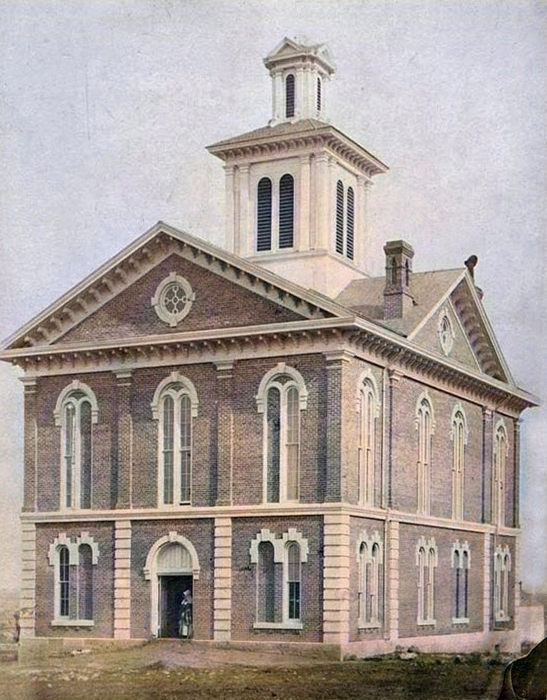
First Jackson County, Kansas Courthouse in Holton, Kansas, 1874.
The first courthouse was built in the center of the square in 1872 for $23,000.
Frank A. Root brought newspaper material from Seneca, Kansas, to Holton on April 13, 1872, and started the Holton Express, a Republican newspaper. Having purchased the Jackson County News on February 6, 1874, he consolidated it with the Holton Express. He continued to publish the paper until March 26, 1875, under the title of the Express and News. He then sold it to Messrs. Beck & Shiner. Messrs.
That year, the Farmers’ Bank and Saving Institution was the first bank established in Holton. Martin Anderson was President; William Cline, Vice-President; H.J. Ransom, Cashier. Also, the Exchange Bank commenced operations with S.K. Linscott as its first President and T.P. Moore as its Cashier. In June 1873, the bank began constructing a new building on the northeast corner of the Public Square.
The Roman Catholics had a good-sized frame building in the East part of the city, erected in 1873. Reverend Father Begley was the Pastor.
The African Methodist Episcopal Church was organized in 1874 by Reverend A.H. Daily with eight members. Its church building, formerly a saloon, cost $350.
That year, the Farmers’ Bank and Saving Institution became a Loan Agency, but later failed.
J.W. Shiner and Edward C. Laithe established the Holton Recorder on March 2, 1875. Two weeks later, M.M. Beck purchased Mr. Laithe’s interest. March 30, 1875, Messrs. M.M. Beck and J.W. Shiner began the publication of the Recorder and Express; Mr. Frank A. Root having sold them the Express. On January 1, 1877, the word “Express” was dropped from the heading. Mr. Beck became sole editor and proprietor in April 1881. It is now a well-managed, eight-page paper and the county’s official one. Mr. Beck has the post office and an excellent drug store. He is a member of the State Republican Central Committee for the First Judicial District.
The Hook and Ladder Company was organized in 1875.
The city ordinance in 1876 required the walks around the square to be 4 feet wide and made of pine lumber, with costs paid by the owners of the surrounding property.
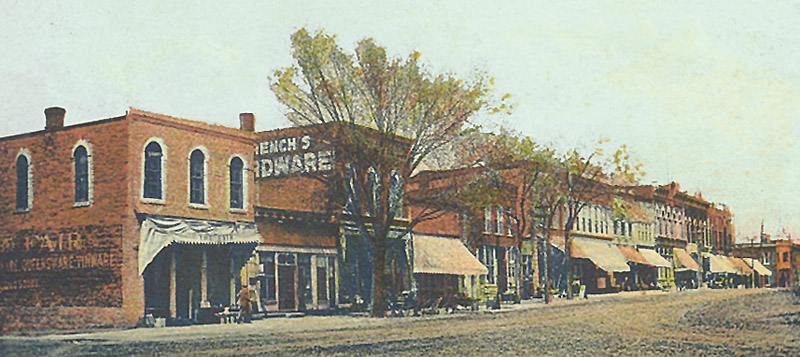
West side of the Square in Holton, Kansas.
On January 16, 1878, Thomas A. Fairchild and W.W. Sargent commenced the publication of the Holton Signal, an eight-column Democratic newspaper. Fairchild severed his connection with it on January 1, 1879. Afterward, it was run by Mr. Sargent. It is the official city paper. Sargent was also the City Clerk. His paper commanded an influence at home and abroad, and he was one of the rising journalists of the State.
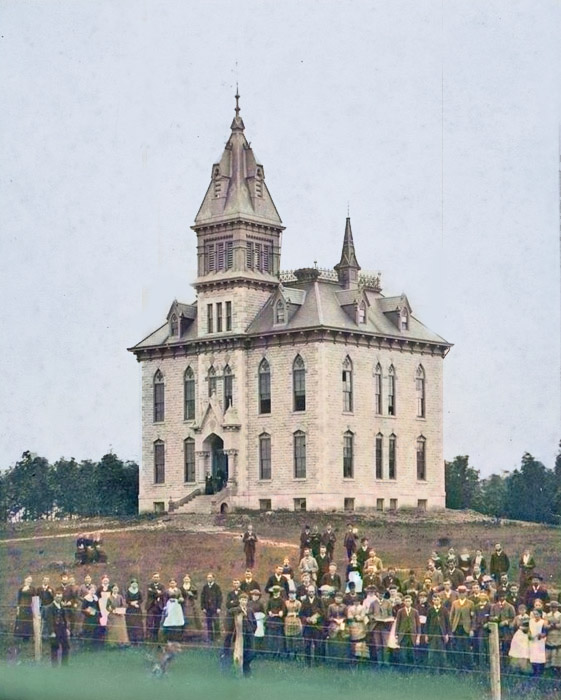
Campbell College in Holton, Kansas, 1883.
In 1879, the residents of Jackson County, Kansas, decided to form a university in Holton. It was funded by mining magnate A.C. Campbell, a former resident who had moved to Utah, and was named Campbell University.
The Holton Church was formed in April, 1880, with a membership of about 20. Reverend J. Roach was the organizer. The congregation worshipped at the courthouse. Reverend H. Shumaker was the pastor in 1882.
A Colored Baptist Church was organized by Reverend Dennis Young, of Missouri, in June 1880, with 37 members. Not having a state preacher, they worshiped with the First Baptist Church.
Linscott’s Bank, one of the finest structures in Holton, was erected in 1881 and opened in November. North of the banking department was a fine store occupied by McGrew & Williams; in the basement were a barber’s shop and a laundry; the upper story contained two law offices and two dentists: C.H. Gilmore and Frank M. Davis. The building cost $13, 600. It was directly West of the courthouse. S.K. Linscott was President; S.B. McGrew, Cashier.
The City Mills, run by proprietors A.W. Post & Co., are adequate to the wants of the city and county, as all fancy and straight grades of flour are manufactured here, and everything in the way of meal, chop-feed, etc. This mill was owned by Dr. J.L. Williams, Sewart, and Nixon, and a large outlay was made on it.
Peter Keiderer, one of the pioneers of the county, operated Elk Flouring Mills two miles East of the city.
The graded school was the great pride and glory of the city. It has seven departments and is under the management of Professor C.Y. Roop, a most skillful instructor and thorough disciplinarian. He had a very efficient corps of assistants. Professor Roop is a weekly contributor to the educational department of the Holton Recorder, and the matter is valuable alike to teachers and students. E.D. Holton contributed a good library to the school. The building was a neat two-story brick, with an excellent bell.
By 1882, Holton had become a very metropolitan, beautiful, and progressive city. A great variety of trades, professions, and branches of business were represented, ensuring general permanence. At that time, there were seven physicians in Holton and numerous law firms.
Hotel Josephine was built by A. D. Walker in 1890 and named after Walker’s daughter, Josephine. The hotel opened when she was four months old. The Hotel was in operation continuously longer than any hotel West of the Mississippi River.
The first woman city official was Mrs. Ella Brown, an attorney from the faculty of Campbell College, who served as city attorney from 1893 to 1895.
The fire department building in the 200 block of West Fifth was built in 1898. The company is still a volunteer group with three engines for use in town and country.
In 1902, Campbell University merged with Lane University and became Campbell College.
In October 1909, the first sewers were built, and in 1915, the first paved street was started.
In 1910, Holton had local manufacturing establishments and other institutions that provided a good income for the town. There was a large brick yard, soda and mineral water factories, a cigar factory, a planing mill, a patent medicine factory, four banks, three grain elevators, telegraph and express offices, and an international money order post office with six rural routes. The educational facilities were exceptionally good for a town of its size. Besides good-graded and high schools, there was a higher institution of learning known as Campbell College, which had four good buildings and eight departments. At that time, its population was 2,842.
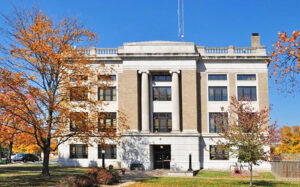
Jackson County, Kansas Courthouse in Holton, Kansas.
In 1913, Campbell College merged with Kansas City University, and it was later closed in 1933. The former site of the college later became the location of Holton High School.
The second and present courthouse was constructed in 1920 to 1921 for $300,000. The Classical Revival-style building was designed by Thomas W. Williamson & Company of Topeka, Kansas, and built by James Cuthbert & Sons of Topeka, Kansas.
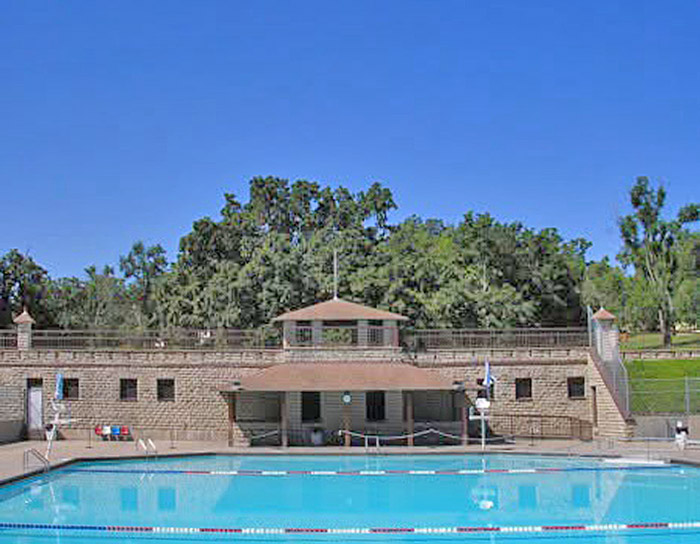
Holton, Kansas Swimming Pool today.
The courthouse is a three-story buff-colored brick, stone, and concrete structure located on the spacious, landscaped grounds of the Courthouse Square in the center of Holton. The West front has five rectangular openings with a recessed entrance. Four large columns rise from the second story to the top of the third story. In the interior, the County District Court courtroom is located on the third story. The building houses the County District Court of the 2nd Judicial District, which includes Jefferson County, Pottawatomie County, and Wabaunsee County. It is located at the corner of 400 New York Avenue and 4th Street.
The Bath House and Swimming Pool in Holton was constructed in the mid-1930s as a Works Progress Administration project. Architect Charles Shaver of Salina and engineers Bob Pulette and Murray Wilson, who had designed dams and lakes for the Kansas Fish and Game Commission, drafted the site plans. The facility, located in Rafter’s Park, opened in 1938, and the city band gave its first concert on the roof of the bath house. The swimming pool was rebuilt and enlarged in 1986. The bathhouse is Rustic in style and measures 132 by 20 feet. It was built of steel and reinforced concrete on a concrete foundation. It was listed in the National Register of Historic Places and the Register of Historic Kansas Places in 2009. It remains open to the public today. With a capacity of over 385,000 gallons, the pool is among the largest in Northeast Kansas.
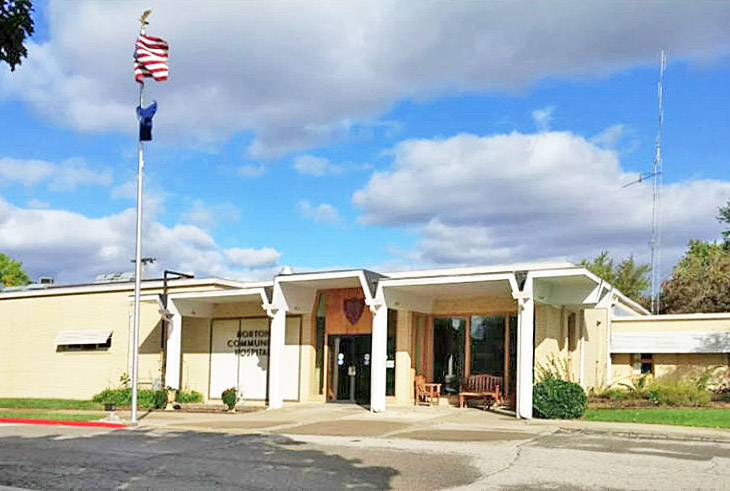
Holton, Kansas Community Hospital.
Holton Community Hospital opened its doors on May 12, 1938, thanks to the visionary efforts of two brothers, Dr. Roy Moser and Dr. Ernest Moser. The original facility, located at 418 West 5th Street, was purchased at a tax sale for $490 and remodeled by local tradesmen and volunteers for an additional $1,000.
In 1948, Dr. Ross Moser, a cousin of Roy and Ernest, joined the hospital staff, and a new wing was added the following year.
By 1966, the Mosers faced increasing administrative burdens under Medicare, prompting them to transfer ownership of the hospital to the City of Holton. Under public ownership, the hospital was renamed Holton City Hospital. Dr. Roy Moser and Dr. Ernest Moser retired in 1972, and Dr. Ross Moser followed in 1985. Reflecting the broad area and population served, the hospital was renamed Holton Community Hospital in 1990. In 1993, a fundraising campaign was launched to build an entirely new facility.
n 1990, the hospital changed its name to Holton Community Hospital to reflect the large area and populations served. In 1993, the hospital started fundraising to construct a new facility. Construction began in 1997 at 1110 Columbine Drive, on the northern edge of Holton, and the new hospital opened its doors on January 4, 1999.
Construction began in 1997, and the new facility opened its doors on January 4, 1999.
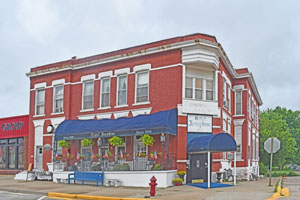
Hotel Josephine in Holton, Kansas by Kathy Alexander.
The Hotel Josephine closed in December 2010. In 2011, it was purchased and reopened. It changed hands again in November 2020 and served as a boutique hotel. It is located at 501 Ohio Ave.
Holton Community Hospital permanently closed in March 2019.
Holton’s population peaked at 2,401 in 2020.
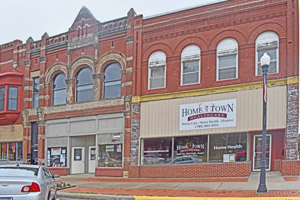
Business buildings in Holton, Kansas, by Kathy Alexander.
©Kathy Alexander/Legends of Kansas, updated July 2026.
Also See:
Sources:
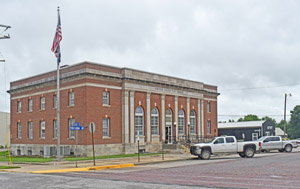
Holton, Kansas post office by Kathy Alexander.
American Courthouses
Blackmar, Frank W. Kansas: A Cyclopedia of State History, Vol. I. Standard Publishing Company, Chicago, IL, 1912.
Cutler, William G.; History of Kansas; A. T. Andreas, Chicago, IL, 1883.
Holton Community Hospital
Holton, Kansas
Rootsweb
Wikipedia