
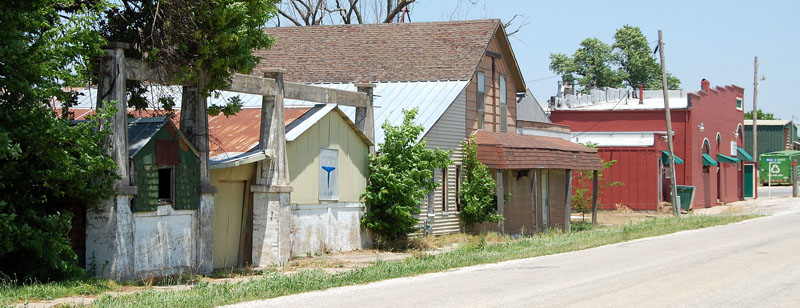
Main Street buildings in Colony, Kansas, by Kathy Alexander.
Colony, Kansas, is a small town on Deer Creek in Ozark Township near the southern boundary of Anderson County. As of the 2020 census, its population was 381, and its total area was 0.52 square miles, all land.

Stagecoach.
In 1858, a mail route was laid out through the area from Lawrence to Humboldt. Along this 90-mile stretch, the stagecoach passengers were tired after many miles of travel. At some point, a tavern catering to travelers, called the “Halfway House,” was established in what would become the town of Colony.
In 1870, the Leavenworth, Lawrence & Galveston Railroad built a depot at a spot known as the High Divide or Ozark Ridge, as it divides the waters of the Arkansas and Missouri Rivers. This spot was the highest point on the railroad from Kansas City, Missouri, to the Gulf of Mexico.
The railroad company laid out a town and named it Divide. The plat was recorded on August 2, 1870. A post office was established at the depot on June 2, 1871, and was kept by the railroad agent, Mr. Wyman. Although its location was pleasant, no improvements were made because obtaining water was difficult. Located on a spur from the Ozark Mountains, well water was impossible to obtain, so rainwater had to take its place.
In the meantime, Colonel Henry Wilson, Colonel N. Bostwick, J.J. Fairbanks, J.G. Norton, and others had formed colonies in Ohio and Indiana. After examining Colorado and Kansas, the Divide station was chosen as the most favorable location. The colonists began arriving early in 1872, and J.J. Fairbanks built the first dwelling. Fairbanks & Reams opened the first store in what later became the Grandview Hotel, and Reverend Travis preached the first sermon on Sunday, March 31, 1872.
The post office’s name was changed to Colony on April 3, 1872. By the middle of May, about 100 people had selected the land, and most had begun making improvements. On their arrival, they elected Colonel Wilson President, J.J. Fairbanks Vice President, J.P. Ewing Secretary, and D.W. Ream Treasurer. The town plat was filed on August 2, 1872.
Though the initial group was large, the colony soon disbanded, and most of the settlers returned to the East, some abandoning land on which they had made payments. However, a few families remained, did well, and accumulated property. Before long, the only people remaining in the colony were the families of A.G. Perkins and Thomas Bell.
In the town’s early history, the schoolhouse was about three miles away. However, in 1876, a new school building was constructed on the townsite, and Frank P. Ewing taught a term there in the fall of that year.
Charles Porter Walker, a real estate professional from Pennsylvania, came to Anderson County in April 1866 and located on Deer Creek. Four years later, he homesteaded 80 acres and pursued agricultural pursuits. In July 1876, he moved to Colony and engaged in the real estate business. He was appointed the local land agent for what is now the Leavenworth, Lawrence & Galveston Railroad and the Missouri, Kansas & Texas Railway. He also conducted a general real estate and loan business.
The Methodist Episcopal Church congregation was organized in 1877 from what was then known as the Deer Creek circuit. At that time, the town had about 85 residents, a store, a blacksmith shop, a wagon shop, a hotel, a real-estate office, and a post office.
John McD. Martin, of Martin & Shockey, merchants, was originally from Georgia. He came to Kansas in the spring of 1857 and lived in Bourbon County. He supported the Free-State Party during the troubles of that period. He then farmed in Allen County and enlisted in Company B of the Tenth Kansas Infantry during the Civil War. In 1866, he sold his farm in Allen County, moved to Anderson County, purchased land on Deer Creek, and embarked on farming and stock-raising. In 1877, he moved to Colony and engaged in the general merchandise business. On December 15, 1881, Martin became associated with his partner, M. Shockey, and the firm did a large business, carrying a stock of $6,000. Martin also owned 487 acres of land and was engaged in the grain business with S.C. Varner. He held the offices of Clerk and Treasurer of Ozark Township several times.
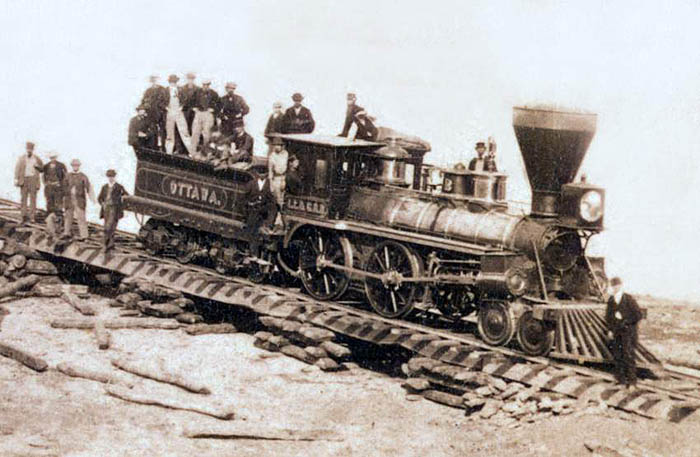
Leavenworth, Lawrence, & Galveston Railroad Locomotive.
By 1878, Colony remained a station on the Leavenworth, Lawrence & Galveston Railroad. At that time, the town had a public school, a general store, a hotel, a blacksmith, a physician, a telegraph, and a population of 50. It was on the stagecoach line from Geneva and Neosho Falls, from which its mail was delivered daily to postmaster John McD. Martin. The community made regular shipments of corn, livestock, and butter. By then, the adjoining country had been quickly settled, and the land was being cultivated.
Ed F. Ewing, a Union soldier during the Civil War, originally from Ohio, came to Anderson County in May 1872 and settled in Ozark Township, where he improved an eight-acre farm. In 1879, he came to the Colony and opened a mercantile.
John B. Rhodes, a farmer and attorney from Massachusetts, arrived in Anderson County in the spring of 1870 and engaged in agricultural pursuits in Ozark Township. In March 1879, he moved to Colony and began a general merchandise business, building up a large and lucrative trade. He sold it to Bush Bros. & Co. in March 1882 and returned to farming and ranching on his 254 acres.
Samuel C. Varner, a grain and implement dealer originally from Pennsylvania, arrived in the Colony in April 1879 and established a lumber yard. He was a former Union First Lieutenant in the Civil War, entered the hardware business, and built an excellent trade before selling out in 1882. He was also engaged in the grain business with John McD. Martin.
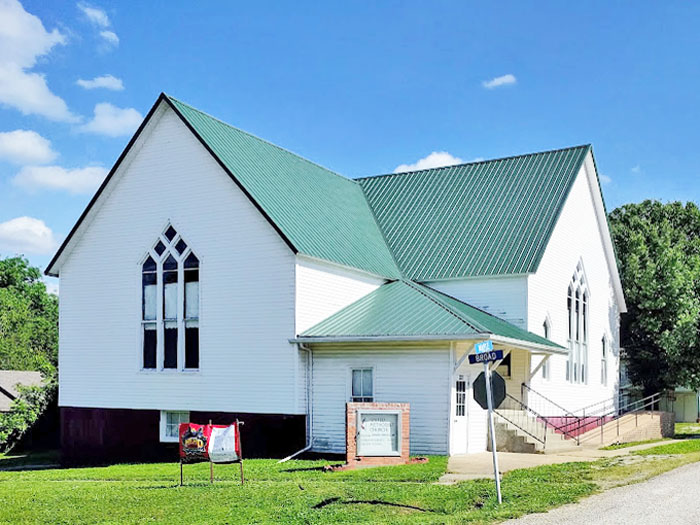
Methodist Church in Colony, Kansas.
The Methodist Episcopal Church, built in 1880, had about 60 members and was pastored by Reverend N.T. Ryne.
The Baptist Church Society was organized in 1881, and the church was erected in 1882, with Reverend C.J. Coulter as pastor. A Catholic Church congregation had also been organized but had not yet erected a house of worship.
At that time, one of the town’s chief industries was baling and shipping hay. Hall & Rogers owned and operated three portable presses, in addition to two large ones powered by steam. The company shipped 15,000 tons of hay annually.
Joseph Walker, a carpenter and builder from Pennsylvania, purchased a farm on Deer Creek in Anderson County and farmed in connection with his trade until March 1881, when he moved to the Colony and dedicated his attention to building.
George W. Matthews, a merchant from Illinois, accompanied his parents to Kansas in 1860. After serving in Company F of the Eighth Kansas Infantry for three years, he was wounded at the Battle of Chickamauga, Georgia, in September 1863. His father, P. T. Matthews, lived on Deer Creek in Anderson County and practiced medicine while his boys managed the farm. George W. Matthews engaged in the grocery business in Colony in the spring of 1881. His store burned in the summer of 1882, and in October, he started again with a general stock of about $2,500.
In the middle of August 1881, a number of the town’s best buildings were swept away by a fire that broke out in a meat market between the hotel and a large store. The building was soon in flames, and the news was rapidly communicated to others. In a short time, the Empire House, Roberts’ meat market, Buford’s store, Dr. Malone’s office, Yokum & Matthews’ furniture store, and Matthew’s grocery were in ashes. Though it was a hard blow, it was not long until most buildings were replaced.
The town’s greatest growth occurred in 1881 and 1882.
On January 5, 1882, J.J. Burke established the Colony Free Press newspaper, a seven-column folio. The same month, T.L. Elliot, a merchant originally from New York and a Union soldier during the Civil War, came to Colony and opened a general merchandise store, carrying a good stock valued at about $8,000, and did a nice trade.
John L. Hall of Hall & Rogers, balers and shippers of hay, was originally from New Hampshire. He first came to Kansas, in Wyandotte (Kansas City), and worked as a carpenter for several years. Afterward, he engaged in the furniture and undertakers’ business, ran steamers on the Missouri River, and milled. He came to the Colony on May 25, 1882, and engaged in business with R.H. Rogers, running two steam presses of ten horsepower each, employing 12 men, and baling from 15,000 to 20,000 tons of hay annually.
In June 1882, George Edwards, originally from Indiana, arrived and worked as an agent for S.A. Brown & Co., lumber dealers.
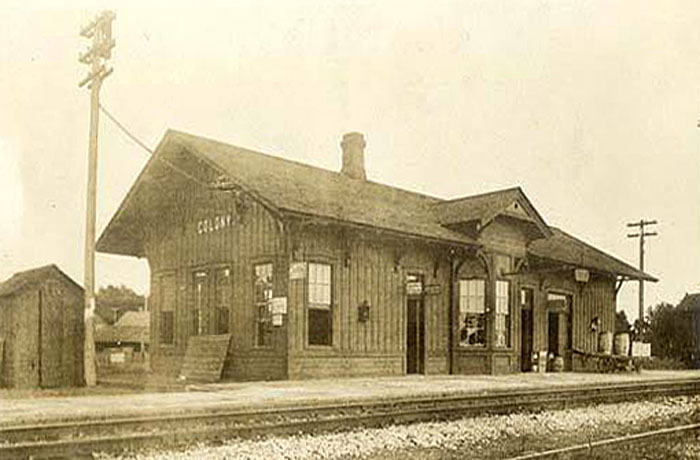
Atchison, Topeka & Santa Fe Railroad Depot in Colony, Kansas.
The Yates Center branch of the Atchison, Topeka & Santa Fe Railroad was constructed in 1886 and succeeded the stage route between Colony and Neosho Falls. The Missouri Pacific Railroad was built across Ozark Township in the same fall.
At one time, Colony had a driving park with a half-mile track on land owned by I.A. Gray northwest of town. A judge’s stand and a string of feed barns were built.
The first telephone line in the Colony was built by George White and extended from his house to that of I.A. Gray’s. In the early 1890s, a telephone line, financed by prominent citizens of Garnett, Colony, and Westphalia, was strung from these towns. The wires were supported on green timber poles, which soon rotted, and the line went into disuse.
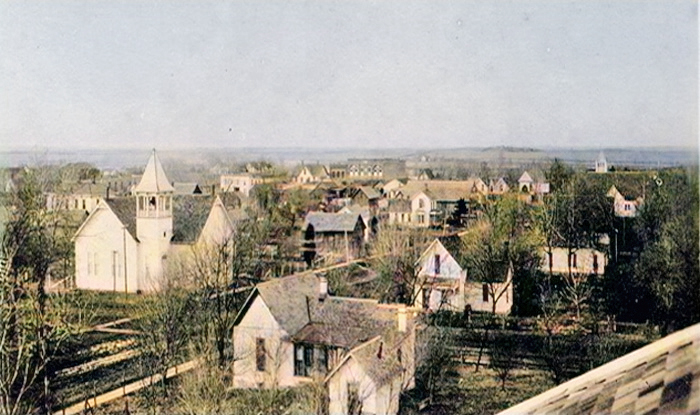
Colony, Kasnas in 1911.
The Reverend John Redeker of Westphalia dedicated the Sacred Heart Catholic Church on September 18, 1898. Up until this time, church services had been held in private residences.
It was not until 1907 that a four-year high school course was established, and the school officially became accredited as a second-class school.
In 1910, the incorporated town was at the junction of the Missouri Pacific Railroad and two divisions of the Atchison, Topeka & Santa Fe Railroad systems. At that time, it had a bank, an international money order office with three rural routes, grain elevators, a hotel, an opera house, a weekly newspaper called the Free Press, telegraph, telephone, and express accommodations, churches of several of the leading denominations, good public schools, and a population of 530. Several nearby gas wells furnished both light and heat for the residents.
The colony’s population peaked at 997 in 1920. That year, a new school was built.
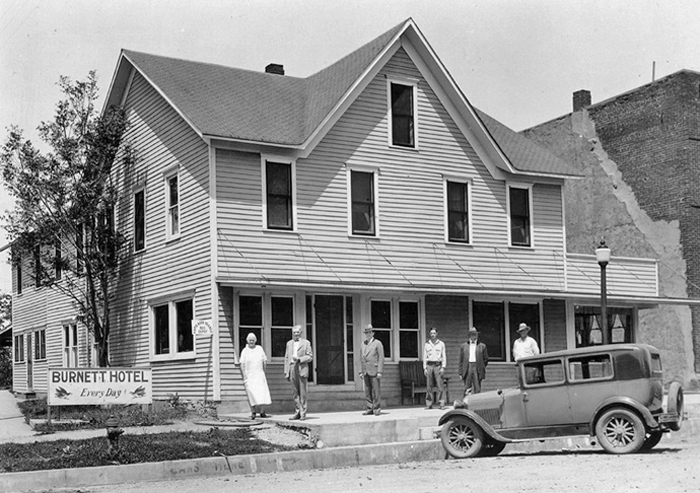
Burnett Hotel in Colony, Kansas, 1915.
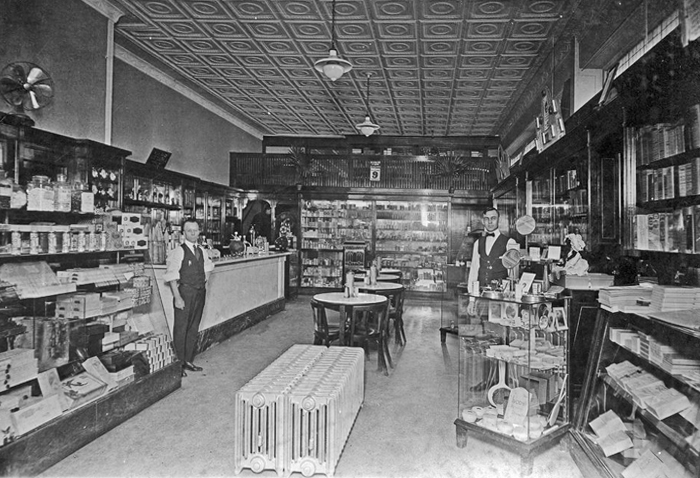
Colony Drug Store and Soda Fountain, 1909.
In 1921 and 1922, a massive natural gas boom in southeast Kansas attracted many new residents and drilling companies. While drilling for gas, they also found oil at about 820 feet.
From 1900 to about 1930, Colony was known as “The Hay Capital of the World.” During these years, more carloads of No. 1 pea green, blue-stem prairie hay were hauled out of Colony by train. Many area residents considered hay the primary source of income.
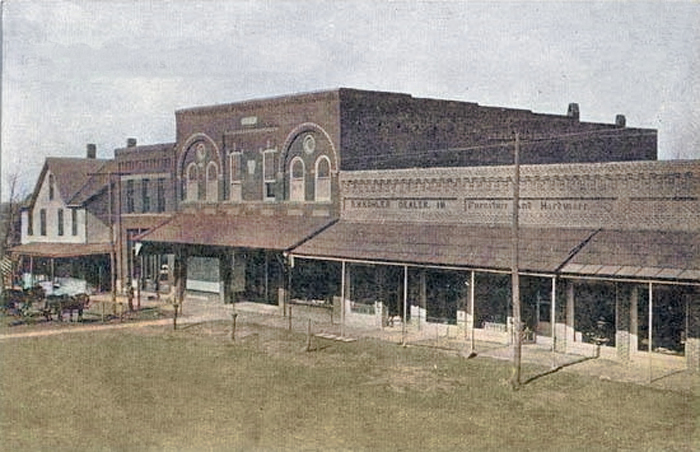
North Broad Street in Colony, Kansas, 1920s.
In 1950, the Cities Service Gas Company leased and capped the wells. A large natural gas storage facility was located in nearby Iola. However, when the storage site caught fire, the gas company struck a deal with the Colony City Council to store natural gas in caves beneath the Colony. In return, the citizens of the Colony would enjoy cheap gas rates for 99 years.
The Colony Santa Fe Depot was torn down in July 1973.
The area railroad tracks were later converted into a rail trail. The trail is part of the Prairie Spirit Trail State Park, the first rails-to-trails site in Kansas. It follows the original bed of the old Leavenworth, Lawrence, and Fort Gibson Railroad, built in the 1860s, Kansas’s first north-south rail line. The 52-mile trail was constructed from Ottawa to Iola between 1996 and 2008.
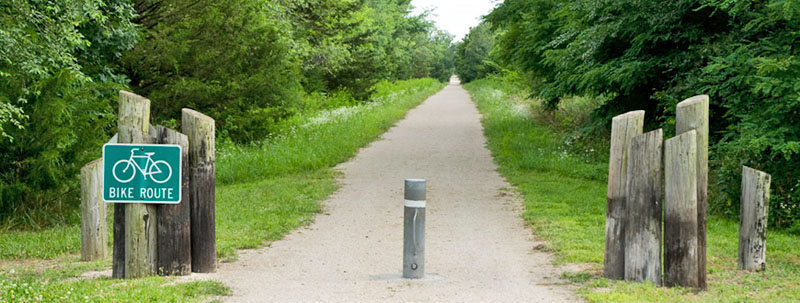
Prairie Spirit Trail State Park.
Today, the Colony’s chief industries are farming and hay raising. It also has fine oil and gas fields, which were opened early in the 1920s. The products from these fields are supplied to the town, sold to large pipeline companies, and sent nationwide.
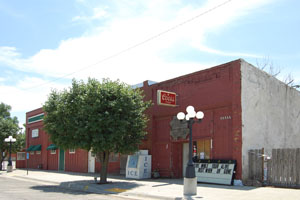
Business Buildings in Colony, Kansas by Kathy Alexander.
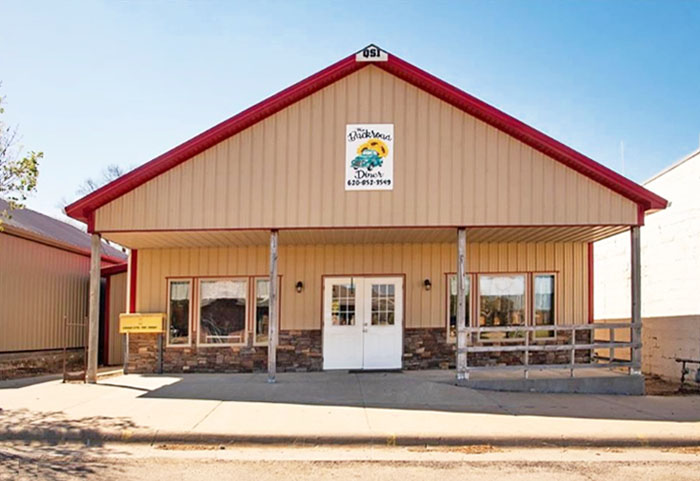
Diner in Colony, Kansas.
The community is served by the Crest USD 479 public school district in Colony.
Colony is 16 miles south of Garnett, the county seat, and 93 miles from Topeka.
©Kathy Alexander/Legends of Kansas, updated July 2026.
Also See:
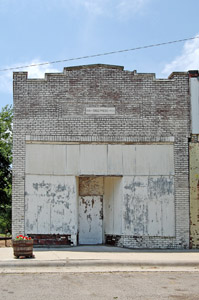
Free Press Building in Colony, Kansas by Kathy Alexander.
Sources:
1878 Gazetteer and Business Directory, R.L. Polk & Co., Chicago, IL.
Anderson County Historical Society
Blackmar, Frank W.; Kansas: A Cyclopedia of State History, Vol I; Standard Publishing Company, Chicago, IL 1912
Cutler, William G; History of Kansas; A. T. Andreas, Chicago, IL, 1883.
Kansas Post Office History
Tinsley, Amber; Colony, KS; Chapman Center for Rural Studies, Kansas State University, 2012
Travel Kansas
Wikipedia