
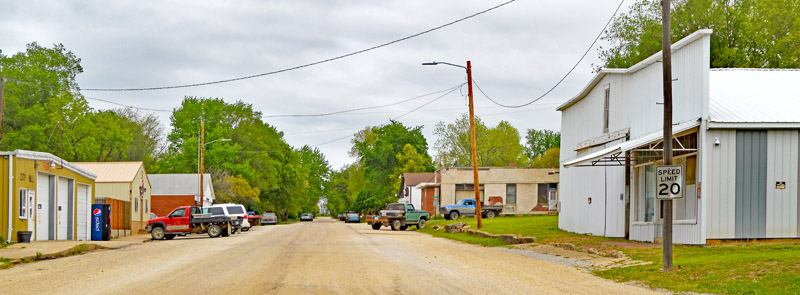
Denison, Kansas Main Street by Kathy Alexander.
Denison, Kansas, is a small town in Garfield and Cedar Townships of Jackson County. As of the 2020 census, its population was 146, and it had a total area of 0.11 square miles, all land.
The Reformed Presbyterian Church was established North of Denison in 1871, with Reverend J.S.T. Milligan as the founding pastor.
The United Presbyterian Church was established in 1880.
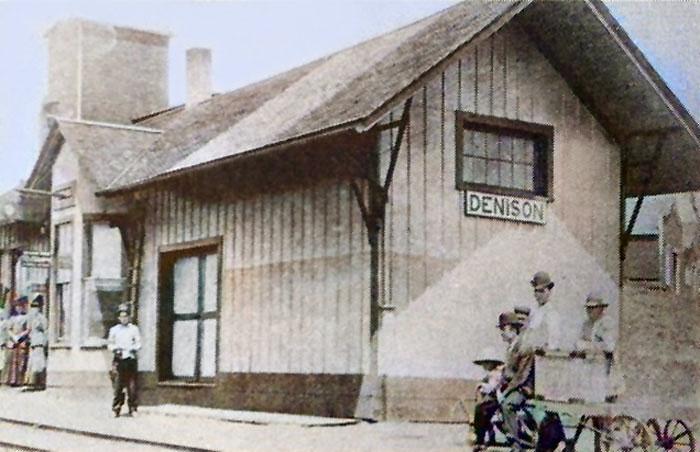
Railroad depot in Denison, Kansas.
Denison was founded when the Kansas City, Wyandotte & Northwestern Railway laid tracks connecting the communities of Valley Falls and Holton. The railroad was slated to come through one mile south of the old village of Tippinville. In September 1887, A.D. Walker and Hollis Tucker, land speculators, laid out lots for a new town named after Tucker’s hometown of Denison, Ohio. Most of the houses and two churches in Tippinville were physically moved to the new townsite. A lumber company, a meat market, a hotel, and a cheese factory were among the first businesses.
On December 13, 1887, the North Cedar post office was moved to Denison.
The Methodist Church first met in 1889 in the old Tippinville schoolhouse. A charter was established on July 8, 1889, and soon after, a modest building was erected.
By August 1890, Tippinvile had been officially vacated, and by 1894, Denison had a population of 150. At that time, the town had a doctor, a grain elevator, a hardware store, a meat market, a barber, a general store, a blacksmith, a wagonmaker, a druggist, a couple of carpenters, a livery, and a stone mason.
By the turn of the century, an estimated 300 people were living in and around the town.
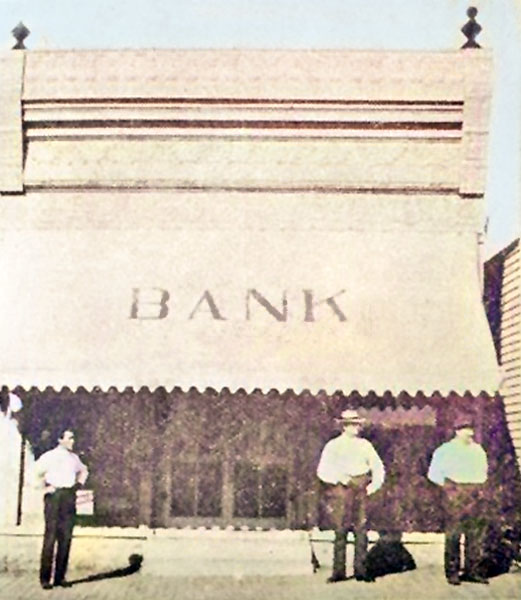
Denison State Bank.
The Denison State Bank was founded in 1901.
A schoolhouse was built out of local stone in 1908.
In 1910, Denison was located on the Missouri Pacific Railroad. Among the public improvements were a $2,000 electric light plant and a $5,500 school building. There were several well-stocked stores, banking facilities, express and telegraph offices, and a post office with one rural route. That year, its population peaked at 325.
As technological advancements such as indoor plumbing and the telephone improved the quality of life for Denison residents, the automobile had a transformative impact on the town. In the 1910s, both farmers and townspeople embraced this invention with enthusiasm, despite the ongoing issues with road conditions and maintenance. The automobile also allowed many residents to relocate to larger cities.
Membership in the Methodist Church grew rapidly, and the need for a larger space became apparent. Started by Jim Copas and Dave Neff, construction was completed in January 1916, made possible by a community-wide effort. Finishing touches were added later, with pews, plastered walls, and stained-glass windows in place by June 1916.
The Denison Rural High School was established in 1916, and a brick building was built from 1916 to 1917, with 80 students attending the first classes in 1918. C.R. Van Nice was the first principal of the school.
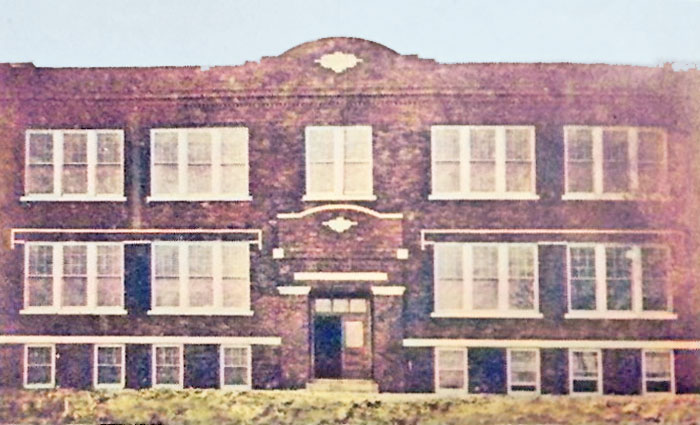
Denison, Kansas Rural High School, 1917.
The railroad ceased operations in 1919 due to bankruptcy. Afterward, Denison began to lag.
The Great Depression, triggered in October 1929, also extracted a toll on the community. Membership and wages continued to shrink; the town suffered a drought in the early 1930s, further reducing available money.
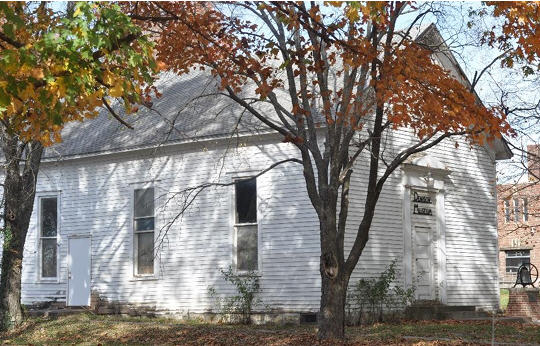
The old Christian Church was turned into a small museum.
The deacons and elders of the Christian, Methodist, and United Presbyterian churches met in 1937 to find a solution to the situation. They proposed to combine the three churches into one. So it was determined that one pastor would lead the combined congregation, each denomination supplying a minister on a rotating schedule. The Methodist and United Presbyterian buildings hosted the sermons, and the Christian structure housed Sunday School classes. This system carried them through World War II.
After the second robbery at Denison State Bank in 1938, it moved to Holton. That year, the Denison Rural High School was engulfed in flames and destroyed.
A new high school building was completed in 1941.
The pastor of the Holton Methodist Church, Reverend Travis Siever, held evening services in 1948 and 1949.
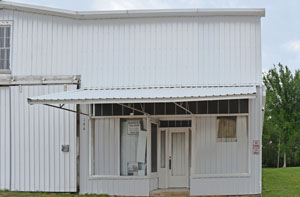
A business building in Denison, Kansas, by Kathy Alexander.
As the community recovered from the Depression and war, a full-time minister was secured in June 1950. Later, the Methodist building was selected to house all the services and classes, as the Presbyterian church was too small for the growing number of attendees.
After 18 years of successful merger and cooperation, despite denominational differences, conversations began in 1955 to permanently unite the churches.
After the Christian Church services were moved full-time to the Methodist building, the church was sold to the local schools in 1957 for use as a music building.
After extensive revision, Denison Union Church was officially established on January 5, 1958. It saw various improvements, including tiled floors, folding doors installed to divide classrooms, the kitchen and bathrooms remodeled, and a library started. Additions to the building were constructed throughout the years, including an education unit in 1963.
The church flourished under the new structure, with membership around 300 in 1965 and an average attendance of about 195.
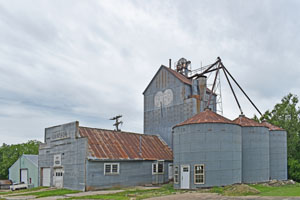
Co-op Grain Elevators in Denison, Kansas by Kathy Alexander.
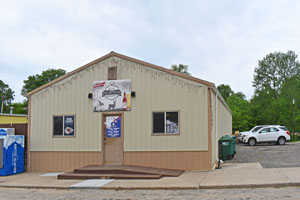
Bar & Grill in Denison, Kansas by Kathy Alexander.
Due to school district unification, the last class to graduate from Denison High School was in 1969. However, the school continued to serve lower grades until it closed its doors in 1990. Students then attended schools in Holton.
The closure of the schools reduced the need for Denison establishments. Businesses that were once so necessary, such as general stores and specialty shops, could be found in larger cities, like Holton and Topeka, often at lower prices and with greater selection. Job opportunities were also more plentiful in those cities, and many residents relocated.
Two churches still serve parishioners, including the Denison Bible Church and the Reformed Presbyterian Church.
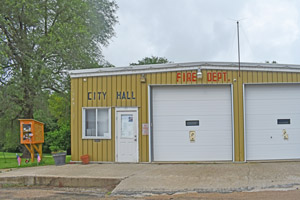
Dennison, Kansas City Hall & Fire Department by Kathy Alexander.
Today, the community is served by the Holton USD 336 public school district.
Denison is 10 miles southeast of Holton, the county seat.
©Kathy Alexander/Legends of Kansas, updated July 2026.
Also See:
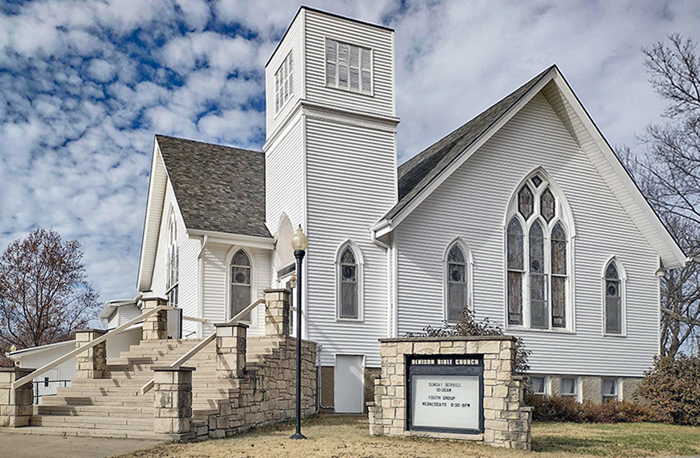
Bible Church in Denison, Kansas.
Sources:
1894 Gazetteer and Business Directory, R.L. Polk & Co., Detroit, Michigan.
Blackmar, Frank W. Kansas: A Cyclopedia of State History, Vol. I. Standard Publishing Company, Chicago, IL, 1912.
Eaves, Tyler Eaves, Chapman Center for Rural Studies: Lost Kansas Communities, Fall 2016.
Wikipedia