
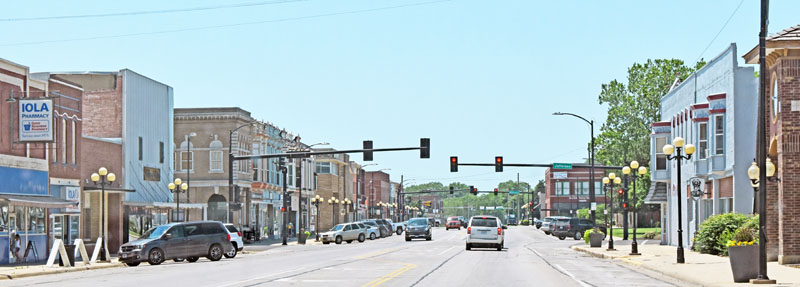
Iola, Kansas Business District by Kathy Alexander.
Iola, Kansas, on the Neosho River, is a city and the county seat of Allen County in southeast Kansas. As of the 2020 census, its population was 5,396, and it had a total area of 4.81 square miles, of which 4.54 square miles is land and 0.27 square miles is water.
The town was named in honor of Iola Colborn, the wife of Josiah Colborn, one of the town’s founders.
In 1858, the Legislature appointed Humboldt, Kansas, as the seat of Allen County.
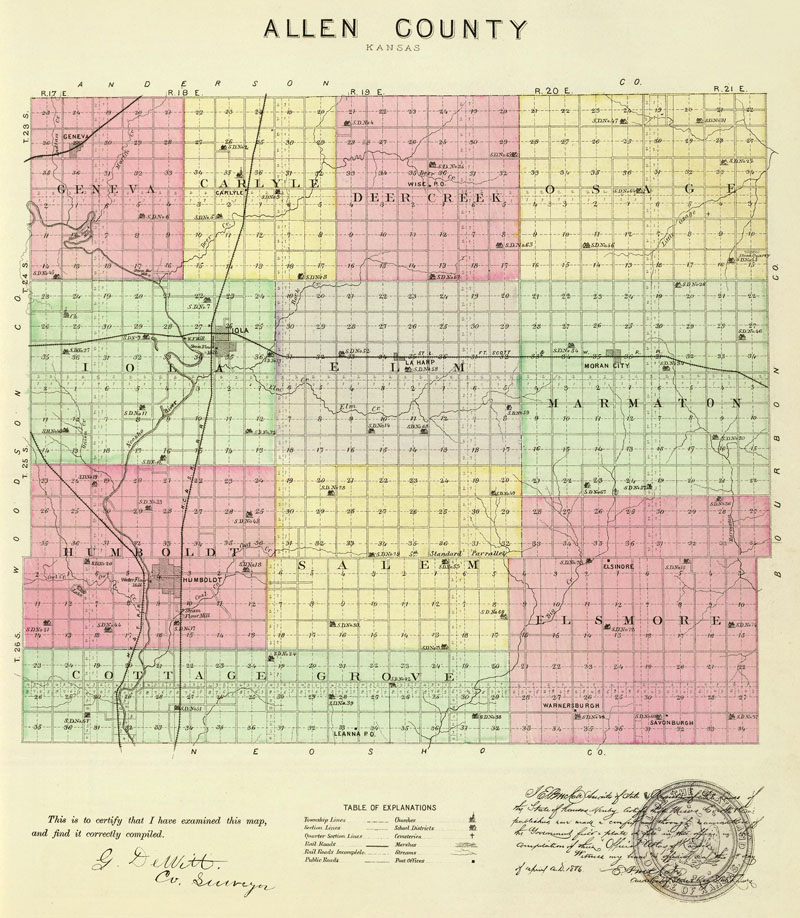
Allen County, Kansas Map, 1887.
For political and geographical reasons, county residents expressed dissatisfaction over this decision. As a result, many residents discussed creating a new town and moving the county seat. Afterward, there was considerable dissatisfaction among the residents of the central and northern parts of the county, and several citizens selected the present site of Iola with the intention of ultimately securing the county seat.
On January 1, 1859, a large meeting was held at the Deer Creek schoolhouse. It was determined to organize a town company, a constitution was adopted, and officers were elected. The officers of the company selected a site for the proposed town, about two miles North of Cofachique, at the confluence of Elm Creek and the Neosho River. The site was owned in part by J.F. Colborn and W.H. Cochrane. The claims on two quarter-sections were bought, and were soon after surveyed into lots.
A meeting was held to choose a name. Several were proposed, and the choice was determined by ballot. Someone had proposed the name Iola, which was the Christian name of J.F. Colborn’s wife, and after a vote, this name was chosen. Company meetings were held every week during the first year, and efforts were made to secure a settlement.
Iola was officially founded and laid out in 1859. A group of citizens gathered in January 1859 to organize the town company, and the settlement was surveyed and platted that same year.
The Methodist Episcopal Church of Iola was formerly a part of the Deer Creek Circuit. The church was organized in the first year of the town’s history.
The first building on the town site was a small log cabin owned by D.B. Bayne.
The first building erected after the town was surveyed was a dwelling completed early in June, 1859, by J.F. Colborn. Upon the completion of the house, Colborn and his family moved in, becoming the first settlers in the town of Iola.
That year, Aaron Case and James Faulkner established two stores after moving their buildings and goods from the old town of Cofachique, and the first hotel was opened.
The first sermon was preached in the unfinished residence of J.F. Colborn, in May 1859, by Reverend Mr. Hawley, a Methodist minister.
The post office was moved from Cofachique and opened in Iola on October 25, 1859, with Aaron Case as postmaster.
That year, a stone building was constructed to serve as the town’s headquarters in the event of trouble with Indians or bushwhackers.
By the close of the year, several lots had been disposed of, several buildings had been erected, and other improvements had been made, as all who bought lots were required to make some improvements at once. The residents of Cofachique, despairing of making their town a success, joined with Iola, and most of them moved to the new site, all working together to secure the county seat at once.
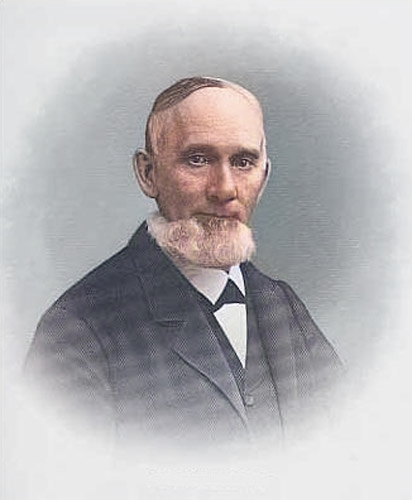
Levi Northrup.
In 1860, Levi L. Northrup, from nearby Geneva, Kansas, established a branch store in Iola.
That year, several buildings were erected, and the population increased to about 150. Two more stores were opened—a dry goods store by D.B. Bayne and a grocery by J.M. Cowan. Soon, there was also a clothing store. That year, religious services were also held under the leadership of Reverend E.K. Lynn, a Presbyterian minister.
On March 26, 1860, an election was held on the relocation of the county seat, but the majority of votes were cast to keep it in Humboldt. Many people remained dissatisfied, and for several years, the county seat question entered every political campaign.
Significant discord and bitterness emerged between the two county sections, leading to harsh accusations and recriminations.
City improvements in 1860 were made almost entirely in the spring and early summer. In the latter part of the year, the effects of the drought were so severely felt, and the failure to secure the county seat was so serious, that business became very sluggish, and for a time all the citizens were much discouraged.
In 1861, the Civil War broke out, and as nearly every able-bodied man in Iola and the county had entered the army, there was little chance for improvement. Due to the war violence and unrest, people struggled to survive. However, a stone building and the block on which it stood were fortified, becoming Iola’s fort. The fort served both the local militia and Army troops throughout the Civil War.
In 1862, Levi L. Northrup moved his family from Geneva to Iola.
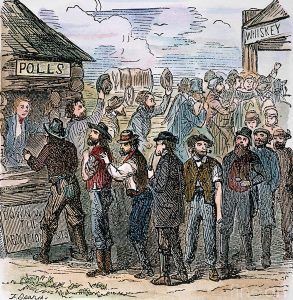
Voting in Kansas.
After several years of strife, an election was scheduled again for May 19, 1865. Having secured a majority of the votes, Iola was declared the county seat, and the records and county offices were removed there, where they remain today.
Afterward, the town company donated 100 lots to the county to aid in the construction of public buildings. In July 1866, bonds were voted to help raise the necessary funds, and not long after, a building was purchased from George J. Eldridge and used for county offices and all courthouse purposes.
Until the close of the war, in 1865, the town grew no larger than it had been in 1860.
After the return of the citizens from the army at the close of the Civil War, the town began to improve steadily.
In 1866, the first courthouse was a building purchased by George J Eldridge in Iola.
The Allen County Courant was the first newspaper published in Iola, and was established January 5, 1867, by W.H. Johnson. On July 27, 1868, Messrs. Talcott & Acers purchased the Allen County Courant, which was renamed the Neosho Valley Register. In the following years, the paper’s ownership changed several times.
In 1868, the Presbyterians built a neat brick church, which was dedicated in September of that year.
The first school was built that year. The historic cast-iron bell purchased by the Union Sewing Circle for the original school has been preserved and is on display at the modern Iola Elementary School campus.
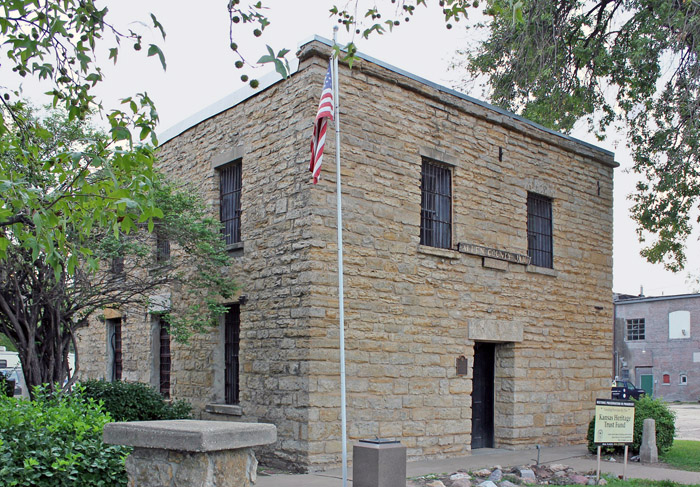
Allen County Jail in Iola, Kansas.
The Allen County Jail, a strong stone structure, was built for $10,000, in county bonds, which were voted in August, 1868. The next year, the building was erected by White & Hays at a contract price of $8,400.
Levi Northrup maintained a branch store at Geneva until 1869, when he consolidated both stores at Iola. At that time, he also established a private bank, called the Banking House of L.L. Northrup. It was the only institution of its kind in town and was in sound condition. It later became Northrup National Bank.
The First Baptist Church was organized on November 20, 1869, by Reverends A. Hitchcock and F.L. Walker, the first named being settled as the pastor. The erection of the church began in September 1871, and it was dedicated on September 1, 1872.
On February 28, 1870, Iola was incorporated as a city of the second class by an act of the Legislature. Having secured the Leavenworth, Lawrence & Galveston Railroad, its population had increased to 1,500. The town made rapid strides in its improvement over the next two years. Several manufacturing establishments were part of the project, and some were built.
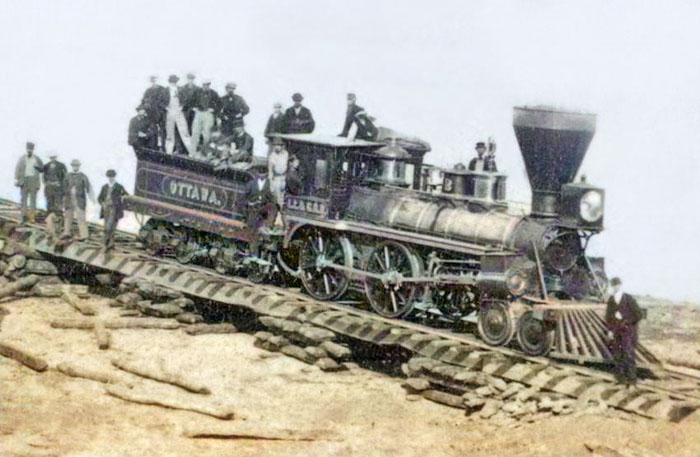
Leavenworth, Lawrence & Galveston Railroad.
That year, a Methodist Episcopal Church, measuring 34 by 50 feet, was erected and dedicated, with Reverend D.P. Mitchell officiating.
The Neosho Valley Register was briefly renamed the Kansas State Register between August 24 and December 10, 1870.
In November 1871, a $5,000 tax was voted to purchase and fit up a poor farm. On February 12, 1872, a tract of land comprising 175 acres was purchased from David Funkhouser for $26 per acre, and J.W. Driscoll was appointed keeper of the poor farm.
Among other heavy institutions at that time was the King Bridge Manufacturing Company, which located the Bridge shops at Iola in 1871. For some time, large numbers of men were employed, and the firm did good business. But during the monetary panic of 1873, bond values depreciated so much that the company failed and removed its machinery. Because they generally received bonds in payment for their bridges and work, the “crash” ruined them. The buildings and several acres of land on which they were located were sold at a Sheriff’s sale for $1,100 and purchased by several citizens of Iola.
In the fall of 1872, a company was formed in Iola to prospect for coal on the Cochran farm, one-half mile southwest of the public square. Drilling began, and a six-inch bed of coal was discovered at a depth of 75 feet. At a depth of 736 feet, a jet of gas and water was struck, which afterward proved of value for its medicinal and curative properties. From this well, 10,000 feet of gas issues each day; it was valuable for lighting and for warming the established baths.
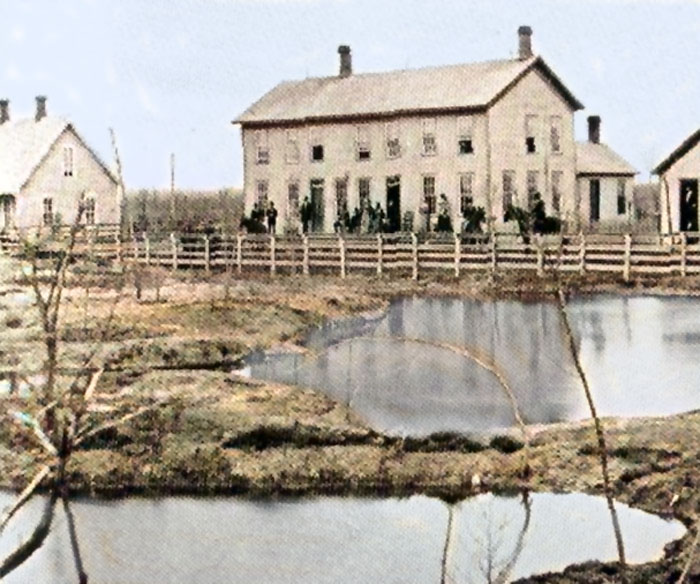
Mineral Wells Hotel in Iola, Kansas.
In the spring of 1874, the Iola Mineral Well and six acres of land were purchased by R.W. & N.F. Acers, who made many improvements, opened a hotel, built cottages and bathrooms, and were making it a summer resort visited by hundreds of sickly people annually. The resort was developed around a pond through which natural gas bubbled. The sulfur in the gas gave the water a strong taste and made it a popular medicine. The water was said to possess curative properties equal to those of Eureka or Hot Springs, Arkansas. The hotel was just to the south of today’s entrance to Riverside Park.
Iola Water Flouring Mills were located on the Neosho River; they are operated by water power, the site being one of the best on that stream. The mills are owned and operated by the firm of W.E. Davis & Co., with a capacity of about 150 barrels of flour and feed each day.
Iola Steam Flouring Mills were located in the western part of town, East of the railroad track, near the depot, and were operated by steam power. The proprietors are Thayer & Co., and care is taken in the manufacture of fine flour.
On January 1, 1875, W.G. Allison & H.W. Perkins took charge and renamed the Kansas State Register the Iola Register. The paper remained Republican under each of these different names and proprietorships.
Between 1873 and 1876, business in all branches was very poor, and little improvement was made in the town.
In 1877, a new stone courthouse was purchased for $1,800, and the old one was sold to the school district for $500 to be used as a schoolhouse. The school was housed in two buildings, one of which was a large two-story stone structure erected in 1868, with an imposing appearance and twin towers. The other building was a two-story frame, and situated just south of the stone schoolhouse.
Iola Carriage Shops, owned and operated by William M. Knapp and William Kinsley, were established in 1882. The shops were in continual operation, and carriages, buggies, sulkies, spring wagons, all light and heavy vehicles, were manufactured. It was the largest establishment of the kind in Southern Kansas.
In 1882, Iola’s population was 1,070.
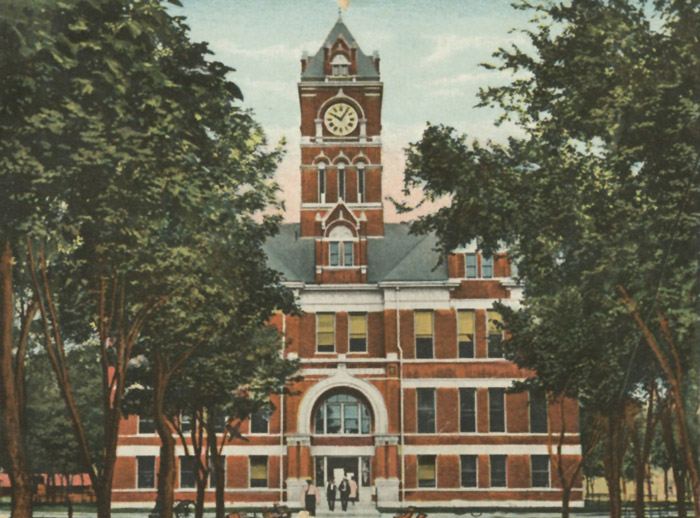
Former Allen County Courthouse in Iola, Kansas.
Smith’s Novelty Works was a new factory established in January 1883 to manufacture locks and other iron and brass goods. The machinery, molds, and furnaces are well adapted to the work, and the new factory opens with excellent prospects for success.
When natural gas was discovered on December 25, 1893, the area boomed, and from 1895 to 1904, Iola exploded from a population of 1,567 to over 11,000.
The third courthouse, an impressive 1904 Richardsonian Romanesque structure, was designed by J.C. Holland & Squires. The three-story structure is in Iola’s massive town square. The original clock from this building still stands on the south side of the courthouse square.
With this great population explosion came many of the homes and buildings still standing today. A water plant and electric generation plant were built; streets were paved, schools were constructed, and Iola prospered.
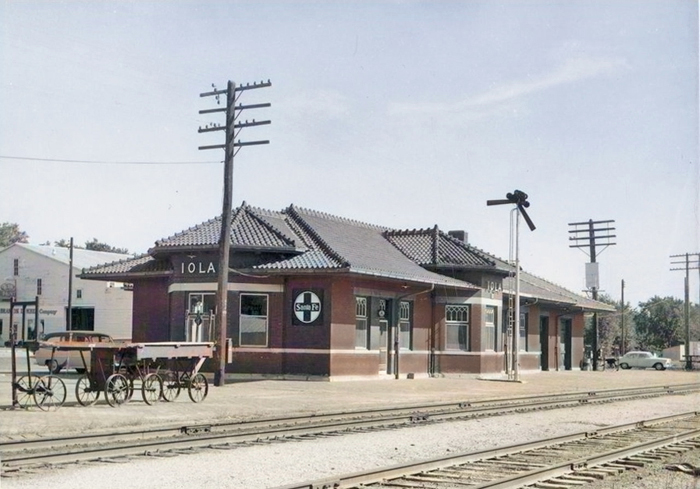
Atchison, Topeka & Santa Fe Railroad depot in Iola, Kansas, by H. Killam, 1956.
In 1910, Iola was at the junction of the Atchison, Topeka & Santa Fe Railroad, the Missouri, Kansas & Texas Railway, and the Missouri Pacific Railroads. At that time, it had two state banks and a savings bank. It was well equipped with paved streets, a good waterworks system, electric lights, a street railway system, a fire department, gas for both heating and illumination purposes, an opera house, two daily and three weekly newspapers, a public library, five fine, graded public schools, and a high school.
Eight large cement factories produced about 25,000 barrels a day, employing about 3,000 men; nine zinc smelters produce about one-third of the world’s supply; and a large spelter employed about 1,800 people. There are also flour mills, brick and tile works, iron works, planing mills, an ice factory, a cold storage plant, a rug factory, bottling works, a creamery, a broom factory, and several smaller manufacturing enterprises. Iola was connected by an electric railway with La Harpe, the line passing through a gas field, with branches to Bassett and Concrete. It had four rural delivery routes emanating from the Iola post office, supplying mail to a large agricultural district and several smaller villages.
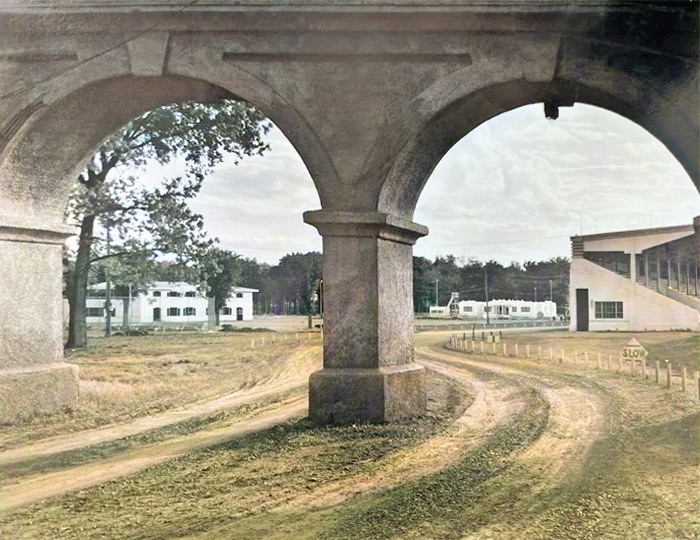
Archways once greeted visitors to Iola’s Riverside Park. Photo courtesy Allen County Historical Society.
In 1910, its population peaked at 9,032.
Unfortunately, the natural gas began to run out, forcing many of the town’s industries, such as the smelters, to relocate to richer fields.
During the Depression-era New Deal projects, Iola received updated improvements. The town received the Riverside Park complex, new schools, new businesses and homes, and upgraded streets and utilities.
There was little positive change in Iola during the 1920s and 1930s. Two exceptions were the Pet Milk plant, which was located here in 1924, and the development of H.L. Miller & Sons dressmakers around 1933.
After World War II, Iola continued to expand its utilities, improve its water purification system, resurface and pave residential streets, and build a new hospital, National Guard Armory, business structures, and homes.
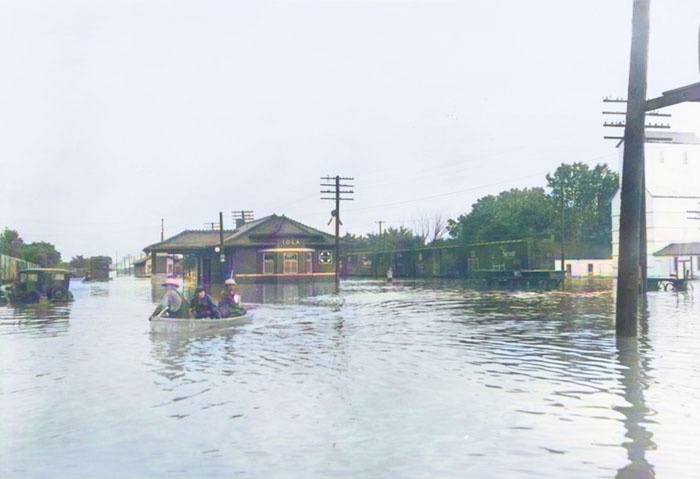
1951 flood in Iola, Kansas.
During the devastating flood in July 1951, the Neosho River crested at an unprecedented 33.4 feet in Iola, Kansas. The catastrophic waters inundated the town for 10 days, submerging homes, closing businesses, and flooding buildings like St. John’s Catholic School. The Great Flood of 1951 remains the most catastrophic natural disaster in the recorded history of Kansas.
The present courthouse was built between 1957 and 1958. Erected in the Modern style, it was designed by Brink and Dunwoody of Iola and built by Dondlinger & Sons Construction Company. Inc. for a total cost of $656,364. The old courthouse was razed in 1959.
The one-story red-brick and light-colored concrete structure is located on spacious, landscaped grounds in the center of Lola. The building has a raised basement. The West front has a northwest entrance with a concrete canopy and a recessed glass entrance. The south entrance has a similar canopy and recessed glass entrance. Inside, the stairs ascend to the first story. The County District Court courtroom is located on the southeast side of the building. The County District Court small courtroom is located on the southwest side of the building. The building houses the County District Court of the 31st Judicial District, which includes Neosho, Wilson, and Woodson Counties. To the northeast is the Old County Jail. The clock from the old courthouse, constructed in 1904, sits on the lawn. It is located at 1 North Washington Avenue and West Jackson Avenue.
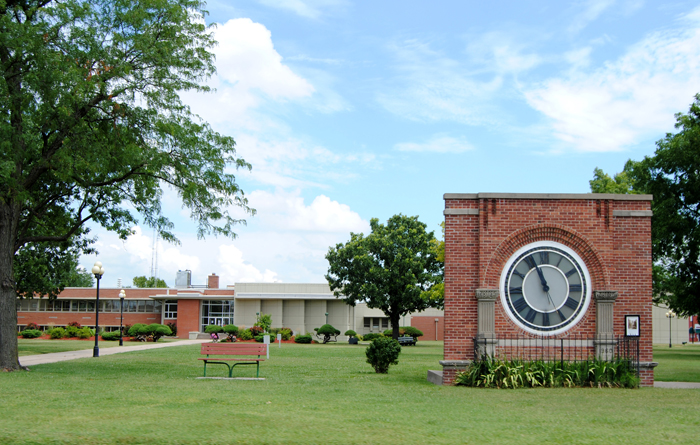
Allen County Courthouse in Iola, Kansas by Kathy Alexander.
In 1958, the Old County Jail closed when the new Allen County Courthouse was built.
In 1959, a special act of the Kansas Legislature authorized the Allen County Commissioners to convey the jail deed to the Allen County Historical Society. On May 20, 1962, the Old Jail Museum opened to the public and had 1,677 visitors from 29 states during its first month. It was placed on the National Register of Historic Places in 1977.
Since the 1970s and 1980s, Iola’s industry has fluctuated. Some of its initial companies declined, including the Thompson Poultry Company and the Lehigh Cement Plant. However, new companies entered the community, including Gates Rubber Company, Tramec LLC, Haldex, and Russell Stover.
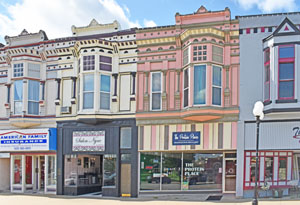
Business buildings in Iola, Kansas, by Kathy Alexander.
In 2011, severe floods swept through Southeast Kansas, wiping out Iola’s southern section and causing a significant population decline.
Allen Community College is located in Iola. It is a small institution with a full-time enrollment of 603 undergraduate students and a part-time enrollment of 1,252 undergraduate students. Popular majors include Liberal Arts and Humanities, Nursing Assistant, and Child Care Provider. Allen County graduates 53% of its students.
Iola is home to the largest Downtown Square in the United States. It boasts a variety of retail shopping, restaurants, and businesses.
U.S. Route 54 passes through Iola along Madison Street and intersects U.S. Route 169, which runs along the East side of the city. The smaller cities of Gas and La Harpe are a few miles East along US-54. The tiny city of Bassett lies adjacent to Iola’s southern border, and the city of Humboldt is approximately seven miles to the south along US-169.
Iola is 100 Miles South of Kansas City, Missouri, and 115 miles East of Wichita, Kansas.
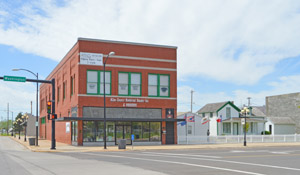
Iola, Kansas Museum by Kathy Alexander.
©Kathy Alexander/Legends of Kansas, updated May 2026.
Also See:
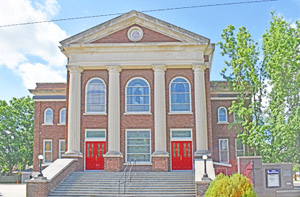
Methodist Church in Iola, Kansas by Kathy Alexander.
Sources:
Allen County History
American Courthouses
Blackmar, Frank W. Kansas: A Cyclopedia of State History, Vol. I. Standard Publishing Company, Chicago, IL, 1912.
Cutler, William G.; History of Kansas; A.T. Andreas, Chicago, IL, 1883.
City of Iola
Iola Brochure
Iola Chamber of Commerce
Wikipedia