
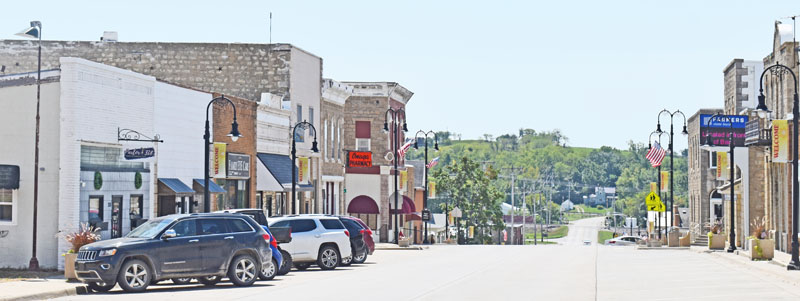
Main Street in Onaga, Kansas, photo by Kathy Alexander.
Onaga, Kansas, is a small town along the banks of the Vermillion River in the Flint Hills of northeast Pottawatomie County. As of the 2020 census, the city’s population was 679, and it had a total area of 0.64 square miles, all land.
On September 15, 1877, the first building, a hotel, was started by Amos Landon. Mr. Paul Havnes, president of the Central Townsite Company, used a pick to break the wild turf for the chief cornerstone of the Landon House. The hotel was a frame building, measuring 20 by 50 feet, and a story and a half in height. Landon also built the first house in Onaga, starting work on it on September 19, 1877.
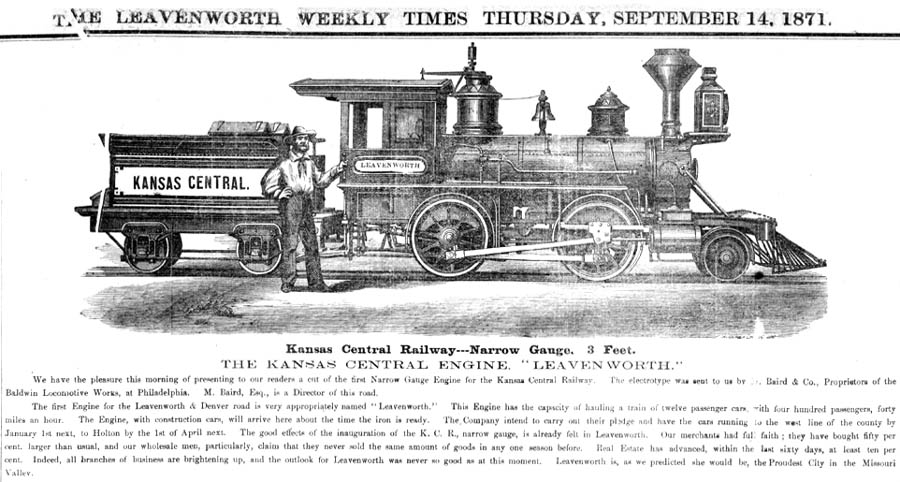
Central Kansas. Railway.
Onaga was platted on October 15, 1877, by Paul E. Havens, president of the Kansas Central Railrway. The railroad winds along the base of the hills between the town and the Wise Creek. The depot was located at the foot of the main street, known as Leonard Street. Its name was derived from the Potawatomi Indian name, Onago.
Another building, constructed in November 1877, was a saloon operated by Mr. David Scott of Elk Creek. His petition to secure the license contained over 100 signatures.
A post office was established on December 3, 1877. The Kansas Central Railrway began running trains to Onaga in December 1877.
In January 1878, Amos E. Landon and J.B. Hubbell, with their families, were the only people on the townsite. A. Hyman came to Onaga from Leavenworth in the spring of 1878. His sales amounted to more than $30,000 the first year.
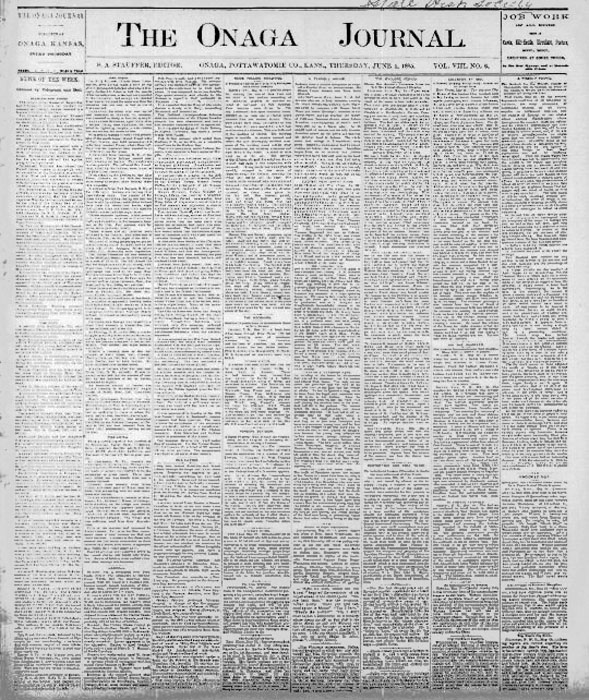
Onaga Journal newspaper.
The Onaga Journal, which was Republican in politics, was established on May 9, 1878, by Carnes & Stauffer, editors and proprietors. About three weeks later, Samuel A. Stauffer bought out Mr. Carnes’s interests.
Thomas O’Meara, originally from Canada, moved to Onaga with his family in 1878 and opened a general merchandise store. At about the same time, Jeffrey J. La Morsna, a livestock dealer born in Upper Canada, moved his family to Onaga and went into the livery business.
Fred Midlam, a druggist from New York, first came to Kansas City, Missouri, where he went into railroading. In 1878, he was assistant foreman of the bridging of the Kansas Central Railroad and came to Pottawatomie County with his family.
A fire occurred in the fall of 1878 that destroyed a grain elevator, corn cribs, 300 bushels of corn, 600 bushels of barley, and a small engine.
By November 1878, when the town was just a year old, there were 18 different kinds and places of businesses, and a considerable number of residences. Henry Rolf, a grocery man from Chicago, Illinois, came to Onaga in the fall of 1878 and erected the first stone building. This structure, including a basement, was three stories high. The third floor was made into a public hall. This building later served as the Onaga Pharmacy.
An addition was made to the townsite on November 6, 1878.
In the early days of Onaga, the hardware and lumber business was very profitable. Four Thomas brothers came here from Muscotah, Kansas, in 1879. They built a large two-story building, measuring 18 by 130 feet. Their business interests were quite extensive, and included a banking business, a large grain elevator, the largest stock of lumber west of Leavenworth, hardware, and heavy farm implements
Joseph Pecheur, a Frenchman, came to the area in 1868 and, with his wife, opened a general merchandise store in 1879.
In 1880, Fred Midlam established the drug store. The same year, William F. Challis, an attorney originally from Illinois, moved his family to the city and established his practice.
Onaga remained the terminus for the Kansas Central Railrway until 1880. The service was notoriously bad from the beginning. A demand for the railroad to replace the narrow-gauge line with the standard gauge began in the early 1880s, and each year the railroad officials assured their patrons that the demand would be met, but it wasn’t until 1890 that anything was accomplished.
F.A. Reed, an attorney from Illinois, came to Pottawatomie County in 1871 and settled in Louisville. In November 1881, he moved his family to Onaga, where he set up his practice.
Onaga originally incorporated as a city in 1881.
Henry Storch, a banker who was originally from Bavaria, came to Onaga in 1872 and established a general store, which he operated until June 1881. At that time, he took E.B. Landon as a partner. In 1882, they built a fine two-story stone building measuring 25 by 50 feet, which was occupied by the Onaga Exchange Bank and Henry Storch & Co. on the first floor, and various offices on the upper story.
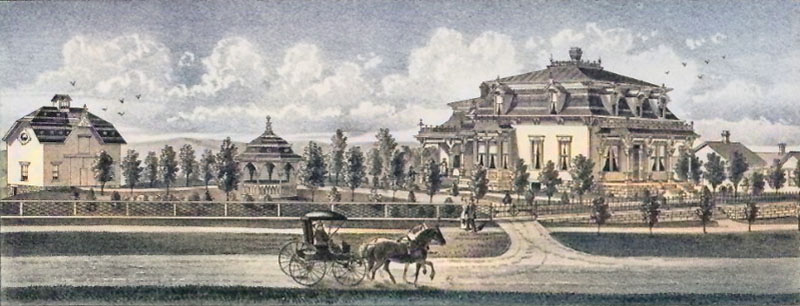
Henry Storch Residence in Onaga, Kansas by L.H. Everts & Co., 1887.
Franklin Miller, an Onaga merchant, came to Kansas in 1869 and initially worked on a farm. In August 1882, he opened a business with his brother, Washington. They had a store measuring 30 by 100 feet, a basement of the same size, that was filled with an immense stock of hardware, stoves, tinware, agricultural implements, wagons, etc. They did a large business.
The first fire, which really threatened the town, occurred in February of 1883. It started on the second floor of a building occupied by a saloon. That building, with its contents and the buildings on each side of it, was destroyed.
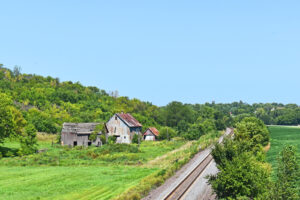
An old homestead in Oneida, Kansas, photo by Kathy Alexander.
During the summer of 1885, there was a need for a half dozen rental properties, and, as most of the desirable building sites had been taken up, Gunn’s Addition was added to the townsite.
The Onaga Journal newspaper ceased publication in 1885. It was replaced by the Onaga Democrat, which was published until 1890. The Onaga Herald replaced the Democrat newspaper.
Another disastrous fire broke out in December 1886. This time, it started in the livery barn, which was destroyed, and due to high winds, the fire spread rapidly, burning a meat market and the Batson House, the town’s only hotel. Consequently, a City Fire Department was established in June, 1887. It was made up of a chief and his assistant, and a sufficient number of volunteers to handle the engine and hose. The equipment consisted of a hand engine with 1,200 feet of hose and two large cisterns, purchased for $ 2,000.
In 1889, Miller Brothers and A. Hyman installed street lamps in front of their business houses. Druggist J.A. Kester placed a gas lamp in front of his store in January 1898 and kept it in running order at his own expense. In August of that year, several businessmen installed similar lights that burned gas generated from gasoline. At last, the city completed arrangements for the installation of seven street lights in January, 1899.
Another project to improve the appearance of the streets aroused public interest in the summer of 1900. The city council passed a resolution removing the hitching racks that were unsightly and obstructed the streets. A few teams tied along the streets prevented others from driving up to the businesses to unload their produce or load their purchases. This move met with decided opposition. A few merchants solved the problem by placing tie rings on the sidewalks in front of their property.
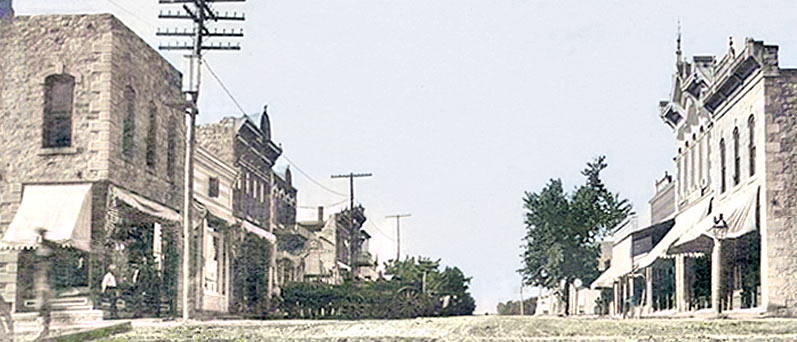
Onaga, Kansas, early 1900s.
The Topeka and Northwestern Railroad Company was incorporated under the general laws of the State of Kansas on June 9, 1904, to construct, maintain, and operate a standard gauge railroad and a telegraph line from Topeka to Marysville, Kansas.
A gang of Italians had laid the track south out of Onaga in January 1906. They reached a point about one-half mile out of town, where they were met with a force of about 140 Japanese workers who had been laying the track from Topeka this way, and the connection of the two pieces of track was made on the August Wegner farm. A large crowd gathered to see the wonderful track-laying machine and to witness the moment when the tracks would be completed, and trains would come in from the south. On January 14, 1906, at five o’clock in the afternoon, the last tie was laid; the last spike was driven. Thus, the greatest event in the history of Onaga had occurred. The first train to reach Onaga over the new railroad consisted of two work trains coupled together and arrived on Monday, January 15, 1906. Conductors Lehman and McDaniel were in charge.
The depot was located at the intersection of Second Street and Clifton Street. It had a freight station, ticket office, express agency headquarters, and a railroad telephone. When the railroad was finished, freight could be received and delivered in any quantity. Southwest of the depot, not far from Hise Creek, was a well and windmill to furnish water for the steam trains.
At this time, the Western Union Telegraph Company was putting up poles, stretching wires, and preparing to open an office in Onaga.
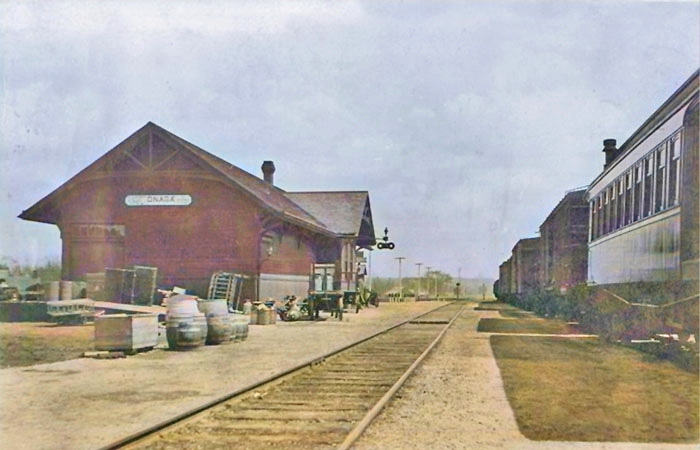
Union Pacific Railroad in Onaga, Kansas, 1910.
The Topeka and Northwestern Railroad Company became part of what is now the Union Pacific Railroad system.
By 1910, Onaga was incorporated, and at the junction of two Union Pacific Railroad lines. At that time, it had two banks and a weekly newspaper, the Herald, and was a shipping point for grain, livestock, fruits, and produce. There were also express and telegraph offices, an international money-order post office, with five rural routes, and a population of 800.
On February 9, 1911, work began on a waterworks system for Onaga. On that day, a gang of men began digging the big well on a piece of ground which the city purchased from John Selback. J. W. Dunn donated a large parcel of land to the city on the north side of the park. Upon investigation, it was found that this piece of ground was three feet higher than the original site for the tower and tank. This fact, together with Mr. Dunn’s site, caused the location change.
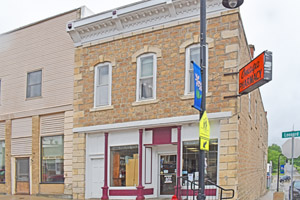
Business buildings in Onaga, Kansas, photo by Kathy Alexander.
The Onaga Herald ceased publication in December 1924.
Onaga was reincorporated in 1926.
Onaga’s population peaked at 930 in 1930.
The Onaga Historical Society is proud of its museum complex, featuring a variety of collections of antiques and other interesting items and displays from the area. In addition to a large Morton building and a small building full of memorabilia, there is an authentic log cabin, a one-room country schoolhouse, a Union Pacific train caboose, and a variety of resources for those interested in doing family genealogy research. Admission is free; however, free-will donations are appreciated. Located at 310 E. 2nd Street, it is open from 1:00 to 4:00 every Friday starting June 9 and throughout June, July, and August, or by appointment at any time of the year by calling 785-889-7104.
Onaga is surrounded by scenic drives, hiking and biking trails, and nearby walk-in public fishing and hunting areas. A beautiful 9-hole golf course is open to the public and offers lovely views of the Flint Hills. The fairgrounds offer picnic areas, a public swimming pool, tennis and basketball courts, and softball fields. All ages can enjoy picnics and playtime at Leisure Land Park.
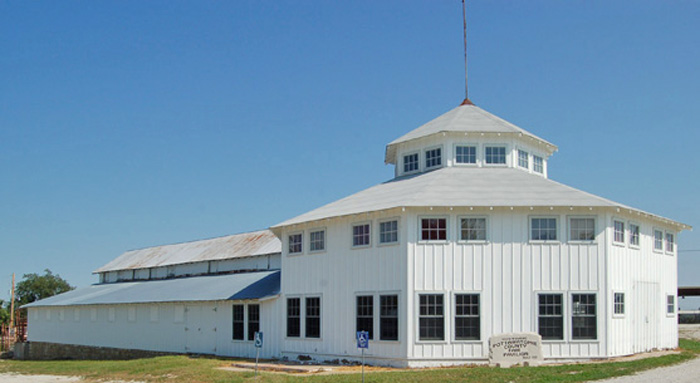
Pottawatomie County Fair Pavilion in Onaga, Kansas, courtesy Wikipedia.
Catch a glimpse of the past in the original limestone buildings downtown and the Pottawatomie County Fair Pavilion, an octagonal wood-frame barn built in 1921, one of the very few of its kind left in Kansas. Listed on the National Register of Historic Places in 2004, the pavilion also has a 54-foot exhibition hall with a domed roof topped by a cupola. A rectangular, one-and-a-half-story, 50-by-81-foot livestock shed accompanies it.
In 1937, when Dr. Charles Fleckenstein arrived in Onaga, he recognized the town’s need for a hospital and established one in a three-story Victorian house. Eugene Walsh joined him in 1947, and together they opened the Onaga Clinic in 1959. Today, the community is served by the Onago Community Health Care System.
Today, the community is served by the Onaga USD 322 public school district, which includes an elementary school, a junior high, and a high school.
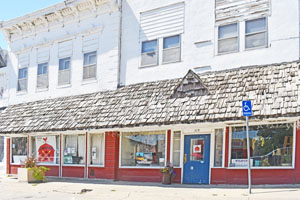
Business building in Onaga, Kansas, photo by Kathy Alexander.
Located within 50 miles of either Topeka or Manhattan, Kansas, Onaga offers the conveniences of a town while retaining the benefits of small-town rural America. It is 20 miles from Westmoreland, the county seat. The city is part of the Manhattan, Kansas Metropolitan Statistical Area.
©Kathy Alexander/Legends of Kansas, May 2026.
Also See:
Cities & Towns in Kansas
Kansas Destinations
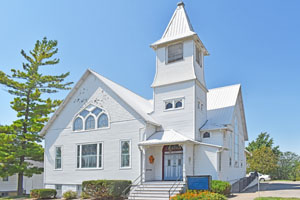
Congregational Church in Oneida, Kansas, photo by Kathy Alexander.
Pottawatomie County Photo Gallery
Sources:
Blackmar, Frank W.; Kansas: A Cyclopedia of State History, Vol I; Standard Publishing Company, Chicago, IL 1912
City of Onaga
Crossroads Humanities
Roots Web
Wikipedia