
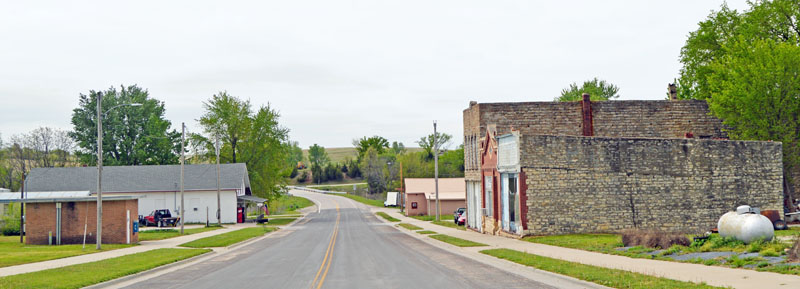
Main Street in Havensville, Kansas by Kathy Alexander.
Havensville, Kansas, is a small town along Straight Creek in Grant Township of Pottawatomie County. As of the 2020 census, its population was 119, and it had a total area of 0.15 square miles, all land. It is also an extinct town, as its post office closed several years ago.
During the Civil War, the site of future Havensville attracted attention from R.M. Croy and his wife, who traveled from Indiana in 1863 to join Mrs. Croy’s brother, W.B. McComas, in northeast Kansas. At this time, freighting and farming were the area’s main industries, and Mr. Croy worked in the freight business.
In July 1863, a small house served as the area’s first school.
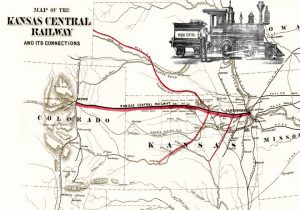
Kansas Central Railway Map.
Within a decade, Mr. Croy had tried and failed in the freight business and turned to farming to make a living. However, in 1877, Croy saw his chance for success when the Kansas Central Railrway decided to extend the railroad west from Holton, Kansas, through Pottawatomie County, crossing Croy’s land. Croy decided to build a town along the railroad and set aside individual lots of his land for sale at a low price. The inexpensive land reportedly attracted many interested investors, resulting in the formation of Havensville.
The town was named after Paul E. Havens, a former banker from Leavenworth, Kansas, and the superintendent of the railroad. A post office was established in Havensville on March 5, 1878, with Abbey Dennen serving as the first postmaster. The Kansas Central Railrway Company filed a plat of this town on November 12, 1878. This success drew more people to the area.
With the coming of the railroad, Havensville became one of the area’s prominent shipping points, with the railroad business supporting eight families.
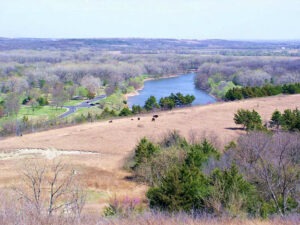
Big Blue River, courtesy Wikipedia.
Settled in the Blue River Valley, Pottawatomie County was considered one of the most fertile areas in the state, and one of the most productive wheat-growing areas in Kansas. Area farmers also grew corn, rye, barley, and several other crops. With an ample supply of trees ranging from walnut and cedar to oak and maple, along with limestone quarries and even gypsum, there were plenty of excellent building materials.
By 1880, the town had a population of nearly 100, a school district, and daily mail service. That year, the Masonic Order formed a lodge, the Independent Order of Odd Fellows was organized in 1881, and the Ancient Order of United Workmen was organized in 1882.
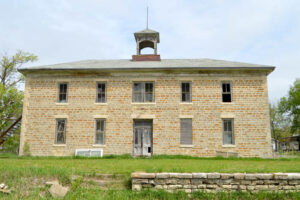
Old stone school in Havensville, Kansas, by Kathy Alexander.
In 1882, a neat two-story stone schoolhouse was erected, two teachers being employed. It offered nine years of grade school and two years of high school. That year, there were three churches in the town. The Baptists erected a neat frame church edifice in the spring of 1880, with Reverend Dick of Circleville as the pastor. The Methodist Episcopal Church erected a frame building in the spring of 1881, with Reverend H.A. Pasley as the pastor. The same year, the Church of the Disciples also erected a frame structure in the autumn of 1881, with Reverend R.L. Downing as pastor.
In 1888, the town’s population had grown to 274, bringing in new businesses.
The Citizens State Bank of Havensville was chartered in September 1889. In 1900, the bank became the First National Bank.
In 1910, Havensville was incorporated and was on the Leavenworth & Miltonvale branch of the Union Pacific Railroad. At that time, it had two banks, a weekly newspaper called the Review, express and telegraph offices, a money order post office with two rural mail routes, and its population peaked at 439. At its peak, the town also boasted two doctors, three druggists, three blacksmiths, two hotels, four general stores, and a dentist.
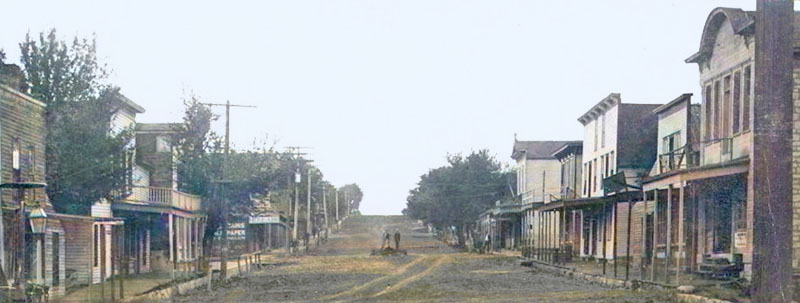
Havensville, Kansas, 1908.
By 1919, more school space was needed, so the town’s Baptist Church served as a lab for vocational agricultural classes. The class achieved considerable popularity, with all the freshman boys enrolled in the course. The church soon became known as “The Crow’s Nest” after instructor Blaine Crow. The vocational courses were important for keeping the farm boys in school at the time. It was even quoted by an anonymous source in the Topeka Capital Journal that Havensville was a “progressive town” that “set an example for other towns in taking advantage of vocational training work.”
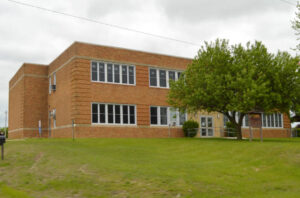
Old Rural High School in Havensville, Kansas by Kathy Alexander.
A new high school building was built in 1921.
Through the Great Depression and World War II, more and more people left rural life. Automobiles created competition among small towns founded close together.
The First National Bank closed in 1932.
The high school building burned down in 1936, forcing students to return to the old grade school for classes over the next three semesters until a new building could be built to replace it.
A two-story brick high school was begun in 1937.
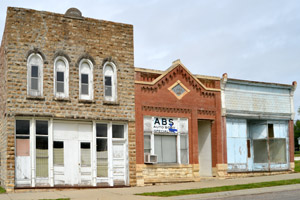
Business buildings in Havensville, Kansas, by Kathy Alexander.
After high school consolidation, Havensville Rural High School students went to Onaga, and the school building was used as an elementary school. The school closed in 2001 when elementary students were moved to Onaga. The building serves as a community center today.
Havensville’s post office was discontinued on April 29, 2005.
The Cow Creek Opry hosts entertainment events at the community building (the old high school) in Havensville.
The town is served by the Onaga USD 322 public school district.
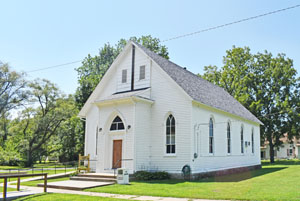
Methodist Church in Havensville, Kansas by Kathy Alexander.
Havensville is located along Kansas Highway 63, 28 miles northeast of Westmoreland, the county seat. The community is part of the Onaga Area Chamber of Commerce, which includes Onaga, Havensville, and Wheaton.
©Kathy Alexander/Legends of Kansas, July 2026.
Also See:
Extinct Towns of Pottawatomie County
One-Room, Country, & Historic Schools of Pottawatomie County
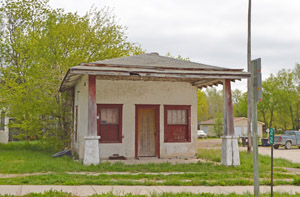
An old gas station in Havensville, Kansas by Kathy Alexander.
Sources:
Blackmar, Frank W.; Kansas: A Cyclopedia of State History, Vol I; Standard Publishing Company, Chicago, IL 1912.
Cutler, William G.; History of Kansas; A. T. Andreas, Chicago, IL, 1883.
Mangus, Maggie; Lost Town Project, Fall, 2011, Kansas State University
Pottawatomie County, KS Economic Development
Wikipedia