
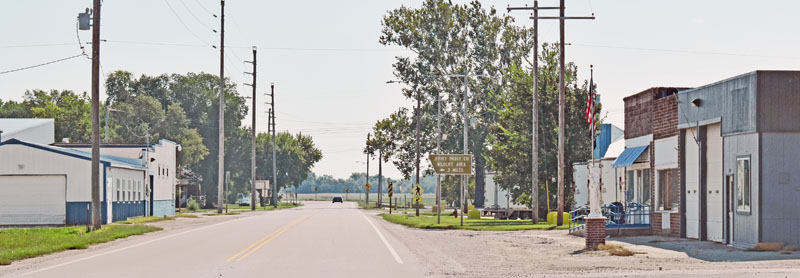
Belvue, Kansas Main Street by Kathy Alexander.
Belvue, Kansas, is a small town near the Kansas River in Belvue Township in southeastern Pottawatomie County. According to the United States Census Bureau, the city’s population was 177, and it had a total area of 0.12 square miles, all land.
The first school in the Belvue area was a one-room schoolhouse, established in 1870. Early teachers included Massey Albright, May Worthing Watt, and Miss Fischer.
Andrew J. Baker and Malcolm Gregory laid out this village on March 14, 1871. On that day, they deeded to the Belvue Township Company the southeast 40 acres of the land they had purchased from the Atchison, Topeka & Santa Fe Railroad. There is some dispute as to where the name “Belvue” originated. It most likely derived from the French name “Belle,” meaning “beautiful,” as proposed by Mrs. Andrew J. Baker. Other versions say the town was named for the daughter of Louis Vieux, who operated a ferry across the Vermillion River, but it’s not known whether he had a daughter named Belle.
A post office was established on May 31, 1871. Serving two rural routes, the first postmaster was George Meens, who earned a salary of $23.08 per year.
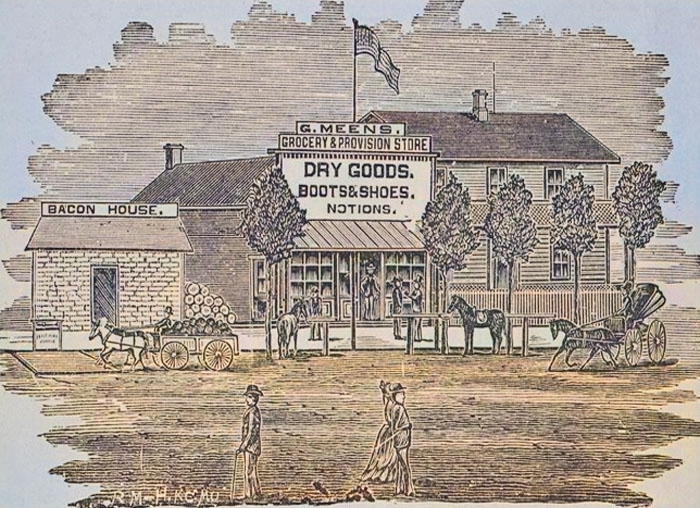
George Meens’ General Store in Belvue in about 1885.
Located on the main branch of the Kansas Pacific Railway, Belvue soon had a steam sawmill and a steam flour mill and was described as “a thriving young village”.
In 1878, Belvue had a flour mill, a Methodist Church, a public school, a general store, a population of 50, and its principal shipment was grain.
In 1885, had a hotel, a wagon maker, a grain dealer, carpenters, two general stores, a stone mason, a blacksmith, a grain elevator, two churches, and a population of 300.
The Dodger newspaper, which was in print from January 1, 1889, to August 6, 1889, was edited by Dr. J.S. Watt. A year’s subscription cost $.50, or as Dr. Watt advertised, “THE DODGER is a BRIGHT, SPICY WEEKLY NEWSPAPER…costs but ONE CENT PER WEEK.” Many people used the newspaper for advertising, and Dr. Watt used his newspaper to urge his patients to “make immediate settlement, by cash or bankable note” for what they owed him.
The Belvue Mirror, which was in print from November 18, 1897, to May 12, 1898, was edited by C.M. Dunn. Local merchants used the paper for advertising, and it was much more staid in tone than the Dodger had previously been.
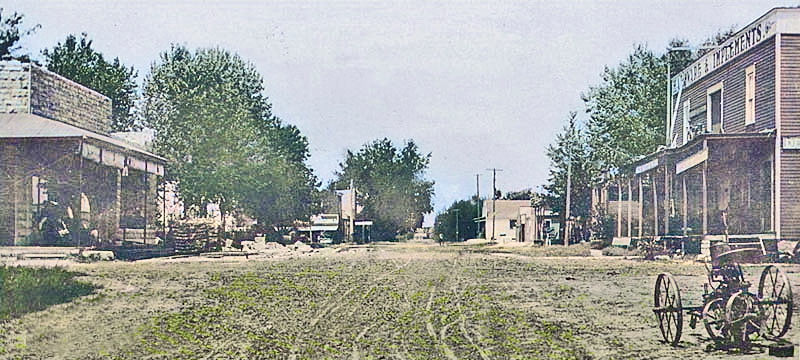
Main Street in Belvue, Kansas, 1908.
In 1910, Belvue was on the main line of the Union Pacific Railroad, with banking facilities and all the main lines of business activity, as well as a money order post office with two rural routes, telegraph and express offices, and a population of 200.
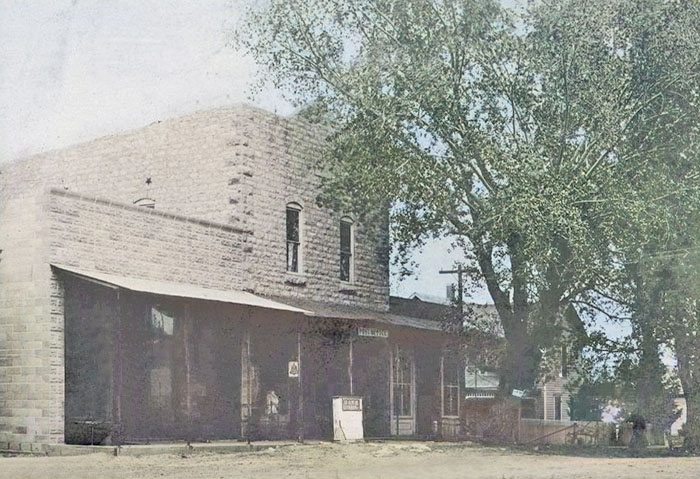
Belvue, Kansas Stores.
The first city council of Belvue met on May 8, 1913. Police Judge J.W. Falkner, having previously qualified, administered the oath of office to Mayor-elect E.C. Hooven, then to Councilmen-elect John D. Weeks, O.R. Searl, W.C. Child, H.G. Lambert, and A.W. Eggers. S.A. Ross was appointed city clerk, and Harold Child the treasurer. Mayor Hooven appointed Frank Rischer as City Marshall and Street Commissioner.
Several ordinances were enacted, and a regular meeting place was decided upon: the Belvue City Council would meet on the first Monday of each month in the director’s room of the Belvue State Bank, which became Farmers State Bank in 1925.
In 1916, a new school building was erected, which served as both the grade and high school.
Early in the 1930s, Belvue was unified into the St. Mary’s school district and closed its high school.
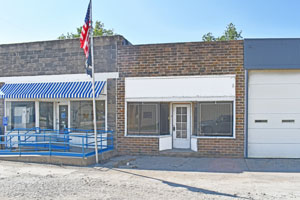
Business buildings in Belvue, Kansas, by Kathy Alexander.
Belvue residents eventually petitioned to leave the St. Mary’s district when St. Mary’s decided to build a new school. Belvue then joined the Wamego school district.
In 1951, Belvue built a Quonset-style gymnasium on the south side of the school, at Anderson and Second Streets. Its construction caused a disagreement among some area farmers, who felt it was far too expensive. They urged each other to take action and stop the construction, but it was in vain.
At one time, there were four churches in Belvue, including two Methodist Churches, a Baptist Church, and a Presbyterian Church. The Methodist Protestant Church was located at the corner of 2nd and Anderson. The Presbyterian Church, built in 1901 at 505 Noble Street, was later converted into a private home. The Methodist Episcopal Church, now known as the Belvue United Methodist Church, is located on Anderson, between 5th and 6th Streets. No particulars are known about the Baptist Church.
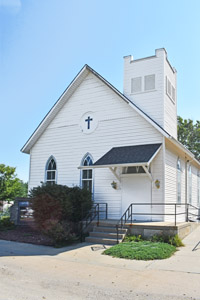
Methodist Church in Belvue, Kansas by Kathy Alexander.
Today, the community is served by the Wamego USD 320 public school district.
Belvue is approximately 30 miles west of Topeka, 20 miles east of Manhattan, and 25 miles southeast of Westmoreland, the county seat.
©Kathy Alexander/Legends of Kansas, May 2026.
Also See:
Extinct Towns of Pottawatomie County
Pottawatomie County Photo Gallery
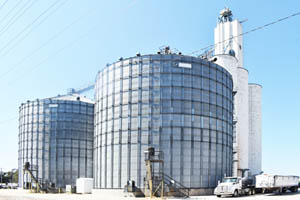
Silos and a grain elevator by Kathy Alexander.
Sources:
Blackmar, Frank W.; Kansas: A Cyclopedia of State History, Vol I; Standard Publishing Company, Chicago, IL 1912.
Cutler, William G.; History of Kansas; A. T. Andreas, Chicago, IL, 1883.
City of Belvue
Polk’s 1878 Official State Gazetteer and Business Directory of Kansas, R.L. Polk & Co., Detroit, MI.
Polk’s 1884-1885 Official State Gazetteer and Business Directory of Kansas; R.L. Polk & Co., Detroit, MI.
Wikipedia