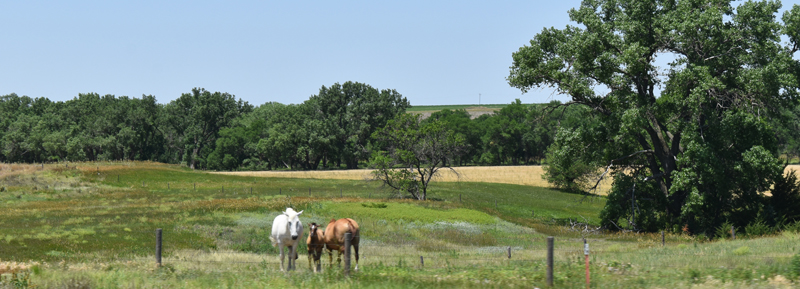
Decatur County, Kansas Landscape by Kathy Alexander.
Towns & Places
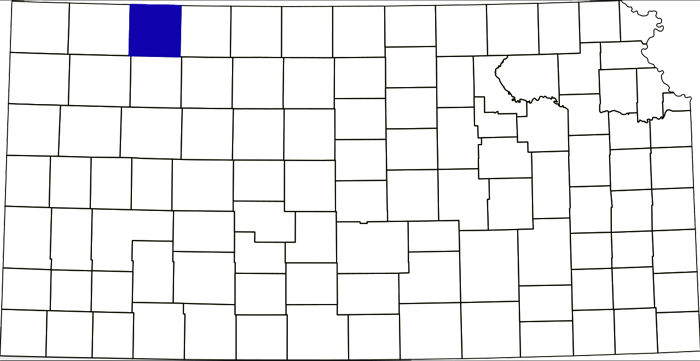
Decatur County, Kansas Location.
Dresden – Extinct
Jennings
Norcatur
Oberlin – County Seat
Jennings State Fishing Lake
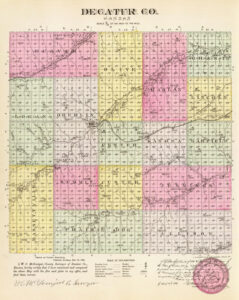
Decatur, Kansas, location by L. H. Everts and Co., 1887.
~~
Decatur County, Kansas, is located in the Northwest part of the state. Its county seat and most populous city is Oberlin. As of the 2020 census, the county’s population was 2,764, with 894 square miles of land and 0.6 square miles of water.
In about 1870, there was a great tide of immigration to the western part of Kansas, which at that time was unorganized, and a large portion of it was unsurveyed territory. Within two years, the population had increased to such an extent that it justified the establishment of several new counties. Accordingly, the Legislature of 1873 passed an act creating 22 new counties and providing for their organization.
Decatur County is bounded by Red Willow County, Nebraska, to the North; Furnas County, Nebraska, to the Northeast; Norton County to the East; Sheridan County to the South; Thomas County to the Southwest, and Rawlins County to the West.
The county is crossed by Beaver Creek and Long Branch Creek in the North, by Sappa Creek in the middle, and by Prairie Dog Creek and the South Fork of the Solomon River in the south. Sappa Creek has two forks, North and South, and Prairie Dog’s principal branch is Tom Cat.
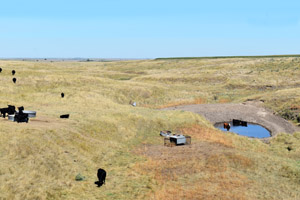
Decatur County, Kansas landscape by Kathy Alexander.
The surface is generally undulating prairie, breaking into bluffs along the streams. Beaver Creek waters the northern part; the central part by Sappa Creek; and the southern part by Prairie Dog Creek and the North Fork of the Solomon River, all of which flow in a northeasterly direction. The belts of timber along the streams are narrow, less than 5% of the entire area being wooded land. Ash, white elm, box-elder, hackberry, and cottonwood are the most common varieties. Fine limestone is found in the bluffs along the creeks, and, in fact, good building stone is found throughout the county. Clay suitable for the manufacture of brick and tile is abundant.
Decatur County was surveyed in 1872, and its first settlers arrived. Among these early corners were Colonel J.A. Hopkins, who came in September 1872 and, in December, located a claim, the land having been surveyed the previous summer in January 1873, D. Coburn, S.M. Porter, John Griffith, Henry M. Playford, and a few others, who came about the time the county was created.
Decatur County was established by an act of the state Legislature on March 20, 1873, and was named in honor of Commodore Stephen Decatur, Jr., in the United States Navy, who served during both Barbary Wars in North Africa, the Quasi-War with France, and the War of 1812 with Britain.
When the first settlers arrived, roads had not yet been opened; pioneer residences were either dug-outs, sod houses, or log cabins of the most primitive type; markets were far distant, and the trusty rifle had to be frequently depended upon to furnish food for the family. Fortunately, the game was plentiful. Buffalo hunts were common and seldom failed to supply meat. The country also abounded in antelope, jack rabbits, and wild turkey, with an occasional elk or deer. But the hardships of frontier life, the loss of crops by drought and grasshoppers, caused a number of the early settlers to abandon their claims and turn eastward.
The first post office established in the county was at Oberlin, then called Sappa, with J.A. Rodehaver being appointed postmaster in April, 1874.
In the summer of 1874, R.L. Booth killed Frank Adams for insulting his wife – the first death by violence in the county.
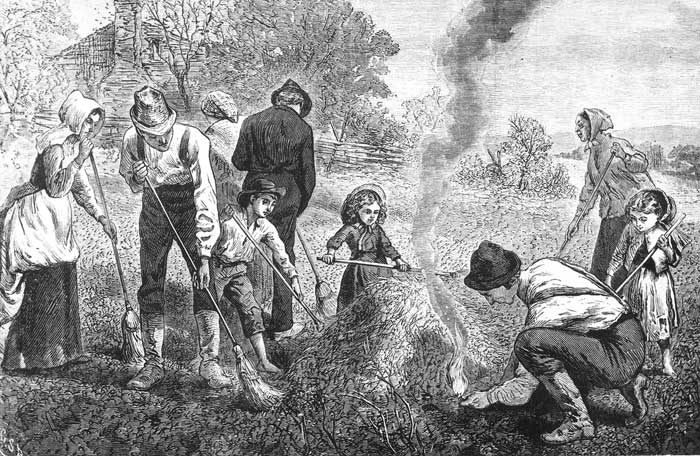
Grasshopper Plague in Kansas.
The grasshopper invasion in 1875 caused the people of the country severe hardships, as the hoppers destroyed all the growing crops, completely taking a narrow strip North and south through the county.
In the fall of 1875, George Worthington taught the first school in what is now Oberlin Township, not far from the present county seat.
In the summer of 1876, several people in Oberlin had an epidemic of typhoid-malaria fever, which caused a great deal of suffering, but no one died of the fever.
The Sappa Creek Valley in Decatur County was the scene of the last Indian raid in Kansas in September 1878. At that time, a band of Northern Cheyenne invaded Kansas. Crossing the State line near the southeast corner of Comanche County, on about September 14, they divided into small bands. They attacked the camps of stockmen along their route across and into Barber, Comanche, Clark, Meade, Ford, and Gray Counties, killing some, wounding others, and destroying and stealing stock and other property. After crossing the Arkansas River near Cimarron, in Gray County, they passed almost due North, doing but little damage until they reached Sheridan, Decatur, and Rawlins Counties, where they committed most foul and brutal atrocities.
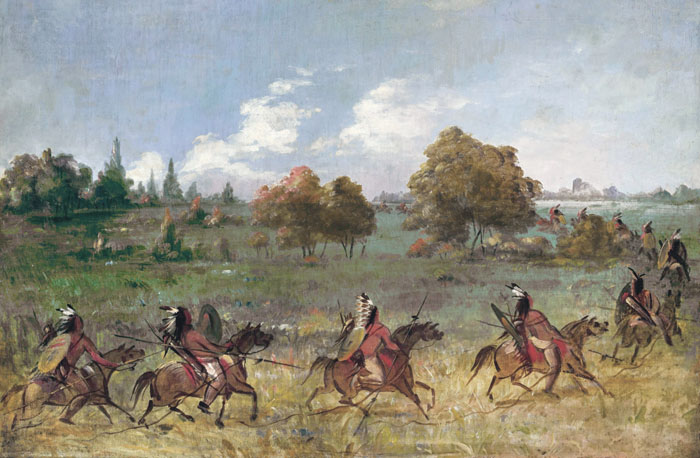
Indian Raid.
During the Northern Cheyenne Exodus after the Battle of Punished Woman’s Fork in Scott County, Kansas, a band of Cheyenne needing horses and provisions raged through the valley, killing more than 30 civilians and raping several women. Several Cheyenne elderly women and children were also killed in the region by soldiers and civilians. In Oberlin, the Decatur County Last Indian Raid Museum commemorates the Cheyenne Raid.
During the raid, on September 30, Mr. H.D. Colvin, living eight miles southwest of Oberlin, on the South Fork of Sappa Creek, was away from his dwelling a few rods when he was suddenly surprised by an advance party of the raiding Indians, who drove him to his house. When the main group arrived, an attack was made on the house, but the 200 or more were driven off by Mr. Colvin and his brave wife, with an old Navy six-shooter and an equally antiquated shotgun. Mrs. Colvin fired the first shot at the Indians with the shotgun. They left, doing no damage.
After the Indian scare had abated, other settlers began to come into Decatur County.
Prairie Dog Creek in Norton County, Kansas, courtesy of Google Maps.
The county’s first newspaper was the Oberlin Herald, established on June 12, 1879, by Humphrey & Counter.
J.P. Rouse, who came to the Prairie Dog Creek in 1879, freighted supplies from both Kirwin and Buffalo Park. On his way over, he would pick up Buffalo bones to sell, as there were “bone buyers” at these railroad stations.
H.D. Colvin performed the duties of Superintendent of Public Instruction on August 23, 1879, organizing school district No. 1, six miles square, with Oberlin in the center. School district officers were elected on September 3, and J. B. Hitchcock was elected director, R.A. Marks, clerk, and George Penson, treasurer.
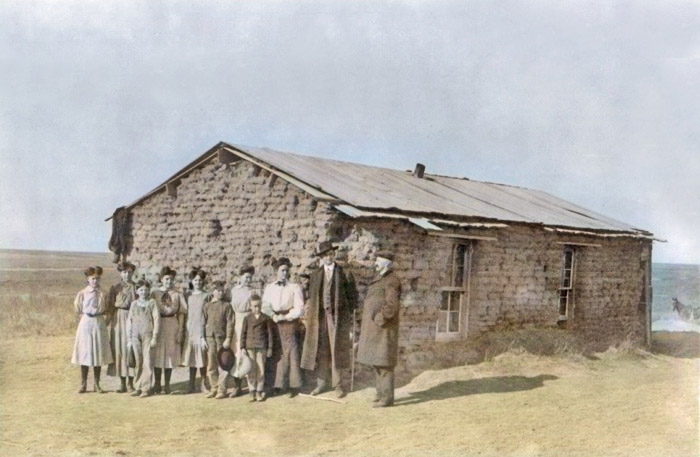
A sod school in Decatur County, Kansas.
By the close of 1879, the county’s population exceeded 1,500, the number required by law for county organization. A petition by 250 householders was presented to Governor St. John, who, on December 11, 1879, issued his proclamation declaring the county organized. The governor appointed Frank Kimball, John B. Hitchcock, and George W. Shoemaker as commissioners, E.D. Stillson as county clerk, and designated Oberlin as the temporary county seat. At their first meeting on December 15, 1879, the commissioners divided the county into six townships: Grant, Beaver, Bassetville, Oberlin, Prairie Dog, and Jennings; defined the boundaries of each; and designated voting places.
An election for county and township officers was scheduled for February 3, 1880. At that election the following officers were elected: Commissioners, Henry Claar, H.C. Johnson and Frank Kimball; representative, M.A. Conklin; county clerk, N.G. Addleman; clerk of the district court, W.A. Colvin; treasurer, George Metcalf; sheriff, W.A. Frasier; county attorney, F.M. Bowman; probate judge, Luther Brown; register of deeds, George W. Keys; superintendent of schools, D.W. Burt; surveyor, S.L. Bishop; surveyor, Dr. — Street. At the same time, the question of a permanent county seat was voted on, Oberlin winning over all competitors by a majority of 181 votes, and officers were elected in each of the several townships.
By 1880, buffalo meat was available for just 7¢ per pound. As the population increased, hunters pushed further West to follow the dwindling herds. This opened up a new industry; collecting buffalo bones for fertilizer provided many settlers with income during tough drought years. In 1880, teams transported bones to the railroad daily, selling them for $8.00 per ton.
A wagon was equipped with two sets of sideboards and filled with food for the men and boys, as well as grain for the team. One man or two boys typically accompanied each wagon. Gathering a load usually took three days, followed by an additional three days to travel to the market and back home. As time went on, it became increasingly difficult to find a good load, with searchers venturing farther and farther West until buffalo bones for the market became a thing of the past.
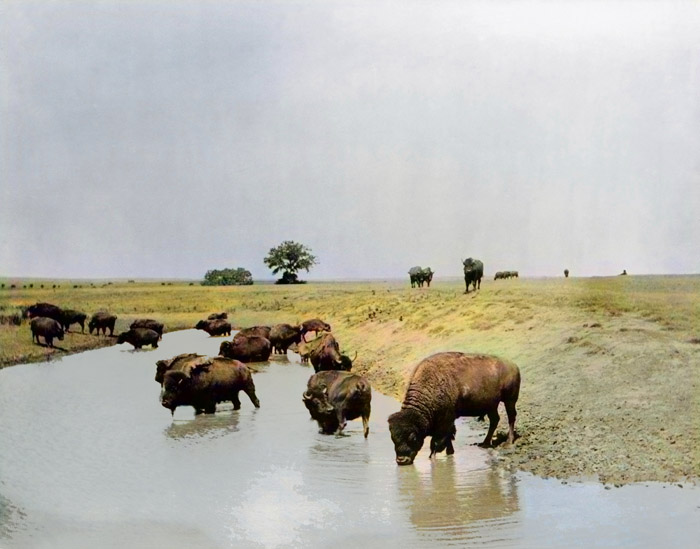
Buffalo on the Great Plains.
As the buffalo population declined, the range, once lush with buffalo grass, became available for other uses. Ranches began to emerge throughout the county, particularly near streams and spring draws. Texas cattlemen controlled large tracts of range land for winter grazing and as stopping points while moving their herds northward. Many of these ranchers supplied the government with meat for Indian reservations. As settlers arrived, ranchers relocated further West. The settlers strongly opposed the movement of large Texas herds through the county, as the herds damaged their small plots of grain and feed. The first trail crossing the county was located near Norcatur, but by 1878, it had shifted nine miles West of Oberlin. Each season, over 300,000 cattle made their way along this trail, most of which were driven to Ogallala, Nebraska, to be shipped via the Union Pacific Railroad.
At that time, there were 30 organized school districts in the county. With 504 school-age people, enrollment was 308, and average daily attendance was 179. It had 15 log and sod schoolhouses, valued at $666, and furniture valued at $73.
The Board of County Commissioners passed a resolution on April 9, 1880, known as the “Herd Law”, prohibiting all meat cattle, horses, mules, asses, swine, and sheep from running at large. Decatur was passing through the first stages of the frontier. Cattlemen were giving way to the agriculturist.
A four-week session of the County Normal Institute was held commencing July 12, 1880, with D.W. Burt, conductor; Sue Kereff and R.C. Lindig, Instructors. The whole number of teachers in attendance was 15; the amount received from examination fees was $26; the amount paid for instruction was $8. An institute was established in the year 1883.

Clayton, Kansas, Main Street.
By that time, Oberlin was the only town in Decatur County that had attained any importance, and it was a mere hamlet compared to many other county seats in Kansas. It was on the Sappa Creek, at nearly the center of the county. Clayton, the next town in point of size to Oberlin, was on the line between Decatur and Norton Counties. It had two general stores, a drug store, a post office, and a hotel.
On March 8, 1881, Rawlins and Cheyenne Counties were attached to Decatur County for judicial purposes.
Over time, organizations were formed to oppose the crossing of herds. A meeting was called for Saturday, April 30, 1881, to organize to prevent Texas cattle from passing through the county that season. Gove and Sheridan Counties were doing the same. A general meeting was held at Kenneth in Sheridan County, Saturday, May 7, 1881. By the summer of 1884, the herd trails had been pushed as far West as Wallace, only a few miles East of the Colorado line. Wild horses roamed the prairies in early days, and as the settlers came in, a lucrative trade of catching and selling them sprang up. They could be captured by following them until they were worn down from the lack of food and water. In this condition, they could be driven into corrals. They were shipped to eastern markets and sold for $15 to $25 per head. As the land was broken and fences built, the wild horses were driven out. Sheep, cattle, horses, and hogs were plentiful and easy to care for. All the early, as well as later, settlers who made it a business to keep plenty of stock around them have made good, though, as early as 1880, it was evident that stock raising by use of free range was over. Agriculture was taking a prominent part in the industries of the county.
Over time, organizations were established to oppose the movement of cattle herds. A meeting was scheduled for Saturday, April 30, 1881, to organize efforts to prevent Texas cattle from passing through the county that season. Gove and Sheridan Counties were taking similar actions. A general meeting was held in Kenneth, Sheridan County, on Saturday, May 7, 1881.
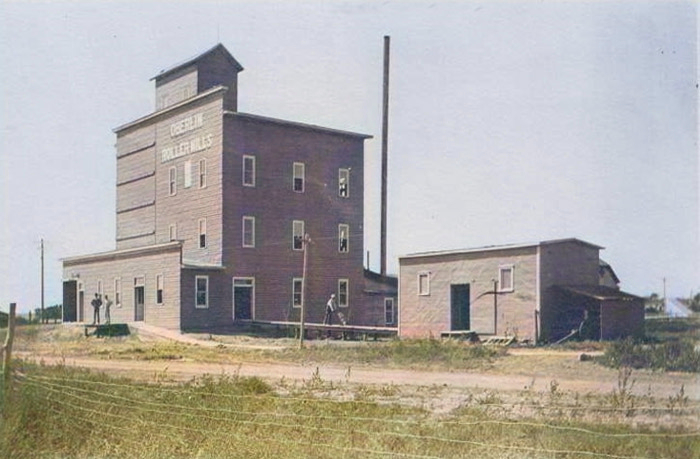
Oberlin, Kansas Roller Mill.
Nathan Haynes received, on January 1, 1882, a patent to the south half of Section 2, Town 2, Range 29. It was the first ever issued to the school land in Decatur County. In March 1882, Henry Inman selected 2,320 acres of land in this county as part of the additional school lands to which the State was entitled from the general government.
In 1882, there were 38 organized school districts. The average monthly salary for male teachers is $20.41; for female teachers, $18.18. At that time, there were 17 school buildings of an aggregate value of $1,700. The school tax levy for 1882 was 11 mills. The amount of money received in 1882 for school purposes was $2,357.77.
The “Frontier Mill,” with McKay and Jenkins as proprietors, was erected during the summer of 1882 at Cedar Bluffs in the northwestern part of the county. The first flour manufactured in the county was ground at these mills on December 18, 1882, and put in the market at Oberlin, Kansas, at the store of John Morrison.
The Independent Volunteer Cavalry Company (State Militia) of Oberlin was organized on December 12, 1882. The company numbered 30, with L.G. Parker as First Lieutenant.
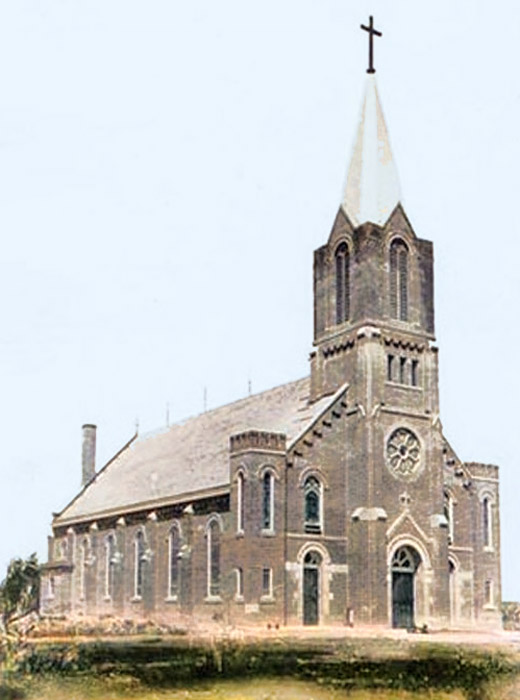
An old church in Leoville, Kansas.
By the early 1880s, there were 13 church organizations in Decatur County. Methodist, seven; Presbyterian, two; Baptist, three; Baptist (Free Will), one. There were 15 Union and one Baptist Sunday schools.
The Legislature of 1883 detached Rawlins and Cheyenne Counties from Decatur, provided for terms of court in Rawlins County in May and November, and attached Cheyenne County for judicial purposes.
On February 14, 1883, the Board rented the Moody and Burnett buildings from R.A. Marks for $200 per year. The Legislature of 1883 passed an act to enable the County Commissioners of Decatur County to fund the county’s indebtedness, authorizing them to issue the bonds of the county in an amount not exceeding $15,000 to be used for the redemption of the outstanding orders, allowed accounts, and warrants, and to pay off any judgment against the county.
By the summer of 1884, herd trails had extended as far West as Wallace, just a few miles East of the Colorado border. In the early days, wild horses roamed the prairies, and as settlers arrived, a lucrative trade developed in capturing and selling them. These horses could be captured by tracking them until they became exhausted from lack of food and water. Once weakened, they could be driven into corrals and shipped to eastern markets, where they sold for $15 to $25 each.
As the land was cultivated and fences were erected, wild horses were pushed out. Sheep, cattle, horses, and hogs became abundant and relatively easy to care for. Many early settlers, as well as those who arrived later and focused on maintaining a sizable livestock population, found success. However, by 1880, it was evident that free-range stock raising was coming to an end, and agriculture was beginning to play a significant role in the county’s economy.
On March 8, 1887, Governor Alexander Martin approved an act of the Legislature authorizing the commissioners of Decatur County to levy a tax of two mills on the dollar for the erection of a courthouse.
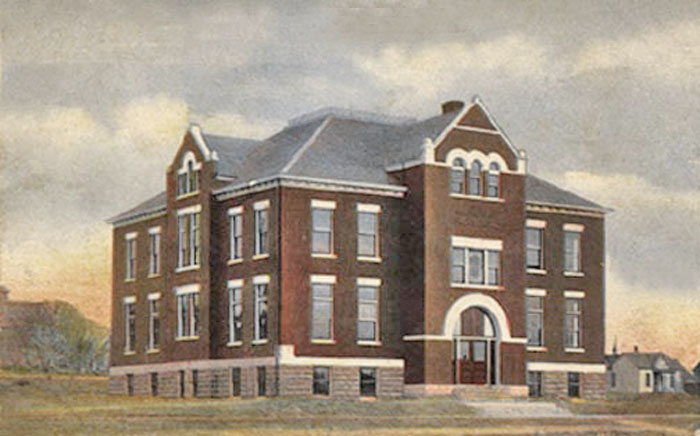
Decatur County High School in Oberlin, Kansas.
Decatur County’s population peaked in 1900 at 9,234.
By the act of March 4, 1903, the county commissioners were authorized to establish a county high school on receipt of a petition signed by a majority of the electors. A petition was filed, and the school was established at Oberlin, the county seat.
By the act of March 8, 1907, the commissioners were authorized to purchase a site and erect a courthouse, the cost of which was not to exceed $50,000, and to levy a tax of not more than three mills on the dollar to pay for the same.
The educational opportunities were good. In 1909, there were 101 organized school districts in the county, with a school population of 3,294. The estimated value of school property in that year was over $124,000.
At that time, there were six weekly newspapers published in the county—three in Oberlin and one each at Dresden, Jennings, and Norcatur.
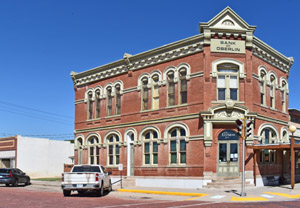
Old bank building and courthouse in Oberlin, Kansas by Kathy Alexander.
Decatur County had three railroads. The Chicago, Rock Island & Pacific Railroad crossed the southeast corner; a line of the Chicago, Burlington & Quincy Railroad crossed the northwest corner, following closely the course of Beaver Creek, and a branch of the same system ran eastward from Oberlin. These three roads provided the county with over 56 miles of main track and offer fairly good transportation facilities.
In 1910, the county’s population was 8,976; the value of taxable property was $12,659,175; the value of field crops for the year was $1,162,021; and the value of all farm products was $1,682,032. The five leading crops, in the order of value, were: Wheat, $397,421; corn, $255,980; hay, $209,427; Kafir-corn, $73,308; barley, $66,104.
In 1894, when the Bank of Oberlin closed due to the Panic of 1893, Decatur County acquired the building as part of a settlement following the bank’s failure and used it as its first permanent courthouse. The 28-by-60-foot, two-story red-brick building was constructed in 1886. Its brick walls include corbelling and herringbone panels beneath each window and are decorated with pressed-tin arches, stringcourses, cornices, and pediments. It continued to be utilized as a courthouse until 1927. Located at 187 S. Penn, the building was listed on the National Register of Historic Places in 1994. The building is now the Landmark Inn.
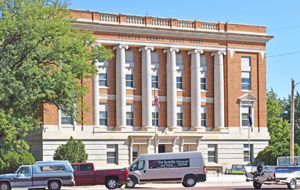
Decatur County Courthouse in Oberlin, Kansas, by Kathy Alexander.
A new Classical Revival courthouse was built between 1926 and 1927. Designed by Squires & Ross, it was built by Cork & Ferrier. The building faces south and is a three-story dark red colored brick, stone, and concrete structure. The building is located on landscaped grounds in the center of Oberlin. Along the south are six large columns rising from the second to the third story. The entrance has a stone-framed door. The first story has horizontal stone. In the interior, the courtroom is located at the northeast corner of the third story. The building houses the County District. It is located at 120 East Hall Street and North Griffith Street. The 17th Judicial District includes Graham County, Norton County, Osborne County, Phillips County, and Smith County.
Decatur County is served by the Oberlin USD 294, a public unified school district headquartered in Oberlin, Kansas. It includes the communities of Oberlin, Norcatur, Dresden, Jennings, Clayton, Cedar Bluffs, and nearby rural areas. The school district operates the Decatur Community Junior-Senior High School and the Oberlin Elementary School.
©Kathy Alexander/Legends of Kansas, July 2026.
Also See:
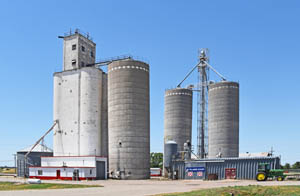
Dresden, Kansas Grain Elevators by Kathy Alexander.
Sources:
American Courthouses
Blackmar, Frank W. Kansas: A Cyclopedia of State History, Vol. I. Standard Publishing Company, Chicago, IL, 1912.
Cutler, William G.; History of Kansas; A. T. Andreas, Chicago, IL, 1883.
Wikipedia